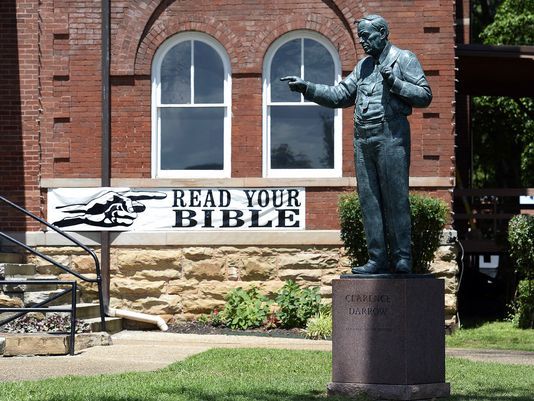
Apparently about a third of the population of Tennessee still doesn’t buy Darwin’s Theory of Evolution (according to a 2015 Pew Research Center study) so it should not be too much of a surprise that in Dayton, Tennessee, site of the famous 1925 Scopes Trial, a newly erected statue of Clarence Darrow in front of the historic red brick courthouse where the trial took place was met with some protests. At a County Commission meeting in the town, resident Ruth Ann Wilson suggested that bronze Darrow might unleash a plague or a curse. “I rise in opposition to this atheist statue, all right?” she said. “This is very serious, folks.”
No, that isn’t serious, but the persistence of ignorance both generally and about the issues battled over in 1925 are. Another resident, Brad Putt, is quoted by the New York Times as saying, “People around here know that if you have a court case, you have to have two sides,” referring to the fact that there has been a Williams Jennings Bryan statue standing in front of the courthouse since 2005. “You can’t have Optimus Prime unless you have Megatron. You’ve got to have a yin to the yang.” Well, that’s not quite right either, depending on what Bryan and Darrow symbolize. If the idea is to have the most famous opposing counsel in U.S. legal history facing off, okay, that’s fair. If he is saying, as I think he is, that science and religion must counter and balance each other, that’s nonsense. Continue reading →
The original Ethics Alarms post, one of two this month implicitly critical of the Catholic Church, has spawned several remarkable and thoughtful discussions, as well as so many candidates for Comment of The Day that any choice among them is somewhat arbitrary. In the case of Ryan Harkins, I’m not even certain this is the best of his comments on the post, so many excellent ones did I have to choose from. Thus I urge readers to read the entire array, which, I regret to say, is impressive and educational even though it does not include my old friend Patrice, Catholic, theologian, and Church employee who has commented here frequently in the past.
I decided to pair two of Ryan’s comments, the first an overview providing context for my original post’s topic, the Church’s insistence that that the bread and wafers used in Communion include gluten. The second, a response to a series of queries from another commenter, delves into an eternal ethics debate topic, the nexus between God and ethics.
Where to begin? The challenge of trying to explain some of the odder details of the Catholic faith is that many of those details don’t make sense without the context of the faith as a whole. So please forgive me if I seem to natter on about tangential matters.
So, let’s begin with a few definitions to make discussion a little easier. A Sacrament is a visible sign, established by Jesus himself, through which God conveys grace upon mankind. A Sacrament is composed of two parts, one spiritual and one material. The reason it possess both qualities is because Sacraments are designed for us, and a human person is a body/spirit composite. We are not purely material beings, nor are we ghosts in a shell. We are not a complete person without our bodies. Now, to have a sign that is purely spiritual would neglect the physical aspect of our existence. To have a sign that is purely physical would neglect the spiritual dimension of our existence.
The Eucharist is one of the Seven Sacraments of the Catholic Church. Catholics really, truly believe Jesus was serious when he said repeatedly, “Amen, amen, I say to you, unless you eat the flesh of the Son of Man and drink his blood, you will not have eternal life.” When at the Last Supper, he blesses bread and wine and says, “Take this and eat. This is my body, given for you” and “This is the cup of my blood, which will be shed for you and for many for the forgiveness of sins”, Catholics believe that yes, Jesus truly held himself in his hands and gave himself to his apostles to consume. So the Eucharist is the Real Presence of Jesus, the fullness of his body, blood, soul, and divinity. When a priest says Mass and confects the Eucharist, Catholics believe that the bread and wine on the altar are transsubstantiated into Jesus. The accidents of bread and wine remain (so yes, consuming Jesus is problematic for anyone who has issues with the accidents of bread and wine), but the substance is entirely Jesus. The smallest drop from the chalice and the tiniest crumb of the loaf contains the fullness of Jesus.
Okay, so a Sacrament has a spiritual and a physical dimension, and the Eucharist obviously uses bread and wine for the physical dimension. Why bread and wine? In just reference to food and drink, we understand the Eucharist as a meal, and historically the greatest communal activity is the sharing together of a meal. In earliest Christianity, the Eucharistic celebration was in the context of the agape feasts, which eventually St. Paul instructed to tone down because people would become drunk and riotous at these feasts. The point, though, is that eating together is sign of communion (which is in part why the Eucharist is also called Communion). Jesus had prayed that “they may all be one, Father, as I am in you and you are in me,” and the Eucharist is the Sacrament Jesus instituted to make that possible. By consuming Jesus himself, we bring him into ourselves and are in turn incorporated into him. (You are what you eat, right?) Continue reading →
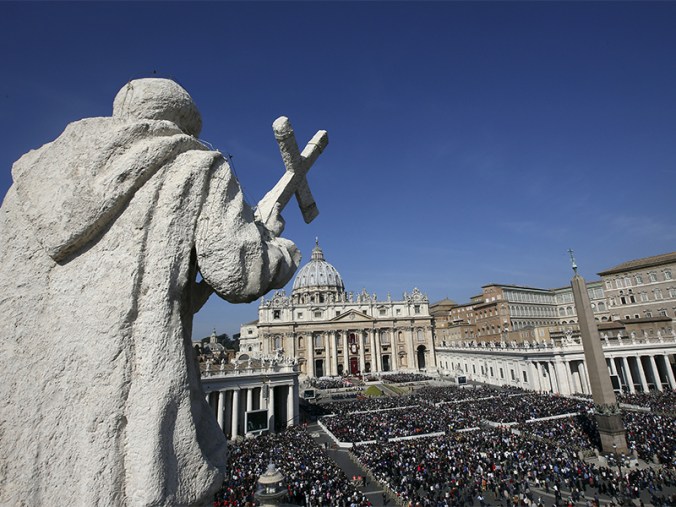
Bravo to Johnathan Turley for neatly summarizing what’s wrong with the Catholic Church’s recent affirmation of its long-standing requirement that the bread and wafers used during communion in Catholic churches around the world must have at least some gluten in them, or the Church will collapse and Satan will reign, or something. Meanwhile devout Catholics who must avoid eating gluten, including people who have Celiac disease, just have to plug along, get half a communion, or get sick. God wants it that way.
What a throbbing example of arrogant and compassion-free bureaucratic thinking. The Professor’s headline captured the idiocy and rigidity of it perfectly.
The Catholic News Agency shrugged the story off with a couple of rationalizations: “It’s always been this way” and “This is nothing new.” Neither are satisfactory excuses when making the communion dangerous to the increasing number of Catholics with Celiac disease. The issue is mirrored by the dilemma faced by alcoholics, who fear drinking wine; the Catholics, unlike the Methodists and other Protestant churches, insist on at least minimally fermented wine. Grape juice just won’t do. Why?
“Christ did not institute the Eucharist as rice and sake, or sweet potatoes and stout,” Chad Pecknold, a theology professor at Catholic University, told the Washington Post. “It may seem a small thing to people. But the Catholic Church has spent 2,000 years working out how to be faithful to Christ even in the smallest things. To be vitally and vigorously faithful … is something which is simply integral to what it means to be Catholic.”
[A long bitter section about how bureaucracies are habitually doctrinaire about small matters while ignoring pervasive corruption and destructive hypocrisy has been deleted here, in part because it is ugly, and also because anyone who can’t write their own version hasn’t been paying attention to the Catholic Church for the last 500 years…or even the last 17.]Continue reading →
The Denver Post has an alarming article on the Flat Earthers, a group of Americans who deny astronomy, physics and other known and proven facts about the physical world and universe. They are, says the Post, “thousands strong — perhaps one in every 500 — and have proponents at the highest levels of science, sports, journalism and arts.”
It would be an amusing article, were it not so sad and frightening. These people, who might be nice, kind, and otherwise great neighbors and patriots, are so suspicious and so committed to their own ignorance that they say astounding things, like Cami, who explains,
“Our YouTube channel gets people to critically think,” she said to the Fort Collins group. “The heliocentric model says that we’re spinning at 1,038 mph. They say you won’t notice it because it’s a continual motion. But you should be able to feel it. You shouldn’t be able to function allegedly spinning that fast.”
1. The Pope gave an interview saying, in Italian of course, that the United States of America, which he offensively grouped with Russia, China, North Korea and Syria, have “a distorted vision of the world.”
The Pope, who has spent the bulk of his adult life seeing the world through the narrowly focused lense of the Catholic Church, and who hails from a South American leftist state, thinks that the United States has a distorted view of the world. Wow. Besides the stunning hubris of this pronouncement, the Pope is engaging in an abuse of position and influence, and a remarkably short-sighted one. If he wants to exercise any influence at all over citizens of the world who have not been indoctrinate since childhood to regard him as a godly sage by virtue of a secret political vote by a bunch of superannuated Cardinals, he has to earn credibility by the evident quality of the statements he makes. Later on, in the same interview, the Pope made it clear that his undistorted vision of the world involves endorsing open borders.
I think the Pope has a distorted view of the trustworthiness of celibate men who have access to young boys, so I really couldn’t care less what he thinks about U.S. policies when he can’t objectively and responsibly process the terrible realities in his own organization.
2. I’ve been reading and listening to sportswriters since I was ten, and I have to say that I have little respect for the critical thinking skills of most of them. I was gobsmacked by an example of why this morning, as Steve Buckley, a long-time baseball reporter for the Hub’s #2 paper The Boston Herald, opined in a virtue-signaling mess of a column that “War heroes, not David Ortiz, deserve streets named after them.” David Ortiz, in case you live in a fallout shelter, is the recently retired iconic slugger of the Boston Red Sox. The team recently retired his number, and in a related honor, the city of Boston re-named a small street near the park after him. It had earlier named one of the many bridges in the city after him.
“We should reserve the streets, the corners, the squares, the playgrounds, to remember the men and women who died serving our country.” Buckley writes. Why? He never really gives a reason, he just tells us that this is the way it should be. Why are the veterans who die in military service more honor-worthy than those who risked their lives but survived? Since when are society’s only real heroes military heroes? Is he a time-traveler from Ancient Sparta? Do contributions to society during peacetime or on the home front matter less to a community than what happens on a foreign battlefield?
What about fallen police officers and fire fighters? Not worth a street name? Philanthropists, inventors and innovators who made life better for all, launched businesses, created jobs, helped families and neighborhood thrive—these don’t warrant a little bit of local immortality? David Ortiz made millions of people happy. In a racially divided city, Ortiz, a black man, became the face of Boston sports, at least for those who were nauseated by Tom Brady’s smug countenance. That was as important as his clutch home runs. Trivializing Ortiz’s contributions to Boston (the relationship of Bostonians to their infuriating baseball team is too complex to explain quickly to anyone who hasn’t been part of it) is trivializing the importance of entertainment and popular culture, which is nothing short of ignorant, especially in the United States. In the District of Columbia, a school is named after Duke Ellington. Good. In Los Angeles, for decades until California leftists finally removed it, a major airport was named after John Wayne. Excellent. And in Boston, the largest tunnel is named after Ted Williams, but maybe Buckley thinks that’s OK because Williams was a combat flier in two wars. (Pssst! Ted’s tunnel isn’t bearing his name because he crash-landed that jet, Steve!)
As a society and a species, we have a duty to remember those who have contributed to the culture we enjoy. There aren’t enough streets, schools, bridges and parks to honor them all, but they all deserve to be honored. Continue reading →
Trying to warm myself up too, as I have to address a room full of new D.C. bar admittees and tell them about their new ethics rules less than two hours from now….let’s see how much I can get down before by wife starts threatening me for not being dressed yet…
1. If anyone pays attention, Fox News is providing nifty lessons to all organizations about how fish rot from the head down, and how a pervasive unethical culture keeps going like the Energizer Bunny until it is decisively changed by responsible leadership. Yet another Fox News host,”Making Money’s” Charles Payne, is being disciplined and may be on the way out after allegations of “professional misconduct,” sexual harassment, and more. It seems that the married analyst was having an affair with one of the blonde clones Fox’s Roger Ailes liked to have on the air, and had her fired after their tryst went sour. I assumed that Fox News was a hotbed of this kind of thing even before Aisles was exposed as a serial harasser; it was laughably obvious, with so many women dressing and sounding like cheerleaders and the on-air banter on “Fox and Friends” often crossing lines. If Payne is the last employee publicly fingered for harassment, it is only because Fox News is handing out preemptive settlements like Halloween candy. This was all right there, in front of millions, for anyone to see, and for Fox News management to stop, for decades before it blew up. Incredible.
2. I watched “Spotlight” again last night, and couldn’t stop thinking about CNN. The Catholic Church sexual molestation scandal doesn’t have much in common with the current descent of the U.S. newsmedia into ethical corruption and professional disgrace, except this: in both cases, leadership of institutions that depend on and are based on trust and faith have willingly embarked on a course directly in opposition to the core values they were supposed to be committed to, and used the rationalizations #13. The Saint’s Excuse: “It’s for a good cause” and #14. Self-validating Virtue to blind themselves for years, doing immeasurable and perhaps permanent harm to society and themselves in the process, not to mention their millions of victims. When in the movie did this parallel start occurring to me? When the film started showing angry Catholics attacking the reporters for daring to expose the truth, because the Church did so much good, and because anyone exposing an institution that was so vital to society was the real villain. Today what I hear is that because we need a courageous, reliable, independent free press (ironically, “Spotlight” shows why) we should pretend the press we have meets those standards, even when it has rejected them for partisan bias.
I envision a time when the whole news media looks back on 2016 and 2017 and wonders how they could have behaved so badly, and done such damage to the public trust. I just hope that time arrives soon.
3. I can’t imagine a more audacious, in-your-face-display of inappropriate partisan arrogance than New York City Mayor Bill DeBlasio’s decision to fly to Hamburg, Germany, to join leftist and anarchist protesters at the G-20 summit. To do this, he is skipping the swearing-in of a new class of NYPD recruits at a time when the assassination of Officer Miosotis Familia, would seem to dictate a mayoral show of support for the police, and it was recently reported that his city is experiencing a rise in homelessness to levels not seen in decades. What a great time to relive his student protesting days instead of doing his job!
Fun question: who is the more egregious jerk, Governor Christie, or DeBlasio?
4.
Ugh…I am being threatened with defenestration if I don’t shave. Back later…
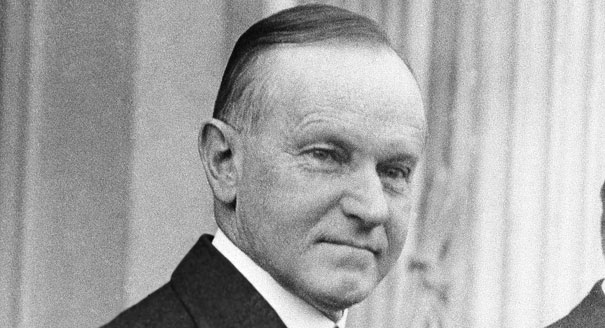
“About the Declaration there is a finality that is exceedingly restful. It is often asserted that the world has made a great deal of progress since 1776, that we have had new thoughts and new experiences which have given us a great advance over the people of that day, and that we may therefore very well discard their conclusions for something more modern. But that reasoning can not be applied to this great charter. If all men are created equal, that is final. If they are endowed with inalienable rights, that is final. If governments derive their just powers from the consent of the governed, that is final. No advance, no progress can be made beyond these propositions. If anyone wishes to deny their truth or their soundness, the only direction in which he can proceed historically is not forward, but backward toward the time when there was no equality, no rights of the individual, no rule of the people. Those who wish to proceed in that direction can not lay claim to progress. They are reactionary. Their ideas are not more modern, but more ancient, than those of the Revolutionary fathers.”
—President Calvin Coolidge
For no particular reason, this is the third post in less than 24 hours to reference Silent Cal. As this speech, on the occasion of the 150th anniversary of the signing of the Declaration of Independence, shows, Cal wasn’t so silent, and when he has something to say, he was often worth listening to. Coolidge’s reflections are thoughtful and characteristic. His ultimate point is that the document is rooted in spirituality and morality, which is to say that it is virtuous and right. Morality, along with religion, has been in steep decline in the public square, academia and in the culture since 1926, but Coolidge’s argument is no less valid and persuasive if transferred to the realm of ethics. Though they were, as Coolidge says, guided by their understanding of religious principles, the Founders were also students of philosophy and ethical analysis. The Declaration, the Constitution and the United States of America are all the offspring of ethics, as well as morality.
I am pleased that the Supreme Court will be taking the case of Jack Phillips, the Colorado baker who refused to sell a wedding cake to a gay couple because, he said, they wanted it to be customized, and doing so would offend his faith. His claim is based on the First Amendment, which prevents the government from making you say what you don’t want to say as much as it prevents the government from stopping you from saying what you want to.
Colorado’s courts denied that Phillips was doing anything but saying that he doesn’t like or respect gays sufficiently to make the exact same cake for them that he would make for non-gays. I agree with their holding that his actions violated the public accommodations laws. I wrote when this case first reared its frosted head…
“The court’s conclusion is impossible to rebut. The cake the baker was asked to bake for the gay wedding differed not at all from one he would normally sell a straight couple. In truth, this had nothing to do with expression. He was just refusing to serve a gay couple because of their sexual orientation. Selling them a standard cake would neither constitute, nor would it be recognized as a “message” in support of gay marriage.
The Court agreed that a wedding cake with a customized message celebrating a same-sex marriage as such might implicate First Amendment speech issues, but “we need not reach this issue,” the court said. “We note, again, that Phillips denied Craig’s and Mullins’ request without any discussion regarding the wedding cake’s design or any possible written inscriptions.”
In other words, Phillips was gratuitously and unnecessarily being a cruel jerk. An alleged Christian who is unable to detect the basic Golden Rule application in treating fellow citizens with the minimal level of respect inherent in allowing them to buy a standard wedding cake requiring no “Yay Gay!” or “Charlie and David Forever!” messages in pink frosting deserves no sympathy or quarter from the law. Could the couple have just shrugged and found another bakery? Sure, they could have. Linda Brown could also have just shrugged and found an all-black school to attend, too.
The gay couple are not the villains here. Jack Phillips broke the social contract, as well as the law.”
Now that SCOTUS has decided, by agreeing to review the case, that he has perhaps a scrawny, shaky legal leg to stand on before they kick it out from under him, Phillips and his lawyer are taking a premature victory lap, as if making it quite clear that you think gays are second class citizens is something to be proud of (and, sadly, too many still think it is.) Their publicity campaign took them all the way to The View, a wise choice. After all, nothing can make an unethical position seem more persuasive than when it is being attacked by idiots, and idiots of the left-wing persuasion are pretty much what ABC’s “Six Opinionated Female B and C List Celebrities Sitting Around Slamming Conservatives” daytime show has to offer. (To be fair, the show usually has one even dumber right-wing idiot on hand to make the left-wing idiots seem astute by comparison.) Continue reading →
As he usually does, when he’s feeling frisky, reader Extradimensional Cephalopod (above right) has dived into the issue of “health care rights” with gusto and perception. As I often do whether I’m feeling frisky or not, I have some cavils about the assumptions being made at the outset.
A right is a moral or legal entitlement to have or obtain something or to be able to do something. Moral and legal rights are two different things. When someone says, as did my friend on Facebook that started this debate. “I believe health care is a right,” he had to be asserting a moral right to healthcare, since a legal right to health care doesn’t exist. If he said, “I believe health acre should be a right,” then he would have clearly meant a legal right. That’s a policy issue. When someone argues that there is a moral right, then they are making the case for a legal right that doesn’t exist. The law in an ethical society ought to protect and advance moral rights, and society must agree what those rights are. Thus when he says, early on, “Note that a right isn’t something we owe Note that a right isn’t something we owe people just because they exist.,” he signals that he is describing legal rights only. Moral rights are what we owe people just because they exist. That’s why the Declaration begins with Jefferson saying that “we are endowed by our Creator” with “unalienable rights.”
Let’s start at the beginning. We need to define the phrase “healthcare is a right”.
A “right” is a protection or entitlement we collectively decide to give to people at the expense of our some of our freedoms because we think that society will be more robust, sustainable, able to advance, or generally pleasant to live in as a result. That’s very similar to the basis for ethics, as far as I can tell. A right is a meta-law, a limitation on what laws can be made. Rights may be conditional. Note that a right isn’t something we owe people just because they exist. It’s something we decide we owe them because we want to live in a world where people have that right–because it’s safer for us, or because it means the world will still be there for our descendants, or because it allows civilization to progress to something better, or because we want others to be happy, or all of the above. This will be important later.
Therefore, when we say, “healthcare is a right”, what we mean is “in order to make society more robust, sustainable, able to advance, or generally pleasant, we choose to sacrifice some of our individual freedoms to provide everyone with healthcare.”
We’re half done. Now, what is “healthcare”?
Let’s actually distinguish it from health insurance, because we’re smarter than Congress. Health insurance, like any insurance, is a gamble, in which people periodically pay a small amount of money to an insurance company, which will pay them back a larger amount of money (whatever is necessary, to the limit of what they are insured for) if the person’s health is in danger in a way that neither of them can predict. The idea is that the insurance company can’t predict who needs the money, but they can predict how many will need money and how much, statistically, so they accept enough money from people that they can afford to pay the people who end up needing more money. Continue reading →
A recipient of Great Britain’s national health care, infant Charlie Gard was born with a rare genetic condition resulting in what is probably irreversable brain damage. He cannot move his arms or legs, eat or even breathe without a ventilator.
After 10 months of being kept alive, Charlie’s caretakers, the Great Ormond Street Hospital for Children in London, announced that it was time for Charlie to die. Chris Gard and Connie Yates, Charlie’s parents, wanted to take him to the United States to try an experimental treatment available here. The doctors at the hospital refused to allow them to take the child, and vetoed their decision, even though the parents had received sufficient funds from donations to pay for the effort. In the resulting lawsuit, British courts sided with the hospital. The parents then brought the case to the European Court of Human Rights, which declined to hear the case last week. The previous court rulings that it was in Charlie’s best interest to withdraw life support and that the state, not the parents, got to make this life and death decision stood.
The parents, Chris Gard and Connie Yates, appeared on a video this week,, sobbing and saying their son would be removed from life support at the hospital. “He’d fight to the very end, but we’re not allowed to fight for him anymore,” Gard said in the video statement. “We can’t even take our own son home to die.”
Initially, the hospital would not delay the fatal disconnection of the child from life support so family members could gather and say goodbye. It has since relented.



 Ethics Alarms