It is generally true, as the indignant members of Greensburg, Indiana’s Apostolic Truth Tabernacle Church say, that what they include in their church’s services is nobody’s business, and the fact that the congregation loudly applauded the horrific spectacle of a 3-year-old boy singing the hate anthem, “Ain’t no homos gonna make it to heaven!”would have never bothered a soul if it hadn’t been videorecorded and placed on YouTube. At this point, however, that no longer matters. The cat is out of the bag, the horse has left the barn and the beans are spilled, and now millions of Americans know that this church teaches hate, indoctrinates young and vulnerable children with its poison, and sows the seeds of prejudice and the active deprivation of American citizens of their rights to life, liberty and the pursuit of happiness. Since millions of people know this now, a critical number of them will go out of their way to make life in this country a living hell for members of that church and the church itself by demonstrating at every turn that we don’t want churches like that in America, or people like that in America. They aren’t good for society, they cause positive harm without any compensating benefits, and they need to change their ways or suffer the consequences. And to that I say: Good. Go to it. Continue reading
Religion and Philosophy
How Consequentialism Leads To Bad Ethics: An Illustration
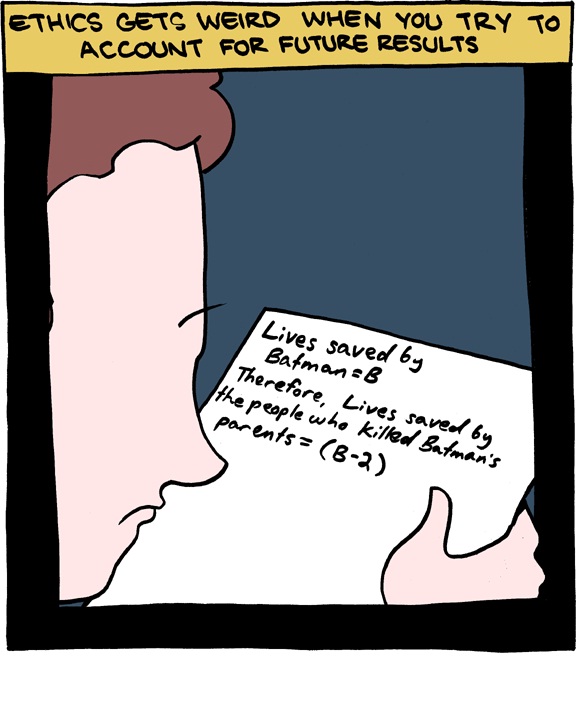 Tgt passes along this cartoon by Zach Weiner. He knew why I would like it: I am often railing about the misuse of consequentialism, justifying an act as ethical after it has produced desirable results. This fallacy bolsters “the ends justify the means” reasoning and makes every act, even clearly wrongful ones, theoretically redeemable in retrospect, after the results are in (although, of course, all the results are never in. That’s Chaos for you!) The defense of torture by Bush administration defenders on the grounds that it may have uncovered valuable intelligence is the most recent example. Had the unconstitutional imprisonment of Japanese-American citizens in World War II prevented some Japanese undercover plot by imbedded traitors, undoubtedly that fact would be used to justify an unjustifiable and disgraceful breach of American law and values. Looking backward creates this ethical distortion.
It is equally infuriating, to me at least, when good and ethical decisions are judged, usually by the media or by political pundits, as “wrong” or ” mistakes” because of bad results that could not have been foreseen when the decision was made or the act undertaken.
Weiner’s cartoon nicely marks the logical flaws in backward ethics, for those for whom the word “backward” is an insufficient clue.
___________________________________________
Spark and Pointer: tgt
Source: Saturday Morning Breakfast Cereal
Ethics Alarms attempts to give proper attribution and credit to all sources of facts, analysis and other assistance that go into its blog posts. If you are aware of one I missed, or believe your own work was used in any way without proper attribution, please contact me, Jack Marshall, at jamproethics@verizon.net.
Ethics Quote of the Week: Michael Fumento
“As a conservative, I disagree with the political opinions of liberals. But to me, a verbal assault indicates insecurity and weakness on the part of the assaulter, as in “Is that the best they can do?” This playground bullying – the name-calling, the screaming, the horrible accusations – all are intended to stifle debate, the very lifeblood of a democracy.”
—-Michael Fumento, writing powerfully in Salon about the increasingly viscous rhetoric of too many conservatives, and how it has left him estranged from his own political philosophy.
 He writes,
“Civility and respect for order – nay, demand for order – have always been tenets of conservatism. The most prominent work of history’s most prominent conservative, Edmund Burke, was a reaction to the anger and hatred that swept France during the revolution. It would eventually rip the country apart and plunge all of Europe into decades of war. Such is the rotted fruit of mass-produced hate and rage. Burke, not incidentally, was a true Tea Party supporter, risking everything as a member of Parliament to support the rebellion in the United States.
“All of today’s right-wing darlings got there by mastering what Burke feared most: screaming “J’accuse! J’accuse!” Turning people against each other. Taking seeds of fear, anger and hatred and planting them to grow a new crop.”
You can read his whole essay, “My break with the extreme right” in Salon, here.
_____________________________________________
Pointer: Volokh Conspiracy
Source: Salon
Graphic: Sleepless heretic
Ethics Alarms attempts to give proper attribution and credit to all sources of facts, analysis and other assistance that go into its blog posts. If you are aware of one I missed, or believe your own work was used in any way without proper attribution, please contact me, Jack Marshall, at jamproethics@verizon.net.
Racism, the Media, and Reverend Wright Distortions
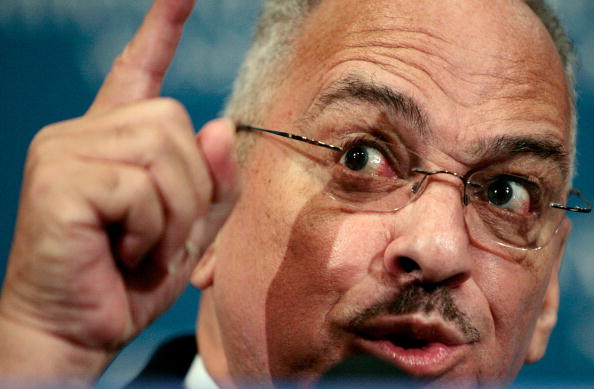
He’s b-a-a-a-a-a-c-k! (Sort of….)
This has been happening to me a lot lately. I see a political story with ethical implications, and decide to pass. I think, “Nah, this is another ‘the news media is in the tank for Obama story”—it’s pretty obvious; I don’t need to go there.” Then the story starts to churn, the news media, left and right, distorts it thoroughly through spin and stupidity, and pretty soon I can’t stand it any more.
The controversy over a proposed, and rejected, Super-Pac ad blitz focusing on the President’s controversial relationship with Rev. Jeremiah Wright—demagogue, radical, racist—began when a leaked copy of a proposal prepared for conservative billionaire Joe Ricketts was leaked to the New York Times. The Times’ decision to put the proposal on its front page was sadly typical, and irresponsible. We don’t what wacky proposals circulate in the back rooms of both parties and their allies, and I don’t see why we would want to know, unless, as in this case, the objective was to suggest a series of things that aren’t true. Prime among them was that the Romney campaign was preparing to mount a full-bore attack on the President’s character. Nothing has suggested that, except the Times, whose story forced the presumed GOP nominee to apologize for a mode of attack 1) he had nothing to do with and 2) had never been approved anyway.
This was unfair, slanted and biased conduct by the Times, and the point at which I decided, “Oh, heck, we’ll be seeing the Times and the Washington Post, not to mention the broadcast media, pulling this until November. People either will recognize it for the partisan bias it is, or they won’t.”
Then came Carol Costello on a typical morning for CNN, when she or the regular morning host Soledad O’Brien spend every AM sneering at Republicans and looking at the camera all dewy-eyed whenever President Obama’s name comes up. Costello, who I have concluded sets my teeth on edge even worse than the smug O’Brien, began her day with this: “Today’s question: Will racial politics work in 2012?” Continue reading
Ethics Round-Up in Race, Religion and Sex: GOP Bigotry, Georgetown’s Integrity, and Warren’s Absurdity
Help! I’m buried in great ethics stories!
This is one of those periods in which there are so many juicy ethics stories that I am falling far behind. Here are three that are worthy of longer treatment that I can’t allow to get lost in the crowd: Continue reading
Ethics Heroes: Seniors at Lexington (Ky) Catholic High School
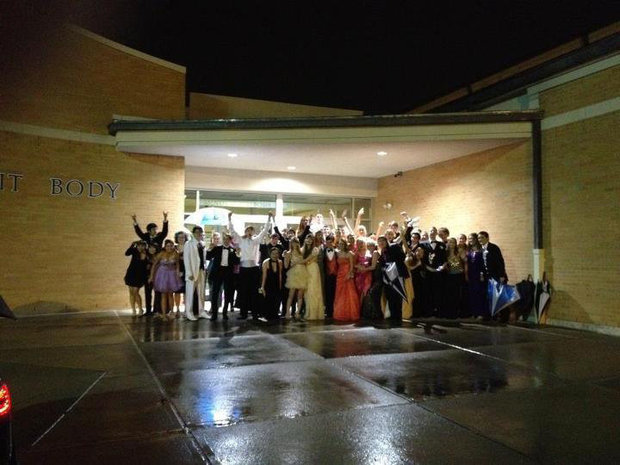
The fun prom…in the parking lot.
When Lexington (Kentucky) Catholic High senior Hope Decker, 18 tried to take sophomore Tiffany Wright, 16, to the school’s senior prom as her date, school officials told the couple that they would not be admitted, because their unholy same-sex coupling violated the Catholic Church’s teachings. Defiant, the couple tried to enter the school’s gymnasium that night, where the prom was held, but as promised, their tickets were refused. So their fellow students held an impromtu protest prom outside the official one, in the parking lot. They played music from their cars, and set up a table for refreshments.
“We had a wonderful night, and we were surrounded by true friends,” Wright said. “I’ll remember it for the rest of my life.”
Here is what else she will remember for the rest of her life: Continue reading
“Show Boat” Ethics: Defining Deceit
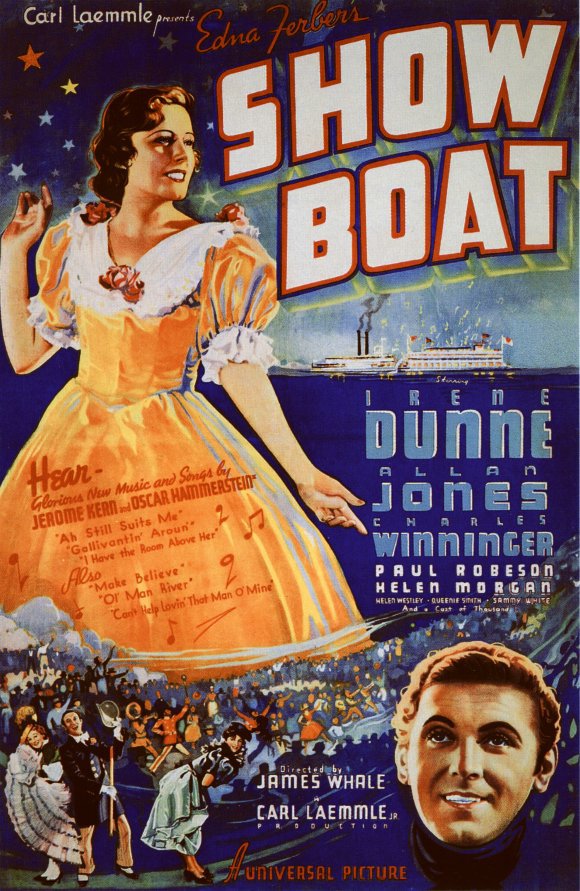 I frequently discuss the concept of deceit in ethics seminars, and my favorite example, which I have also used on Ethics Alarms, is the famous “Does your dog bite?” gag from “The Pink Panther Strikes Again!” This morning I was reminded of an even better example, though not so funny, while watching Turner Movie Classics. TMC was showing the 1936 Hollywood adaptation of “Showboat,” the black-and-white version directed by James Whale of “Frankenstein” fame, that is richer and more faithful to the original Oscar Hammerstein-Jerome Kern Broadway musical than the later, color version starring Ava Gardner, Kathryn Grayson and Howard Keel. Continue reading
Ethics Dunce: David Barton
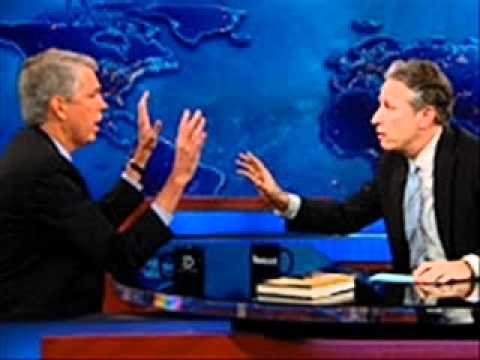
David Barton, telling fairy tales to Jon Stewart
Pseudo-historian and evangelical leader David Barton went on Comedy Central’s “The Daily Show” this week and trotted out a factually dubious story ( and one that is almost two decades old) about a St. Louis elementary school student named Raymond Raines who was, the story goes, reprimanded by both his teacher and a principal for praying over his lunch in the cafeteria. Jon Stewart was skeptical, but Barton, an author, a self-styled historian and, of course, a man of God, insisted that the tale was true, and indicative of the persecution Christians are subjected to in Obama’s America. The story is not “true;” at best it is disputed; I think, as Stewart suggested, that it is highly unlikley. It is dishonest to state that it is fact, because Barton doesn’t know that.
There is no excuse for this, but plenty of possible reasons. One is that Barton was intentionally lying to bolster his claim of culture-wide persecution. Another is that he was in the throes of confirmation bias, and assumed that a horror story that seemed to support his already-formed beliefs must be true. A third is that he related a popularly-repeated myth on national television without bothering to check whether it was true or not. None of them are acceptable. Continue reading
The Unethical Rationalization List: 24 and Counting
Ethics Alarms frequently refers to rationalizations, which lie at the core of most unethical conduct. They are, as one ethicist put it, lies we tell ourselves to allow us to pretend that what we know is wrong, isn’t. Some rationalizations are used so frequently, by us and others, that we come to believe them.
The list of rationalizations has been available on the blog under the Rule Book heading from the beginning, but it is constantly updated, and even though posts frequently link to it, it is clear to me, especially from comments that resort to exactly the same examples of flawed ethical reasoning that populate the list, that a lot of visitors never see it. For those readers, and also those who may not have read the Unethical Rationalizations and Misconceptions page recently, I am posting the whole list of 24 rationalizations here. If you have a candidate for #25, please send it in. Continue reading
“Blue Bloods” Ethics: The Good Lie?
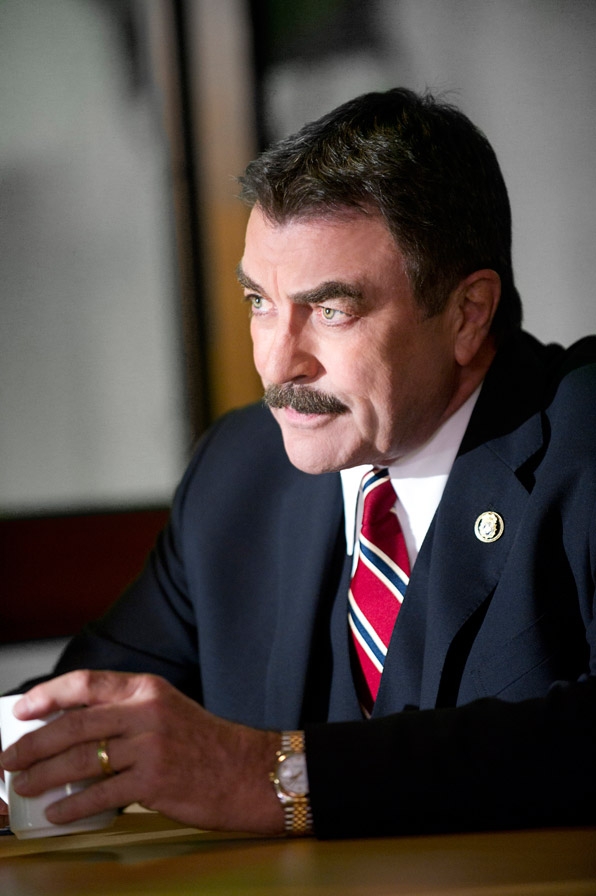
Tom Selleck as NYC Chief of Police Frank Reagan
Tom Selleck’s CBS drama “Blue Bloods,” chronicling the exploits of the Reagans, an improbable fictional New York City family that dominates NYC’s law enforcement, featured an excellent example of a necessary lie last night, in which utilitarian principles would hold that the lie, a rather serious and extensive one—many interlocking lies, really—was the most ethical option available.
The situation arose because the Chief of Police (Frank Reagan, played by Selleck) learned that his police officer son, Jamie Reagan, had rescued a child from an explosion, and the press and city were clamoring to know who the hero was. (Nobody saw the rescue, which is a contrived detail, but necessary to set up the ethical dilemma.) But Jamie was also working undercover in a serious and dangerous operation, having infiltrated an organized crime family. (Why was a uniformed cop allowed to stay on the street while leading a double life? Seems reckless to me, but Father Chief knows best.) To protect the undercover operation and his son, Frank Reagan decides on an elaborate deception, persuading his son’s partner, who was on the scene of the rescue, to take the credit and even accept a commendation in a public ceremony.
Lying to the public and the press to such an extent is almost always inexcusable, but protecting an anti-crime effort in the public interest, as well as the imperiled officer involved in it, is a rare case in which the balance tips away from the truth. The “Blue Bloods” solution was the best one available given the situation and the law enforcement priorities. But… Continue reading
 Ethics Alarms