Comment of the Day: “On Lincoln’s Favorite Poem, and the Poems’ We Memorize…”

What a joy to wake up this morning not only to a spectacular Comment of the Day, but also to a note from an MIA commenter who was last seen in these parts almost nine years ago! I welcome Lisa Smith back to Ethics Alarms with a well-deserved Comment of the Day honor, for her note on the post, “On Lincoln’s Favorite Poem, and the Poems’ We Memorize…”

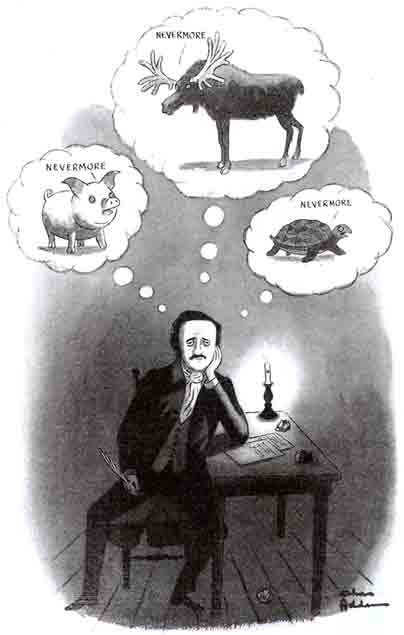
(I couldn’t resist leading this off with one of two brilliant Charles Addams cartoon about “The Raven.” The other has Poe pondering as a raven, perching over his door, says, “Occasionally.”)

***

I don’t know – Poe’s Raven has one of my favorite lines; it isn’t at all profound, but it is profoundly delightful to speak and to allow to roll over the brain like a cool river. I memorized the entire poem when I was a teen in the late 70’s and can still recite it. (But for the life of me, I can’t remember the “new” neighbor’s names, even though they have been here five or six years. Their dog is Annie. My priorities are laid bare, I suppose.)

“And the silken, sad, uncertain rustling of each purple curtain thrills me, fills me with fantastic terrors never felt before.”

There may be errors in there. I write it from memory alone. [JM: Pretty close! “And the silken, sad, uncertain rustling of each purple curtain, thrilled me—filled me with fantastic terrors never felt before”]

Poetry makes equals of us all. From Bukowski to Shakespeare. They speak to each person in their own way.

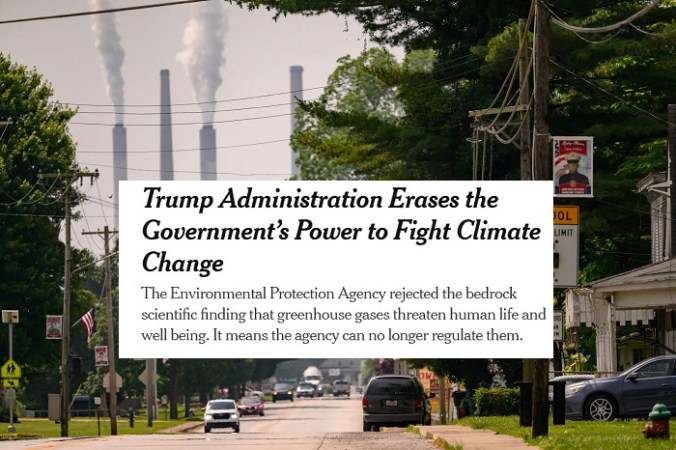
The Fantasy Headline

I don’t want to dwell on the headline above from the Times, but this is just another example of how, as in democracy’s death of a thousand cuts, our journalists deceive, confuse and manipulate public opinion. They also think they are clever about it, just as they think they are smarter than they are.

“President Trump on Thursday announced he was erasing the scientific finding that climate change endangers human health and the environment, ending the federal government’s legal authority to control the pollution that is dangerously heating the planet,” the Times piece begins. “The action is a key step in removing limits on carbon dioxide, methane and four other greenhouse gases that scientists say are supercharging heat waves, droughts, wildfires and other extreme weather.”

Well.

BREAKING: DEI Bias Eats The A.P.’s Brains

Why would the Associate Press feel the world needs this “news” when Savannah Guthrie’s mother is still missing?

The Associated Press is troubled that there are so many white athletes at the Winter Olympics. No, it really offered a new story that says this. No I am NOT kidding. The apparently woke-mad Chris Nisi complains in “Europe’s rising diversity is not reflected at the Winter Olympics. Culture plays a big role” [Note: “Culture plays a big role”= “Bulletin: Water is Wet.”]…

Immigration from Africa and the Middle East has transformed the demographics of Europe in recent decades. And while the growing diversity is reflected in many sports such as soccer — Sweden’s men’s national team has several Black players including Liverpool striker Alexander Isak — it hasn’t made a dent in winter sports…At the Milan Cortina Winter Olympics, Sweden is sending a team made up almost exclusively of ethnically Swedish athletes, with NHL player Mika Zibanejad, whose father is from Iran, a rare exception. That hardly reflects the diversity of the Nordic country: About 2 million of its 10 million residents were born abroad, about half of them in Asia or Africa, according to national statistics agency SCB.

The lack of athletes of color at the Winter Olympics — and in winter sports in general — has been a recurring theme in the U.S., which is sending one of its most diverse teams to the Games. It hasn’t gotten the same attention in Europe.

The Olympic rosters of France, Germany, Switzerland and other European winter sports nations look a lot like Sweden’s: overwhelmingly white and lacking the immigrant representation seen in their soccer or basketball teams…”


I Am Increasingly Reaching The Conclusion That We Can’t Trust Anyone, “Experts,” Researchers and Scientists Included: My Dan Ariely Disillusionment

We’ve had some interesting discussions here about “experts” here of late, notably this post. I am rapidly reaching the point where anyone who appeals to authority to justify his or her position, particularly if the authority is a study, a report, an “expert” or a scientist, immediately inspires my skepticism and even suspicion. Now what?

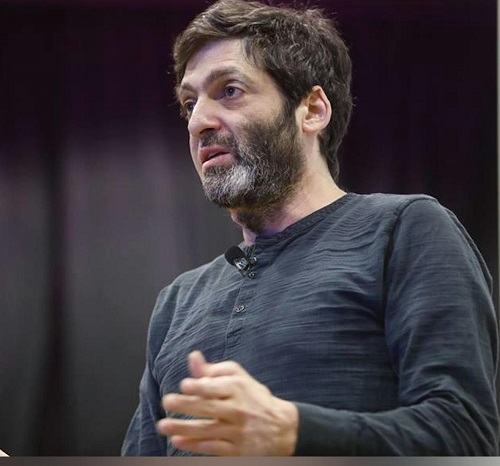
Once again, Duke professor and researcher Dan Ariely is in the news, and not in a good way. Ariely, professor of business administration in the Fuqua School of Business is named 636 times in the more than 3 million additional Epstein files released on January 30. He may be innocent of any wrong-doing and he and Epstein may have just played in a Fantasy Baseball league together, but the problem this creates for me is that I have been using Ariely’s work as authority in my ethics seminars for as long as I can remember.

For more than a decade, I told incoming members of the D.C. Bar as part of their mandatory ethics training that such sessions as mine were essential to making their ethics alarms ring. To support that thesis, I related the finding of research performed by Dan Ariely when he was at M.I.T. Ariely created an experiment that was the most publicized part of his best-selling book “Predictably Irrational,” giving Harvard Business School students a test that had an obvious way to cheat built into it and offering small rewarde for the students who got the highest scores. He tracked how many students, with that (small) incentive to be unethical, cheated. He also varied the experiment by asking some students to do simple tasks before they took the test: name five baseball teams, or state capitals, or U.S. Presidents.

None of these pre-test questions had any effect on the students’ likelihood of cheating, except for one question, which had a dramatic effect.  He discovered that students who were asked to recite a few of the Ten Commandments, unlike any of the other groups, never cheated at all. Never. None of them. Ariely told an NPR interviewer that he had periodically repeated the experiment elsewhere, with the same results. No individual who was asked to search his memory for a few of the Ten Commandments has ever cheated on Ariely’s test, though the percentage of cheaters among the rest of the testees is consistently in double figures. This result has held true, he said, regardless of the individual’s faith, ethnic background, or even whether they could name one Commandment correctly.

The classic moral rules, he concluded, reminded the students to consider right and wrong. It wasn’t the content of the Commandments that affected them, but what they represent: being good, or one culture’s formula for doing good. The phenomenon is called priming, and Ariely’s research eventually made me decide to start “The Ethics Scoreboard” and later this ethics blog.

On The Limitations Of Expertise

Guest Column by Sarah B.

[From your Host: This excellent essay arrived on an Open Forum, and as I sometimes do, has been elevated from Comment of the Day status to a Guest Column. I’ll even forgive Sarah for making me look bad in comparison to such thoughtful, eloquent and perceptive work.]

***

“The embarrassment is that chemistry was treated as a mere technicality rather than the foundation of the entire conclusion. The embarrassment is that skepticism—real skepticism, the disciplined refusal to accept claims without robust evidence—was framed as denial rather than diligence.”

This is, in my opinion, the money quote from The Brain, Microplastics, and the Collapse of Scientific Restraint. 

This particular article discusses the extraordinary claim that our brains contain a huge amount of microplastics.  The problem with this claim is that the study has a fatal methodological flaw.  The study relies on spectroscopy and detecting signatures of chemicals to determine a sample’s composition.  However, the fats in the brain break down into similar compounds as polyethylene, which means without further differentiation methods, there is no way to tell if the “microplastics” the study detected were actually just normal lipids found in the brain.  The whole article is worth reading, as it does an excellent job of explaining the issue. 

I recently saw a post on Facebook that decried the idea that experts could be challenged by some novice watching a few YouTube Videos and reading a few scientific papers.  This led to a long discussion in the comments, which was unfortunately extremely one-sided.  Most everyone agreed that trying to correct an expert in their field was utter hubris.

“Take something you are good at, like maybe changing transmissions.  Imagine someone who has watched a few YouTube videos comes up and tells you that you are doing it all wrong.  How would you respond?”

The main problem with this is that, in terms of changing a transmission, we can obviously see who is right and who is wrong.  The car will run, or the car will not.  Indeed, if you truly are an expert in changing transmissions, you can step up and, in simple terms, explain why your process is the correct one, what is wrong with the YouTube watcher’s process, and even perhaps teach your skeptic how to do it correctly. 

With any field of expertise, we have to remember that experts are people too, and all humans have flaws.  Experts can be tempted by money, power, prestige, and politics.  There are also limitations that even experts struggle to overcome.  For example, in many branches of research, there are serious problems (often ethical in nature) in creating a good control group. 

An Inquirer Asks, “How Can I Stop My Wife From Badgering Our Friends About Climate Change?” How About….

…showing her that her hysteria is based on lies, bad stats, politicized “science” and hooey?

I admit it, that headline sucked me in to reading “Social Q’s,” a Times advice column that puts wokeness over wisdom, causing me to put it on the EA blacklist.

My wife has become an eco-warrior,” a married weenie writes. “She has strong feelings about the environment and other people’s carbon footprints. She challenges our friends repeatedly about their lifestyle choices. I agree with her in principle, but I can’t support her moral outrage. …Help!

Predictably, the column’s proprietor, Phillip Galanes, begins by saying, “I would begin by praising her, rightfully, for her commitment to an important issue.” I’ll fix it for him: “an important issue that nobody really knows much about, especially indoctrinated progressives who are passionate about what their bubble-mates are passionate about regardless of facts.”

Much better.

Continue reading

We Now Know Scientific Pronouncements Are Frequently Garbage, So We Also Should Know “The ’60s Parenting Practices We Now Know Were Terrible For Kids’ Brains” Is Mostly Crap…

Being raised in the Sixties, I was naturally curious about the article in Media Feed titled “The ’60s parenting practices we now know were terrible for kids’ brains.” What I discovered, as one usually will with social science essays with an agenda, is carefully cherry-picked research being used to support an author’s already pre-determined position. You know, “Science!”

“Science” has been so thoroughly polluted by the political left to justify its objectives and claim absolute authority for propositions that are far from determined (or determinable) that the public should be conditioned to doubt any claim that begins, as this one does, “This article explores a dozen once-standard practices and uses modern research to explain why they were tough on a child’s developing brain, emotional health, and long-term well-being.” Here is what modern research as revealed in recent years: it can’t be trusted. It can’t be trusted because researchers and scientists can’t be trusted, and interlocutors like Kaitlyn Farley, the gullible (or dishonest) author, don’t know enough about science to interpret studies with appropriate skepticism. (I just checked: Kaitlyn claims to be, among other things, an AI trainer who specializes in “content creation.” That explains a lot about the article.)

Continue reading

Michael Mann Helpfully Continues To Prove Just How Much “Climate Science” Is Warped By Partisan Agendas and Unprofessional Bias

Climate change hysterics cannot discuss the basis for their passion without mentioning Michael Mann, who must be regarded as the face of whole climate change movement. Wikipedia makes him seem like a master of his domain:

Mann has contributed to the scientific understanding of historic climate change based on the temperature record of the past thousand years. He has pioneered techniques to find patterns in past climate change and to isolate climate signals from noisy data.

As lead author of a paper produced in 1998 with co-authors Raymond S. Bradley and Malcolm K. Hughes, Mann used advanced statistical techniques to find regional variations in a hemispherical climate reconstruction covering the past 600 years. In 1999 the same team used these techniques to produce a reconstruction over the past 1,000 years (MBH99), which was dubbed the “hockey stick graph” because of its shape. He was one of eight lead authors of the “Observed Climate Variability and Change” chapter of the Intergovernmental Panel on Climate Change (IPCC) Third Scientific Assessment Report published in 2001. A graph based on the MBH99 paper was highlighted in several parts of the report and was given wide publicity. The IPCC acknowledged that his work, along with that of the many other lead authors and review editors, contributed to the award of the 2007 Nobel Peace Prize, which was won jointly by the IPCC and Al Gore.

Mann was organizing committee chair for the National Academy of Sciences Frontiers of Science in 2003 and has received a number of honors and awards including selection by Scientific American as one of the fifty leading visionaries in science and technology in 2002. In 2012 he was inducted as a Fellow of the American Geophysical Union and was awarded the Hans Oeschger Medal of the European Geosciences Union. In 2013, he was elected a Fellow of the American Meteorological Society and awarded the status of distinguished professor in Penn State’s College of Earth and Mineral Sciences. In 2017, he was elected a Fellow of the Committee for Skeptical Inquiry.

Mann is author of more than 200 peer-reviewed and edited publications. He has also published six books: Dire Predictions: Understanding Global Warming (2008), The Hockey Stick and the Climate Wars (2012), together with co-author Tom Toles, The Madhouse Effect: How Climate Change Denial Is Threatening Our Planet, Destroying Our Politics, and Driving Us Crazy (2016) with Megan Herbert, The Tantrum That Saved the World (2018), The New Climate War (2021), and Our Fragile Moment (2023). In 2012, the European Geosciences Union described his publication record as “outstanding for a scientist of his relatively young age”. Mann is a co-founder and contributor to the climatology blog RealClimate.

All the honors and accolades prove is how politicized the scientific community is, and how progressive bias has infected so many of the world’s institutions. His so-called “hockey stick graph,” supposedly a reconstruction of past climate temperatures, was shown to be the product of dishonest statistics methodology; for example, it conveniently ignored the Medieval Warm Period that continues to bedevil the climate change narrative.

Continue reading

Comment of the Day: “About That Climate Change ‘Consensus’”….

It’s about time recent EA comment auteur Holly A. was recognized with a Comment of the Day, and she actually had two strong candidates back-to-back. I chose the second. Both involved the same issue: garbage “climate change” advocacy and activism unhinged to actual facts. In the first comment, Holly impressively examined both the professors and the paper that sparked my post. I responded with gratitude, but noted that the technical details of the paper were not my concern. I wrote in part,

The ethics bottom line remains the same. There is not any “consensus.” The data is inconclusive. The hysteria is manipulated and politically motivated. Spending large amounts of treasure to alleviate a problem that is not well-understood is irresponsible. The news media has no interest in informing the public, and the people and politicians talking most loudly about climate change literally don’t know what they are talking about.

Fair?

Here  is Holly A.’s response, the Comment of the Day on the post, “About That Climate Change ‘Consensus’”….

***

I would say mostly fair.

Continue reading

About That Climate Change “Consensus”….

MIT’s Richard Lindzen, Professor of Earth, Atmospheric, and Planetary Sciences, Emeritus, and Princeton’s William Happer, Professor of Physics, Emeritus, have published a paper titled Physics Demonstrates That Increasing Greenhouse Gases Cannot Cause Dangerous Warming , Extreme Weather or Any Harm.

Wait! How can that be?! We are told by climate change hysterics in government, universities, news organizations and international organizations—and Robert Kennedy, Jr,!—that there is no question that we are doomed if we don’t immediately curtail carbon-based fuels, stop flying, stop using gas-powered cars, stop fighting world government, stop having babies, stop using plastic ARRRRGH! AND we have been assured that this is the consensus of the scientific community, and not to grovel to these apocalyptic prognostications is to “reject science.”

Now, all of this has always been a pack of lies, speculation and hyperbole, but our betters (that is, progressives, artists, academics and Hollywood) have been allowed to pound this junk into the heads of the logically challenged and scientifically ignorant for decades, often harvesting votes and lucre all the while. I don’t know whether the latest paper is wrong just as you don’t know that the scientific opinions behind the “We’re all going to die!” papers are right. However, enacting draconian measures on faith, guesswork and speculation is irresponsible, or in technical terms, really, really stupid.

Continue reading