Animal Ethics: Oh No! Prairie Dogs Are Serial Killers!

Aww, look at the cute little prai---MY GOD, WHAT IS IT DOING TO THAT SQUIRREL???

Aww, look at the cute little prai—MY GOD, WHAT IS IT DOING TO THAT SQUIRREL???

Here’s the most troubling quote from the article in Gizmodo about a biologist’s startling discovery that prairie dogs routinely kill baby ground squirrels because they don’t like baby ground squirrels…after all, they are herbivores:

“Pop culture loves to portray herbivores as peace-loving pacifists—just look at Zootopia as the latest example of this—but who can say what other barbarous acts are going undocumented in our backyards? Are rabbits stealing into burrows to throttle chipmunks in their sleep? Do elk and buffalo lose their cool and impale each other over prairie grass? These are the sorts of unsettling questions biologists will have to start asking.”

The reason those questions will be asked is the work of biologist John Hoogland of the University of Maryland Center for Environmental Science. His observations of prairie dogs, resulting in a paper published today in the Proceedings of the Royal Society B, indicate that the cute, fuzzy mammals “will chase ground squirrels—usually babies—and if they catch them, they shake them violently. While they’re shaking, they’re biting the back of the neck to sever the vertebral column. Sometimes they grab by the head and literally debrain the baby. It’s violent, savage, and awful.”

There is a reason for this violence: ground squirrels and prairie dogs compete for the same grasses as food. It is the first known instance of a mammalian herbivore killing another mammalian herbivore on a routine basis, and Hoogland’s research indicates that it’s “just business”: the fewer ground squirrels there are; the more food there is for the prairie dogs and their young.

Clearly, prairie dog society is organized according to extreme utilitarian principles: the ends justify the means….at least when it comes to ground squirrels.

I think the ground squirrels should build a wall.

How Cognitive Dissonance Works: A Case Study

Cognitive DissonanceJust last fall, the percentage of Americans identifying as Republicans and Democrats was essentially the same. Now, after months of the party being represented in the media by ugly, boorish, violent, dumb, name-calling Donald Trump, and the necessarily messy GOP debates that were the direct result of a major participant whose modus operandi consisted of mockery, lies and ad hominem attacks, this is the current split:

Party affiliation

Continue reading

Twitter Makes Us Stupid, Twitter Makes Neil deGrasse Tyson Look Stupid, Twitter Allows Neil deGrasse Tyson To Make His Fans Stupid

bats

Great.

Twitter is a wonderful medium for people who can only digest simple thoughts, as well as for those whose full powers of observation and analysis can be expressed in 140 characters. For everyone else, the social media device is an invitation to emote with inadequate thought, and to demonstrate undesirable character traits like arrogance, carelessness, recklessness and poor judgment.

Neil deGrasse Tyson, for better or worse, currently fills the niche of Pop Culture Smart Person, or PCSP. This is a role that has genuine cultural value, and has fallen in the past to such figures as Albert Einstein, Carl Sagan, Bill Nye and Stephen Jay Gould, among others. Smart people accepted by the broader culture can do more to help banish bad ideas, myths and biases than years of formal education, but they must wield their power with care, guard their credibility and appearance of integrity, and most of all, not abuse the trust of their fans.

In these matters, Tyson is a most irresponsible PCSP.  He ventures into partisan politics too frequently, is a media attention addict, and worst of all, he is addicted to Twitter, where he regularly tweets factoids barely worthy of a bubble gum wrapper and makes jokes that display his sophomoric sense of humor—for example, “If you removed all arteries, veins and capillaries from your body and laid them end to end, you’d die.” Steven Wright, he isn’t.

Those tweets are just embarrassing. However, it is affirmatively damaging when a man recognized as being educated and wise issues outright false scientific facts, like he did with a recent tweet announcing,

“If Batman wants so badly to be a bat, he might be more intriguing if (like Marvel’s Daredevil) he were also blind, like a Bat.”

Continue reading

Documentary Ethics: Is Pulling An Anti-Vaxx Documentary A Freedom of Expression Breach Or Simply Responsible?

tribeca_film_festival_ny

Until yesterday, “Vaxxed: From Cover-Up to Catastrophe” was an entry in the 2016  Tribeca Film Festival. It was directed and co-written by Andrew Wakefield, the disgraced doctor and researcher whose study purporting to show a link between vaccinations and autism was published in the British medical journal “The Lancet” in 2010 and then retracted. Wakefield subsequently lost his medical license because of undisclosed conflicts of interest and misrepresentations in his paper, and has been wandering the earth wearing the metaphorical sackcloth robe of the outcast ever since.

The decision by the festival and its founder Robert De Niro to screen the film was the focus of a furious controversy. Many consider Wakefield a murderer because his work has convinced parents to eschew vaccinations out of irrational fear sown by his false research conclusions. De Niro insisted that the film deserved a screening to provoke dialogue, but has had a change of heart, mind, or self-preservation instinct. He pulled the film yesterday, writing,

“My intent in screening this film was to provide an opportunity for conversation around an issue that is deeply personal to me and my family. But after reviewing it over the past few days with the Tribeca Film Festival team and others from the scientific community, we do not believe it contributes to or furthers the discussion I had hoped for.”

Translation: “When it comes to standing up for free expression, Andrew Wakefield and the anti-vaxxer delusion is not a hill worth dying for.” Continue reading

Unethical Technology On The Way: Imagine What Breitbart Will Be Able To Do With THIS

The video above shows a still-in-development system called Face2Face (research paper here) created by researchers at Stanford, the Max Planck Institute and the University of Erlangen-Nuremberg. It would allow you to take YouTube video of anyone speaking, and to pair it with a standard webcam  video of someone else emoting while saying something entirely different. Thehe Face2Face system will synthesize a new video showing the originals speaker making the second speaker’s facial movements, including the interior of the mouth, so it looks like the original speaker is saying what the second speaker was.

Tech Crunch reports that the system isn’t quite ready for market yet. Gee, I can hardly wait. This “advance” has the potential of making video just as unreliable and untrustworthy as still photography is now. Web hoaxers, Ted Cruz’s marketing team, unscrupulous political websites like Breitbart and others will have a field day once Face2Face is perfected.

The justification for creating such technology is the same as the rationalizations behind cloning velociraptors in “Jurassic Park”: because we can, and because we can make money with it. Can any good come from Face2Face? It’s late and I’m not at my best, but it seems to me that the end results of having another tool for liars just means more lies, more cynicism, more misinformed people, and less trust.

Isn’t it irresponsible and inherently unethical to invent something like this?

A Law Student Creates A Dishonest List Called “100 Times A White Actor Played Someone Who Wasn’t White” And Begins Another List Called “Times The Washington Post Published A Race-Baiting Piece Of Lazy Research And Sloppy Reasoning By Someone Who Looks Like She Will Be A Terrible Lawyer”

I didn’t set out to make the news media’s tolerating unethical race arguments the theme today, I really didn’t. While I was researching ESPN’s decision not to hire whites on its new website, to which the Wall Street Journal shrugged and said, by not saying, “Wait….WHAT?” in effect, “Sure, go ahead, discriminate!”, I came upon this piece of journalistic offal called “100 Times A White Actor Played Someone Who Wasn’t White” on the Washington Post website. It was authored by Meredith Simons, a law student and freelance writer. Well, Meredith, free-lance writers get away with these miserably researched and unfairly gathered articles a lot, but if you try to sneak this kind of crap past a judge or a senior partner, you’re going to have a rude awakening.

The fact that her article is incompetent and unfair in myriad ways doesn’t mean that Hollywood has been an equal opportunity employer throughout decades past. It hasn’t, but it has reflected the society and tastes in which it operates, and often has been a leader in race attitudes, as in the film “Imitation of Life.” There is work to be done, but careless articles like Simons’ just causes ignorance and confusion.

The immediate impetus for her hit piece on Hollywood casting was apparently the controversy over the casting of white actor Joseph Fiennes as Michael Jackson in a planned biopic. Simons calls him “African American icon Michael Jackson,” which is the lawyer’s trick of framing an issue to rig the debate—good one, Meredith—but skin-bleaching, child-molesting, whitebread pop star Jackson is hardly an “African American” icon: he’s a national pop icon who went out of his way to reject race and racial labels. That is what the song “Black and White” was about, right? Sure, the casting was a gimmick, but it’s a clever and legitimate gimmick that I would guess Jackson would have approved of enthusiastically. When they make “The Rachel Dolezal Story,” will Simons complain if a black actress gets the part?

So based on a phony race controversy—two, in fact, with the Oscar nomination spat included—Simons comes up with an even more phony list. “Despite decades of protests over racially inappropriate casting and the recent protests over the lack of diversity among Oscar nominees, filmmakers continue to cast white actors as minority characters on a depressingly regular basis,” she writes.

(A tip  for Social Justice Warriors: don’t write about the performing arts and casting if you don’t know a damn thing about either. The purpose of the performing arts is 1) to make a good product and 2) to make money. Anything that in any way interferes with either is irrelevant. There is no such thing as “racially inappropriate casting” if it furthers either of these objectives, or ideally both. It is not Hollywood’s job to eradicate racial inequality in the U.S. If it helps, that’s responsible and ethical of the movie-makers. This is, however, neither its art nor its business.)

Simons’ list is the epitome of the Texas Sharpshooter fallacy done badly. The fallacy consists of cherry-picking facts that support a predetermined argument and “drawing a circle around them” as if they are the sole relevant facts, while intentionally or mistakenly omitting equally relevant facts that would tend to disprove it. Bad lawyer that she is, she draws a metaphorical circle around “facts” that don’t even support her argument. I’m not going to go through the entire hundred  (say “thank-you, Jack!”) but I’ll point out some of her most egregious botches.

To begin with, either she didn’t see the movies on the list, or intentionally misrepresents them. My favorite, and typical of her terrible research: Continue reading

Ethics Questions And Answers Regarding The Flint, Michigan Water Crisis

how-lead-gets-injpg-1e9d798a1edee129

First, a background question: What is the Flint water crisis?

Here is what has happened so far:

1. In March of 2013, the Flint City Council voted to leave the Detroit water system and join a new pipeline project that would deliver water to the city from Lake Huron. The state agreed that it was a good idea, since it would save the financially strapped Flint 19 million dollars over 8 years. [ Addendum: The news media and progressive spin is that the cruel state unilaterally imposed this decision on Flint. That’s not true, and don’t trust any source that claims it is. Here’s one such hack, who states “In 2013, the Emergency Manager for Flint, Ed Kurtz, signed the order that Flint would stop relying upon Detroit for water and, instead, switch to a the Karegnondi Water Authority run out of Lake Huron.” The Flint City Council voted 7-1 to take this course prior to the sign-off. It was approved by Kurtz, but this blogger’s statement that the crisis “is a direct result of reckless cost-cutting by the unelected bureaucrat who Governor Snyder appointed to run the city under the state’s controversial “Emergency Financial Manager” law” is deceptive and false.]

2. Detroit retaliated by announcing that it would cut off Flint’s water supply. Since the new pipeline wouldn’t be ready for three years, Flint had to find a temporary supplier of its water needs. It then spent millions upgrading its water processing plant.

3. The months leading up to the Detroit shut-off deadline generated many meetings with the state and regulatory bodies. Mayor Dayne Walling, a Democrat, announced that the temporary supply would come from the Flint River. The plan for the switch was implement by state-appointed emergency manager, Darnell Early. The system went into operation in April of 2014.

4. Immediately, residents started complaining about the water’s taste and appearance. Early (the state) and Mayor Walling (the city) insisted that it was safe to drink. Four months later, there was a fecal content alert, meaning that the water wasn’t being sufficiently purified. In October of 2014, General Motors said that the water seemed to be corrosive, and it would no longer use it in its plant.

5.  In January of 2015, Flint told its residents that the water wasn’t safe because of chemical contamination that could cause serious health problems. Detroit offered to go back to the old arrangement. Flint declined. Erin Brockovich (yes, that Erin Brockovich)  publicly argued that there was a water safety  crisis in Flint. The Mayor asked the state for assistance, and was assured that they were “working on it.”

6.  Activists said that the water was dangerous and the city should go back to its old arrangement with Detroit. The city hired an expert who claimed the water was safe. More work was done to fix the problem, but the City Council voted to re-connect to the Detroit system, and Lake Huron water. However, the vote had to be approved by the State’s emergency manager for the city. He didn’t approve it. The advocates for going back to Detroit water sued in Federal court, and lost.

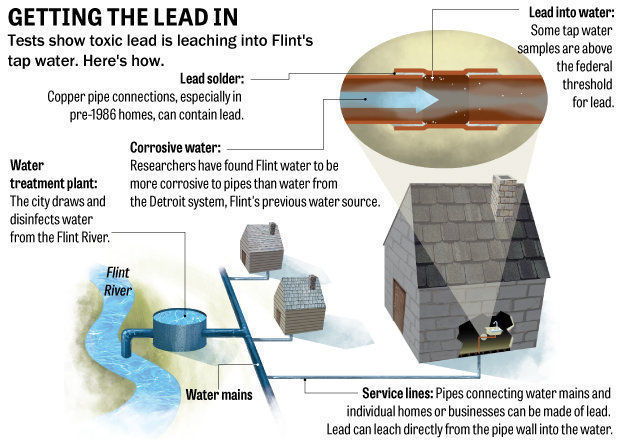
7.  This mess  dragged into last fall. In September of 2015, researchers from Virginia Tech University reported online that their testing of Flint’s water found it “very corrosive” and that it was “causing lead contamination in homes.”  “On a scientific basis, Flint River water leaches more lead from plumbing than does Detroit water,” the report concluded. “This is creating a public health threat in some Flint homes that have lead pipe or lead solder.” The very same day, Michigan told Flint that the earlier chemical contamination had fallen within acceptable levels due to improved treatment methods, and the water was officially compliant with all standards, and safe.

8. Later that month, however, testing showed frightening levels of lead in the blood of Flint infants and children. A new lead warning was sent to Flint residents.

9. In October, 2015, the County issued a warning that Flint’s water was dangerous, and asked the Governor to declare a State of Emergency. The next day, Governor Rick Snyder announced various measures to address the problem.

10. Again, the city, this time through a special advisory committee, recommended that Flint switch back to the Detroit supply. On October 8, Snyder announced a multi-million dollar plan to reconnect Flint to Detroit’s water.  A week later, the Michigan Legislature and Snyder approved  $9.4 million in aid to Flint, including $6 million to  switch its drinking water back to Detroit.

11. Thanks to the water problem, Walling was defeated in his race to be re-elected as mayor  by Karen Weaver. The switch didn’t stop the lead problem, because the corrosive water had prompted a deterioration in Flint’s lead pipes. It took a the entire holiday period for this to become sufficiently obvious, for some reason, as many residents drank lead-contaminated water they had been told was now safe.

12. Shortly after Christmas, Snyder fired Department of Environmental Quality Director Dan Wyant and apologized for what was happening in Flint. He declared a state of emergency.

13. On January 13, Governor Snyder activated the Michigan National Guard to  distribute bottled water and filters in Flint, and asked the federal government for assistance.  The same day, Michigan health officials reported an increase in Legionnaires’ disease cases during periods over the past two years in Flint and the surrounding county. Snyder requested a major disaster declaration from President Obama, and more federal aid. Obama signed an emergency declaration last week, ordering federal aid for Flint and authorizing the Federal Emergency Management Agency and the Department of Homeland Security to coordinate relief efforts.

Why doesn’t everybody know about this? Continue reading

Blame Tom Toles For This Post: NO, Obama Can NOT Honestly Claim That He Cut The Deficit

Toles deficit

While we’re on the topic of misleading statements, as in lies, foisted on the American public by the President of the United States, I now have to bring up his boast in his State of the Union speech that “We’ve done all this while cutting our deficits by almost three-quarters.” [Don’t get me started with “all this.”]

I was going to leave this infuriating line alone, I really was, because when you get on the topic of deficits, the numbers-spinners have a field day. Then I saw Tom Toles’ cartoon, above, for the Washington Post.

Toles, if I haven’t made it clear before, is the worst of a breed that is itself a disgrace to journalism, a form of editorial content that is immune from the ethical restrictions that are supposed to govern journalism. It is the ultimate “clown nose on/ clown nose off” scam, and Toles exploits its license beyond the nauseating limits set by his over-rated predecessor, the equally biased but not quite as shameless Herb Block….you remember, the guy who drew all businessmen as obese, cigar-chomping robber barons out of the 1890s, and conservative Congress members as cavemen. Yeah, he was subtle and fair all right. Toles is much worse.

By what version of English and logic can anyone say that Obama reduced the deficit at all, much less by “almost three-quarters? Here is the chart of the deficits since 2005 in dollars: Continue reading

Epilogue: The Boo-Boo Hoax, Blues Blindness, and Trust

The comments on the boo-boo hoax post have me so upset that I can't see this...

The comments on the boo-boo hoax post have me so upset that I can’t see this…

Every now and then, and it is never on a post that I am especially keen on or that I expect to catch fire, a link to an Ethics Alarms essay is suddenly being clicked on by a lot of people who have no interest in ethics, but a particular interest in a topic I happened to stumble into, as I am wont to do. Usually these waves of traffic contribute nothing of substance to our ethics colloquy, produce no new regular readers, and  they depress me, as did the so-called “Instalanche” of a few years back when Glenn Reynolds deigned to link to a post.  A bigger group of nasty right wing jerks I have never encountered before or since: I lost a bit of respect for Professor Reynolds that day (His avid followers maintained it was ethical to spread a web rumor that Harry Reid was a pederast in retribution for Reid’s “Romney hasn’t paid taxes” lie. It’s not.)

The current ‘-lanche’ has arrived courtesy of my post of a couple days back about an unlabeled hoax study published by The Journal of Evaluation in Clinical Practice, a (formerly) respectable scientific journal. Of the few new readers who have commented, most have distinguished themselves by making the typical threadbare rationalization used for all web hoaxes, to wit:  “Anyone who didn’t figure out it was a gag isn’t as smart as I am.” If these people typify the ethical acumen of scholarly journal readers, we have trouble my friends, right here in River City.

See, Brilliant Advanced Degree-holders, the problem with respectable journals (if there are such things) publishing inside jokes without proper labeling is that the false studies are read and believed by journalists, who spread the misinformation like an oil slick over the culture and public consciousness. It doesn’t matter if you got a chuckle out of it; what matters is that a lot of people were made to believe false information, and it is the purveyors of that false information, not the oh so gullible and ignorant victims of it, who are at fault. Continue reading

Comment of the Day: “The Washington Post Drops Its Resident Op-Ed Socialist. Good.”

Post paper

The honor of the first Comment of the Day in 2016 goes to pennagain, previously penn, who assesses the forces turning our journalistic establishment to ethics mush. It is not a pretty scenario, but well worth thinking about. He was inspired by my article about the Washington Post dropping socialist pundit Harold Meyerson in part because he wasn’t getting enough clicks. Where it stops, nobody knows.

Here’s pennagain:

Twelve [delivered Washington Post daily print editions in another commenter’s apartment building] down to two is about what the trend is for paper subscriptions running out, and free internet use taking over. In the short run, probably, the metro papers will all go behind the paywall while smaller ones hold out for local advertisers, but for now there is a steady drop in print and a rise in online subscriptions, with a (temporary) small increase in access to both. All news media — newspapers, television and radio — are losing ground to the fragmentation of the internet universe as it “narrowcasts” to further and further special interests. The long run is not a pleasant prospect.

In the meantime, the born-to-the-web generation has been raised on free news, as have a majority of the current readers who lost their home-delivered (now less than 400) newspapers.

My concern is that perception of news is probably down about the same (12:2) — the smaller the screen, the poorer the perception. Internet pages are awash with advertisements up and down the sides and through the middles, flashing and flickering, sounding out automatically (this is fairly recent distraction and, I think, a true impingement on privacy), not to mention the seductive invitations between paragraphs to links that frequently cut into the text itself.

In a medium where the whole story could be presented as such on one “page,” it is cut into pieces and continued-on other screens, each of which takes more and more time to load its own load of ads. More incentive for those not desperately hooked to the story to check out one of the links or the next site down the line instead of getting all the information saved for more advertising. Click.

Continue reading