Accumulated Ethics Notes On The Charlottesville Riots, The Statue-Toppling Orgy and The Confederate Statuary Ethics Train Wreck, Part 2 Of 3: Amy Alkon Loses Her Mind

Part One is here.

Perhaps the scariest capitulation to the Confederate statue hysteria is Amy Alkon, the usually astute and level-headed blogger, advice columnist and political correctness foe (her book is called “Good Manners For People Who Sometimes Say Fuck“). I often quote her and cite her blog, which in some ways is similar to Ethics Alarms.  Tragically, this issue has both lobotomized and hypocritized her:

Not “Foolish” To Remove Confederate Statues From Public Squares — It’s What We Do To Be Decent Human Beings And Fellow Americans To Black Americans

That “so foolish” remark is how the President put it — and, as usual — as John McWhorter pointed out on CNN, it comes from an impulse appropriate to a 12-year-old boy.

There’s the argument some are dragging out that Jefferson owned slaves (so shouldn’t we yank his statues and pictures, too?). I’m disgusted by that; however, it’s a side note to what he was to this country — to all he gave to this country. So, no, I’m not for going around the country and doing searching background checks on all the subjects of monuments and pulling them down.

Having monuments to confederate leaders in public squares, however, is like naming a school “Hitler Junior High.”

It’s a horrible slap in the face to black citizens and it makes me sadder than any of the stuff that we’ve seen in the news lately.

Yes, disgustingly, people are actually fighting to have monuments up that glorify people who believed blacks to be inferior and fought to the death to protect that view and the shameful capture and enslavement of other human beings that went with it….

What? What hysterical, historically ignorant social justice warrior has a cocked gun at Amy’s head, making her type crap like this? Let’s see:

1. It is foolish…short sighted, destructive, presentist, hysterical, knee-jerk—to remove “Confederate statues” by which Suddenly Stupid Amy really means “Individuals who at some point in their career performed bravely or ingeniously in the Confederate army, or on the side the Confederacy.” Are monuments to President John Tyler, who served in the Confederate cabinet, Confederate monuments? Tyler is the one who decided that the Vice President should become President, not just acting-President, when a President dies in office. I’ve visited his home in Virginia; we honor him on President’s Day.

If Tyler hadn’t made his stand for the continuity of government, Lyndon Baines Johnson, the masterful liberal Democrat who moved heaven and earth to pass the Civil Rights Act, would almost surely never have been President at all. Every American should raise their eyes heavenward in thanks to Tyler’s statues and monuments, especially African Americans. Were his honors raised to emphasize Jim Crow? Hardly. Jefferson Davis was a distinguished statesman based on his public service before the civil war, just as Pete Rose was a record-setting baseball player before he got himself thrown out of baseball for gambling. Pete’s statue is justified for his on-field achievements, just as Davis’s honors can be justified by his that had nothing to do with the Confederacy.

2.The President’s words are typical of a twelve-year old. Those criticizing him for properly standing up for his nation’s historical record, complex human beings and major figures in our history who are not just good or bad but an amalgam of influences, upbringing, the times and regions in which they lived and the circumstances under which they made crucial choices, and for seeing immediately the perils of forced cultural amnesia may be more articulate—it isn’t hard—but have failed a test of citizenship that he has passed with flying colors.

3. The fact that Thomas Jefferson was not only a slaveholder but one who repeatedly raped a slave who did not have the power to say “no” while he was extolling her “inalienable rights” is no “side issue.” How breezily Alkon, a fierce feminist, abandons her values so she can oppose Donald Trump!

Yechh.

Alkon is taking the “No True Scotsman” fallacy in her teeth. “We must pull down the statues and memorials of supporters of slavery because they are insults to African Americans, but Jefferson isn’t really a supporter of slavery.” No, he was also a moral coward, a liar, a thief, and perhaps the biggest hypocrite in American history.  Forced to choose, I’ll take Robert E. Lee over Jefferson for character every time. However, Tom wrote our mission statement as a nation, defined our values in his words (though not his conduct), and managed to pull off the Louisiana Purchase.

Those achievements are worth every honor we have given him. The thesis behind the statue assault, however, is that only the bad stuff recognized in hindsight matters. Amy’s rebuttal to those who rightly recognize the unethical nature of that assertion consists of shouting “That’s ridiculous!” She doesn’t have a legitimate rebuttal. There isn’t one. Continue reading

Ethics Dunces: The 8th U.S. Circuit Court of Appeals

I don’t understand this ruling at all.

In 2011, Cooper Tire & Rubber Co. had locked out union workers. After the company later settled a contract dispute, they all returned to work except for Anthony Runion, who had been fired. Runion had shouted at a van carrying replacement workers onto the company’s grounds: “Hey, did you bring enough KFC for everybody?” and “Hey, anybody smell that? I smell fried chicken and watermelon,” the opinion noted, adding that most of the replacement workers were black.

In the 2-1 ruling for the fired worker, Judge William Duane Benton cited the law protecting unions, strikers and pickets, 29 U.S.C. § 157. Section 7 of the Act guarantees employees the right to “assist labor organizations . . . and to engage in other concerted activities for the purpose of collective bargaining or other mutual aid or protection.” Section 7
gives locked-out employees the right to picket. Section 8(a) prohibits an employer from interfering with, restraining, coercing, or discriminating against employees in the exercise of their Section 7 rights.

How would firing  a worker for uttering undeniable racially hostile verbiage in the process of striking? Benton writes, citing various cases in the line of labor decisions:

“One of the necessary conditions of picketing is a confrontation in some form between union members and employees.” Chicago Typographical Union No. 16, 151 NLRB 1666, 1668 (1965), citing NLRB v. United Furniture Workers of Am., 337 F.2d 936, 940 (2d Cir. 1964). “Impulsive behavior on the picket line is to be expected especially when directed against nonstriking employees or strike breakers.” Allied Indus. Workers No. 289 v. NLRB, 476 F.2d 868, 879 (D.C. Cir. 1973) (internal citation omitted). This court analyzes picket-line conduct under the Clear Pine Mouldings test: a firing for picket-line misconduct is an unfair labor practice unless the alleged misconduct “may reasonably tend to coerce or intimidate employees in the exercise of rights protected under the Act.” NMC Finishing v. NLRB, 101 F.3d 528, 531 (8th Cir. 1996), citing Clear Pine Mouldings, Inc., 268 NLRB 1044, 1046 (1984), enf’d, 765 F.2d 148 (9th Cir. 1985). The test is objective.

Wait: racially prejudiced rhetoric is “impulsive behavior”? Not by non-racists, its isn’t. Non-racists don’t suddenly start talking like racists on impulse. Anthony Runion unmasked himself as a racist by his behavior on the picket line. It may not have been “picket line misconduct,” but it was certainly unacceptable workplace and employee conduct, with a strong indication of more to come. Benton wrote that there was no evidence the black “scabs” heard Runion’s racist words, though dozens of others nearby did, and that the comments were not directed at any individual. Wait again: is the judge arguing that using racial epithets in the workplace isn’t a firing offense as long as the offender can say, “I didn’t mean you” ?

The lone dissenting judge, Judge C. Arlen Beam  dissents by stating the obvious: Continue reading

Morning Ethics Warm-up: 8/17/17

Good Morning!

1. I got back late last night from my pilgrimage to say thanks to the Impossible Dream team, and now I’m on my way out to teach an ethics seminar for D.C. government attorneys. I haven’t caught up with the comments yet; I’m sorry. Things should be back to normal hear by this afternoon. Here are the surviving members of that 1967 Red Sox team that changed my life:

Incredibly, the Red Sox barely promoted the event, and had no memorabilia, not even a T-shirt, available at the souvenir stands. I asked one of the sales people, who said the team had given them nothing, figuring that the typical fan was too young to remember or care.

And people wonder why I object to tearing down statues…

2. …which the unethical Mayor of Baltimore ordered to be done yesterday in the dead of night. From the Times:

It was “in the best interest of my city,” Mayor Catherine Pugh said Wednesday, as she explained why she ordered Confederate monuments removed under the cover of darkness, days after violence broke out during a rally against the removal of a similar monument in neighboring Virginia.

“I said with the climate of this nation,” Ms. Pugh said later, “that I think it’s very important that we move quickly and quietly.”

With no immediate public notice, no fund-raising, and no plan for a permanent location for the monuments once they had been excised — all things city officials once believed they would need — the mayor watched in the wee hours on Wednesday as contractors with cranes protected by a contingent of police officers lifted the monuments from their pedestals and rolled them away on flatbed trucks…

David Goldfield, a professor of history who studies Confederate symbols at the University of North Carolina at Charlotte, said the removal of the monuments in Baltimore was likely to be part of a “rolling cascade” of cities and states ridding themselves of, or at least relocating, similar statues.

”You’re going to see another wave of these removals.” Mr. Goldfield said. “The fact that it’s done fairly expeditiously is not surprising because if you do it quickly the opposition can’t build up, and the confrontations that we’ve had, not only in Charlottesville but elsewhere, will not materialize.”

By all means, move quickly and without notice or due process so lawful protests and expressions of public opinion “can’t build up.” “It was in the best interests” is such a versatile rationalization for unilateral government action.

Democracies don’t undertake controversial actions in the night. Dictatorships do. Pugh and others nascent fascist of the left are as responsible for “the climate of this nation” as much or more than anyone else, and now want to exploit the dangers of that climate to stifle dissent.

Perfect. Continue reading

Morning Ethics Warm-up: 8/16/17

GOOD MORNING!

1. I’m heading to Boston and Fenway Park in a few hours to meet with two of my high school classmates and together pay our respects to the 1967 Boston Red Sox, the spiritual beginning of Red Sox Nation, and a group of men, then barely more than boys, who had as profound an effect on my life and view of it as anything I have ever experienced.

It’s the 50th Anniversary of that amazing team and the heart-stopping pennant race it won against all odds, in a four team race that came down to the final game of the regular season. I mean heart-stopping literally: the team wasn’t called “The Cardiac Kids” for nothing. TWO of my father’s colleagues at the Boston Five Savings Bank died of heart attacks while attending Red Sox games, during one of the 9th inning desperation rallies for which the team was famous. The only reason I didn’t perish in like fashion is because I was just 16 years old.

Why was this team, and that summer 50 years ago, so important to me? I don’t have time or space to answer that question well, and you’d probably wonder what I was babbling on about anyway. A 2017 film by Major League Baseball called “The Impossible Dream” does a fair job of explaining it, but it’s too short to do the job right.

I had listened to, watched or attended every Boston Red Sox game for five years, as the team lost and lost. From those bad teams, followed weakly by the city in those days, in a crumbling old park that seemed destined to be abandoned and torn down, I learned that winning wasn’t everything, that loyalty wasn’t easy, that Hemingway was right, and that baseball was about courage, humility, perseverance, doing your job every day, sacrifice, and hope, as well as usually losing at the end. That summer of 1967 taught me that hope is worth the effort even though hope is usually dashed by the ice water of reality, that you should never give up, that miracles do happen, and that nothing is as wonderful as when a community is united in a single, inspirational goal, no matter what that goal might be…and that you should never be afraid to give everything you have in pursuit of a mission, even when it is likely that you will fail.

I learned difficult, discouraging lessons, too. When an errant pitch hit Red Sox right-fielder Tony Conigliaro in the face on August 18, 1967, it was the beginning of a lesson that revealed its tragic last chapter 23 years later. That one taught me that life is horribly, frightening unpredictable, and that we envy others at our peril. It taught me that we need to do what we can to accomplish as much good as we can as quickly as we can, because we may lose our chance forever at any moment.

Tony C, as he was and is known as, was a beautiful, charismatic, local kid, the idol of Boston’s huge Italian-American community,  in his fourth season with his home town team at the age of 22. He dated movie stars; he recorded pop songs; he had a natural flair of the dramatic, and was destined for the Hall of Fame. One pitch took it all away. Although he had two comebacks and played two full seasons facing major league fastballs with a hole in his retina and his field of vision, Tony was never the same. After his final attempt to keep playing failed at the age of 30, he became a broadcaster, and at 37 was seemingly on the way to stardom again in 1982 when he suffered a massive, inexplicable heart attack—Tony  did not smoke, and had no family history of heart problems– that left him brain damaged until his death in 1990.

As Henry Wiggin, the star pitcher protagonist of the novel, play and movie “Bang the Drum Slowly” observes as he  reflects on the death of his catcher and roommate, everyone is dying, and we have to remember to be good to each other. But it’s so hard. Ethics is hard. The ethics alarms ring faintly when we are about the task of living, or not at all…

At the end of the story, the narrator, the best friend of the catcher (but not really that close a friend) recalls how quickly everyone on the baseball team went back to their selfish ways after their teammate went home to die Even the narrator, who was the leader of the effort to make the catcher feel loved and appreciated in his last days, ruefully recalls his own failing. The catcher had asked him a favor, just to send him a World Series program (the team won the pennant after he had become too ill to play), and he had forgotten to mail it until it was too late. How hard would it have been, the narrator rebukes himself, to just put it in an envelope and mail it? Why are we like that, he wonders?

1967 was the beginning of my exploration of that mystery too.

So I am going to Boston for the 30 minute ceremony. I can’t even stay for the game; I have a seminar to teach tomorrow morning, and the last flight out of Logan is at 9 PM. There will probably be just a small contingent from the Cardiac Kids: most of them are dead now, or too infirm even to walk onto the field. But Yaz will be there, and Gentleman Jim Lonborg; Rico Petrocelli, Mike Andrews, and maybe even Hawk Harrelson  and Reggie Smith. I will be there to say thank-you, that’s all.

And to show that I remember. Continue reading

Yes, Virginia, There Is A White Supremicist Teacher Principle

“Oops! Sorry.”


A commenter yesterday inquired about the Ethics Alarms position regarding efforts to punish participants at white nationalist rallies by publishing their photos on Facebook and other social media, presumably to help get them fired.

I’ll begin the analysis with the Naked Teacher Principle, explored in its many variations on Ethics Alarms, which states,

“A secondary school teacher or administrator (or other role model for children) who allows pictures of himself or herself to be widely publicized, as on the web, showing the teacher naked or engaging in sexually provocative poses, cannot complain when he or she is dismissed by the school as a result.”

The same general reasoning would apply to a secondary school teacher or administrator (or other role model for children) who placed videos or photos of himself or herself demonstrating in favor of racist causes, or giving the “Sieg Heil!” salute, on social media. Even a superb teacher, and one who never exhibited any racial bias at all, would be rendered untrustworthy by such photographs. A neo-Nazi has a right to his or her political views, but those views cannot interfere with the individual’s ability to do a job.

No, I wouldn’t trust a Klan member, a neo-Nazi or a white nationalist to teach my child.

The same would apply to social media posts, and the exact analogy are the college professors who have recently found themselves enmeshed in controversies by declaring on Twitter or Facebook that white people should be killed, that males are a social contagion, or similar bigoted sentiments. These teachers should be separated from their students, and many, though not all, have been. They are, however, publicizing themselves, as well as their bigoted views. Like the naked teachers who posed on-line, they are accountable for the images they project and publish, and how those images affect present and future employees.

However, this is different:

Thousands of strangers across the country had been working together to share photographs of the men bearing Tiki torches on the University of Virginia campus. They wanted to name and shame them to their employers, friends and neighbors. In a few cases, they succeeded.

The activity described is a direct effort to punish people for  their opinions expressed through legal means. It is in the same unethical category as sending private e-mails that reflect badly on former lovers through social media, or using a questionable tweet to destroy the life and career of the tweeter. This kind of  “amateur sleuthing”  as the Times whitewashes the practice, is vicious, destructive, reckless, unfair, and a Golden Rule breach.

I have already pointed out that I might be tempted  join a demonstration against the unethical airbrushing of history that taking down Robert E. Lee’s statue in his home state represents. If I were an idiot (but not a bigot), and didn’t recognize that the white nationalists were just exploiting the General’s memory for their own agenda, I might have been in that group of Tiki torch marchers. A photograph of me marching with a bunch of Klansman and neo-Nazis would hardly be good for my ethics business, though I would be completely innocent of racist views.

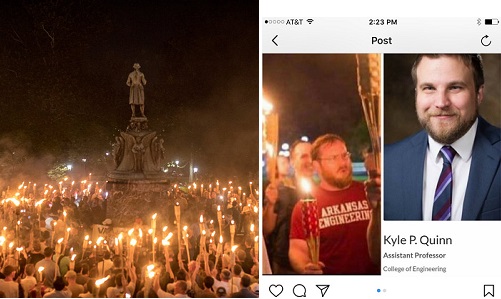
The “amateur sleuths” also are not always correct (being amateurs, after all) , as well as being self-righteous, vicious, and opponents of free speech. The Times describes that fate of a professor, Kyle Quinn, who runs a laboratory dedicated to wound-healing research, and who resembled another man caught in a photo marching with the racists. Quinn was attacked on Twitter and Instagram, and social media demanded that he be fired, accused him of racism, and posted his home address online.

Nice.

Be proud, you vicious social justice warriors! Continue reading

More Perspective On Charlottesville, The Left, And The First Amendment

I’ve been spending the day pointing out the bias and hypocrisy of various Facebook friends who posted emotional, warped, virtue-signaling junk assuming they would be greeted with the sounds of a thousand well-trained seals clapping. I’m not sure why I bother: it gets close to the cartoon about the guy who tells his wife, “Someone is wrong on the internet!” I feel like the alternative is to  just let a brain virus run amuck. These once intelligent people just know the President is secretly a white supremacist. He’s obligated to specifically condemn the white nationalist group, because they were “emboldened” by his election. And, they say, their “side’s” violence is “less disgusting” than the violence of the bad people….because, though they don’t say this, the ends justify the means.

I think the reason I subject myself to the sneers and abuse—did you know I must be a Donald Trump supporter and a white nationalist?—is that the Left’s assault on free speech, which is the cornerstone of democracy,  has to be opposed, called out and condemned every single time, until they either embrace the Constitution, move to Canada, or haul us off to re-education camps. White supremacists aren’t a danger to the nation, because that kind of prejudice is antithetical to core American values, and no credible, respectable institutions and individuals support them, or ever will. Fascism of the Left is a real danger, because it is seductive and misleading, and it is infecting the most powerful and influential institutions we have. We saw it in Charlottesville. In a college town indoctrinated in the progressive cant that the wrong opinions don’t deserve to be heard because they constitute harm and violence by spoken word, the state and local government  combined to use violence to stifle political speech.

One of the best and most objective political, government and ethics websites around is City Journal; I really should cite it more often. Today Bob McManus posted an excellent essay which began with this… Continue reading

Morning Ethics Warm-Up, Charlottesville Aftermath Edition: 8/14/2017

Charlottesville, Virginia.

Good Morning?

1. Just a side note before the serious stuff: WordPress spell-check thinks “Charlottesville” is misspelled. It says the correct spelling is “Chancellorsville.”

And you wonder why I have so many typos…

2. Either one believes in, supports and will fight for freedom of speech, expression and assembly, or one does not. Those who do not also do not genuinely believe in democracy, the Constitution, civil rights or the core principles of the United States of America. This group, which has been slowly—not so slowly, really—taking over the progressive movement and the Democratic Party, and with them that party’s institutional allies, the U.S. education system and journalism, is far, far more dangerous than the alt-right, racist fools who tried to exercise their own rights over the weekend.

At the center of the implicit rejection of the freedom to say, express, demonstrate for and hold whatever wise, creative, idiotic or hateful opinions and ideas a U.S. citizen chooses were the despicable and anti-American comments of Virginia Governor Terry McAuliffe, ( WordPress thinks I should spell his name “Cauliflower”) who told a group of U.S. citizens that they were not welcome in his state, and that there was no place for them in the United States of America—you know, like the German Nazis told the Jews. Pathetically and dispiritingly, knee-jerk defenders of McAuliffe have spun this as mere “opprobrium,” a deflection that we technically refer to as “baloney.” When the leader of a government points to any group and says, “Get out!” based solely on what the group says and believes, that’s totalitarian oppression. It also paints a bullseye on the backs of every member of that group. Continue reading

Morning Ethics Warm-Up: 8/13/2017

1. Is the concept that people and groups who have ugly or even essentially un-American beliefs and positions still ave the right to express them, advocate them, and do so without being attacked, and once attacked, have the right to defend themselves like any other citizen really so hard to grasp? Is it also controversial after all these years? Based on the echo-chamber garbage I’m reading on Facebook and on blogs like The Huffington Post, it would appear so.

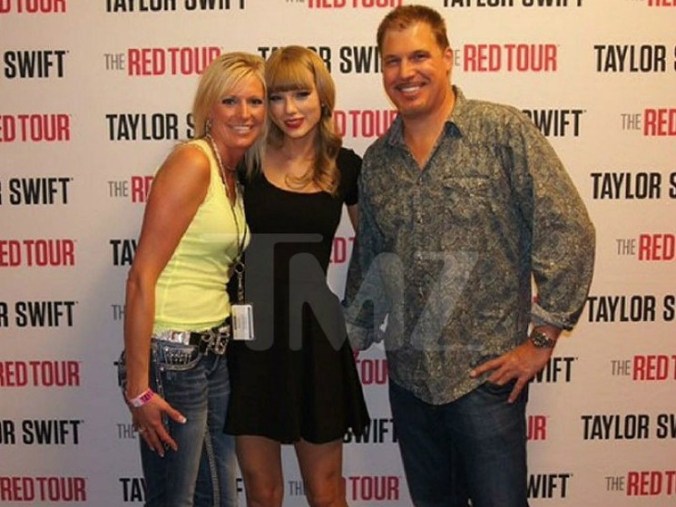
2. I haven’t been following the Taylor Swift groping lawsuit, have you? I’m not sure it justifies following, though it does follow the path of campus sexual assault accusations. To summarize for those of you with higher priorities, pop superstar Taylor Swift was in the midst of a 2013 tour when  she hosted a meet-and-greet for fans in Denver. David Mueller, then a DJ for the radio station KYGO, came to the event and posed for a photo with Swift and his girlfriend. Here is the resulting photo, courtesy of gossip site TMZ:

Swift said that Mueller reached under her skirt and molested her from behind. Her security team ejected the DJ and complained toMueller’s employer, KYGO, which fired him.. In 2015,  Mueller filed a defamation suit against Swift,  denying that he touched her intimately and demanding millions in damages for his lost job and sullied reputation. She has counter sued for a single dollar.

As with many sexual assault cases tried in a civil setting or by a university kangaroo court, this lawsuit will come down to who the jury believes, and the photo, which is the only evidence. (Mueller says that he recorded a two-hour phone call with KYGO the day after he learned of  Swift’s complaint, and had a copy of the audio file on his laptop and on an external hard drive, and his cell phone too, but he spilled coffee on and then lost the laptop, while the external hard drive inexplicably stopped working. Then he threw out the cell phone.  ( Sure. ) In its article about the case, Vox says,

“America has long had an unspoken understanding that famous women have no real right to bodily autonomy. Women in general aren’t understood to have much right to bodily autonomy in America: hence rape culture, hence comments about rape like, “if a man walked around with a suit made of $100 bills, he’d expect to be robbed, wouldn’t he?” that make women’s bodies analogous to money. But because fame already comes with diminished expectations of privacy, celebrity women are considered to be especially fair game.”

Fake history. I was certainly not taught this, nor did I “understand it” to be true. There are, and have always been, pig assholes who think like Vox describes, but they have been regarded as assholes for decades. This is feminist bigotry at work, stated as fact. As a civilized male who was raised to respect women and their bodily autonomy, I find the trope that all men, especially those on college campuses, are nascent rapists political propaganda of the most despicable kind, and not worthy of the seriousness accorded it by female Democratic Senators, publications like Vox, Obama’s Education Department and feminists.

My reading of the case is that Swift made the unfortunate but understandable choice of continuing to pose for the picture while this creep was fondling her butt, but that Mueller will have a difficult time proving defamation—the burden is on him, not her—and is likely to lose, not in small part because Swift, a trained PR whiz, was a spectacularly effective witness. ( Question from the plaintiff’s counsel: Why did your skirt look undisturbed in the photo if my client had his hand under it as you claim?  Swift: “Because my ass is located in the back of my body.” Continue reading

Morning Ethics Update: 8/10/17

Good Morning!

1. Less than two weeks after social justice bullies on social media chastised actor Mandy Patinkin for agreeing to take the place of a black actor in Broadway’s “Natasha, Pierre & The Great Comet of 1812,”  causing the politically impeccable Mandy to withdraw with humble mea culpas, and the “woke” creator of the  the Tony winning musical to humbly kowtow to the new show business principle that it is better for a show to close entirely, putting everyone out of work, than for a white actor to take over a role from a black actor who took over the role from a white actor in the first place, “The Great Comet’s” producers announced that the show will close in September.

Good job, everybody!

Morons.

2. First Amendment incursions are creeping in from all sides and all angles so fast it’s hard to slap them down. Cowboy Joe West, the major leagues’ longest-serving umpire,was just suspended for three days for comments he made a in an interview with USA Today published on June 20, to mark   the umpire’s 5,000th regular-season game. Asked which player beefed most frequently about his calls, West said “it’s got to be Adrian Beltre.” Beltre, who recently punched his own ticket into the Hall of Fame by getting his 3000th hit, is apparently something of a human Bermuda Triangle for ethics controversies.

“Every pitch you call that’s a strike, he says, ‘Whoa! Whoa! Whoa!,'” West was quoted as saying.  “I had a game with him recently and the pitch was right down the middle. He tells me, ”That ball is outside.’ I told him, ‘You may be a great ballplayer, but you’re the worst umpire in the league. You stink.'”

MLB suspended West for three days, telling the umpires union in a letter that the discipline was in response to an “appearance of lack of impartiality.” Beltre has said that he never assumed West was being anything but facetious. The umpires union is livid, and West is likely to file a grievance.

There are two theories about this strange episode in the Marshall household. I think it’s more evidence of slippage on the societal slope to speech suppression. My wife thinks baseball is laying the groundwork for replacing umpires on balls and strikes with robo-calls. After all, robots aren’t biased.

I hope she’s right, but I doubt it.

3. Why don’t Democrats want to clean up eligible voter rolls?the Justice Department filed a Supreme Court amicus brief  supporting the state of Ohio as it fights to defend its law that purges names from voter rolls if  those names aren’t attached to votes for a significant period. This reverses the Obama Administration’s position, which backed a lower court decision  that it ran afoul of the 1993 National Voter Registration Act.

Why does Ohio want to de-register voters who don’t vote for two years, then are sent notices asking that they confirm their voter registration, don’t respond to the notices ,and continue to not vote for another four years? I assume it is because the state doesn’t want dead people on the voter rolls. Why do Democrats want the names of dead people listed as eligible voters?

I’ll leave that to your imagination… Continue reading

Ethics Quiz: “13 Reasons Why”

“13 Reasons Why” is a Netflix  television series based on the 2007 novel “Thirteen Reasons Why” by Jay Asher. A high school student receives a box containing 13 cassette tapes recorded by his friend Hannah Baker, before she committed  suicide. The show has been a critical and popular success (although the Times didn’t like it much) , and a second season is planned.

But Researcher John Ayers of San Diego State University has studied the results of the show on the culture by monitoring discussions of suicide on the internet following the debut of “13 Reasons Why.” The phrases “how to commit suicide” and “commit suicide”  have experienced a 26% and 18% increase in searches. Ayers sees no other explanation for this other than the show.  Searches for the phrase “suicide hotline number” also jumped, by 21%

Ayers now says, “Our worst fears were confirmed That is, thousands of people, thousands more, are searching online about ways to kill themselves.”

Ayers wants the first season to be re-edited to discourage suicidal behavior, and argues that the second season should be postponed. “Psychiatrists have expressed grave concerns because the show ignores the World Health Organization’s validated media guidelines for preventing suicide. The show’s staff instead continue to prefer their gut instincts,” Ayers says.

Your Ethics Alarms Ethics Quiz of the Day is this head-scratcher…

Is it ethical for Netflix to continue running the series in light of Ayers’ research and recommendations?

Continue reading