Res Ipsa Loquitur! The News Media’s Anti-Trump Bias Expressed As Naked Censorship

first version

“Nah, the news media isn’t biased! It’s just right wing Faux News lovers who say that! The news media OTHER than Fox is fair and objective!”

I get these protests all the time, and I am considering being more direct and unpleasant in my responses when I do. For this statement is either proof of ignorance, stupidity, or dishonesty. There is no fourth option, and the recent example I will now describe shows why.

Earlier this week, a woman noticed a four-month-old girl in a locked car in a New Jersey Kohl’s parking lot . She screamed, alerting passer-by Steve Eckel, the New York Daily News reported.  Eckel called 911 but didn’t wait: he used a sledgehammer to break a window in the car, rescuing the cooking child.

During an HLN interview on cable TV,  the retired New Jersey police officer wore a T-shirt with the legend, “2016 Trump for President.” Yet when the CNN headline news channel ran the interview an hour later, the message was blurred out.

Would a pro-Hillary Clinton, pro-Obama, Black Lives Matter, Planned Parenthood, anti-gun or virtually any other non-obscene message or image be so censored? Never. My assumption, if I saw such a blur, would be that the T-shirt was wildly offensive in some undeniable way, making that blur a slur on Eckel’s character.  (A pro-Trump T-shirt doesn’t exactly speak well of him either, but that’s irrelevant.) Continue reading →
Pundit Malpractice: NBC Sports Defends Colin Kaepernick By Misrepresenting Jackie Robinson

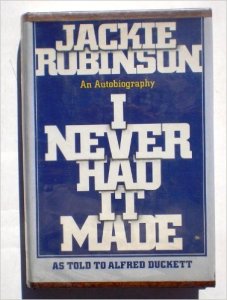
What does Jackie Robinson's autobiography have to do with Colin Kaepernick, you ask? Well...nothing at all, really.

What does Jackie Robinson’s autobiography have to do with Colin Kaepernick, you ask? Well…nothing at all, really.

It also represents a rationalization for unethical conduct that is not currently represented on the Ethics Alarms Rationalization List.

Someone sent Craig this quote, from Jackie Robinson’s  autobiography,  as baseball’s color-line breaker thought back to the first game of the 1947 World Series:

“There I was, the black grandson of a slave, the son of a black sharecropper, part of a historic occasion, a symbolic hero to my people. The air was sparkling. The sunlight was warm. The band struck up the national anthem. The flag billowed in the wind. It should have been a glorious moment for me as the stirring words of the national anthem poured from the stands. Perhaps, it was, but then again, perhaps, the anthem could be called the theme song for a drama called The Noble Experiment. Today, as I look back on that opening game of my first world series, I must tell you that it was Mr. Rickey’s drama and that I was only a principal actor. As I write this twenty years later, I cannot stand and sing the anthem. I cannot salute the flag; I know that I am a black man in a white world. In 1972, in 1947, at my birth in 1919, I know that I never had it made.”

This naturally made Craig, whose mind sometimes cannot help itself from shifting into progressive cant autopilot, think about Colin Kaepernick’s incoherent grandsitting as he refuses to stand on the field with his team for the National Anthem. He wrote,

“Colin Kaepernick is not Jackie Robinson and America in 2016 is not the same as America in 1919, 1947 or 1972. But it does not take one of Jackie Robinson’s stature or experience to see and take issue with injustice and inequality which manifestly still exists…the First Amendment gives us just as much right to criticize Kaepernick as it gives him a right to protest in the manner in which he chooses. But if and when we do, we should not consider his case in a vacuum or criticize him as some singular or radical actor. Because some other people — people who have been elevated to a level which has largely immunized them from criticism — felt and feel the same way he does. It’s worth asking yourself, if you take issue, whether you take issue with the message or the messenger and why. Such inquiries might complicate one’s feelings on the matter, but they’re quite illuminative as well.”

Let’s begin with the fact that there is nothing similar about Jackie Robinson and the 49ers quarterback, except their race and the broad occupation of “sports” that they shared. Continue reading →

Health And Survival Rationing Ethics

cointoss

Beginning in 2012, Dr. Lee Daugherty Biddison, a critical care physician at Johns Hopkins and some colleagues have held public forums around Maryland to solicit the public’s opinions about how life-saving medical assistance should be distributed when there are too many desperately ill patients and not enough resources. The exercise was part of the preparation  for Biddenson’s participation in preparing official recommendations for state agencies that  might end up  as national guidelines regarding when doctors should remove one patient from a ventilator to save another who might have a better chance of surviving, or whether the young should have priority over the old.

Ethically, this is pure ends justifying the means stuff. The Golden Rule is useless—How would you like to be treated? I’d want to be left on the ventilator, of course!–and Kantian ethics break down, since Immanuel forbade using human life to achieve even the best objectives…like saving a human life. Such trade-offs of life for life (or lives) is the realm of utilitarianism, and an especially brutal variety….so brutal that I doubt that it is ethics at all.

When Dr. Biddenson justifies his public forums by saying that he wants to include current societal values in his life-for-a-life calculations, she is really seeking current biases, because that’s all they are. On the Titanic, it was women and children first, not because it made societal sense to allow some of the most productive and vibrant minds alive to drown simply because they had a Y chromosome, but because that’s just the way it was. Old women and sick children got on lifeboats;  young men, like emerging mystery writer Jacque Futrelle (and brilliant young artist Leonardo DiCaprio), went down with the ship. That’s not utilitarianism. That’s sentimentalism.

The New York Times article mostly demonstrates that human beings are incapable of making ethical guidelines, because Kant was right: when you start trading one life for another, it’s inherently unethical, even if you have no choice but to do it. Does it make societal sense to take away Stephen Hawking’s ventilator to help a drug-addicted, habitual criminal survive? Well, should violating drug laws sentence a kid to death? TILT! There are no ethical answers, just biased decisions. Continue reading →

From The Ethics Alarms Mail Bag: “Does It Matter If A Lawyer Is A Neo-Nazi?”

"Anyone who would hire this lawyer is evil! EVIL!!!"

“Anyone who would hire this lawyer is evil! EVIL!!!”

“…What if he’s hired for a government job?”

This is a great question, and I’m going to bedevil the lawyers in my upcoming ethics seminars with it. It’s not a hard question, though.

The answer is, “No, it doesn’t matter, just as it doesn’t matter if the lawyer is a Republican, a vegan, a libertarian, a creationist, a global warming denier, an Adam Sandler fan, a Donald Trump loyalist, a Muslim, an ISIS sympathizer, a Druid, a Celine Dion worshiper, a New York Yankee fan or anything else. Lawyers have First Amendment rights. Lawyers can think what they want to, believe what they want to, donate where they want to and spout whatever unpopular or offensive opinions they want to, as long as it doesn’t interfere with their representation of their clients.

What prompted the question was this post on the Southern Poverty Law Center (SPLC) website, which attempts to use guilt by association and classic McCarthyism tactics to smear the City of Baltimore because of what the lawyer defending it in a law suit believes. The SPLC—which itself often resembles a hate group–writes, Continue reading →

Was It Ethical For Donald Trump’s Former Lawyer To Trash Him In The Huffington Post?

Backstabbed

That’s an easy question.

The answer is maybe, and no.

A couple of weeks ago, a real estate lawyer named Thomas M. Wells provoked a lively debate in the legal ethics community when he authored a Huffington Post piece titled “Donald Trump Hired Me As An Attorney. Please Don’t Support Him For President.” I’m proud to say that I flagged the issue for my colleagues first, in part because they unanimously detest Trump, even the tiny minority who aren’t full-blooded Democrats or progressives, and may have been blinded by that bias.

For me, the issue was crystallized by the headline. Wells’ headline (it doesn’t matter if it was really his or the site’s: as a lawyer, he is obligated to make sure that his article doesn’t breach legal ethics rules and principles, and the headline is part of his article) suggested that he had some special knowledge and authority regarding Trump because of what he had learned while representing him decades ago. The ethics rules prohibit lawyers from revealing client confidences, which are usually defined as what a lawyer learns about a client during the course of a representation that the client would not obviously want revealed to the world. Confidences can be revealed by actions, as well as words, and the headline comes very, very close to saying “I know things you don’t about Donald Trump because of what learned when I was his trusted lawyer.” What follows from that may be  a reader’s conclusion that the post reflects secret information. Thus the headline made my legal ethics alarms sound.

Wells has the same right as you or I to register a public opinion about his former (or current, for that matter ) client, as long as the opinion doesn’t interfere with his representation. Lawyers do not give up free speech right by being lawyers. That’s where the “maybe” comes from. There is strong disagreement in the profession about whether the answer to “Is this unethical?” should be an outright yes. The status of loyalty among the legal ethics values hierarchy is as hotly contested now as it ever has been. If a lawyer wants to attack a former client in a matter unrelated to the representation and no confidences are revealed in the process, is that a legal ethics breach? If it is, it would be a very tough one to prosecute. I think it’s a general ethics breach, as in wrong and unprofessional. It is disloyal, and clients should be able to trust their lawyers not to come back years later, after a client let the lawyer see all of his or her warts, and say, “This guy’s an asshole.” It undermines the strength of the public’s trust in the profession. Continue reading →

Ethics Quiz: Does “Black Olives Matter” Matter?

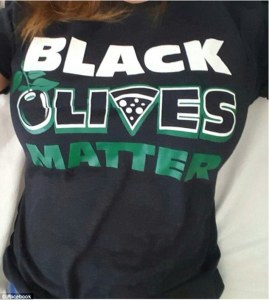
Black Olives matter shirtI almost made this controversy an ethics quiz in July, but decided it was a fleeting jest. Wrong, Ethics-breath! Now the story has heated up again.

Paisano’s, an Italian restaurant  in Albuquerque, New Mexico is selling ‘black olives matter” T- shirts and caps following the uproar over the phrase last month, when the restaurant placed it on a marquee outside the restaurant in July:

Black Lives Matter sign

Then, owner Rick Camuglia said he came up with the play on words to sell a new tuna dish with black olive tapenade. When Camuglia posted pictures of the dish and the sign on Facebook, he drew angry complaints that he was being insensitive and “trivializing a movement aimed at trying to stop police shootings of black residents.”

Even if they are resisting lawful arrest, threatening the officer or holding a gun. But I digress…

Camuglia protested that he was only trying to sell food. Now, after receiving unexpected support, even internationally, and with business booming, the entrepreneur has reacted to requests for souvenirs from the restaurant with his new product line.

Your Ethics Alarms Ethics Quiz of the Day: 

Are the slogan, T-shirts and hats inherently disrespectful and divisive at a racially troubled time, and thus socially irresponsible, or is it a harmless play on words?

Continue reading →

Wow: A Whole Unethical TOWN!

Upsidedownflag1

In Somers, Iowa, Homer Martz  flew his  U.S. flag upside down  to protest the future placement of an oil pipeline near his home.  He has been charged with desecrating Old Glory under Iowa code 718A , which makes it a misdemeanor punishable by up to 30 days in jail  to “publicly mutilate, deface, defile or defy, trample upon, cast contempt upon, satirize, deride or burlesque, either by words or act, such flag, standard, color, ensign, shield, or other insignia of the United States, or flag, ensign, great seal, or other insignia of this state…”

The law, however, is unconstitutional. So said an  Iowa Federal District Court judge in 2004, when he ruled Iowa’s flag desecration laws violated the First Amendment. Martz, a U.S. Army veteran, has told anyone who will listen that the Supreme Court has ruled citizens can burn the American flag, so presumably flying it Bizarro World-style is also okay. He’s right, too. In 1989, the Supreme Court ruled in Texas v. Johnson, 491 U.S. 397 (1989), that prohibitions on desecrating the American flag were unconstitutional.. It reaffirmed the holding in  1990.

Writes an exasperated Jonathan Turley, a Constitutional law expert,  “The town of Somers appears to lack a single lawyer — or a telephone number for a single lawyer — to explain free speech protections to them.”

Is it too much to expect a municipality to absorb a First Amendment right that was settled almost a quarter century ago, and not persecute a veteran for exercising the rights he served to protect and preserve?

Apparently. They could google flag burning and learn that this law is void. Such incompetence in government, at any level, is unconscionable.

Observations On The University Of Houston’s Anti-Free Speech Oppression

zipper on mouth

Prelude

I gave an ethics training session for a local non-profit yesterday. At the end of the two hours, a staffer who was pursuing U.S. citizenship was obviously stimulated by the various issues and principles we had discussed and had many provocative questions, which he struggled to articulate in his second language, for he was Sorth Korean. “Why is it right for me to pay taxes to assist illegal immigrants?” he asked. “In Sorth Korea, they say we are decades behind the US is democracy, but Korean laws are enforced no matter who the law-breaker is. I see that law-breakers in the US who are rich and powerful or famous get special dispensations from the law. Doesn’t that mean that Korea is ahead of the U.S., at least in that respect?” (Gee, I wonder who he was referring to…)

He had insightful observations, as recent immigrants to the U.S. so often do. Finally he said, “Do you agree that political correctness is a great threat to liberty and democracy?”

Yes. Yes I do. I thought so the first time I heard the term “politically correct” in the Seventies, and was so certain that the concept’s loathsomeness (and the parallel loathsomeness of its advocates, frankly), ensured that it would be a short-lived phenomenon.

Which shows how smart I am…

***

Shortly after the July 7 massacre of  five police officers in Dallas, Rohini Sethi, the vice-president of the University of Houston’s Student Government Association, posted this on Facebook:

BLM tweet

The student governing body suspended her from her office and the group.

From the Houston Chronicle…

Student body vice president Rohini Sethi has been suspended by the SGA and is temporarily barred from participating in group activities. She is also due to attend a “diversity” workshop per the ruling….The University of Houston issued a statement this week that said the move is not a university action and doesn’t impact Sethi’s academic standing. “The University of Houston continues to stand firm in support of free speech and does not discipline students for exercising their constitutional rights,” the statement said.

The action came after minority student groups on campus condemned her statement as racist or “insensitive,”and demanded her removal. The accommodating president of the SGA complied. For her part, Sethi apologized and agreed to take a three-day cultural sensitivity workshop, though she wrote several Facebook posts defending her actions. Ultimately she was brought to heel, made a public statement along with the SGA head, and like a brain-washed prisoner of war, grovelled..

“I have chosen to take these steps on my own because of the division I’ve created among our student body. I may have the right to post what I did, but I still should not have. My words at the time didn’t accurately convey my feeling and cause many students to lose their faith in me to advocate for them. I will always continue to learn and be ready to discuss these issues.”

Observations: Continue reading →

Wait, I’m Confused: I Thought Racial Segregation Was BAD….

segregation

Two of these stories in one week—something’s  happening here. What it is ain’t exactly clear, however.

I’m sorry, I start channeling old Sixties songs at times like this.

Not one but two colleges have advocated segregation in their policies this week:

  • Hampshire College explains on its website that it allows students to reside in “identity-based” housing communities, provided they have a “unique social identity” that has “historically experienced oppression,” arguing that such residences “give support to members of our community with social identities that have been historically marginalized in this country, and strive to counter systemic oppression.” The Massachusetts school’s confident  promotion of such living arrangements “arises from our commitment to fostering diverse, socially just, and inclusive communities.” An  informational booklet explains that “identity-based housing is an institutional structure designed to assist members of historically oppressed groups in supporting each other,” and “helps to create an added level of psychological comfort and safety for those who choose to live in those spaces, often providing the foundation for those students to be able to engage fully in the greater community.”

Translation: Black students don’t want to live with whites, but prefer “their own kind,” because whites are viewed as potentially dangerous. And that’s okay! Continue reading →

No, There Is Nothing Unethical Or Hypocritical About A Feminist Lawyer Defending Roger Ailes

"A feminist lawyer like Estrich taking on the same clients men do? That's outr...wait, what side am I on again?"

“A feminist lawyer like Estrich taking on the same clients men do? That’s outr…wait, what side am I on again?”

Fired Fox News creator Roger Aisle hired renowned feminist lawyer and teacher Susan Estrich to defend him against the sexual harassment law suit filed by former Fox Blonde Gretchen Carlson. Responding to shock and disappointment among some feminists and others that Estrich would “abandon her principles” to defend such a client, Slate’s feminism reporter Nora Caplan-Bricker authored a post titled “The One Good Reason for a Trailblazing Feminist Lawyer to Defend Roger Ailes.”

This is in the category of a supposedly enlightening post that actually makes readers less informed. There only needs to be one Reason for a Trailblazing Feminist Lawyer to Defend Roger Ailes, and it is a great reason. Susan Estrich is  a lawyer; lawyers defend people who are sued; lawyers do not have to agree with, support or approve of  a client’s alleged actions requiring such a defense; and there’s is no reason in legal ethics or any other ethical system that argues that a U.S. citizen shouldn’t have access to the best representation possible.

For her part, Estrich has said that she is taking the case because “The individual gets convicted long before he or she has had an opportunity to defend himself. And that’s not fair, whether it is happening to a woman or a man.” That’s the civil law equivalent of the late Johnnie Cochran defending his accepting O.J. as a client by saying, “In this country, everyone has the right to be treated as innocent until found guilty by a jury of his peers.”

Partial translation of both statements: “I’m a lawyer, and I don’t judge my clients. That’s not my job. My job is to help them use the law and legal system for their own purposes and protection, like any other citizen.”

I’ve written about this aspect of lawyers’ vital function in society, one that non-lawyers just cannot seem to grasp, so many times. Here’s a recent post; but maybe this one from 2015 is more on point. That one was about progressive legal icon and Harvard law prof Larry Tribe representing Peabody Energy, the world’s largest private-sector coal company, in a lawsuit that sought to invalidate some EPA regulations adverse to their horrible, evil, earth-destroying–but legal!–business. Tribe was called a traitor to the Cause of turning the U.S. into a wind and solar run nation, and I explained that the attacks on him, like all such attacks, were based on a stubborn lack of comprehension by non-lawyers, writing..

That is what lawyers do, and what they exist to do: represent citizens and companies as they seek to avail themselves of their guaranteed right to use the law to protect their interests. The public and media just don’t get it, and appear to be immune from educating on the subject: what your lawyer personally believes about your cause doesn’t matter. His or her job isn’t to judge you or your purpose. It is to give you the chance to use your rights to due process and the courts to have the law work for you rather than against you, and to have your position, if legal, serious and offered sincerely, represented by the best legal talent available.  Whether or not Tribe personally believes or supports the position being taken by his client is irrelevant to his role, unless he is so unprofessional (as in emotional and unable to overcome his own biases) that he can’t represent a client whose objectives he opposes. Then he would be obligated to refuse the representation. Then he would also be a poor lawyer, and Lawrence Tribe is anything but.

Replace “Larry Tribe” in that paragraph with “Susan Estrich”, and save me some time.

Thanks! Continue reading →