Ethics Quiz: “Advertising” Safe Zones

illegal crossing sign

Interesting.

The U.S. Customs and Border Protection (CBP) includes information on its website about “Sensitive Locations,” which is CBP-speak for “Places where we won’t arrest you if you are an illegal immigrant.”  In careful, oh-so-delicate and respectful language, the agency explains that immigration laws are not to be enforced at  designated “sensitive locations”  so that illegal aliens can be “free” to live their lives “without fear or hesitation.”

It reads in part…

“The policies provide that enforcement actions at or focused on sensitive locations such as schools, places of worship, and hospitals should generally be avoided, and that such actions may only take place when (a) prior approval is obtained from an appropriate supervisory official, or (b) there are exigent circumstances necessitating immediate action without supervisor approval.  The policies are meant to ensure that ICE and CBP officers and agents exercise sound judgment when enforcing federal law at or focused on sensitive locations, to enhance the public understanding and trust, and to ensure that people seeking to participate in activities or utilize services provided at any sensitive location are free to do so, without fear or hesitation.”

“This policy is designed to ensure that these enforcement actions do not occur at nor are focused on sensitive locations such as schools and churches” without meeting special exceptions, the  ICE Sensitive Locations Policy states.

Locations covered by  Sensitive Locations Policy  include, but are not limited to:

  • Schools, such as known and licensed daycares, pre-schools and other early learning programs; primary schools; secondary schools; post-secondary schools up to and including colleges and universities; as well as scholastic or education-related activities or events, and school bus stops that are marked and/or known to the officer, during periods when school children are present at the stop;
  • Medical treatment and health care facilities, such as hospitals, doctors’ offices, accredited health clinics, and emergent or urgent care facilities;
  • Places of worship, such as churches, synagogues, mosques, and temples;
  • Religious or civil ceremonies or observances, such as funerals and weddings; and
  • During public demonstration, such as a march, rally, or parade.

“The enforcement actions covered by this policy are (1) arrests; (2) interviews; (3) searches; and (4) for the purposes of immigration enforcement only, surveillance,” the ICE  further explains.

The CBP  “FAQ” answers are accompanied by a Spanish translation, and the CBP website  provides a toll-free number and email address so aggrieved illegal aliens can report immigration that violate these policies.

As I said…

Interesting.

Your Ethics Alarms Ethics Quiz of the Day is…

Is this a responsible, competent and ethical exercise of government power?

Continue reading →

Four Supreme Court Decisions: Abortion, Guns, Affirmative Action, Corruption…And Ethics. Part 4: Voisine v. United States

"Aw, come on, that was a love tap! Now put some ice on that while I go out and buy a Glock...."

“Aw, come on, that was a love tap! Now put some ice on that while I go out and buy a Glock….”

Be honest, now: you thought I’d never finish this series, did you? (Part 1 was posted June 28.)

In Voisine v. United States, a 6-2 U.S. Supreme Court holding issued on June 27 approved extending a federal statute banning firearms possession by anyone convicted of a “misdemeanor crime of domestic violence” to include individuals who have “misdemeanor assault convictions for reckless (as contrasted to knowing or intentional) conduct.”

Justice Elena Kagan, writing for the majority, said that “the federal ban on firearms possession applies to any person with a prior misdemeanor conviction for the ‘use…of physical force’ against a domestic relation. That language, naturally read, encompasses acts of force undertaken recklessly—i.e., with conscious disregard of a substantial risk of harm.”

The opinion isn’t remarkable, nor is it a significant attack on gun rights. The case is really about language, as so many Supreme Court cases are. From the opinion:

“Congress’s definition of a “misdemeanor crime of violence” contains no exclusion for convictions based on reckless behavior. A person who assaults another recklessly “use[s]” force, no less than one who carries out that same action knowingly or intentionally. The relevant text thus supports prohibiting petitioners, and others with similar criminal records, from possessing firearms.”

The real question, from an ethical standpoint, is whether Congress can and should remove a citizen’s Second Amendment right based on a misdemeanor conviction for domestic abuse. Is that fair? Sure it is. It is already settled law that it is Constitutional to prevent convicted felons from owning  guns, even if it was a non-violent felony. From an ethical public policy standpoint, why would it be overly restrictive to ban gun ownership from those who engage in a violent misdemeanor?

Writing in dissent, Justice Clarence Thomas, joined by Justice Sonia Sotomayor (of all people), rejected the majority’s “overly broad conception of a use of force.” In the view of the two dissenters, “the majority blurs the distinction between recklessness and intentional wrongdoing” and thereby does a grave injustice to criminal defendants. Continue reading →

Leading Candidate For Most Unethical Opinion Column Of 2016: Daily Beast Editor Goldie Taylor

Ox-Bow-still-3

How a major U.S. news and public affairs website can produce an article like Daily Beast Editor-At-Large Goldie Taylor’s is a fertile subject for inquiry, as is the question of how much the ignorant, un-American, values-warping assertions it contains are reinforced throughout our rising generations’ education and socialization. Those investigations must wait for another day, when I have the stomach for it.

For now, let’s just consider what Taylor wrote. It is titled “Six Baltimore Cops Killed Freddie Gray. The System Set Them Free,” an unethical headline that kindly warns us regarding the awfulness to come. No, six Baltimore cops did not kill Freddie Gray, as far as we, or the system, knows based on the evidence. That Taylor would state such an unproven and unprovable statement as fact immediately makes her guilty of disinformation, and shows that she is willfully ignorant of the principles of American justice, as well as too hateful and biased to comprehend them. Damn right the system set them free. That’s because in the Freddie Gray cases the system worked spectacularly well, despite the best efforts of an incompetent and biased prosecutor to make it do otherwise.

And that was just the title. The rest is infinitely worse: if you are feeling sturdy, read it all here. If not, the selected highlights (lowlights?) to follow will suffice.

Taylor wrote early on, Continue reading →

The Democratic National Convention Presents The Most Unethical Use Of Mothers Yet

Mothers

The Republicans exploiting the grief of Patricia Smith, the mother of a young man slain in the 2012 Benghazi attack, by putting her on the party’s convention program was irresponsible and ethically revolting, especially from a party that (correctly) labelled Cindy Sheehan a grief-addled nuisance when she was protesting the Iraq War. Smith’s emotional rant against Hillary Clinton was pure grief porn, and expanded the sensationalist  trend in the news media (and legislative hearings) to use the most conflicted and biased figures imaginable—the loved ones of victims of tragedy—to frame a controversial issue in complex events.

Naturally, the Democratic Party’s allies in the media returned the hypocrisy many-fold. Maureen Dowd of the Times, who had pronounced Sheehan as someone with “absolute moral authority”—because having one’s son killed instantly makes you an authority on foreign affairs, at least when a Republican President is in office—was silent about Smith’s moral authority as she was attacked by critics, including the Washington Post, Chris Matthews, and a GQ writer who wrote that he wanted to “beat her to death.”

Foolishly, I took these attacks as  a hopeful sign that the Democrats and progressives were maturing ethically, and had rendered the proper ethics judgment that by prioritizing emotion over reason, it was unfair, misleading, exploitive and irresponsible to use grieving mothers this way. No, it wasn’t hypocrisy. It was ethical growth. Democrats, unlike Republicans, now knew this was a cheap and tawdry tactic, and they would no longer stoop so low.

Boy, am I gullible.

It was hypocrisy, and the Democrats wouldn’t stoop as low as Republicans, they would stoop much, much, much lower.

Among those who appeared on the Hillary Clinton coronation stage last night were members of Mothers of the Movement, an offshoot of Black Lives Matter. Though the message spoken by these women appeared to be about police brutality, unjustly killed black men and the need to ban guns, their commonality was only this: all of them were mothers of African Americans who died violently, and all of them blame whites, police, guns, the justice system or the United States of America, regardless of evidence, the findings of juries, and investigations. That is a fair description.

Let’s look at the women who appeared on stage: Continue reading →

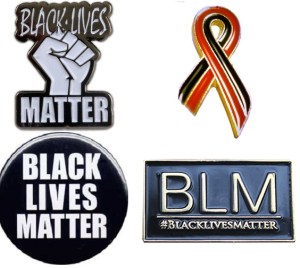
Wearing Black Lives Matter Pins In The Courtroom Matters To This Judge

Q: Which of these can a judge ban from a courtroom? A: All of them.

Q: Which of these can a judge ban from a courtroom? A: All of them.

Youngstown (Ohio) Municipal Court Judge Robert Milich ordered NAACP attorney Andrea Burton to remove the Black Lives Matters pin she was wearing. The attorney refused, and was declared in contempt of court.

Good.

She was.

Judge Milich  sentenced the grandstanding lawyer to five days in jail, though the sentence has been stayed while she appeals the decision, as   as long as she obeys Milich’s order not to wear items that make a political statement in court. When she loses her appeal, and she will, she will have to serve the five days in jail.

Milich is on firm ethical and constitutional ground, not that this episode won’t subject him to being called a racist. It is well-established that judges can ban political expressions in the courtroom, and in 1998, the Supreme Court let stand the rulings of a federal district court and the 1st Circuit Court of Appeals, in Berner v. Delahanty, that a the judge’s prohibition of political buttons was a reasonable method of “maintaining proper order and decorum” in a courtroom. In that case, the judge prohibited lawyer Seth Berner from wearing  a button saying “No on 1—Maine Won’t Discriminate,” a declaration against an upcoming state referendum.

As long as a judge doesn’t allow one form of political advocacy while banning others, there is no free speech issue. Judges have gotten themselves involved in controversy when they have allowed buttons, as in the 2006 Supreme Court case of Carey v Musladin, in which Court ruled  unanimously that murder trial spectators were free to wear buttons with a picture of the victim in front of the jury that convicted the defendant. The justices agreed with California prosecutors who said the buttons were a harmless expression of grief by family members at Mathew Musladin’s trial.

I really don’t like that decision. A wise judge will avoid the issue by prohibiting any advocacy in court of of any political, social or case-related opinion. Continue reading →

DNC Progressives Jump The Shark

Pop Quiz: Name all the ways this photo is appropriate to the post...

Pop Quiz: Name all the ways this photo is appropriate to the post…

[A “Happy Days” reference seems felicitous, since last week saw series creator, writer and frequent director Garry Marshall head off to the Big Malt Shop In The Sky. In addition to having the good taste to be named Marshall, Gary’s myrth-inducing career in TV and movies as a producer, writer, director and actor (Marshall’s turn in “Lost on America” as the incredulous casino boss whom a desperate Albert Brooks tries to persuade to give back the life savings lost by Brooks’ wife in a mad gambling spree might be my favorite comic acting bit of all time) was long and productive, and the culture will miss him greatly. As will I. ]

Attention must be paid to the fact that while the speakers at the Republican National Convention sounded scary (to some), the Democratic National Convention authorities acted scary.

Twenty-one Vermont Democrats have filed an official complaint with the party, protesting that the Democratic leadership ordered  the state party to replace Vermont Sen. Tim Ashe and party member Ken Dean with women, in the name of “gender balance” without adequate due process.

By all means, let’s make sure that gender discrimination in pursuit of the greater good and Progressive Nirvana is done with due process!

I think it’s cute that both political parties are losing their minds at the same time, don’t you? Continue reading →

From An Ethics Dunce Playmate Of The Year, A Full Pazuzu!

dani-mathers post

Dani Mathers is a former Playmate of the Year. On the left below, you see Dani as she appears to unknowing bystanders; on the right, the oil portrait of herself that she keeps in the attic.

Dani+Mathers

Befitting the character and soul accurately portrayed by the portrait, the skin-deep beauty took a cellphone photo of an unaware naked female member of LA Fitness in the gym’s shower. Then Dani posted the pic on Snapchat with the caption, “If I can’t unsee this then you can’t either.”

The actual photo does not have the victim’s body blotted out.

Said LA Fitness of  Dani:”Her behavior is appalling and puts every member’s privacy at risk. We have handled this internally and also notified the police.”

Of course cell phone photography is prohibited in locker rooms. Doing what Mathers did may also be against the law.

Caught with her ugly soul exposed to the world, the model reverted to full Pazuzu mode. Pazuzu was the demon who made poor Linda Blair say all those horrible things in “The Exorcist,” and the Pazuzu Excuse is what Ethics Alarms calls apologies for horrible statements or conduct that include such incredible statements as “Those statements do not express my real beliefs,” “That doesn’t reflect who I am,” and the always popular “That wasn’t me.” Continue reading →

Four Supreme Court Decisions: Abortion, Guns, Affirmative Action, Corruption…And Ethics. Part 3: Whole Woman’s Health v. Hellerstedt

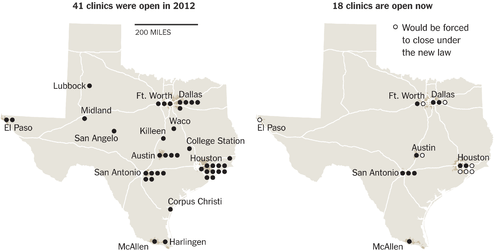
shrinking-number-of-abortion-clinics-in-texas

[The Supreme Court came down with four controversial and ideologically contentious decisions in June, and I apologize for taking almost a month to cover them all. One of the reasons Ethics Alarms occasionally launches a series like this one is to ensure that developing ethics stories of importance do not push important issues to the sidelines. The fact that this four part series had only finished parts 1 and 2 was an irritant to me, as well as some readers.]

In Whole Woman’s Health v. Hellerstedt, decided on June 27, the Supreme Court held in a 5-3 majority that two provisions of a Texas law, one requiring physicians who perform abortions to have admitting privileges at a nearby hospital and another requiring abortion clinics in the state to have facilities comparable to an ambulatory surgical center,  places a substantial and unconstitutional obstacle in the path of women seeking an abortion, because they constituted an undue burden on abortion access.

Life would be so much simpler if our elected officials and activists employed an adaptation of the Golden Rule, and looked objectively at issues from the other side’s point of view. This is especially true in the realm of rights.  Second Amendment absolutists insist that virtually any laws regulating who can purchase guns, when and where they can purchase them, and how and how quickly they can be purchased are efforts to whittle away the right to bear arms. They also argue that such regulations have the ultimate goal of  eliminating that right entirely, which, in many instances is the case, especially if you listen carefully to the rhetoric of the legislators proposing such measures. There is little difference from this and what anti-abortion advocates are attempting to do with laws like House Bill 2 (H. B. 2).

The bill ostensibly is designed to make abortions safer, thus protecting women’s health, just as many gun laws are promoted as safety measures. Oddly, virtually all of the supporters of the Texas bill would make abortion illegal if they could. I’m sure it’s just a coincidence, just as it’s a coincidence that the authors of bills requiring potential gun owners to jump through increasingly burdensome hoops and deal with mandatory trigger locks and “safe gun” technology would gladly repeal the Second Amendment if they could. The ethical principle is the same in both matters: a right isn’t a right if legal obstacles make it difficult to exercise that right.

The question is, what’s a reasonable obstacle? Any regulation imposed on a constitutional right must not create “a substantial obstacle” and must be reasonably related to “a legitimate state interest.” The Supreme Court uses the language and logic of case precedents, which are its previous examinations of these issues and the balancing they require. One such case, though I did not find it mentioned in the majority opinion or dissents in Hellerstedt, would be the voter ID decision of many years ago, in which a strong majority ruled that the state interest in preventing fraudulent voters and maintaining the integrity of the election process justified inconveniencing those who were subjected to the extra burden of obtaining appropriate identification. In recent years, this decision has been questioned because many believe the motive behind voter ID laws is not really to protect the franchise, but to keep likely Democratic voting blocs from the polls.

Is there a difference legally between a bill that is authored with the intent to restrict the right to vote of older, poorer, and darker citizens while claiming that its sole purpose is to make sure non-citizens don’t affect the results of elections, and an identical  bill that is genuinely intended to safeguard the voting rolls, without any political motive at all? No, or at least there shouldn’t be. The Court’s job is to evaluate what the law does, not try to read the minds and hearts of those who wrote it. Justices only should try to do the latter when there is a debate over what the law says.

Ethically, however, there is a significant difference between a law using a public purpose as a sham to accomplish unethical ends, and a law with a legitimate purpose that has some negative side effects. Trying to restrict a citizen’s rights because one doesn’t respect those rights (or perhaps the citizen) is unethical.

The SCOTUS majority, in its typical examination of a balancing case like this, looked at whether there was a sufficient public safety benefit to a law that had resulted in a precipitous reduction in abortion services: Continue reading →

Ethics Quote—But Not Necessarily ETHICAL Quote!—Of The Month: Supreme Court Justice Ruth Bader Ginsburg

i-was-wrong

“On reflection, my recent remarks in response to press inquiries were ill-advised and I regret making them. Judges should avoid commenting on a candidate for public office. In the future I will be more circumspect.”

—- Justice Ruth Bader Ginsberg, officially apologizing for making remarks sharply critical of Donald Trump last week, including suggesting (in jest) that if her were elected President, she might “move to New Zealand.”

Observations:

1. Supreme Court justices almost never apologize, and I only say “almost” because I can’t do enough research right now to safely say “never.” They don’t apologize because the don’t have to: they are, ethically, a law unto themselves, and accountable to nobody unless impeached and convicted. (Justice Samuel Chase, was impeached by the U.S. House of Representatives on March 12, 1804, on charges of arbitrary and oppressive conduct of trials; it was a purely political attack. He was, correctly, acquitted by the U.S. Senate on March 1, 1805.)

2. An apology was appropriate, however. Justice Ginsberg proved herself smarter, better, more ethical and more principled than the embarrassing, crypto-facsist “these are not ordinary times” crowd, including the folks at Salon and other left-wing blogs, this guy, and too many of my dear friends on Facebook, whose expressed opinions really are beginning to make me wonder if they will solemnly send me to a Lobotomy Man when I oppose President Clinton’s declaration of open borders, ban on fossil fuels, race and gender quota in all hiring and admissions to (free) colleges, and confiscation of 50% of my property to help pay for national health care including late-term abortion on demand and tax-payer funded recreational drugs.

3. She apologized because any fool could see that her comments did undermine trust in the institution of the Supreme Court, and that her critics were right. Some of my more misguided colleague in the legal ethics field opined that it was silly to think that Justices don’t have political opinions and biases, just as it is silly to think journalists do not, so why shouldn’t she exercise her First Amendment rights? This  lame notion was decisively rebutted by a lawyer whose name I wish I could reveal, except that his comments were on a private list. He wrote in part… Continue reading →

The Black Lives Matters Effect, Part 2: Purdue’s Free Speech Chill

Perdue letter


So powerful is the desire to be seen as on the “right” side  in an era where race trumps everything that a major university is harassing a student because he dared to be critical of Black Lives Matter. This is another, more sinister aspect of the Black Lives Matter Effect. A racist hate group that claims to promote virtuous objectives as cover, Black Lives Matter causes well-intentioned progressives-in-denial to equate well-earned attacks on the group to rejection of racial justice.

This episode is especially troubling. Purdue University Northwest student Joshua Nash received an ominous letter summoning him to a “required Administrative Meeting” scheduled by a campus administrator to discuss Nash’s personal Facebook comments. This is as appropriate as a letter demanding a student’s appearance before authorities because there was a complaint about his off-color toast at a wedding reception.

Nash says he isn’t certain which Facebook post was deemed worthy of threatened discipline, but it was probably the one where he states “Black Lives Matter is trash because they do not really care about black lives. They simply care about making money and disrupting events for dead people.” According to Nash, that comment was reported to Facebook, with removed it and suspended his account for 30 days. Nash also claims that a campus official said his social media comments could result in his expulsion.

I assume that FIRE will soon be in Nash’s corner, and maybe, just maybe, the ACLU, depending on what its integrity level is these days. This is campus suppression of free speech. I think the threat of expulsion–for a Facebook post?—is too ridiculous to be taken seriously, but the letter is bad enough. All students need to know is that a politically incorrect Facebook post will get them hauled into a “meeting,” a.k.a. inquisition, and their speech, with the exceptions of a few wilful martyrs, civil libertarians, and rebels, will be effectively muzzled. Continue reading →