How Can Schools Teach Students About Citizenship And Rights When They Don’t Know What Rights Students Have?

Sorry about this, Tiffany, but your school definitely can't suspend ME...

Sorry about this, Tiffany, but your school definitely can’t suspend ME…

Today’s example of totalitarian school tactics committed by administrators who should be attending classes rather than overseeing them comes to us from Memphis, Tennessee. Highland Oaks Middle School suspended three students for posting a teacher’s mugshot on Instagram. Eighth grade teacher Tiffany Jackson had been arrested for driving with a suspended license, and a student discovered her mugshot online. He posted it,  and many more students re-posted the picture.

How could students posting public information on their own Instagram accounts be grounds for punishing them?  It isn’t. The school has no right to do this, and suspending students for such protected conduct just serves to intimidate them  and other students from exercising their rights as citizens.

That, of course, is the idea.

I agree that it wasn’t kind or fair of the students to set out to embarrass a teacher, but that’s a matter for discussion—education, perhaps— not discipline.

There has been a disturbing amount of deliberate or ignorant trampling on student speech lately, notably the University of Oklahoma expelling students for a constitutionally-protected racist chant, but also in high schools across the country where personal social media posts have been and are being treated as grounds for discipline. This is not to be tolerated from educational institutions in a democracy. Schools are fond of n0-tolerance: I can’t think of any conduct that should be less tolerated than teachers and administrators trying to control legal conduct and protected speech by students that occur off school grounds. We need to raise citizens who understand and respect individual rights, not burgeoning fascists who think that authority can and should shut down speech and conduct it doesn’t like.

At Highland Oaks Middle School, administrators eventually overturned the suspensions. I don’t care: fire them.

For this has to stop.

Meanwhile, welcome to the Streisand Effect, Ms. Jackson! Thanks to your employers trying to cover-up your offense by muzzling your students, everyone is seeing your mugshot. Just trying to do my part to discourage this blatant abuse of power….

_________________________

Pointer: Res Ipsa Loquitur

Facts: WNC Action 5

 

Tales of the Indiana State Legislature: “Your Baby Is A Racist!”

Indiana State Rep. Vanessa Summers. (All right, not really, but I couldn't resist. Read the story and you'll get it.)

Indiana State Rep. Vanessa Summers. (All right, not really, but I couldn’t resist. Read the story and you’ll get it.)

Can it get worse than this? During the debate  in the Indiana House  over the Religious Freedom and Restoration Act,  state Rep. Vanessa Summers, (D-Indianapolis) rose to set a new record in outrageous race-baiting.

“I told [Republican colleague] Jud McMillin I love his son, but he’s scared of me because of my color.”

Responding to a rumble of protest from her assembled colleagues, Summers insisted, “It’s true.” When challenged on the assertion later. she defended her accusation, saying:

“He (the eighteen-month-old child) looked at me like I was a monster and turned around and cried. And I told him (McMillin) you need to introduce your child to some people that are dark-skinned so he will not be scared.”

There are so many take-aways from this episode that it’s difficult to know where to begin, or where to stop.

Continue reading →

Well-Earned But Wrong: The Parody Website And The Attack On Memories Pizza

Memoriespizza

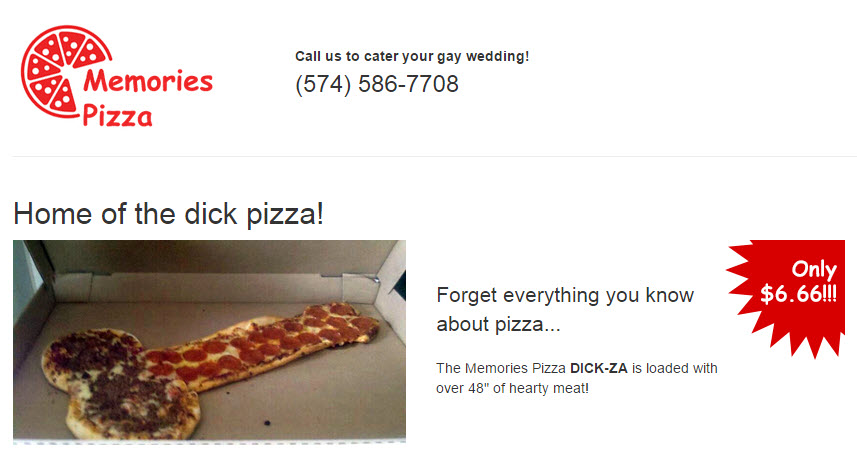
It is difficult to work up much sympathy for Memories Pizza, the Indiana pizza place that rushed to be known as the first business to announce that it plans on refusing to serve gay customers under the cover of Indiana’s new and poorly thought-out religious freedom law.  Oh, I agree that it was thoughtful of the owners to help show that the law, regardless of the neutral words used, was intended to be a rallying point for anti-gay advocates who want to fight back against what they see as a frightening cultural shift that they don’t understand and can’t accept, but the owners are still, to be blunt, morons.

Announcing that the law would allow them to refuse to cater a gay wedding, they injected their biases into a debate they were neither legally, ethically, morally or intellectually equipped to participate in. Crystal O’Connor, whose family owns the small-town pizzeria, spouted off  that “If a gay couple came in and wanted us to provide pizzas for their wedding, we would have to say no,”  as the national debate over the law was heating up. Well, no, Crystal, you wouldn’t have to, and the law probably wouldn’t protect you if you did. Baking pizza is not the exercise of religion, and nothing in the Bible says “Thou shalt not send pizza to the reception of a wedding you disapprove of.”

I just heard one of the law’s supporters from a “family values” group that spends much of its time, words and money attacking homosexuality swear to Chris Cuomo on CNN that the law has nothing whatsoever to do with Indiana embracing anti-gay bigots (and tricking them into thinking that stunts like Crystal’s are acceptable). “It’s about conscience, ” he intoned, without giggling. But the law says nothing about conscience either.It prevents the government from  substantially burdening the exercise of religion. Catering an event, religious or not, is not a religious act, nor is a wedding reception a religious ceremony. It is no more legitimate to say that your conscience forbids you from selling pizza to strangers than it is to say that your conscience forbids you from letting a transsexual into your cab. O’Connor, not surprisingly, doesn’t comprehend the law. Continue reading →

Ethical! Funny! But Stupid: Kentucky’s Risible Same-Sex Marriage Ban Defense.

laughing Scotus

Supreme Court justices deserve to have a good laugh now and then.

Michigan, Ohio, Kentucky, and Tennessee are all defending their legislative bans on gay marriage in briefs before the U. S. Supreme Court. Only one of their legal teams came up with—-or had the guts to include—the novel argument contained in the Bluegrass State’s brief, which explains why a ban on gay marriage does not “discriminate on the basis of sexual orientation”:

Kentucky’s marriage laws treat homosexuals and heterosexuals the same and are facially neutral. Men and women, whether heterosexual or homosexual, are free to marry persons of the opposite sex under Kentucky law, and men and women, whether heterosexual or homosexual, cannot marry persons of the same sex under Kentucky law.

This is in the amusing category of arguments that make technical sense in legal terms—well yes, come to think of it, if you look at it that way, you’ve defined discrimination right out of the case!— but no sense whatever in the real world. Gays can’t marry their intended life partner but heterosexuals can; that’s obviously unequal treatment and constitutes discrimination. The defense deceitfully pretends that the whole reason for the emotional controversy doesn’t exist: “Love? What’s that? We know nothing of this thing you call love!”

These come up all the time when legal teams are brainstorming which theories to pursue in an appellate brief, and are virtually always discarded after some general amusement and admiration for the Clintonian who devised it. There is nothing unethical about including a dubious argument along with better ones in a brief, even a Supreme Court brief: consider the position that carried the day in the Obamacare case, when Chief Justice Roberts adopted a rationale for the individual mandate that the Obama Administration had repeatedly rejected and denied. The problem is that such an off-the-wall argument is risky:

1. It pulls time, attention and consideration from more promising arguments.

2. It makes the client look foolish or unserious to the public.

3.  Worse, it might make the client look foolish to the justices.

4. Some justice might react to it as an insult to his or her intelligence.

More than all of that, however,the argument is not going to work. Can you imagine what the reaction would be if the Supreme Court endorsed gay marriage bans relying on that logic? The argument is a non-starter, so including it in the brief sends a loud and clear message that no appellate lawyer ever wants a judge to hear:

“We got nothin’.”


The Case Of The Too Candid Catholic Teacher

"You can unzip it, Patricia, when you work somewhere else...."

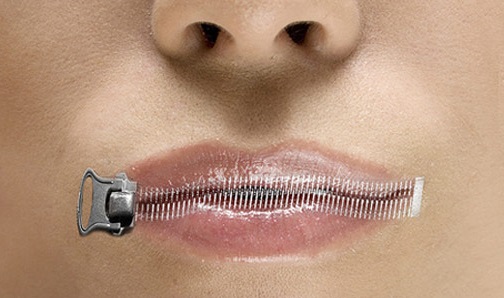
“You can unzip it, Patricia, when you work somewhere else….”

Apparently I missed another “media firestorm,” so allow me to catch up, particularly since the analysis of this story has been muddled beyond comprehension.

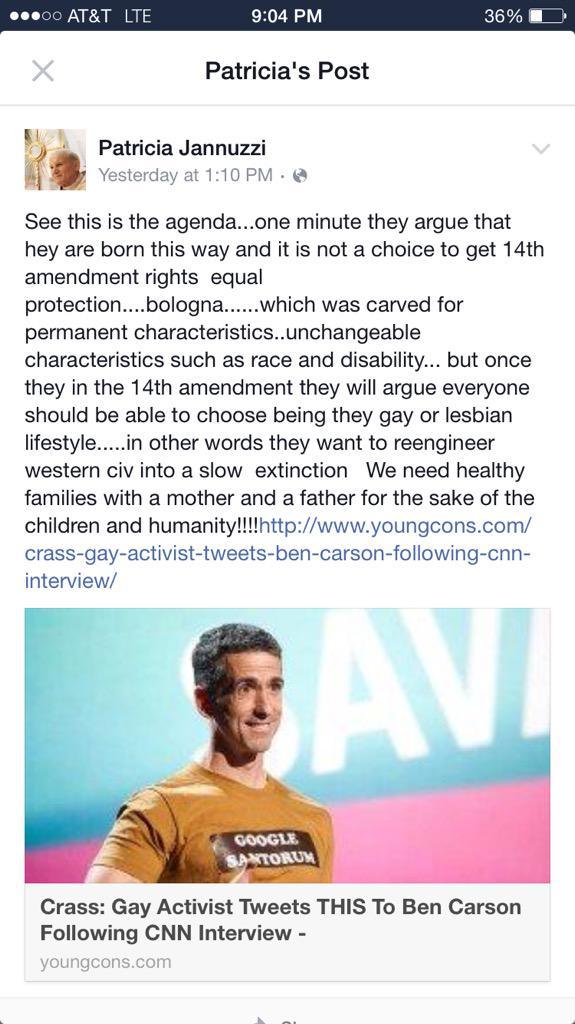
Patricia Jannuzzi, a religion teacher at Somerville’s Immaculata High School, posted this on her personal Facebook page:

jannuzzi-fb-post

This being the internet, after all, someone sent it far and wide, with resulting embarrassment to the school. Jannuzzi, a theology teacher with Immaculata for 33 years, was ordered to de-activate her Facebook page after an online petition   demanded that she be punished. Jannuzzi was placed on administrative leave,  and the school administration notified alumni, parents and students, in a letter that said in part,

“This episode has reflected not only on this teacher but, by extension, on Immaculata High SchoolWe regret deeply any hurt this has caused to any individuals and the negative light in which it has cast our school….Although these were posts to a personal social media page, Immaculata High School recognizes the need to ensure that our faculty, staff and students full understand the behaviors expected of them as members of our community and recognize our intolerance of discriminatory behaviors of any kind.”

Points: Continue reading →

Jerks, Liars, Hypocrites, Fools and Hoosiers: 10 Ethics Observations On Indiana’s Religious Freedom Restoration Act Controversy

Indiana5

1. The law was passed to make discrimination against gays, trans individuals and especially same-sex couples seeking marriage if not easier, to at least seem easier. Anyone claiming otherwise is lying, or being intentionally obtuse. Would Indiana be passing this law without the Hobby Lobby decision or the various court rulings requiring photographers, bakers, and other businesses to provide the same products and services to gay couples that they do to heterosexuals? Yes, you say? Tell me another.

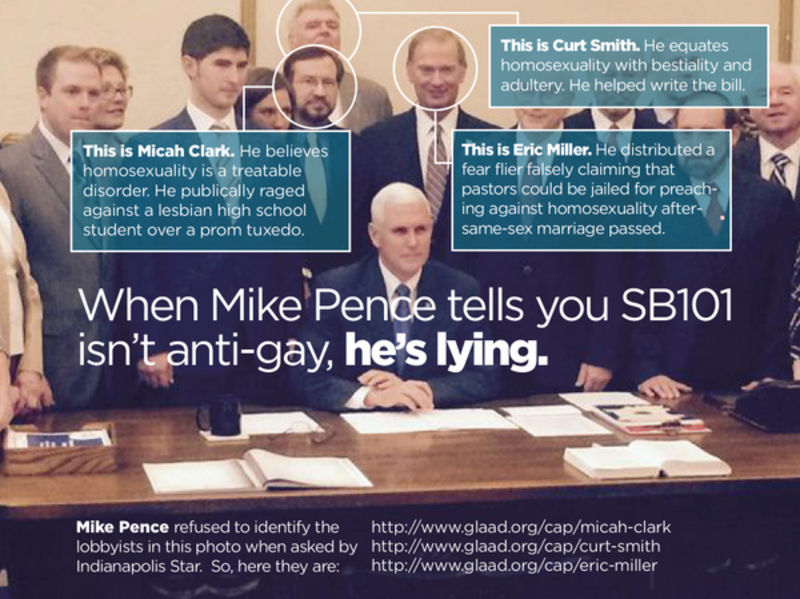
As GLAAD alertly pointed out, Governor Pence was surrounded by anti-gay activists when he signed the bill:

GLAAD Pence

This is res ipsa loquitur, and doesn’t speak well for the Governor’s candor or intelligence.

2. Context matters. The original laws of this sort (the Federal law signed by President Clinton is also called the Religious Freedom Restoration Act) were part of the left’s long range pro-drug strategy, like medical marijuana. It was essentially a hippie law designed to create a slippery slope to recreational drug legalization by allowing fringe religious groups, specifically Native American tribes, to use peyote in tribal ceremonies. Now you understand why Clinton signed the bill.

Oops. Excuse me if I enjoy the spectacle of the clever members of the Church of the Perpetually Stoned—including the ACLU, which once supported such laws as long as they pointed the way to their young lawyers being able to have their Saturday night joints legally but now opposes them—being hoisted on their own petard.

“When the federal government adopted a religious protection act in 1993, same-sex marriage was not on the horizon,” whines the New York Times. Well, competent, well-considered, properly drafted, responsibly passed laws don’t suddenly become unbearable, then fine, then unbearable again with every shift of the cultural winds. The intent of the law was never to protect mainstream religions, but cloaked itself in language that did. It backfired.

3. That being stipulated, the good states need to read their own laws before they start grandstanding. Connecticut Governor Dan Malloy just announced on Twitter that he plans to sign an executive order banning state travel to Indiana in response to its Religious Freedom Restoration Act. Yet Connecticut, hippie enclave and bedroom community of rich, white, liberal New Yorkers that it is, happily jumped on the religious freedom train with a law of its own, one that, as the Federalist points out, makes discrimination on the basis of religion easier than the Hoosier version, which only prohibits the government from substantially burdening religion. Connecticut’s law does not include the word “substantially,” meaning that all government-enacted burdens on religion are theoretically illegal.

I wonder how Malloy is going to ban government travel to Connecticut? Is the theory that the same law can be good when liberal states pass it and evil when those bad conservative states pass it? It is more likely that the governor hasn’t looked at his own state’s law.

4. The hysteria being stirred up over the supposed horribles Indiana’s law will lead to is irresponsible. Jonathan Adler explains on The Volokh Conspiracy: Continue reading →

Sliding UP The Slippery Slope: NO To Forced Sterilization, And A Belated NO To Forced Vasectomies Too

"OK, now this is entirely your free choice..."

“OK, now this is entirely your free choice…”

This has turned into Revisiting Old Posts Day on Ethics Alarms.

Last July, I posted an Ethics Quiz regarding a Virginia judge’s sentence offering a profligate and irresponsible serial father to choice between an extra four years in jail and a vasectomy at his own expense. After asking readers whether they thought the sentence was ethical, especially in light of the state’s ugly history of forced sterilizations, I demurred, writing,

I am not ready to make a call on this one. Since neglected children often become the responsibility of taxpayers, the argument that the state has no legitimate interest in regulating profligate reproduction by irresponsible parents falls flat. Is taking away someone’s ability to have more children (after seven) really a greater intrusion on his freedom than locking him up? Yet this sentence seems to cross lines that government should cross with caution, if at all. I’m not sorry that Herald won’t be inflicting more of his line on us. I am uneasy, however, with the way this result came about.

I am now ready to make an ethics call in the quiz in light of this news report: Continue reading →

Now THIS Is An Unethical Lawsuit!

chuck.chuck_

A New Mexico appeals court has refused to overturn the summary judgment dismissal  of Arthur Firstenburg’s five-year-old lawsuit against his neighbor Raphaela Monribot, whom he had accused of causing him excruciating pain and discomfort by using her iPhone, a Wi-Fi connection, dimmer switches, and other electronic devices in her own home. Firstenburg says that he suffers from electromagnetic sensitivity, or EMS, an acute sensitivity to electronic radiation that doctors and and scientists almost unanimously (but not quite) believe doesn’t exist.

Because Monribot had the misfortune to live next door to this guy, she had to defend against a $1.43 million lawsuit that has racked up court costs of over $85,000, and heaven knows what in legal fees. Firstenburg is not paying for any of it because he is broke; his lawyer, Lindsay Lovejoy, had taken the case on a contingent fee basis. She decided the appeal was a lost cause: the plaintiff handled it himself.

This case will, I assume, become the new poster child for those favoring a “loser pays” system, a bad idea that would be godsend in abuses of the system like this one. Continue reading →

Ethics Hero: Sterling Karrenstein

mobile_phone_cameraAt West Iredell High School in Statesville, North Carolina, student Sterling Karrenstein witnessed a resource officer using a taser to subdue a fellow student who punched the officer in the face. As he documented the incident on  his cell phone, school staff attempted to stop Sterling, demanding that he hand over the phone and even attempting to take it from him. He refused. The school principal apparently later told Sterling that being on school property eliminated his right to record events.

Wrong.

At least someone knows what is in the First Amendment. Obviously Sterling didn’t learn it at West Iredell High School, but Ethics Alarms salutes him for insisting on his rights as a citizen despite being pressured to do otherwise by incompetent authority figures.

If it is not disrupting class, infringing on the privacy of others or otherwise violating school policy, taking photos or video is a fully protected right.

This does not mean, it is important to note, that tasering a student who punched him was necessarily wrongful conduct by the officer.

______________________

Pointer: Tim LaVier

Unethical App: Yik Yak

The cute Yik Yak mascot, hanging out at a fraternity, where ethics go to die.

The cute Yik Yak mascot, hanging out at a fraternity, where ethics go to die.

Yik Yak is a suddenly surging social media app that is running viral on college campuses. The app allows users to post anonymous messages (“yaks”) that only appear to users within a 1.5-mile radius. The New York Times called it “ a virtual community bulletin board—or maybe a virtual bathroom wall at the student union.”

Yik Yak is unethical.

There.

Yik Yak was created in late 2013 by Tyler Droll and Brooks Buffington, fraternity brothers (and based on their names, escapees from a Dickens novel) who came up with the idea after seeing that there were only a handful of popular Twitter accounts at Furman College, where they were frat brothers, almost all belonging to campus big shots and athletes. With Yik Yak, they say, they hoped to create a more “democratic social media network” where users didn’t need a large number of followers or friends to have one’s thoughts read widely. Continue reading →