Phtography Ethics, Parenting Ethics, Face-stomping Ethics

no photographs

Item:

“A 32-year-old city resident was arrested for allegedly stomping on the face of a college student who was taking pictures at a Liberty Heights park on Tuesday afternoon. Victoria M. Torres, of 211 William St., was taken into custody for assaulting a 22-year-old student who was taking snapshots for a “photography class project” near the water park in Van Horn Park, Springfield police spokesman Sgt. John Delaney said.”

The student was taking photos of Torres’s young daughter, among other subjects.

More…

“Torres approached the photographer and “demanded in a threatening manner” that she delete any pictures containing images of her children, according to Delaney. The student, who wasn’t publicly identified by police, tried to avoid a confrontation and started to leave the park.”As she was walking out, the outraged female came over and punched her twice in the face, grabbed her by the hair and pulled her to the ground,” Delaney said. Torres then “kicked the victim and stomped her face” after the photographer had fallen to the ground, Delaney said.Torres also tried to take the woman’s camera and equipment, valued at about $4,000. Torres grabbed hold of the camera strap in effort to pull the camera from the student’s neck, Delaney said.”

Let’s stipulate that stomping on the student’s face…indeed, stomping on faces generally, is per se unethical. Now that this is settled, did the t mother have a legitimate objection? Was the student behaving ethically?

Yes, and no. Continue reading

Ethics Dunce: Radio Talk Show Host Bryan Fischer

To be fair, I guess it's possible that Fischer captured a leprechaun who granted him three wishes, in which case his prescription for ending AIDS isn't crazy after all. So I may owe him an apology...

To be fair, I guess it’s possible that Fischer captured a Leprechaun who granted him three wishes, in which case his prescription for ending AIDS isn’t crazy after all. So I may owe him an apology…

When ideology, including religion, requires one to abandon all connection to reality, unethical positions are sure to follow.  Christian conservative talk show host Bryan Fisher launched an angry rant over what he called President Obama’s promotion of sexual deviancy in his remarks following the downing of MH17 over the Ukraine. Here are the relevant remarks by the President:

“Let me close by making one additional comment. On board Malaysian Airlines Flight MH-17 there were apparently near 100 researchers and advocates traveling to an international conference in Australia dedicated to combating AIDS/HIV. These were men and women who had dedicated their own lives to saving the lives of others, and they were taken from us in a senseless act of violence.

In this world today we shouldn’t forget that in the midst of conflict and killing, there are people like these, people who are focused on what can be built rather than what can be destroyed, people who are focused on how they can help people that they’ve never met, people that define themselves not by what makes them different from other people but by the humanity that we hold in common. It’s important for us to lift them up and to affirm their lives. And it’s time for us to heed their example.

The United States of America is going to continue to stand for the basic principle that people have the right to live as they choose, that nations have the right to determine their own destiny, and that when terrible events like this occur, the international community stands on the side of justice and on the side of truth.”

Now here is Fischer’s reaction: Continue reading

Ethics Quiz: Blaming the Messenger

"Hey, I just deliver the boxcar contents to someplace called "Aushwitz." It's not my business what's in them..."

“Hey, I just deliver the boxcar contents to someplace called “Aushwitz.” It’s not my business what’s in them…”

In 2013, the United Parcel Service Inc  agreed to forfeit $40 million in fees that it had received from illegal internet pharmacies shipping bootleg prescription drugs using UPS services, in exchange for a non-prosecution agreement with the U.S. Department of Justice. UPS also agreed to put policies and procedures in place to prevent illegal online pharmacies from distributing drugs through its shipping services in the future. Naturally, the faux pharmacies moved over to FedEx, and when that shipping service refused to cut a similar deal with DOJ under threat of prosecution, the government persuaded a Federal grand jury to indict the company for delivering drugs associated with internet pharmacies, and thus being a willing party to a criminal enterprise.

Now many are cheering FedEx as, in essence, an ethics hero for refusing to knuckle under to the government and accept responsibility where it has none. There are two arguments against the government’s prosecution of FedEx. One is that its natural result would be to require shipping companies to open every parcel and be certain that nothing illegal is inside. The other is that trying to eradicate crime and other misconduct by creating secondary service liability is inherently unjust. By pressuring credit card companies  to refuse payments to companies the government regards as breaking the law, for example, alleged illegal enterprises can be put out of business without the government having to meet its burden of proof to show they really are breaking the law. If the government can intimidate carrying companies into refusing the business of illegal pharmacies, then the illegal pharmacies never have to be prosecuted. There is a third argument, but it is irrelevant: that the government shouldn’t be prosecuting the crime of providing prescription drugs over the internet at all.  This is an entirely different and separate issue: The point is that the shipments are illegal now, and FedEx is facilitating them.

Your Ethics Alarms Ethics Quiz to begin what I sense will be a busy ethics week is…

Is FedEx an Ethics Hero?

Continue reading

Ethics Quote Of The Week: Prof. Glenn Reynolds


Obama float

“To even investigate something like that is itself a civil rights violation.”

—-Prof. Glenn Reynolds, the “Instapundit, commenting on the news that the Department of Justice is investigating as a possible civil rights violation the anti-Obama float that appeared in a Nebraska Independence Day parade.

He is correct. This is government intimidation and an attempt to chill political speech. The float was crude and its sentiment was misplaced, but sending government agents to investigate it is indistinguishable from sending the FBI to knock on your door after your letter to the editor  critical of the President appears in the paper.

Where are the liberals who will have the integrity to call this what it is?

I can’t wait to find out.

The Unethical Opposition To Tennessee’s Fetal Drug Abuse Protection Law

200439961-001Tennessee is one of the most activist states that it comes to protecting children; for example, it has the among most stringent laws in the nation regarding the mandatory reporting of suspected child abuse. It also has a new law that just went into effect this month that allows officials to arrest mothers for assault who illegally use narcotics while they are pregnant if the child is born with symptoms indicating that the drug use impaired the child’s condition.

Predictable and tiresomely, the media and “war on women” scolds are attacking this is yet another incursion on the rights of women to have dominion over their own bodies. Think Progress, dishonestly, calls it a “pregnancy criminalization law.”  This is intentional misrepresentation, a TP specialty. The law doesn’t criminalize pregnancy in any way, by even the most distorted interpretation.  The knee-jerk opposition to the law highlights the problems of consistency and integrity that the women’s rights and pro-abortion forces have in all the areas relating to childbirth. Essentially, their position is that if conduct is related to child birth—or preventing it—in any way, anything they say, want or do must be accepted, and asserting otherwise, no matter what the justification, makes the government an oppressor of women. Continue reading

A Proposed Guide To Spoiler Ethics

"It SINKS??? You spoiled the ending!!!"

“It SINKS??? You spoiled the ending!!!”

I was just admonished on Facebook by a friend (a real friend, not just the Facebook variety), for referencing the end of the last episode of Season One of “Orange is the New Black.”  He hadn’t finished viewing the season yet, and this was a breach of spoiler ethics. Or was it?

Ever since I encountered for real someone who was angry with me for “spoiling” the end of “Thirteen Days,” ( “Yes, World War III started and everybody died”), I have been dubious about spoiler etiquette. The advent of DVDs and Netflix has made this all the more annoying. If I’m in a group of five, and one individual hasn’t kept up with “House of Cards,” are the rest of us obligated to censor our discussion? As a devotee and fanatic devourer of popular culture, I admit that my first instinct is to say, “Keep up, get literate, or pay the price.” If I actually live by that rule, however, I will be a walking, talking, writing, spoiler machine.

Chuck Klosterman, “The Ethicist” in the world of the New York Times, recently pronounced himself an anti-spoiler absolutist:

“I’m an anti-spoiler fascist. I don’t believe that any conversation, review or sardonic tweet about a given TV show is more valuable than protecting an individual’s opportunity to experience the episode itself (and to watch it within the context for which it was designed). I’ve never heard a pro-spoiler argument that wasn’t fundamentally absurd.”

Even Klosterman, however, excepted sporting events (the question posed involved mentioning World Cup scores to a friend who was annoyed that the game had been “spoiled” for him) from his fascism, writing, reasonably:

“I must concede that live, unrehearsed events are not subject to “spoiler” embargoes A live event is a form of breaking news. It’s not just entertainment; it’s the first imprint of living history. …Because this guy is your buddy, you might want to avoid discussing the games’ outcomes out of common courtesy — but not out of any moral obligation. It’s his own responsibility to keep himself in the dark about current events.”

For once I agree with Chuck. But what are reasonable ethics rules for dealing with the other kind of spoiler, involving literature and entertainment?

Luckily, this is not new territory, though it is evolving territory. The underlying ethical principles include fairness, trust, consideration, compassion, and empathy, which means that the Golden Rule is also involved.

Back in 2010, an erudite blogger calling himself The Reading Ape proposed a draft “Guide to Responsible Spoiling.” That blog is defunct; the promised successor is not around, and so far, I haven’t been able to discover who the Ape is. Whoever he is (Oh Aaaaape! Come back, Ape!) , he did a very good job, though some tweeks might  improve his work, especially in light of the emergence of Netflix.  (I have edited it slightly, not substantively…I hope he doesn’t mind, or if he does, that he’s not a big ape.) His approach is to frame the problem as an ethical conflict, in which two competing ethics principles must be balanced. I think that’s right.

Here is his “draft”—what do you think?

“A Brief Guide to Responsible Spoiling”

by The Reading Ape (2010)

The objective is to balance two ethical principles:

I. The Right to Surprise: The inherent right of any viewer or reader to experience the pleasure of not knowing what’s
going to happen next.

II. The Right to Debate: The inherent right of any viewer or reader to engage in public discourse about the content of
a given work of narrative art.

Part 1: When Spoiling is Fair Game

In the following circumstances, one can discuss crucial plot details and reveal endings with a clear conscience. Continue reading

Ethics Strike Three And Four Against Facebook In Its Creepy Mood Manipulation Study

Facebook is so out.

"Meh. Look at this neat picture of my dog!"

“Meh. Look at this neat picture of my dog!”

Ethics Strike One was the research itself, using its own, trusting users as guinea pigs in a mad scientist experiment to determine whether their moods could be manipulated by secretly managing the kind of posts they read from Facebook friends.

Ethics Strike Two was the lack of its subjects informed consent for the study, violating the basic standards of human subject research. A boilerplate user agreement that makes a vague reference to using data for “research” in no way meets the requirements of informed consent for this kind of study.

This brings us to Ethics Strike Three.  In justifying the legality and ethics of the research, Facebook’s researchers explained that leave to perform such experiments was consistent with the user agreement (See Strike Two):  “[the experiment] was consistent with Facebook’s Data Use Policy, to which all users agree prior to creating an account on Facebook, constituting informed consent for this research.” As I pointed out above and in my previous post on this topic, this isn’t informed consent as the research field and various ethics codes define it. But even if it was, this statement is a lie. Continue reading

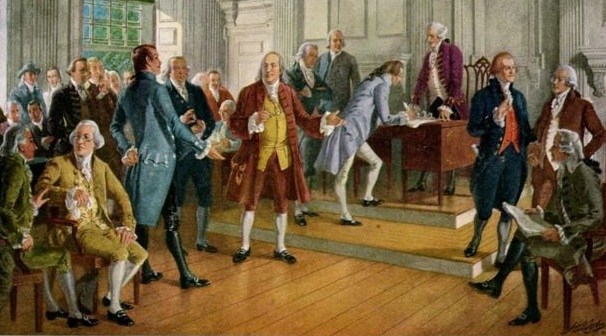
Independence Day Ethics: Historian Hype, Liberal Bias, And The Great Punctuation Mystery

founding-fathers-declaration-of-independence

First, a little background…

I have often found it depressing that historians so often lack the ethical integrity necessary to do their jobs. If there was any profession in which avoiding bias would seem to be paramount, historical research and analysis would seem to be it, but that just isn’t the case. Because historians are academics and scholars, and because academia has become almost exclusively a hot-house of left-ward ideology for more than half a century, too many historians view their duty as using the past to manipulate the present and future.

My introduction to this came early, when I was a fifth grader suddenly fascinated with the U.S. Presidency as the first national election that I could follow approached. I read various assessments of who the greatest of our past POTUSes were, and there was near consensus, it seemed. Washington and Lincoln, naturally, were “the berries,” and they were joined as “greats” by Jefferson, Jackson, Wilson, FDR, and Truman, Democrats all. Teddy Roosevelt was “near great”; Eisenhower was a dud. What a great party this Democratic Party must be! Of course, Jefferson’s racial hypocrisy, Jackson’s lawlessness and persecution of Native Americans, Wilson’s racism and bungling of the peace after World War I and FDR’s complicity in locking loyal Japanese-Americans in prison camps was never mentioned. Over time, I learned that even the most respected American historians were likely to be pursuing partisan agendas. The classic example, of course, was Arthur Schlesinger, Jr., who carefully and unforgivably culled the facts he deemed worthy of revelation in order to add John Fitzgerald Kennedy to that list of brilliant Democratic Presidents. Was I surprised when a large number of prominent American historians signed a petition opposing the impeachment of President Clinton, a Democrat, thus asserting that a degree of dishonesty and lack of trustworthiness that was sufficient in every state in the union to mark a lawyer as unfit to practice was nonetheless not sufficient cause to remove a President from office?

I was not.

This brings us to the Case of the Missing Comma, brought to us by Danielle Allen, a professor at the Institute for Advanced Study in Princeton, N.J., aided and abetted by her left-leaning allies. Allen (who by the purest coincidence has a book out!) claims a major discovery. The iconic sentence in the Declaration of Independence“We hold these truths to be self-evident, that all men are created equal, that they are endowed by their Creator with certain unalienable Rights, that among these are Life, Liberty and the pursuit of Happiness.–”—was not intended to end in a period, as all current quotations and reproductions show, and the official transcript produced by the National Archives and Records Administration indicates.  Allen claims that her extensive research indicates that the period at the end of that phrase almost certainly did not appear on the original parchment version of the Declaration, and was mistakenly included in later versions. Just in time for July 4th (when Allen’s publicist calculated that her “Eureka!” would get maximum exposure) Allen explained to the New York Times that the extra period contributes to a “routine but serious misunderstanding” of the famous document signed by the Second Continental Congress in 1776. Continue reading

Unethical Website Of The Month, Sort of: Newsball

image2

I had never heard of Newsball until I read a sneering account of Cole Baritomo’s “news blog” in the Daily Beast, titled “He Bullies Kids and Calls It News,” by DB reporter Brandy Zadrozny. She caught me at a bad time, because I was still gagging from reading an outrageous, incompetent, slanted and useless Daily Beast account of the Supreme Court’s unanimous ruling striking down a Massachusetts law establishing anti-protest “buffer zones” around abortion clinics as a First Amendment violation. Nobody reading this mess could possibly figure out what the ruling was about, what it was, and the distinctions it drew. There were no quotes from the opinion, no discussion of the important disagreements among the justices, not even a clear description of what a buffer zone is, or what the law that was struck down said. The reporter, however, quoted Plannned Parenthood three times—yes, they are certainly the most unbiased analysts of this issue. Then the screed masquerading as news reporting ended with this: Continue reading

Warped Values and Perverse Incentives: Banning Employers From Asking Whether A Job Applicant Served Time

Sorry Hedley---it's unfair to ask a potential employees if they were rustlers, cut throats, murderers, bounty hunters, desperados, mugs, pugs, thugs, nitwits, halfwits, dimwits, vipers, snipers, con men, Indian agents, Mexican bandits, muggers, buggerers, bushwhackers, hornswogglers, horse thieves, bull dykes, train robbers, bank robbers, ass-kickers, shit-kickers...and don't you dare ask if they are Methodists!

Sorry Hedley—it’s unfair to ask a potential employees if they were rustlers, cut throats, murderers, bounty hunters, desperados, mugs, pugs, thugs, nitwits, halfwits, dimwits, vipers, snipers, con men, Indian agents, Mexican bandits, muggers, buggerers, bushwhackers, hornswogglers, horse thieves, bull dykes, train robbers, bank robbers, ass-kickers, shit-kickers…and don’t you dare ask if they are Methodists!

I was unaware that this was a trend: states and cities making it illegal for employers to ask job applicant’s whether they had been convicted of a crime and served jail time.

It is an unethical, foolish and illogical trend, an example of misplaced compassion being used to justify placing risks on law-abiding citizens for the benefit of those who are less trustworthy.

A news article regarding the problems faced by former prisoners re-entering society quotes Zach Hoover, executive director of LA Voice, a multiracial, faith-based organization working to get such a measure passed in Los Angeles:

“Sometimes people think of someone who’s been in prison and they think only of what they did instead of what they’re doing today. They’ve done their time. They served their sentence, and they’re looking for a job.It’s like double jeopardy. You’ve done your time, and now you get a life sentence of joblessness.”

What utter claptrap: Continue reading