Unethical Quote of the Week; Chris Rock

Shut up, Chris.

Shut up, Chris.

“You say the wrong thing — you see what happened to [Donald Sterling],” Rock said. “I’m not defending what Sterling said at all, but if that’s not the First Amendment then what the [bleep] is? And what did he say, ‘I don’t want my girlfriend hanging out with black basketball players’? Me neither!”

—Black comic and “truth-teller” Chris Rock, discussing the fear in Hollywood as a result of the Sony hacks.

Gee, Chris, that’s courageous, fair, perceptive and true.

What a shame you didn’t have the integrity or guts to condemn what happened to Sterling while every other black pundit, columnist, athlete, and celebrity was comparing him to Satan. You just allowed everyone to pile on the old, rich white guy, take away his team and make him the face of racism for telling his slutty black  girlfriend—in his own bedroom!—not to flaunt the fact she was only hanging with him for the money by showing up at his teams’ games with her real boyfriends. You Hollywood types are hilarious–as in disgusting— in your selective belief in rights, privacy and fair play. First Aaron Sorkin, who didn’t object to the media feeding frenzy over Sterling’s private remarks, suddenly argues that his friends and business associates’ equally damning comments shouldn’t be reported because they aren’t about crime and corruption, and thus aren’t news. Then you suddenly decide to defend Donald Sterling’s rights of privacy and free speech now, when there is no cost to you at all, and the damage is done and irreparable.

Here’s what’s unethical about your statement, Chris: it’s too damn late.


Ethics Alarms Mail Bag: The Cologne Allergy

Perfume allergyEvery now and then readers think I’m Ann Landers. Today I got a “Dear Ethics Alarms: What’s right?” e-mail from a friend, and I thought I’d answer it on the blog because it raises a classic ethics conundrum.

The inquirer belongs to a social group that meets weekly. It is a weekly joy, I am told; the writer has been attending for years. Everyone convenes, on the given day, right after work. Attendance varies, and membership is informal, though individuals have been told, on rare occasions, to come no more.

Of late an infrequent attendee, but a member of long standing, has begun to attend meetings with some regularity. My friend says this is not the happiest of developments, because the two do not get along. It is a breach of long-standing, I am told and is not going to be healed. “She is an asshole,” is how the letter delicately puts it.

Last week, shortly before the end of the 90 minute gathering, the recent interloper stood up and declared that she had developed a serious allergy to colognes, perfumes, aftershave, and all chemical scents. Looking right at my friend, she declared that this allergy made exposure to any sort of commercial scent unbearable, and she asked that in the future no members should wear perfume of any kind.

“I have worn a favorite brand of cologne every day for over thirty years,” the from my acquaintance letter says. “I always get complimented on it; the scent is subtle and nobody would notice it unless they were right next to me. The asshole and I have been separated by the length of the room since she started coming. Personally, I think she made the demand just to make me miserable. She knows, from our previous relationship [NOTE: I think it was more than just a friendship], that I wear the cologne.”

The question: Is she ethically obligated to stop wearing cologne on the day of the meeting (she goes right from work) to accommodate this member’s special problem?

Add to this the broader ethics question that comes up often: Does a group member with special sensitivity have the ethical upper hand allowing such a member to demand that all other members avoid conduct that only bothers that member? Continue reading →

Comment of the Day on “Comment of the Day on ‘The Perils Of Over-Regulating The Police: A Case Study'”

Robocop

Stephen Mark Pilling contributes the second consecutive Comment of the Day providing perspective on the issue of police militarization, in response to the first. Here is his Comment of the Day to the post (by dragin_dragon, which you should read first if you haven’t yet), Comment of the Day on “The Perils Of Over-Regulating The Police: A Case Study”

When critics speak of the “militarization” of the police, not all are looking at it from the same viewpoint. Some are, of course, sociopathic or are conspiracy theorists. Some have swallowed the loudly flaunted concept that policemen are evil racists, corrupt ward healers in uniform or just about anything heinous, as they represent law as an absolute, not a relative.

There is a rational based distrust, however. Many of us grew up in a time where the police still walked a beat or patrolled his neighborhood in a squad car, armed with nothing more than a revolver. We’re also the product of an old tradition of law enforcement that stems from the British mold. Unlike the continental European system of paramilitary gendarmes, we adapted a system of localized lawmen, run by an elected county sheriff. The metropolitan police department is still a relatively new phenomenon, started in late 19th Century London.

To many citizens, police who are unaccountable to a directly elected chief and who sport automatic weapons strike a sour note. But recently, people have been seeing them acquiring armored vehicles, military assault training and a tendency to wearing black uniforms. They’ve also noted an increased likelihood of these tactics and weapons being utilized and the increased incidence of “no knock entries”. Likewise, citizens have been imaging police making arrogant idiots out of themselves and caused other cops to become ever more touchy about cell phones, whether they’re right or wrong.

These and other factors have been serving to create a gap between the citizens and the police. That’s never a good thing, of course, because that trust is vital in a free society. Citizen distrust only deepens when they perceive policemen in whom this sense of civil mastery is full blown. As a former military cop, as a private citizen and as a friend or relative of a lot of civilian cops, I’ve seen all this from different angles. I’ve also seen the divide deepen in recent days.

One small note. The funding of police units on all levels directly from federal sources coincides with the worry by many that state and local police units may be more or less within the pocket of federal departments. The actual militarization of once innocuous federal police units and the memory of Obama’s projected National Civilian Defense Force has resulted in fear that this is an intentional part of a program to create an instrument of oppression. For myself, I highly doubt that any street cops would lend themselves to some “martial law” based takeover of the homeland of America. What I’m not sure of, though, is how many in higher authority have not conceived of the notion and would execute it if they could.

Again; it’s vital that the bonds of trust be strengthened between the police departments and those law abiding citizens whom they “serve and protect”. They must never- ever- be heard to make disparaging remarks about “civilians”, as that only deepens the gulf. In the Army Military Police Corps, the official motto is “Of the troops and for the troops”. It’s a good motto. It should also carry over to every local police or sheriff’s department in America. “Of the citizens and for the citizens”. Policemen who embrace that attitude will seldom go wrong. Both they and the communities they serve will benefit.

Continue reading →

Transparency, Causation, Eggshells, Trust : Seven More Ethics Issues In The Eric Garner Case

jigsaw-puzzle-record

1. There is near unanimity in the response to the non-indictment by the Staten Island jury in the Eric Garner case. In light of the graphic video, it is hard to see how there wasn’t probable cause to indict. The coroner verdict of “homicide” would see to provide sufficient evidence all by itself. However, in the absence of the complete record of what the grand jury heard and saw, nobody can be certain that this was a miscarriage of justice. However, given the context of the case and its deleterious impact on faith in the justice system, that is no solace and scant mitigation. As in Ferguson, it is prudent and essential that the public see what the decision was based upon. It is true that those who are determined to see injustice, bias and racism will do so regardless of what the evidence shows–again, as in Ferguson—but the only evidence that has been made public, the various videos and the officer’s testimony–only makes the non-prosecution more suspicious.

2. Can the non-prosecution be justified? If so, the only reason I can see would be lack of proof of causation. Causation is tricky, and  juries get confused about how to analyze it. Since it is fair to assume Daniel Pantaleo did not intend to kill Eric Garner, the issues are a) whether his actions during the arrest were negligent, and b) whether they were the proximate cause of Garner’s death. That his conduct was negligent is not enough to sustain and indictment—that negligence had to be the reason Garner died. Remember, he was not choked to death. The medical examiner ruled that Garner died from a collection of factors: compression on his chest and throat, the position he was forced into, his obesity, weak heart, and asthma, all causing asphyxia.

  • If Pantaleo’s actions alone would not have caused Garner’s death, then it could be legitimately argued that he was not guilty of a crime. The other officers were given immunity for their testimony, which seems like either a bad decision by the district attorney, or intentional sabotage of the case against Pantaleo’s. If it was the collective action of the police that caused Garner’s death, it would be unjust to make Pantaleo the sole officer punished. If some of the testimony from the unchargeable cops made the case that it was another officer, or several, who really caused Garner’s death, that would explain the no indictment result.

In the widely seen video of the arrest, Pantaleo can be seen with his arm around Garner’s neck as Garner is taken to the ground and for some time thereafter, but in watching the video it’s difficult to determine whether Garner was in fact choked. And if he was, it did not appear it was long enough even to render him unconscious, much less kill him…I saw nothing excessive in the manner in which the officers subdued Garner. He was neither beaten with batons nor even punched. To me, it appeared to be a fairly typical scuffle with a large man who had clearly demonstrated his unwillingness to be arrested peacefully.

He misses the point. The question is whether the take-down was excessive for Garner, not some theoretical average arrestee. It is true that with a normal, healthy subject, what the officers did would not typically cause death….but Garner was obviously not normal, nor healthy. He was morbidly obese, and 350 pound middle-aged people tend to have the kinds of heath issues Garner in fact had. Nobody would argue that an elderly woman or a ten-year old girl or someone in a wheelchair should be manhandled like that. Such treatment was negligent for Eric Garner, and the deadly result could and should have been anticipated.

It is true that the officers couldn’t know that Garner had a weak heart and suffered from asthma, but it doesn’t matter: the rule in negligence is that “you take your victim as you find him.” If your negligence is the proximate cause of someone’s death, the fact that it wouldn’t have caused anyone else’s death is no defense. This is the so-called “Egg-shell Skull” rule.

Garner was an egg-shell perp. Continue reading →

The Perils Of Over-Regulating The Police: A Case Study

This is Dirt Harry's badge. Seconds later, he throws it into a river. Lots of other police will be doing the same.

This is Harry “Dirty Harry” Callahan’s badge. Seconds later, he throws it into a river. Lots of other police officers will soon be doing the same.

Yesterday, for the third time in my life, I was the first one on the scene after a fellow human being’s death. This time, it was a very close friend and, though it has little to do with this post, a wonderful man. I had headed out to his home because I was worried: an unusually reliable and conscientious individual, he had missed several appointments the last few days and hadn’t been answering e-mails and phone calls. When I was told about this, I immediately suspected the worst, and sadly, I was right.

His car was outside his house, and though it was mid-day and he was supposed to be somewhere else, I could see that the TV was on. In front of his door, getting soaked in the rain,  was a package: it had been delivered there on December 2. I got no response to my bangs on the door. It was time to call 911.

The police responded quickly. I’m not going to name the department, which has an excellent reputation here, and I do not fault the officers, who were diligent and polite, and who set about investigating the scene professionally and quickly. Nonetheless, after a full 90 minutes, after which they could not discern any more than I had before they came, they would not enter the house.

They told me that they could not risk being sued, and that there were elaborate policies and procedures that had to be checked off first. The officers had to track down their supervisor (it was a Saturday), and, they said, more than one official would have to sign off, to protect the department

“He could be drunk; he could be shacked up; he could just want to be alone,” they told me. “The law says his privacy can’t be breached, even by us.”

“But he’s not any of those things,” I said. “He doesn’t do any of those things, and if he were OK, there wouldn’t be a four-day-old package outside.”

“Maybe he took a trip on a whim.”

“He would have called and cancelled those commitments,” I said. “Look, you and I both know that he could be inside, on the brink of death, with every second bringing him closer. The only alternative is that he’s died already. If you won’t do it, let me break in, chase me, and you’ll find him legally as you pursue me. How’s that?”

The police weren’t sold. Finally, after a full 90 minutes, they requisitioned a ladder from a neighbor and were able to see into a second floor window. My friend was visible on the floor, and then they moved quickly, breaking down the door. They were too late by days. They might have been too late by minutes though. All those procedures and policies that forced the police to avoid taking action that in this case, under these circumstances, were prudent and that might have saved a life imperiled.

The lesson is only this: if we cannot trust police to make decisions like this, we obviously are not going to trust them to decide when to fire their weapons. Laws, rules and procedures are rigid, and have to be examined slowly; real life operates in the shadows of uncertainty, among the loopholes, gray areas and ambiguities, and it moves fast. The protests and demands in the wake of the recent police controversies will undoubtedly result in more regulations, policies and laws, but there is good reason to believe that they will also make us less safe rather than more safe, and make it difficult to find reasonable, dedicated, ethical men and women willing to serve as police, a job which, we seem to be deciding, should be subjected to strict liability whether the officer acts too quickly, or not quickly enough—judged, of course, after the results are in. Continue reading →


The Rams’ “Hands Up!” Gesture: Of Course The Players Deserved be Disciplined

rams protest 1201

The five St. Louis Rams who entered their NFL game last week with their hands up aren’t going to be disciplined by the league, for reasons that have nothing to do with the appropriateness of their conduct. The NFL is up to its faceguards in bad public relations already, and understandably wants to avoid wading into the Ferguson quagmire and being perceived to be taking sides, a move with no up-sides at all. Sportswriter Sally Jenkins also took issue with the St. Louis police demanding that the players be punished, in an emotional statement that seemed to threaten vague consequences if they were not. She was right to point out that government entities may not use threats of non-performance of their duties to members of the public in order to control their speech, like, say, the Federal government is doing now to try to force Dan Snyder to change the name of his Washington, D.C. NFL team.

Jenkins’ conclusion, however, was an ethics mess:

“Five members of the St. Louis Rams made an edgy gesture on Sunday, and you may not agree with them. But they merely joined a long tradition of athletes using their celebrity for symbolic public protest, and the NFL was right to reject the call to punish them. Punish them for what, after all? For showing an alertness and sensitivity to current events in their community, and holding an opinion on them?”

1. The “long tradition” argument is “everybody does it,” and nothing better. Professional athletes are paid to play games and entertain. Few of them have any qualifications or expertise that elevate the value of their opinions on public policy and politics above that of the regulate citizens watching them, and it is an abuse of their position and an exploitation of the venue for any athlete to exploit both to make a personal statement. Earlier, Jenkins says that to punish the Rams players “would also smack of 1968, when Tommie Smith and John Carlos were expelled from the Olympic Games for their black-gloved salutes,” as if that’s an argument. Smith and Carlos should have been expelled. The Olympics wasn’t theirs to co-opt for national political statements, no matter how valid or worthy. The Rmas players can hold opinions, and nobody is saying otherwise. Once they are in uniform and on the field, however, their opinions are not for display. They don’t own the forum. Continue reading →

Deval Patrick’s Indefensible, Terrifying Admission

Welcome to my nightmare...

Welcome to my nightmare…

It is 4:30 AM. I can’t sleep, and among the reasons are not, as you might think, the fact that my father died five years ago today and I miss him terribly, or that this is my birthday, and I am that much closer to my own death. No, the cause for my tossing in bed is that I read  Massachusetts Governor Deval Patrick’s comments on “Meet the Press” about the Michael Brown shooting (yes, those eleven Ferguson posts still weren’t enough) just before retiring, and they have been giving me nightmares.

What Patrick’s remarks suggest to me  is that this incident is quite literally driving Democrats, civil rights activists and African-Americans crazy, causing them to lose their grip on basic principles of ethics and democracy. Here is what Patrick said, in part, in his interview with Chuck Todd, who, incompetently, did not ask properly probing questions in response (falling over in a dead faint would have also been appropriate):

“Look, without knowing all the facts, of course I wanted to see an indictment. And mostly because I think a trial and the transparency of a trial would be good for the community. And because so many of us have the supposition that police officers are not going to be held accountable and not going to have to answer for the shooting of unarmed, young, black teenagers.”

I challenge any civil libertarian to defend this statement. Continue reading →

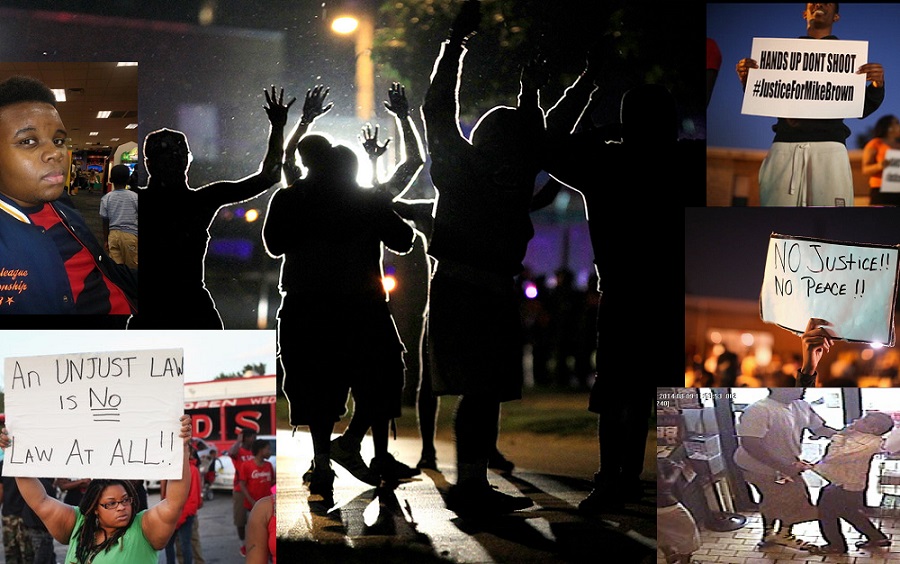
Eleven Ferguson Ethics Posts In One!

APTOPIX Police Shooting Missouri

There are too many ethics topics for me to cover adequately as it is. This is frustrating. That the Ferguson Ethics Train Wreck is generating ethics issues on a daily, even hourly basis creates a professional dilemma for me. I don’t want to appear obsessed with this mess; I’m not. I am really quite sick of it, and sick as well—and depressed—by the relentless stream of emotional, incompetent, and toxic opinions issuing from the news media, well-meaning but ignorant friends, and in some cases, professionals who appear overwhelmed by confirmation bias. One of my father’s favorite lines was “My mind’s made up, don’t confuse me with facts,” and I doubt that I have ever seen commentary on an event so dominated by that state of mind. Except, perhaps, the Trayvon Martin-George Zimmerman fiasco.

Allow me, then, to indulge in this compromise, while I wait for the entries in the Ethics Alarm contest to find the most unethical article, essay or blog post about Ferguson. Here are eleven points about the current Ethics Train Wreck that I would devote full posts to if I had the time and we lived in a Hell where Ferguson was the only thing going on. I may write full posts on a few of them yet, but meanwhile, here are shorter summaries that I hope you can use to enlighten some of your friends, relatives and associates afflicted with jerking knees….

1. We keep hearing that Officer Wilson is suspect and not credible because he expresses no remorse, and seems “cold.” This attitude projects the critics’ unjustified conclusions onto Brown, who doesn’t share them and shouldn’t. Why don’t interviewers point this out? If Brown was killed in self-defense, prompted by his own threats to the officer, Wilson shouldn’t be remorseful. Remorse means “deep regret or guilt for a wrong committed.” Wilson only did wrong if he shouldn’t have shot Brown, which is the assumption—an evidence-free assumption—of those who want him tried for murder. As for “cold”: Wilson’s whole life has been turned upside-down because a community and a substantial part of the nation have decided to make him pay the price for insensitive and poorly run police departments over decades and across the country. People are calling him a murderer based on political agendas. He’s supposed to respond to that warmly?

2. On ABC this morning, Jelani Cobb, a professor of African-American studies—and boy, are we learning a lot about the racist biases of that area of scholarship lately—pronounced the testimony of Wilson “fantastical” based on this statement: Continue reading →

The Fire Chief’s Book

Chief Cochran

Chief Cochran

I may I agree with this result. I think. My problem is that I don’t see a natural stop on this very slippery slope.

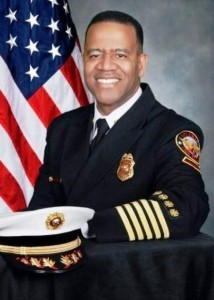
The Atlanta Fire Rescue Department has suspended Chief Kelvin Cochran for a month without pay this week after employees complained about the content of his self-published religious book, “Who Told You That You Were Naked,”  which is available in paperback on Amazon.com. The Chief’s book calls homosexuality a “sexual perversion” that is the moral  equivalent of “pederasty” and “bestiality.” Elsewhere, Cochran wrote that “naked men refuse to give in, so they pursue sexual fulfillment through multiple partners, with the opposite sex, the same sex and sex outside of marriage and many other vile, vulgar and inappropriate ways which defile their body-temple and dishonor God.”

The Chief apparently distributed his book to some of his subordinates, who found his published views offensive and complained.  In handing out the suspension, the Atlanta Mayor’s office said, “The bottom line is that the [Mayor Kasim] Reed administration does not tolerate discrimination of any kind.” Cochran, said the Mayor, will be prohibited from distributing the book on city property; he will also be required to undergo sensitivity training.

Ah yes, now comes the brain-washing.  Continue reading →

Unethical Quote Of The Week: Attorney General Eric Holder

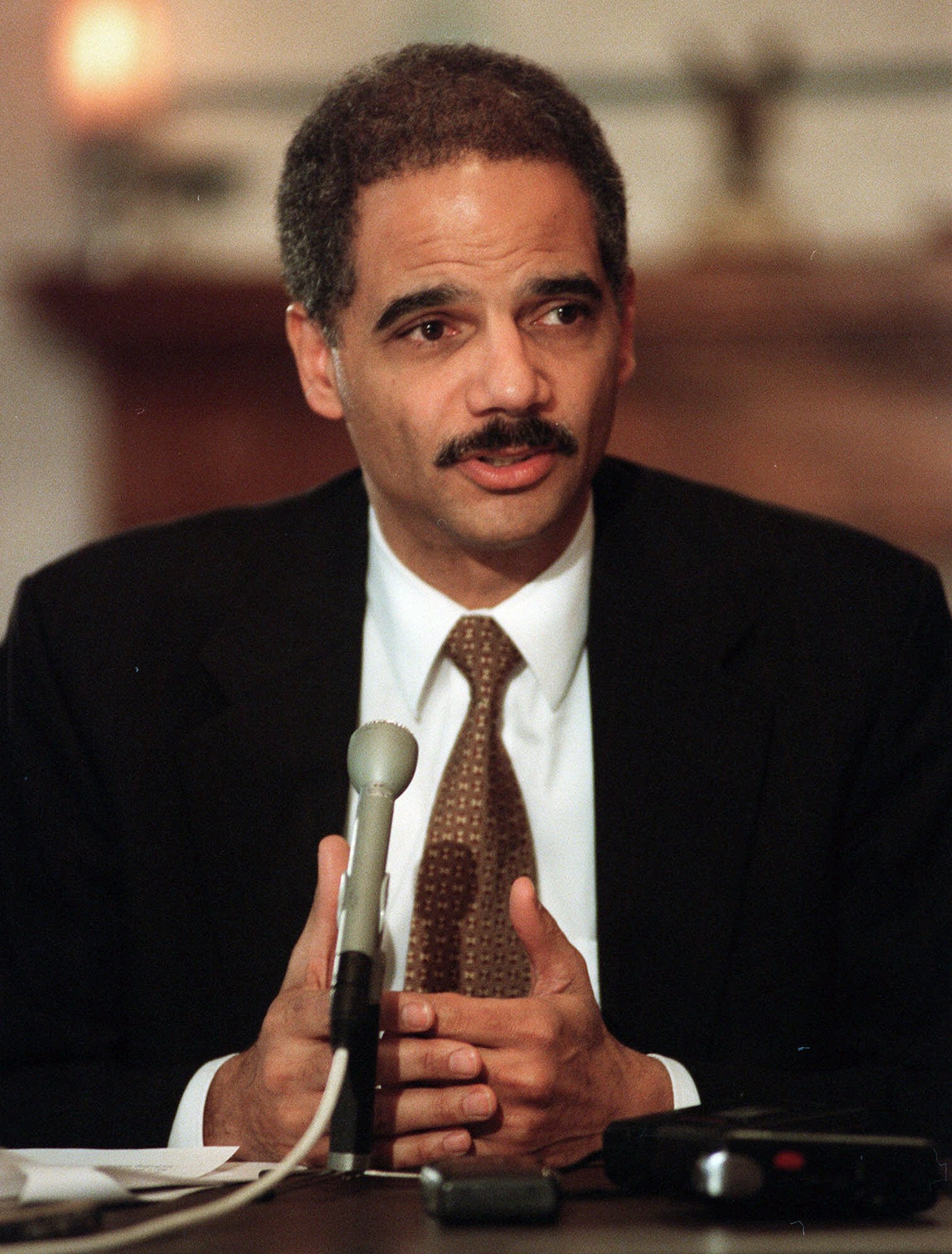
“While the grand jury proceeding in St. Louis County has concluded, the Justice Department’s investigation into the shooting of Michael Brown remains ongoing.  Though we have shared information with local prosecutors during the course of our investigation, the federal inquiry has been independent of the local one from the start, and remains so now.  Even at this mature stage of the investigation, we have avoided prejudging any of the evidence.  And although federal civil rights law imposes a high legal bar in these types of cases, we have resisted forming premature conclusions.”

—-Attorney General Eric Holder’s official statement following the announcement that the grand jury would not be handing down an indictment against Michale Brown’s shooter, Officer Wilson.

Sure, why change now?

Sure, why change now?

Why is this statement so unethical? There are three reasons.

1. The positioning of this statement, at the very beginning of the whole release, suggests and is meant to suggest that Holder and the Justice Department are in sympathy with those who believe that Wilson should be prosecuted. It translates into “Don’t despair! There is still hope! Your black Attorney General is doing all he can to get this racist cop and avenge Mike Brown!” for many who read or heard it, and that was the intent.

2. This is misrepresentation, essentially a lie, designed to mislead. No legal experts believe that there is any chance that the Justice Department will find probable cause to make a civil rights case against Wilson, and Holder is too good a lawyer—or once was—not to know that.  The bar is too high, and the evidence isn’t there, just as it wasn’t there in the equally futile civil rights investigation against George Zimmerman. Most, if not all, of those determined to see Wilson punished don’t comprehend what the investigation of the shooting by Justice signifies, and think it is just a separate chance to get him on trial for murder. Holder, again intentionally, did nothing to enlighten them.

3. To the extent that anyone does believe that the Justice investigation holds out hope of an indictment against Wilson, Holder is setting Brown’s supporters up for a second disappointment, and conceivably setting up Ferguson and the nation for a second round of rioting when the inevitable bad news comes down. Good plan.

What an ethics disaster and a national disgrace Eric Holder has been as Attorney General. And he is clearly determined to be both until the day he walks out of Justice for good….and I do mean “for good.”