A Puzzlement! Non-Lawyers Desperately Need A Legal Education, And Unemployed Lawyers Think Theirs Is Worthless


Quick, get a non-lawyer to pay you to teach him about the law, then you will have  rent money, and he'll be unemployable!

Quick, get a non-lawyer to pay you to teach him about the law, then you will have rent money, and he’ll be unemployable!

From the Fordham Law Review comes an article making an important point about American life: it is so intertwined with laws, regulations and procedures that citizens are overwhelmed, and at risk of serious adverse consequences. This provides a function for lawyers, indeed an essential one: allowing citizens of a democracy to be protected and served by laws rather than victimized by them. That is a function lawyers often serve, however, after legal ignorance has raised the specter of harm. From the abstract of Bridget Dunlap’s “Anyone Can Think Like a Lawyer,” which argues for “legal empowerment” for non-lawyers, and the duty of  lawyers to provide it: Continue reading

Unethical Quote Of The Week: SunTrust Bank

pop weasel2

“SunTrust supports the rights of all Americans to fully exercise their freedoms granted under the Constitution, including those with respect to free speech and freedom of religion.”

—-SunTrust Bank, doing its best Cracker Barrel imitation by reversing its decision, announced  earlier in the day, to pull all of its listed properties with the Benham brothers’ bank-owned property business.

SunTrust was following the lead of craven, political correctness bully-enabling HGTV, which a week ago announced it was canceling a planned home renovation show hosted by the Benhams as punishment for their conservative views on same-sex marriage, because, as we all know, gays are the heart and soul of the home renovation business. Thus emboldened, the bank decided that citizens opposing same-sex marriage as taught by the faith they had been raised to embrace deserved to have their business harmed, since that’s what the SunTrust suits’ moistened fingers in the wind told them their sensitive, right-thinking customers wanted.

But the announcement turned that wind into a roaring hurricane of protest from conservatives, and, we can at least hope, some actual liberals among Democrats who comprehend that banks should not be enforcers of the growing, un-American movement to make life nasty, brutish and short for anyone who dares to see the world differently from the news media, the universities, and the rest of the thought-crime legislators among us. Thus the quick reversal, and the noble words above.

So why is SunTrust’s impeccable affirmation of their iron-clad support for our precious freedom unethical? Continue reading

Ethics Hero: NBA Clippers Owner Donald Sterling (And Yes, I Mean It)

When you think about it, the champion in this fight would almost have to be repulsive for a victory to mean anything.

When you think about it, the champion in this fight would almost have to be repulsive for a victory to mean anything.

The other shoe dropped, and however it may be intended, it’s an ethical shoe. Donald Sterling now says that he’ll refuse to pay the 2.5 million dollar fine levied on him by NBA Commissioner Silver and his fellow owners for what he said in his own bedroom.

Good. I was waiting for this, and hoping that would be his course of action. Ironically, a good, compliant, progressive billionaire, and one who was not, unlike Sterling, a repulsive asshole, who was nationally embarrassed as Sterling has been, would crawl quietly into a hole, periodically send out big checks and mea culpas to Al Sharpton, Jesse Jackson, and the NAACP, and in the process, take  big, bloody chunks out of our freedom to think and speak freely, and our personal privacy. Sterling is doing the right thing, although it is going to cause him to be even more vilified by the media and even more assailed as the personification of racism than he has been already—and that has already been disproportionate to his “crime.”

Fighting is also going to be expensive. Never mind. It is revolting to write it, or even think it, but he is fighting for all of us. Continue reading

Michael Sam Flunks Trailblazer Ethics, And Many Will Suffer Because Of It

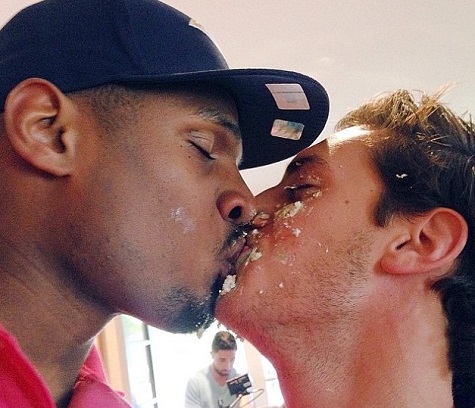
Sam kiss

The most charitable explanation for Michael Sam’s disastrous performance in the wake of the NFL draft is that he’s a young man who got terrible advice. A less charitable theory is that he’s an idiot. The worst theory of all is that Michael Sam is less interested in being the first openly gay pro-football player who blazes a clear path for those who follow him, and more concerned about becoming a gay icon, or worse, a martyr. Whatever the reason, Sam accepted the massive responsibility of being a cultural trailblazer, and fumbled the ball.

Sam wasn’t the best player in the NFL draft, but everyone knew, including Sam, that he would be the most closely watched. He had “come out” as gay soon after the college football season, and in light of his prominence and recognition as a stand-out athlete, his honesty and openness about his sexual orientation was hailed as a cultural turning point, an advance for gay Americans, and a test for the macho NFL. Would he be drafted? If he wasn’t (or was?), would it be because he was gay? ESPN’s cameras were in the Missouri defensive end’s home Saturday as the drafts neared its final stages with Sam name still uncalled. When St. Louis Rams coach Jeff Fisher called Sam at his agent’s house in San Diego to tell the former University of Missouri defensive lineman that they had selected him in the seventh and last round of the draft, it was instant drama.

There was more drama, in fact, than ESPN and viewers probably expected. Sam burst into tears while receiving the call, and then received an emotional, mouth-t0-mouth kiss from his boyfriend, Vito Cammisano.

Not that there’s anything wrong with that.

Actually, there is; several, in fact. To begin with, Sam had violated the Second Niggardly Principle, which states,

“When an individual or group can accomplish its legitimate objectives without engaging in speech or conduct that will offend individuals whose basis for the supposed offense is emotional, mistaken or ignorant, but is not malicious and is based on well-established impulses of human nature, it is unethical to intentionally engage in such speech or conduct.”

A clearer example of the SNP would be hard to find. No doubt about it, most heterosexual Americans, which means most of the public, are not used to seeing adult men kissing each other on the lips. There is no question that Sam knows this: of course he does. Even now, popular culture uses the image for shock value; it was only the 90’s when an impulsive lip-lock from Kramer on Jerry drove the studio audience to screams of laughter. No, there’s nothing “wrong” with two men kissing each other, but an awful lot of people were raised to think it is unnatural, and it is wrong to intentionally or negligently offend or upset them gratuitously. It is the flip side of tolerance: consideration and etiquette. Causing discomfort just because you can, or because your targets “deserve” or “need” to feel uncomfortable is just trouble-making for the hell of it. “Deal with it!” is confrontational and aimed at creating rancor, not comity. Continue reading

Harvard’s Black Mass: An Ethics Problem With No Answer


Impossible.

Impossible.

P versus NPthe Hodge conjecturethe Riemann hypothesisthe Yang–Mills existence and mass gap The Navier–Stokes existence and smoothness. The Birch and Swinnerton-Dyer conjecture. These are some of the unsolved problems of mathematics, but they are child’s play compared to the unsolvable ethics dilemma concocted at Harvard College.

Is Harvard right to allow students to hold a historic recreation of a Black Mass? Is Harvard wrong? Is it unethical for the students to engage in the project? Is it gratuitously insulting to religion, particularly Catholicism? Does it even matter if it is?

To bring you up to date:

The Harvard Extension Cultural Studies Club is planning to recreate a “satanic black mass” on campus next week, enacted by Satanic Temple, a New York-based, Satanist group that engages in outrageous displays to draw attention to First Amendment rights. “Our purpose is not to denigrate any religion or faith, which would be repugnant to our educational purposes, but instead to learn and experience the history of different cultural practices,” the HECSC said in a statement.

The statement lays the foundation for a hung jury in seeking an ethics verdict. Since the Black Mass was originally devised to denigrate the holy mass, saying that recreating the mass isn’t intended to denigrate religion is the kind of thing Captain Kirk used to say to evil, logic-bound computers to make smoke come out of their hard drives. “It-is-true-but- it’s-not-true-but-nothing-can-be-true-and-not-true–KABOOM! Continue reading

HGTV And Corporate Cowardice: Hold Companies Accountable For Stifling Speech, Opinion, And Thought

"Remodeling Homes, and Wrecking Democracy"

“HGTV: Remodeling Homes, and Wrecking Democracy”

Once again,  a company that is in effect punishing an American for his or her views on a complex social or political issue is being excused as simply “watching out for the bottom line.” This time, it is cable network HGTV, which cancelled a planned cable show about home repair because one of the prospective stars expressed an opinion adverse to gay activists. Last week, it was the NBA; before that, the agent of activist vengeance was Mozilla, and before that, A&E, until it decided that it was more profitable to do one “right thing” (not punish the duck call eccentrics for being open about who the network and its viewers always knew they were) rather than what it had decided earlier was the “right thing” (“STONE THE BIGOTS!!!”). None of these profit-making organizations are the least bit interested in what is right or wrong, of course, and probably don’t give the ethical implications of their acts a moment’s thought. All they are worried about is money, and what they will grandstand as their “principled decision” will always, amazingly, coincide with whose bullying tactics are more likely to succeed. Continue reading

A Brief Ethics and Culture Lesson For First Amendment Pedants

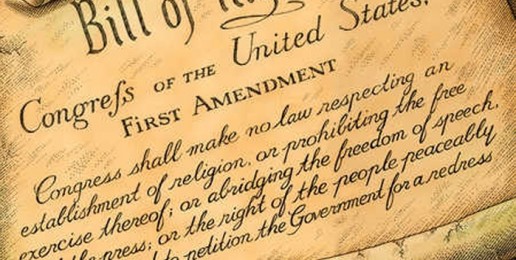
First-Amendment-on-scroll1

Thousands or pundits and web commenters, perhaps hundreds of thousands, in their concerted effort to justify the speech and thought police, (at least as long as the Enforcers are not likely to disapprove of their thoughts and speech), are mocking those who cite the First Amendment as authority for the proposition that the treatment of Donald Sterling, and others, are harmful, sinister, and un-American. The pedants are technically correct, of course. When someone who is fired for posting something offensive on Facebook screams, “My First Amendment right of free speech has been violated!”, that typically speaks of a poor civic education. The Bill of Rights only constrains government action, not private transactions. No rights, which are enumerated and protected from government incursions by the Constitution, have been lost or affected when only private action is involved.

That does not mean, however, that when private action opposes an individual’s Constitutional rights, it is necessarily acceptable, fair, harmless, reasonable or right. Indeed, the government and law serves a crucial function by delineating and encouraging cultural and ethical values. The principles articulated in the Declaration of Independence, the Constitution and the Bill of Rights do not merely constrain government. They form the basis of the ethical values that make the United States a unique culture, and point the way to what Americans, as Americans, regard as right and wrong.

Thus, while searching though a friend’s private e-mail account isn’t a violation of one’s right to privacy under the 10th Amendment, violating a fellow citizen’s privacy is wrong, and the Bill of Rights stands as authority that it is something important to each individual that should be respected. The Constitution and the 13th, 14th, and 15th Amendments won’t and can’t stop Americans like Sterling from being bigots in their private dealings, but they send a clear message that bigotry is not approved by the United States and was not by those who have charted our ethical course. Privately interfering with someone’s right to worship as they please is wrong, and the fact that the government is prevented from doing it tells us so. The First Amendment’s existence also tells us that preserving free speech—open, fearless, speech—is essential to core American values, because it also supports free thought, that which tyrants and dictators fear. Yes, we all have the right to make free speech, thought and discourse costly, difficult and painful, but we should not. We have the right to punish severely the non-conformist, the iconoclast, the rebel, or the citizen who may be a little late, or slow, or reluctant, to accept the conventional wisdom of the moment. We have the right to do it, but it is wrong. It is un-American. The Constitution tells us so.

Addendum: After I wrote the post, I encountered this.
 

Comment of the Day: “Clayton Lockett Is Dead, Right? Then 1) Good! and 2) His Execution Wasn’t “Botched””

capital-punishmentThere are well-established group of ethics topics that will always cause spirited debates here, because they are issues that have always divided public opinion and always will: morality vs ethics, drug legalization, abortion, war, social justice, socialism, plus various controversies involving race, sexuality and gender. I try to wade into these only when a current even beckons, as to some extent the arguments are futile and familiar, and too many people refuse to think or listen anymore, retreating to slogans and reflex positions articulated by others.

I decided to wade into one of the most polarized, of these, capital punishment, when the Clayton Lockett execution in Oklahoma sparked a national debate that seemed strange to me, and indeed driven by the unwarranted assumption, uncritically accepted by the news media, that the painlessness of executions were a crucial feature of making them ethical as well as societally palatable. It also opened the question of whether one execution that doesn’t follow the script necessarily calls capital punishment itself into question. I confess: both in my post’s title and in the tone of my responses to anti-death penalty commentators, I intentionally sought to roil the waters of debate, and was determined not to allow the nice people who usually express compassion for the pain and suffering of humanity’s worst and deadliest escape with the usual pieties.

Sure enough, this annoyed the heck out of some readers. Responding to the emphatic objections of one, Isaac delivered a personal and powerful rebuttal. Here is his Comment of the Day on the post Clayton Lockett Is Dead, Right? Then 1) Good! and 2) His Execution Wasn’t “Botched:” Continue reading

Clayton Lockett Is Dead, Right? Then 1) Good! and 2) His Execution Wasn’t “Botched”

Capital punishment foes have no shame, and (I know I am a broken record on this, and it cheers me no more than it pleases you), the knee-jerk journalists who have been squarely in their camp for decades refuse to illuminate their constant hypocrisy. In Connecticut, for example, holding that putting to death the monstrous perpetrators of the Petit home invasion was “immoral,” anti-death penalty advocates argued that the extended time it took to handle appeals made the death penalty more expensive than life imprisonment—an added expense for which the advocates themselves are accountable.

A similar dynamic is at work in the aftermath of the execution of convicted murderer and rapist Clayton Lockett in Oklahoma.Witnesses to his execution by lethal injection said Lockett convulsed and writhed on the gurney, sat up and started to speak before officials blocked the witnesses’ view by pulling a curtain. Apparently his vein “blew,” and instead of killing him efficiently,  the new, three-drug “cocktail” arrived at as the means of execution in Oklahoma after extensive study and litigation failed to work as advertised.  Why was there an excessively complex system involving multiple drugs used in this execution? It was the result of cumulative efforts by anti-death penalty zealots to make sure the process was above all, “humane.” Of course, the more complicated a process is, the more moving parts it has, the more likely it is to fail.

Continue reading

A Sterling Ethics Train Wreck Update, Ethics Heroes Opposing The Mob, and The Comment of the Day

thoughtpoliceEthics Alarms commenter Chris Marschner again scores a Comment of the Day regarding the subtext of my recent post about Peoria Mayor Jim Ardis, whose stunning abuse of government power to punish a citizen’s free speech was ignored while destroying NBA team owner Donald Sterling, because he privately articulated offensive views to a vengeful girlfriend, became a media obsession and a national rallying point.

Before I get to Chris’s excellent comment, however, I should bring us up to date on the Donald Sterling Ethics Train Wreck, which has proceeded as I feared it would: Continue reading