Harvard’s Black Mass: An Ethics Problem With No Answer


Impossible.

Impossible.

P versus NP…the Hodge conjecture…the Riemann hypothesis…the Yang–Mills existence and mass gap The Navier–Stokes existence and smoothness. The Birch and Swinnerton-Dyer conjecture. These are some of the unsolved problems of mathematics, but they are child’s play compared to the unsolvable ethics dilemma concocted at Harvard College.

Is Harvard right to allow students to hold a historic recreation of a Black Mass? Is Harvard wrong? Is it unethical for the students to engage in the project? Is it gratuitously insulting to religion, particularly Catholicism? Does it even matter if it is?

To bring you up to date:

The Harvard Extension Cultural Studies Club is planning to recreate a “satanic black mass” on campus next week, enacted by Satanic Temple, a New York-based, Satanist group that engages in outrageous displays to draw attention to First Amendment rights. “Our purpose is not to denigrate any religion or faith, which would be repugnant to our educational purposes, but instead to learn and experience the history of different cultural practices,” the HECSC said in a statement.

The statement lays the foundation for a hung jury in seeking an ethics verdict. Since the Black Mass was originally devised to denigrate the holy mass, saying that recreating the mass isn’t intended to denigrate religion is the kind of thing Captain Kirk used to say to evil, logic-bound computers to make smoke come out of their hard drives. “It-is-true-but- it’s-not-true-but-nothing-can-be-true-and-not-true–KABOOM!“ Continue reading →

HGTV And Corporate Cowardice: Hold Companies Accountable For Stifling Speech, Opinion, And Thought

"Remodeling Homes, and Wrecking Democracy"

“HGTV: Remodeling Homes, and Wrecking Democracy”

Once again,  a company that is in effect punishing an American for his or her views on a complex social or political issue is being excused as simply “watching out for the bottom line.” This time, it is cable network HGTV, which cancelled a planned cable show about home repair because one of the prospective stars expressed an opinion adverse to gay activists. Last week, it was the NBA; before that, the agent of activist vengeance was Mozilla, and before that, A&E, until it decided that it was more profitable to do one “right thing” (not punish the duck call eccentrics for being open about who the network and its viewers always knew they were) rather than what it had decided earlier was the “right thing” (“STONE THE BIGOTS!!!”). None of these profit-making organizations are the least bit interested in what is right or wrong, of course, and probably don’t give the ethical implications of their acts a moment’s thought. All they are worried about is money, and what they will grandstand as their “principled decision” will always, amazingly, coincide with whose bullying tactics are more likely to succeed. Continue reading →

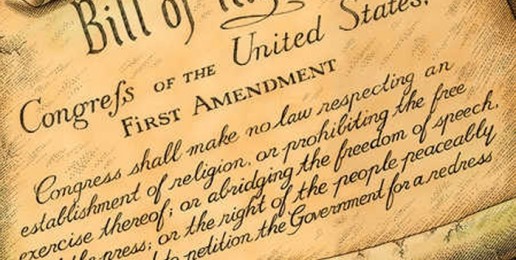
A Brief Ethics and Culture Lesson For First Amendment Pedants

First-Amendment-on-scroll1

Thousands or pundits and web commenters, perhaps hundreds of thousands, in their concerted effort to justify the speech and thought police, (at least as long as the Enforcers are not likely to disapprove of their thoughts and speech), are mocking those who cite the First Amendment as authority for the proposition that the treatment of Donald Sterling, and others, are harmful, sinister, and un-American. The pedants are technically correct, of course. When someone who is fired for posting something offensive on Facebook screams, “My First Amendment right of free speech has been violated!”, that typically speaks of a poor civic education. The Bill of Rights only constrains government action, not private transactions. No rights, which are enumerated and protected from government incursions by the Constitution, have been lost or affected when only private action is involved.

That does not mean, however, that when private action opposes an individual’s Constitutional rights, it is necessarily acceptable, fair, harmless, reasonable or right. Indeed, the government and law serves a crucial function by delineating and encouraging cultural and ethical values. The principles articulated in the Declaration of Independence, the Constitution and the Bill of Rights do not merely constrain government. They form the basis of the ethical values that make the United States a unique culture, and point the way to what Americans, as Americans, regard as right and wrong.

Thus, while searching though a friend’s private e-mail account isn’t a violation of one’s right to privacy under the 10th Amendment, violating a fellow citizen’s privacy is wrong, and the Bill of Rights stands as authority that it is something important to each individual that should be respected. The Constitution and the 13th, 14th, and 15th Amendments won’t and can’t stop Americans like Sterling from being bigots in their private dealings, but they send a clear message that bigotry is not approved by the United States and was not by those who have charted our ethical course. Privately interfering with someone’s right to worship as they please is wrong, and the fact that the government is prevented from doing it tells us so. The First Amendment’s existence also tells us that preserving free speech—open, fearless, speech—is essential to core American values, because it also supports free thought, that which tyrants and dictators fear. Yes, we all have the right to make free speech, thought and discourse costly, difficult and painful, but we should not. We have the right to punish severely the non-conformist, the iconoclast, the rebel, or the citizen who may be a little late, or slow, or reluctant, to accept the conventional wisdom of the moment. We have the right to do it, but it is wrong. It is un-American. The Constitution tells us so.

Addendum: After I wrote the post, I encountered this.


Comment of the Day: “Clayton Lockett Is Dead, Right? Then 1) Good! and 2) His Execution Wasn’t “Botched””

capital-punishmentThere are well-established group of ethics topics that will always cause spirited debates here, because they are issues that have always divided public opinion and always will: morality vs ethics, drug legalization, abortion, war, social justice, socialism, plus various controversies involving race, sexuality and gender. I try to wade into these only when a current even beckons, as to some extent the arguments are futile and familiar, and too many people refuse to think or listen anymore, retreating to slogans and reflex positions articulated by others.

I decided to wade into one of the most polarized, of these, capital punishment, when the Clayton Lockett execution in Oklahoma sparked a national debate that seemed strange to me, and indeed driven by the unwarranted assumption, uncritically accepted by the news media, that the painlessness of executions were a crucial feature of making them ethical as well as societally palatable. It also opened the question of whether one execution that doesn’t follow the script necessarily calls capital punishment itself into question. I confess: both in my post’s title and in the tone of my responses to anti-death penalty commentators, I intentionally sought to roil the waters of debate, and was determined not to allow the nice people who usually express compassion for the pain and suffering of humanity’s worst and deadliest escape with the usual pieties.

Sure enough, this annoyed the heck out of some readers. Responding to the emphatic objections of one, Isaac delivered a personal and powerful rebuttal. Here is his Comment of the Day on the post Clayton Lockett Is Dead, Right? Then 1) Good! and 2) His Execution Wasn’t “Botched:” Continue reading →

Clayton Lockett Is Dead, Right? Then 1) Good! and 2) His Execution Wasn’t “Botched”

Capital punishment foes have no shame, and (I know I am a broken record on this, and it cheers me no more than it pleases you), the knee-jerk journalists who have been squarely in their camp for decades refuse to illuminate their constant hypocrisy. In Connecticut, for example, holding that putting to death the monstrous perpetrators of the Petit home invasion was “immoral,” anti-death penalty advocates argued that the extended time it took to handle appeals made the death penalty more expensive than life imprisonment—an added expense for which the advocates themselves are accountable.

A similar dynamic is at work in the aftermath of the execution of convicted murderer and rapist Clayton Lockett in Oklahoma.Witnesses to his execution by lethal injection said Lockett convulsed and writhed on the gurney, sat up and started to speak before officials blocked the witnesses’ view by pulling a curtain. Apparently his vein “blew,” and instead of killing him efficiently,  the new, three-drug “cocktail” arrived at as the means of execution in Oklahoma after extensive study and litigation failed to work as advertised.  Why was there an excessively complex system involving multiple drugs used in this execution? It was the result of cumulative efforts by anti-death penalty zealots to make sure the process was above all, “humane.” Of course, the more complicated a process is, the more moving parts it has, the more likely it is to fail.

Continue reading →

A Sterling Ethics Train Wreck Update, Ethics Heroes Opposing The Mob, and The Comment of the Day

thoughtpoliceEthics Alarms commenter Chris Marschner again scores a Comment of the Day regarding the subtext of my recent post about Peoria Mayor Jim Ardis, whose stunning abuse of government power to punish a citizen’s free speech was ignored while destroying NBA team owner Donald Sterling, because he privately articulated offensive views to a vengeful girlfriend, became a media obsession and a national rallying point.

Before I get to Chris’s excellent comment, however, I should bring us up to date on the Donald Sterling Ethics Train Wreck, which has proceeded as I feared it would: Continue reading →

Comment of the Day: “Ethics Quote of the Week: Justice Sonia Sotamayor”

Here is Chris Marchener’s Comment of the Day on the post, “Ethics Quote of the Week: Justice Sonia Sotamayor”: and the ongoing debate it has sparked here:

I am not a lawyer. do not play one on TV, nor did I spend the night in a Holiday Inn Express last night. BUT, my understanding of the decision was that the SCOTUS would not overrule the will of the electorate, who, after reasoned debate on the issue, voted to amend its state constitution to state unequivocally that no person shall be granted a preference based on some genetic characteristic, belief, religion, etc. Isn’t that what we are striving toward? They did not strike down nor address the merits of affirmative action.

I get Jack’s point that Justice Sotamayor’s dissent was not based on Constitutional law and was reflecting her own biases regarding race and gender.

Outside of this decision, there is no doubt that some people in this country have a cultural aversion to people of other races, nationalities, genders, lifestyles, Such aversions apply equally to all genders, races, nationalities etc. on a global scale. In the US. such personal aversions must not be a criterion for employment decisions, educational, or other economic opportunities.

To Mr. Green’s assertion, “You mean racists are the ones who talk about racism? How is that not like blaming the victim? This is a pernicious, evil lie – that the victims of racism are in fact the cause of racism because they have this nasty habit of pointing out the unpleasant fact of racism’s existence” : The evil lie is that racism and gender discrimination remains an institution perpetrated by white males such that all benefits inure to them within the economy of the US. Therefore, such institutional racism must continue to be addressed through the very means that created unequal opportunities in the first place. I have stated in earlier posts that any group that demands perpetual preferential treatment by virtue of race, ethnicity, gender or some other factor is guilty of the same institutional bias that we seek to overcome.

In Justice Sotamayor’s words  “Race also matters because of persistent racial inequality in society…” What does this mean? Does it mean that every race be identical in population size? Does it mean that income distribution within the racial sub-segment reflect the income distribution in the majority demographic? Or, does it mean that everyone has an equal chance based on persistence, education and intellect?

This is same Justice that said, “I would hope that a wise Latina woman with the richness of her experiences would more often than not reach a better conclusion than a white male who hasn’t lived that life,”

Blatant racism if we switched the nouns, And why just white men?

Later she said, “Whether born from experience or inherent physiological or cultural differences,” she said, for jurists who are women and non white, “our gender and national origins may and will make a difference in our judging.” To this I do not disagree. However, the difference does not mean that better decisions will be made just different decisions. If we accept the premise that physiological or cultural differences are acceptable biases in judicial rulings then no culture, race, or national origin is inherently racist. She cannot say that white European physiology or culture is inferior for is she does then the logical conclusion is that all others are cultures and genders are superior to the white European culture which is a racist statement.

She continues, “And race matters for reasons that really are only skin deep, that cannot be discussed any other way, and that cannot be wished away. Race matters to a young man’s view of society when he spends his teenage years watching others tense up as he passes, no matter the neighborhood where he grew up.”

To that I say, Why can’t they be discussed in any other way? I cannot wish away what others think, I can only think for myself. Why do you feel the need to tell me how I think and feel? Why does the young man sense the tension of others when he walks by? Are the passerby’s truly in a state of tension or has such hypersensitivity been planted within him through the rhetoric of those “leaders” who amass great wealth and power rationalizing every perceived slight as evidence of racism. We need to tell children that they can be anything they want provided they work hard in school and apply themselves. If we continually tell them the majority is against them and they have no chance without government protections then they will simply fail to strive for greatness, reinforcing within them the sense that majority society is against them. This is exactly what the self-described champions of racially equality seem to want. If it is not then I challenge them to try alternative tactics to get my support.

However, because there has been past injustice and we feel that we must compensate those affected by such injustice, we must ask who should pay the price for past injustice and for how long. Is evidence of economic disparity the only means to determine evidence of racism; I think not. It takes individual effort and if that effort is not forthcoming then failure to achieve is not evidence of racism. For those that advocate for affirmative action, should only the sons of whites who had the misfortune of being born into lower and middle-income American families bear the burden of reparations? I don’t think that the sons of well-connected whites suffer from being denied employment in favor of a greater, equally, or lesser qualified women or minority candidate as a result of ensuring affirmative action plan goals. Nor do I think that the daughters of many well to do citizens have ever faced any form of discrimination in their lives.

Continue reading →

Ethics Musings On The Guy With “MURDER” Tattooed On His Neck….


Hey! Cool tattoo, dude! Just don't get caught actually murdering someo...oh. Bummer.

Hey! Cool tattoo, dude! Just don’t get caught actually murdering someo…oh. Bummer.

Jeffrey Chapman, who is soon to stand trial for first degree murder in Great Bend, Kansas, wants to remove the giant tattoo that spells out the word  MURDER around his neck, believing that it will prejudice the jury against him.

Ya think?

The judge will allow Chapman to have the tattoo removed before the trial, it appears. There is precedent for this: in Florida, in 2010, a neo-Nazi charged with hate crimes was permitted to have the hate-related tattoos on his face and neck, including a swastika, covered up by a professional make-up artist. It was paid for by the state, naturally.

Observations:

  • I suppose this is the necessary and fair decision by the judge. Lawyer-pundit Alan Dershowitz made some interesting points regarding the Florida case, however, suggesting that the swastika and other tattoos were an extension of tattooed defendant John Allan Ditullio’s character, and covering them could be construed as misleading the jury. “He is alleged to have attacked people on the basis of sex orientation and race. The court has the chance to make its rulings based on whether the tattoos are relevant to the case,” Dershowitz said. “It depends on what the prosecution is trying to prove. If they are saying his Nazi ideology drove him, then you could argue that seeing the tattoos is relevant.” Dershowitz noted that his tattoos were obviously the way he chooses to present himself publicly. “It’s not like the swastika was on his rear end,” he said.

Continue reading →

Ethics Quote of the Week: Justice Sonia Sotamayor

Sonia_Sotomayor

“Race matters. Race matters in part because of the long history of racial minorities’ being denied access to the political process…Race also matters because of persistent racial inequality in society…And race matters for reasons that really are only skin deep, that cannot be discussed any other way, and that cannot be wished away. Race matters to a young man’s view of society when he spends his teenage years watching others tense up as he passes, no matter the neighborhood where he grew up. Race matters to a young woman’s sense of self when she states her hometown, and then is pressed, “No, where are you really from?”, regardless of how many generations her family has been in the country. Race matters to a young person addressed by a stranger in a foreign language, which he does not understand because only English was spoken at home. Race matters because of the slights, the snickers, the silent judgments that reinforce that most crippling of thoughts: “I do not belong here.” In my colleagues’ view, examining the racial impact of legislation only perpetuates racial discrimination. This refusal to accept the stark reality that race matters is regrettable.”

–—-Supreme Court Justice Sonia Sotamayor, dissenting in the case of Schuette v. Coalition to Defend Affirmative, Integration and Immigration and Fight for Equality by Any Means Necessary, in which a 6-2 majority ruled that Michigan voters could ban race-based preferences at universities without violating the Constitution.

This screed was remarkably unprofessional for a Supreme Court Justice, an emotional recitation of unsupported assertions, perceptions and complaints with no constitutional relevance. Sotamayor, you may recall, was nominated by the President in the midst of a public debate regarding the importance of “empathy” on the bench, code for “we need more women.” But the Constitution is supposed to be interpreted by principles of law and legal reasoning, not from “the heart.” Well, we clearly got the empathetic Justice he wanted, for better or worse. Continue reading →

Autonomy: The Ethics Alarm That Obamacare Should Be Setting Off, But Isn’t

fire_alarm

Autonomy. This is the ethical value, a sub-set of the “respect” section of the Josephson Institute’s Six Pillars of Character, that is suddenly absent from the value set of the New American Left. This is cause for concern to say the least, because autonomy is the very value that was the impetus for the nation’s founding, and that is at the core of the Bill of Rights as well as the “inalienable rights” that introduce Mr. Jefferson’s mission statement for our strange experiment in self-governance. Beginning back in Bill Clinton’s administration, advocates of a nationalized health care system, including President Clinton himself, began floating the historical and logical nonsense that Jefferson and the Founders would have enthusiastically supported national health care. This is, of course, a cynical lie if one is educated (as it was in Clinton’s case) or proof positive of complete unfamiliarity with, oh, everything about the Founders, their political philosophy, and political philosophy generally. Whatever the value of a national health care program, the idea that the government would presume to dictate how one managed something so personal and intimate as one’s own health would have horrified  every signer of the Declaration, from its author to Button Gwinett.

That Mr. Jefferson’s supposed followers—he is the Original Democrat, by most lights, would reach the point of maintaining that the public’s beliefs, opinions and attitudes must be bent to their will is a development that threatens the existence of United States society and culture as we know it. The recent flare in this emergency arrived via the mugging of Brandon Eich, ex-CEO of Mozilla, who was deemed by the liberal elite as unworthy of keeping his job (though Mozilla is an internet company and he is an innovator in the field) because he was not convinced of the rightness of same-sex marriage by the elite’s newly determined, and well past,  deadline—a deadline that such progressive icons as Barack Obama and Hillary Clinton also missed, but never mind. Conformity to Progressive Truth has become the order of the day, and woe be to any good citizen who dares to oppose it. Does this sound like freedom to you? “Choice,” to use a popular rallying cry in the protest against the “War against Women?” It doesn’t sound like freedom to me. Continue reading →