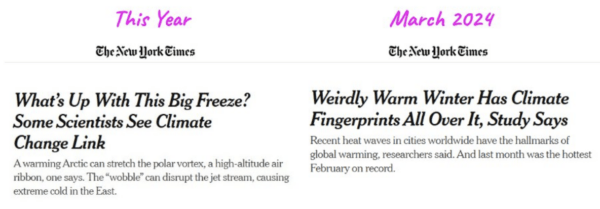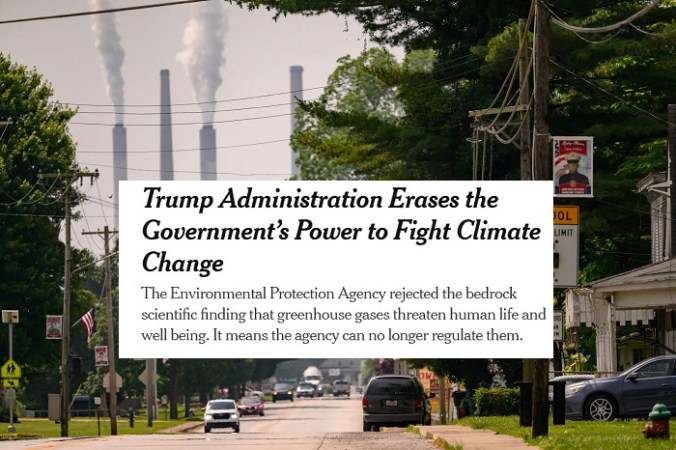
An Inquirer Asks, “How Can I Stop My Wife From Badgering Our Friends About Climate Change?” How About….

…showing her that her hysteria is based on lies, bad stats, politicized “science” and hooey?

I admit it, that headline sucked me in to reading “Social Q’s,” a Times advice column that puts wokeness over wisdom, causing me to put it on the EA blacklist.

My wife has become an eco-warrior,” a married weenie writes. “She has strong feelings about the environment and other people’s carbon footprints. She challenges our friends repeatedly about their lifestyle choices. I agree with her in principle, but I can’t support her moral outrage. …Help!

Predictably, the column’s proprietor, Phillip Galanes, begins by saying, “I would begin by praising her, rightfully, for her commitment to an important issue.” I’ll fix it for him: “an important issue that nobody really knows much about, especially indoctrinated progressives who are passionate about what their bubble-mates are passionate about regardless of facts.”

Much better.

Continue reading

If A.I. Wrote a WAPO Op-Ed Piece to Set Us Up For a Take-Over By the Bots, This Is What It Would Be Like…

Oh , yeah, this is good advice.

The Washington Post (gift link, but don’t get excited, it’s a crummy gift) permitted a father-son team of faithful dupes to reassure us all that artificial intelligence is no different from any other machine, and can never compete with the human mind. Authors Andrew Klavan (a novelist) and Spencer Klavan, a classicist, are here to explain to us that artificial intelligence is like a wax writing tablet was to Plato (Spencer’s idea, I bet) or computers were to past generations, technological advances humans foolishly thought could match the human mind. “But by using machines as metaphors for our minds, we fall prey to the illusion that our minds are nothing more than machines. So it’s not surprising that now, when the possibilities of AI are enthralling Silicon Valley, those who think programs can become conscious are trying to tell us that consciousness is just a program,” they write.

Point? We have nothing to worry about! These things can’t really think or feel like we do! A.I. lacks “what ancient philosophers called “the inner logos” — the unique interior apparatus we have for structuring and understanding our experience of the world.”

Neither Klavan has anything in his biography to indicate they have more than the average landscaper’s understanding of technology, so what’s their authority for this verdict? Jesus, and Louis Armstrong. I kid you not. “The great Louis Armstrong, performing the George David Weiss and Bob Thiele song, “What a Wonderful World,” put it this way,” they write. “I see friends shaking hands, saying ‘How do you do?’ / They’re really saying: ‘I love you.’” Jesus put it similarly in Matthew 15: “The things that come out of a person’s mouth come from the heart.”

The two non-scientists have come to the dangerous and ignorant conclusion that A.I. bots are just “large language models” (LLMs) that are not capable of thought because, well, that’s what Louis sings. They tell us at the end,

Continue reading

Comment of the Day: “Unethical Bank of the Month: Merrick Bank”

Diego Garcia entered an instructive description of an interaction with a bank on credit card matters that nicely illustrates a theme Ethics Alarms has been commenting on for quite a while. It is not exaggerated, because I have been enmeshed in dozens of these maddening experiences almost every month since my wife died last year. The practices are cruel, frustrating, time-consuming and hostile, and, I am convinced, often intentional. They are the product of multiple unethical conditions and practices, including incompetent management, needless technology complexity, sloth, poor hiring criteria, poor training, the public school system, lack of sufficient emphasis on English proficiency, corporate arrogance, outsourcing of jobs, inadequate staffing, and more. I also believe these systems and the factors creating them cause serious stress-related health problems among the public and even domestic and urban violence as well as mass shootings.

People have been conditioned to just shrug it all off as “how we live now.” We shouldn’t do that.

Here is Diego Garcia’s Comment of the Day on the post, “Unethical Bank of the Month: Merrick Bank”:

…I do have a recent BoA experience regarding account setups.

My sister has had a BoA credit card for something like 50 (!) years. She is very much not tech savvy, and is someone who always wants paper statements mailed to her.

On this card, she had made arrangements for her payment to be automatically drafted each month — the payment would be $150 or the statement balance, whichever was smaller. She had made this arrangement by phone as she never had set up an online account for this card. Well, a couple months ago they wrote her to say that they were cancelling this automatic payment and she would have to go online to set it back up.

Continue reading

Elon Musk: “Delusional,” Huckster, or Credible Dreamer?

A twitter user I have never heard of (but who somehow has amassed over half a million followers posted that tweet above with the comment, “I don’t understand why people continue investing in a company whose CEO is self-evidently delusional and whose plans for the business have no basis in reality.” Another user quickly pointed out that the eccentric billionaire entrepreneur “reduced the cost of launch to orbit by ~90%, mainstreamed electric cars, and gave a paralyzed man the ability to control a computer with his mind.” Yes, that’s a complete rebuttal to the “influencer’s” snark. Why do investors trust Musk? Because he’s an out-of-the-box thinker with the resources to make impossible-seeming ideas reality, and has a track record that says, “Don’t bet against him.”

Regular readers here know that I detest John Lennon’s anthem for idiots, “Imagine.” John identifies himself as a “dreamer,” which he rationalizes “Everybody does it” style: He’s not the only one who thinks we can achieve his juvenile version of utopia (“Nothing to live or die for…”). But John was a minimally educated lifetime musician and poet: like the Everly Brothers, all he could do was dream (and they were silly dreams anyway). Elon Musk has shown that he is capable of making some previously impossible dreams possible. That deserves awe and respect.

Continue reading

And Now…Here Comes A.I. Derangement Syndrome!

Coca-Cola’s AI ad just ruined Christmas… again” rages tech blog CB (Creative Bloq) Wow. A Coca-Cola by-the-numbers holiday ad lasting a bit more than 60 seconds ruined Christmas just like the Grinch or Mr. Potter. How is that possible?

It isn’t, but apparently the new tool of artificial intelligence which can create things like the Coke ad faster and cheaper than CGI has some folks losing their jingle bells. What’s going on here?

This: the Marxists and progressives on social media and elsewhere are upset because AI puts actors out of work, or soon will. Of course, except for Santa, there are no humans in the ad to be put out of work, but the critics on X and elsewhere aren’t fooled. Coke used cute animals, see, so people would be fooled into thinking that AI wasn’t taking away human jobs. “Firstly, can you really put aside the issues of AI generated creative displacing artists simply by using animals instead of humans?,” Fergus McCallum, CEO at TBWA\MCR wonders. “Even if you can, there’s no getting away from the lack of joy and authenticity. As audiences start to turn away from the AI slop being served to them on a daily basis, Coca-Cola are in danger of becoming inauthentic too. Whatever happened to ‘I’d like to teach the world to sing’?!”

Continue reading

The Duty To Remember: Jan Ernst Matzeliger, Inventor, (1852-1889)

This kind of thing drives me crazy, as regular and long-time readers here know. The culture and society lose so much when important events, figures and trailblazers are gradually lost—forgotten, ignored, erased by ignorance and apathy. That this remarkable and important inventor somehow fell into the memory hole of American history is particularly galling because he was black, and black activists have gone to extreme lengths, at times manufacturing significant black historical figures out of otherwise marginal accomplishments, to show the contributions of African Americans to U.S. society and culture. Jan Ernst Matzeliger was a big deal. We should know his name.

Continue reading

No, Dr. Gelman, Just Because You Think Your Toaster Is A Lawyer Doesn’t Mean What You Say To It Is Privileged

Its continues to amaze me whom the New York Times will give a platform to. Take Dr. Nils Gilman (please!), a historian who “works at the intersection of technology and public policy,” whatever that means.

He has written a supposedly learned column for the Times [gift link] claiming that human beings should have something akin to attorney-client privilege when they shoot off their mouths to their chatbots. His cautionary tale:

On New Year’s Day, Jonathan Rinderknecht purportedly asked ChatGPT: “Are you at fault if a fire is [lit]because of your cigarettes?”… “Yes,” ChatGPT replied…. Rinderknecht…had previously told the chatbot how “amazing” it had felt to burn a Bible months prior….and had also asked it to create a “dystopian” painting of a crowd of poor people fleeing a forest fire while a crowd of rich people mocked them behind a gate.

Somehow the bot squealed to federal authorities. Those conversations were considered sufficient evidence of Rinderknecht’s mind, motives and intent to start a fire that, along with GPS data that put him at the scene of the initial blaze, the feds arrested and chargeed him with several criminal counts, including destruction of property by means of fire, alleging that he was responsible for a small blaze that reignited a week later to start the horrific Palisades fire.

To the author, “this disturbing development is a warning for our legal system.” You see, lonely, stupid people are using A.I. chatbots as confidants, therapists and advisers now, and the damn things cannot be trusted. “We urgently need a new form of legal protection that would safeguard most private communications between people and A.I. chatbots. I call it A.I. interaction privilege,” he pleads.

Continue reading

The Sec. of Transportation Tells Kim Kardashian That She’s an Irresponsible Ignorance-Spreading Fool. Good!

In an episode of the reality show “The Kardashians” (My god, is that still on?) Uber Kardashian Kim, the only one of the breed who earned her celebrity (with a sex tape and a huge derriere), told actress Sarah Paulson that she had watched interviews with Buzz Aldrin, who was on the Apollo 11 mission with Neil Armstrong and the second person to walk on the moon, and they convinced her that the moon landing was a government hoax.

“I don’t think we did. I think it was fake,” the Kimster announced. “I’ve seen a few videos on Buzz Aldrin talking about how it didn’t happen. He says it all the time now, in interviews.” Does anyone know what the hell she’s babbling about? The last time I heard about Aldrin in relation to the moonwalk conspiracy theory, he punched a guy in the face for claiming it was true.

Then Kardashian repeated a trope of the ancient conspiracy theory: “There’s no gravity on the moon. Why is the flag blowing?” I view that statement all by itself as signature significance: anyone who says it once is too gullible to be let outside without a keeper, and anyone who says it publicly is an idiot. The “mystery” can be answered by viewing the archived videos or by 3 seconds of googling. Who goes on TV and asserts a non-fact that anyone, including her, can prove false in a trice?

This time, however, big guns were trained on the specific idiot. Sean Duffy, the US Transportation Secretary and acting administrator of NASA, rebutted the whatever-she-is on X. He wrote: “Yes, Kim Kardashian, we’ve been to the moon before … Six times! And even better, NASA Artemis is going back under the leadership of [President Trump]. We won the last space race and we will win this one too.”

Madison, Wis, bloggress Ann Althouse, in one of her “it’s not the topic, it’s the tangents” posts, asks,

“Why is a government official calling out a private citizen who expresses interest in a conspiracy theory? We’re Americans. We have our conspiracy theories. Keep your government nose out of our business. You’re only giving more ammunition to the conspiracy theorists. Why stick your neck out to deny what isn’t true? You’re making it more fun to believe the theory!”

Ann is evoking the “Streisand Effect” with her “You’re only giving more ammunition to the conspiracy theorists.” She’s wrong, maybe even at an Ethics Dunce level. This conspiracy is hardly unknown: there was even a movie about it, and I have encountered moonwalk skeptics periodically ever since the event. “Why is a government official calling out a private citizen who expresses interest in a conspiracy theory?” Because, Ann, celebrities are not “private citizens.” They are public citizens; they make their millions by being famous and by appearing, speaking and misbehaving in public. More Americans by far know who Kim Kardashian is than who know who Sean Duffy is. A disturbing number of Americans, maybe even a majority, believe that being a celebrity (and appearing on TV) indicates virtue, wisdom and intelligence. Celebrity culture helped get Donald Trump elected President. Doesn’t Ann Althouse understand that? Hasn’t she ever heard the rejoinder, “If you’re so smart, why aren’t you rich?”

Continue reading

Ethical Motive, Stupid Idea: The 6 pound Smart Phone

There are quite a few posts on Ethics Alarms about the scourge of smart phones: mothers’ eyes glued to the screen when they should be watching the kids; dog-owners ignoring their canine companions on walks, teens interacting with the web while ignoring the world around them; narcissism-feeding selfies; intrusive assholes looking for social media fame while destroying any semblance of privacy by taking photos and videos of everyone and everything, and more.

But start-up company Matter Neuroscience has a solution! Their masterstroke is to create the most inconvenient smartphone case imaginable to make using one’s phone tiring and uncomfortable. It’s stainless steel phone case weighs 6 pounds, mote than a 16-inch MacBook Pro laptop and light dumb-bell. Two separate pieces that screw together around the phone ensure that you can’t wait to put the damn thing away unless you’re a pro arm-wrestling champ in training.

The stainless steel smartphone case won’t fit in your pocket and becomes more annoying the more you check your phone. The 6-pound smartphone case is currently in the crowdfunding stage on Kickstarter, but you can pre-order one for $210, or opt for the brass version, which is heavier and costs a $500.

I cannot imagine any adult, even one acknowledging that he or she is addicted to cell phones, buying one that is inherently inconvenient to use. Maybe, maybe, giving unwieldy phones to one’s kids will have some appeal, using the “Look, it’s this, two vans with a string, or nothing” ultimatum.

I doubt it, however. The too-heavy phone gets ethics points for good intentions, but loses them and more for incompetence.

Matter Neuroscience has a $75,000 crowdfunding goal, but has raised just $17,000.

Needed: A Smart Phone and Social Media Code of Ethics (At Least)

Begosh and begorrah! “Rolling Stone” published a useful ethics essay! The topic: Gen Z altering their conduct and becoming wary of social contact because of fear of public shaming.

Eli Thompson writes in part,

At the Chicago high school I graduated from in June, phones were out during private and public moments. It could be in class when someone fumbled a presentation, or the cafeteria when someone tripped. Most clips stayed in private Snapchat group chats, shared among a few dozen kids. But they could spread further, and cut deeper. Last year, a friend from another school was filmed in his attempt to ask a girl out in the hallway. Even though it was awkward, he didn’t do anything crazy in the video and it was mostly just a rejection. But someone recorded him and posted it on a Snapchat story. The video had the caption, “Bro thought he had a chance,” and over 200 people saw it by the time he got to lunch…Trends such as “fail compilations” or “cringe challenges” — posts showing awkward mistakes or uncomfortable situations meant to make others laugh — encourage people to document embarrassing moments…After seeing these moments play out, I realized this was no longer a far-off fear. It changed how young men conducted themselves in real life. The threat of public shaming makes normal interactions risky and at times can lessen the chance young men will pursue relationships or go on dates. Constant fear of embarrassment can leave some young men too hesitant to take the social risks needed for dating. The fear of online exposure doesn’t just stop certain young men from asking girls out — it can plant seeds of resentment that threaten to fracture gender relations for a long time. 

Continue reading