Morning Ethics Warm-Up, 9/11/17: Irma and Climate Change Hype; Democrats And Anti-Catholic Hypocrisy

Good Morning!

1 I’m in Boston to address a group of new admittees to the Massachusetts bar today.

2. Broadcast journalists were surprisingly restrained with Harvey, but the second major hurricane in less than two weeks is apparently too much for them, as it is for other climate change shills on social media and elsewhere (I’m looking at YOU, Jennifer Lawrence…which, I admit, isn’t all that unpleasant…)

Thus I am hearing (and reading) more and more claims that Hurricane Irma on top of Hurricane Harvey is the result of the nation’s failure to aggressively limit carbon emissions…as if two (or more) big storms in hurricane season is unprecedented, and didn’t, in fact, occur far more frequently when Al Gore was knee-high to a grasshopper. What does the cynical use of the 2017 storms as propaganda for the gullible and weak-minded tell us?

It tells us that the journalists don’t know beans about climate, weather and the science of global warming. It shows us that they are willing to mislead the public out of dishonesty, bias or incompetence, by spreading what amounts to junk science regarding an important policy issue. It tells us that they can’t resist using their position as reporters to boost what is for them a political agenda, for not one of them has first hand knowledge or genuine expertise regarding whether the earth is warming, how much, for how long, to what effect, and what will actually slow it down, and very, very few of them could explain a climate change model if their lives depended on it.

Finally, it tells us they are stupid. Every time it becomes obvious that the news media, elected officials and others are hyping this issue by using weather as an argument that climate change is occurring, they make skeptics more skeptical, and justly so. When advocates and activists resort to phony arguments and fake facts, it is  fair to assume that they don’t have sufficiently persuasive actual facts, and that they cannot be trusted not to cheat to get their way. Continue reading

Stunt Performers And CGI, Integrity and Life, Art vs. Ethics

Stuntwoman Joi ‘SJ’ Harris was killed in a motorcycle accident last month while filming “Deadpool 2.”  Her death occurred not long after stuntman John Bernecker perished in a fall on the set of “The Walking Dead.” Even though CGI technology would not have saved Harris or Bernecker, their deaths have re-ignited a controversy that began surfacing almost 20 years ago, and it is more bewildering now that it was then. Moreover, it will only get worse.

The question: Does it make sense—and is it ethical—to endanger human beings in filmed stunts when they can be accomplished using computer technology?

Interestingly, a case could be made that movie stunts are safer than ever. Bernecker’s death represented the first stunt-related fatality in the US since 2002 (Harris’s death was in a Canada shoot.) This represents great progress from the wild and woolly days of cinema’s pioneers, when actors like Douglas Fairbanks performed insane stunts for stunned moviegoers, and maniacal directors like D.W. Griffith bullied actors into taking life-threatening risks. For example. in this famous sequence, Lillian Gish waited for actor Richard Barthelmess to rescue her from a real ice flow that was on its way over a real waterfall as a frozen river broke up:

Many actors have died, and in the modern age when few stars are allowed to do dangerous stunts (one exception is Tom Cruise,  who broke his ankle last month roof-jumping on the set of “Mission: Impossible 6”), many stunt performers as well.  From 1980 to 1990, 40 stunt-related deaths occurred in the US. Computer technology has made the stunts safer, but if real people aren’t placing their bodies at risk, movies just aren’t as exciting….or profitable.

“It’s a terribly fine line when it comes to guaranteeing safety, because in reality there is no guarantee,” says Andy Armstrong, who has done stunt coordination for “The Amazing Spider-Man,” “Thor,” “Planet of the Apes” and “Total Recall.” “If these stunts were common, you wouldn’t want it in the movie. So you’re invariably asking someone to do something outside the box, which is where it becomes so difficult to regulate.”

Now dramatic improvements in the technology make an ethics examination unavoidable. “When CGI first came about, stunt people thought, ‘that’s the end of our business, everyone’s going to be replaced by computers’,” Armstrong says. “That hasn’t happened, because there’s still a certain authenticity to seeing a real human do something.” Yes, but at what cost? Is that authenticity worth the inevitable deaths of human beings?

Movie artists say yes, and stunt performers don’t want to be put out of business. As with pro football, the beneficiaries of proposals to eliminate the deadly risks in their profession don’t want to be saved. Continue reading

Morning Ethics Warm-Up, 9/8/17: Hybrid Topics! CNN, Hillary, DACA And More…

Good morning, all.

1 The Public Interest Legal Foundation, a conservative non-profit public interest group that focuses particularly on voting issues, claims to have data suggesting that Hillary Clinton’s narrow win in New Hampshire in the 2016 election—about 2,700 votes gave her the state—may have been achieved by fraud. A study showed that more than 6,000 voters in New Hampshire had used the state’s same-day voter registration procedures to register and vote.  The current New Hampshire speaker of the House, Shawn Jasper, sought and obtained data about what happened to these 6,000 “new” New Hampshire voters who showed up on Election Day. Most of them are no longer in the Granite State. Only 1,014 have ever obtained New Hampshire driver’s licenses. Of the 5,526 voters who have not, just 3% have registered a vehicle in New Hampshire.  70% of the same-day registrants used out-of-state photo ID to vote in the 2016 presidential election in New Hampshire and to utilize same-day registration.

All of which suggests that it would be prudent if a group other than a right-wing advocacy organization did an unbiased and objective study.  Since Democrats won several top races last year along thin margins, notably Maggie Hassan defeating Kelly Ayotte in the U.S. Senate race by 1,017 votes, some Republicans are claiming that out-of-state voters illegitimately tilted the election. Of course, for all anyone knows, the same-day voters may have voted Republican. The episode does compel three conclusions:

  • Same day registration is a recipe for chicanery. I am suspicious of any elected official or activist who supports it.
  • The Democratic/ mainstream media cant that there is no voter fraud is incredible on its face, and manifestly dishonest.
  • The nation’s lack of eager, objective investigators without partisan agendas is crippling. I don’t believe what conservative sources and pundits conclude about the New Hampshire vote, and I find the lack of interest the liberal national mainstream news media seems to have in the story— on Google, I see New Hampshire sources and conservative sources like Breitbart, BizPac, Fox and the Washington Times—gives the story more credibility, not less.

2. For those who are still having trouble accepting that the DACA was an illegal measure as executed by President Obama, I highly recommend the article by Constitutional law expert Jonathan Turley, who explains why he regarded it as “a flagrantly legislative act by President Barack Obama.”  So did I, but he’s a legal scholar and I’m just a lawyer. From an ethics perspective, my area of expertise, I’m still disturbed at the attitude of the supporters of this Obama’s end-around the Constitution (and others). which can be summarized as, “Let’s see if we can get away with it, because we like the results.” It translates into “the ends justifies the means,” and epitomizes the drift of the Left toward totalitarian methods and philosophy. Continue reading

Ethics Alarms Baseball Ethics Special Report: The Boston Red Sox, Sign Stealing, Technology, And Cheating [UPDATED]

[I got the news about Major League Baseball’s announcement that the Boston Red Sox had admitted that some of the team’s employers and players had engaged in illegal sign-stealing about an hour before the Sox-Blue Jays game was scheduled. My intent was to write the post about it last night after the game. The game, however, went 19 innings and lasted 6 hours. (The Sox won, and absent this scandal, it would have been a big news story itself, one of the most important victories of the year and one that set several team records.) So the post didn’t get written, and believe it or not, I have occasional priorities and commitments that take precedent over my profit and income free ethics blog. Thus I consider the multiple e-mails and Facebook messages I have received accusing me of ducking the issue less than amusing, an unwarranted attack on my integrity. To all of those individuals, most of whom barely read the news reports, I say, “Bite me.”]

Yesterday afternoon the New York Times broke the following story, which reads in part:

Investigators for Major League Baseball have determined that the Red Sox, who are in first place in the American League East and very likely headed to the playoffs, executed a scheme to illicitly steal hand signals from opponents’ catchers in games against the second-place Yankees and other teams, according to several people briefed on the matter.

The baseball inquiry began about two weeks ago, after the Yankees’ general manager, Brian Cashman, filed a detailed complaint with the commissioner’s office that included video the Yankees shot of the Red Sox dugout during a three-game series between the two teams in Boston last month.

The Yankees, who had long been suspicious of the Red Sox’ stealing catchers’ signs in Fenway Park, contended the video showed a member of the Red Sox training staff looking at his Apple Watch in the dugout. The trainer then relayed a message to other players in the dugout, who, in turn, would signal teammates on the field about the type of pitch that was about to be thrown, according to the people familiar with the case.

Baseball investigators corroborated the Yankees’ claims based on video the commissioner’s office uses for instant replay and broadcasts, the people said. The commissioner’s office then confronted the Red Sox, who admitted that their trainers had received signals from video replay personnel and then relayed that information to Red Sox players — an operation that had been in place for at least several weeks.

As reported by ESPN, Baseball Commissioner Rob Manfred said in a statement,

“We actually do not have a rule against sign-stealing. It has been a part of the game for a very, very long time. To the extent that there was a violation of the rule here, it was a violation by one or the other [team] that involved the use of electronic equipment. It’s the electronic equipment that creates the violation. I think the rule against electronic equipment has a number of policy reasons behind it, but one of them is we don’t want to escalate attempts to figure out what a pitcher is going to throw by introducing electronics into that mix.To the extent there was a violation on either side, we are 100 percent comfortable that it’s not an ongoing issue, that if it happened, it is no longer. I think that’s important from an integrity perspective going forward.”

This is a complicated story, and part of not one complicated ethics category, but several: technology ethics, baseball ethics, cheating, and general ethics. In the interests of clarity, I’m going to cover the story in a series of short observations, each with a heading. At the end of this post, I have posted a long published essay I authored about baseball ethics within the culture of the game. Those who are not familiar with these issues, which are fascinating, might want to read that first. it is helpful background information.

Points and Observations:

  • Traditional sign-stealing in baseball is not regarded as cheating. This seems counter intuitive because of the word “stealing.” Sign-stealing refers to teams decoding the signals given by the catcher to the pitcher (regarding what kind of pitches to throw and where ), and the coach or the dugout to a batter or baserunner (in bunt and hit-and run plays). Theoretically, knowing the other team’s signals provides an advantage, as to a batter who knows that the next pitch will be a curve rather than a fastball. Usually, signs from the catcher to the pitcher are in jeopardy when there is a runner on second base. He can see the catcher’s signs as well as the pitcher can. Catchers use finger-signs in various combinations to ask for various pitches, and position their gloves to indicate where they want the balls thrown. If the runner at second can signal to the batter what the catcher has told the pitcher to throw, the batter may have an advantage.

This is why catchers often go to the pitching mound when a runner is on second base. They change the signs. The second baseman will often join them, because it is his job to know what pitch is being thrown so he can signal (usually behind his back, using his hand) to his team’s outfielders. An outside fastball makes it unlikely that the batter will pull the ball, for example.

Sign-stealing on the field, using just eyesight and hands, is what players call “the game within the game.” Joe Girardi, the Yankee manager, said in an interview yesterday that he just assumes every team is trying to steal signs, whether they are or not. Continue reading

How The Human Factor Foils Technology And Ethics: A Case Study (UPDATED)

Baseball finally installed a replay review system to address umpire calls that were shown by TV slow-mo to be clearly wrong. For all the complaining about the system, it was the only ethical choice. Mistaken calls were changing the results of games, and because of technology, this was now obvious to all. Only technology could solve the problem.

Unfortunately, however, human beings still control the technology. Bias, emotion and other impediments to ethics will still prevail more often than we like to think. Yesterday’s Red Sox Yankee game provided a classic example.

Yankees manager Joe Girardi challenged a safe call on the Sox’s Andrew Benintendi when he slid into second base for an apparent double. The video showed that the second base umpire had missed the play. Upon review—the umpires put on headsets to get the verdict from a New York studio where another set of umpires check the video from multiple angles—the call was reversed, and Benintendi was out.

In the same inning, Red Sox manager John Farrell challenged an inning-ending double play. The review showed Red Sox baserunner Mookie Betts safely reached second before the throw, allowing the Red Sox to score the game’s first run. For the second time in a single inning, Greg Gibson,  the second base umpire, had his call reversed. I have never seen this happen before. For an umpire, this is not just embarrassing, it is professionally humiliating.

Later, in the seventh inning, the same star-crossed (cross-eyed?) umpire  called Yankee Greg Bird  out as he was doubled off second base after a lineout. The video this time was more conclusive than the first challenge: the umpire blew it, again. Bird had beat the throw.

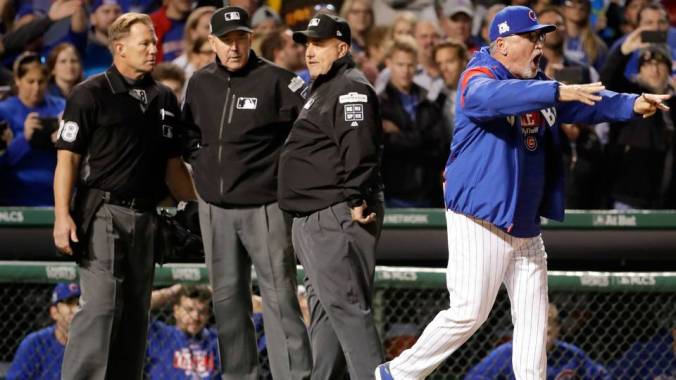
While the challenge was being reviewed, the Red Sox broadcasters, who had concluded that Bir should have been called safe at second, were talking about the rarity of the same umpire being reversed three times in a single game. Sox color man Dennis Eckersley wondered aloud if professional courtesy and loyalty might affect the review.  What he was really asking was whether the umpires in New York would allow a colleague to be exposed to the disgrace of being reversed three times in one game. This wouldn’t only  make him look bad, after all. It would make umpires look bad. Three strikes and you’re out, after all.

Sure enough, the decision from New York was that the call at second was correct. Bird was out, even though the video showed he was safe.

The umpires have plausible deniability here: this was hardly the first time that a replay review seemed at odds with a video. Nonetheless, it was a sobering display. By all appearances, the umpires distorted the game to protect one of their own who was having a terrible night. They were employing the Golden Rule in the kind of setting where the Golden Rule works against an ethical result, not for it.

Fortunately for the umpires, allowing the third blown call at second was allowed to stand had no effect on the game’s outcome, but that is just moral luck. The umpires made a very clear statement. They regard loyalty to colleagues as more important than their profession, the game, their fans, or public trust. They, or at least the umpires involved, cannot be trusted to put aside their biases and conflicts when their duties demand it. Technology may be unbiased, but the humans using it are not. Professionals are not always professional when a colleague’s fate is involved.

Humanity is the ultimate conflict.

When “Ick!” Strikes Out Ethics: The Intensifying Robo-Umpire Controversy

[I see that I last wrote about this issue in April, and before that, in June of 2016, and in 2012 before that.Well, it’s worth writing about again, and again, until ethics and common sense prevails.]

This weekend Major League Umpires held a silent protest, wearing armbands in support of colleague Angel Hernandez, whose competence was publicly questioned by Detroit Tiger player Ian Kinsler. In fact, Angel Hernandez is a terrible umpire, and terrible, indeed, even mildly fallible umpires have a problem now that they never had to worry about in the good old days: their mistakes are obvious and recorded for all to see.

Yesterday Red Sox color man and former player Jerry Remy was reminiscing during the Red Sox -Yankee game broadcast about one of his few home runs. He said he had struck out, missing with his third swing by almost a foot, and was walking back to the dugout when the umpire called him back, saying he had foul-tipped the ball. “I know that was wrong, but I’m not going to argue I’m out when the ump says I’m not.” Remy said. He went back to the plate, and on the next pitch hit a home run. “Of course, they didn’t have replay them,” Jerry added.

Before every game was televised and before technology could show wear each pitch crossed the plate, balls and strikes were called definitively by umpires, many of whom proudly had their own strike zones. “As long as they are consistent with it ” was the rationalization you heard from players and managers. It was, however, a travesty. The strike zone isn’t a judgment call; it is defined, very specifically, in the rules. A pitch is either within the legal zone or it is not. A strike that is called a ball when it is not, or vice-versa, is simply a wrong call, and any time it happens can affect the outcome of the at-bat and the game. If you watch a lot of baseball, you know that we are not just talking about strikeouts and walks.  The on-base average when a batter is facing a 2 balls, one strike count as opposed to a 1-2 count is significantly higher. The wrongly called third pitch can change the result of the at bat dramatically.

Since the technology is available to call strikes correctly 100% of the time, why isn’t the technology being used? Actually it is being used, in TV broadcasts. The fan can see exactly when the umpire misses a call, and the broadcasters talk about it all the time. “Where was that?” “That was a gift!”  “Wow, the pitcher was squeezed on that one.” Once, a missed call in a game was virtually undetectable, because one could assume that the umpire had a better and closer view than any fan or broadcaster could have. Now, there is no doubt.

Yet the players, sportswriters and broadcasters still overwhelmingly argue against the use of computer technology to call balls and strikes. It’s amazing. They know, and admit, that  mistaken  ball and strike calls warp game results; they complain about it when it happens, point it out, run the graphics repeatedly to show how badly a crucial call was botched, and yet argue that a completely fixable problem with massive implications to the players, the games and the seasons, should be allowed to persist.

These are the rationalizations and desperate  arguments they advance: Continue reading

An Ethics Hypothetical: If “The Nation” Is Right About The DNC Hacks, How Should Democrats And The Mainstream Media React?

And how will they react?

Yesterday, The Nation, the most Left of the Left’s major national publications, reported this:

  • There was no hack of the Democratic National Committee’s system on July 5 last year—not by the Russians, not by anyone else. Hard science now demonstrates it was a leak—a download executed locally with a memory key or a similarly portable data-storage device. In short, it was an inside job by someone with access to the DNC’s system. This casts serious doubt on the initial “hack,” as alleged, that led to the very consequential publication of a large store of documents on WikiLeaks last summer.
  • Forensic investigations of documents made public two weeks prior to the July 5 leak by the person or entity known as Guccifer 2.0 show that they were fraudulent: Before Guccifer posted them they were adulterated by cutting and pasting them into a blank template that had Russian as its default language. Guccifer took responsibility on June 15 for an intrusion the DNC reported on June 14 and professed to be a WikiLeaks source—claims essential to the official narrative implicating Russia in what was soon cast as an extensive hacking operation. To put the point simply, forensic science now devastates this narrative.

“This narrative” has been a cornerstone of the effort, undemocratic and indefensible, to undermine the legitimacy of Donald Trump’s Presidency from the beginning. It was launched as a primary rationalization for Hillary Clinton’s stunning loss, James Comey and a sexist, racist, stupid electorate being the others. As the Nation writes,

“The evolution of public discourse in the year since is worthy of scholarly study: Possibilities became allegations, and these became probabilities. Then the probabilities turned into certainties, and these evolved into what are now taken to be established truths. By my reckoning, it required a few days to a few weeks to advance from each of these stages to the next. This was accomplished via the indefensibly corrupt manipulations of language repeated incessantly in our leading media.”

The Nation’s report, essentially declaring that a major element in the “Russiagate” narrative, the DNC hacks, is fiction, that the intelligence agencies that declared it otherwise are wrong, and that Wikileaks, Russia, Putin and Donald Trump have been correct all along is noteworthy because the publication is no ally of the Republicans or Trump, but their declared intractable foes. This is an ideological publication, squarely in Bernie Sanders’ camp because it is run by Socialists like Bernie. But bias doesn’t necessarily make you stupid. The Nation has been around for a long time because while its analysis is colored by it view of humanity and the world, it has largely avoided the kind of dishonesty and distortion that are slowly destroying the credibility of CNN, Rolling Stone, the New York Times and others. The Nation has strived to maintain its integrity, not always succeeding, but obviously trying. Its staff believes that the truth supports its dedication to socialism, so it does not usually try to hide the truth—unlike the mainstream media reporters, for example, who apparently tried hard to make the troubling episode of Bill Clinton’s meeting with Loretta Lynch go away. Continue reading

Comment Of The Day: “The Viral Google Diversity Memo”

The perspective Ethics Alarms readers often add to topics based on their personal experiences is a often great enhancement to the discussions here. This Comment of the Day by Alex is a perfect example, as he clarifies the context of the Google diversity memo through his own observations as an employee of another large tech company.

Here is his Comment of the Day on the post, “The Viral Google Diversity Memo”:

Rather than rehash the memo or analyze it or say what is right or wrong with its reasoning, I’ll instead add my experience dealing with internal policies and “requests for comment” at a large tech (software) company – this is a direct competitor of Google, based in the Pacific NW and employing ~100,000 people (you can figure out who they are with that). My background is in Electrical Engineering with a strong focus on Computer Science, and I was hired by my previous employer just out of college after spending a summer internship with them. I worked there for 12 years, until the summer of 2016 (actually today is my one year anniversary at my new job). In my time there I can only describe diversity and HR policies around race and gender are schizophrenic, even if well-intentioned. These are my stories [insert Law and Order opening notes].

The official harassment/discrimination policy as stated in the employee handbook (which was updated every year) is incredibly vague, and this is intentional (although no one will come out and accept it publicly). We are in an at-will state, so you can be easily dismissed based on that one vague rule; and it has been used as a negotiation tactic on borderline performance dismissals to settle for a lower severance package. (“Do you really want us to state that you’re leaving for violations of the harassment policy? No? Ok, how about you settle for 2 weeks instead of 4?”) But I also have to state that the cases where I saw this section being arguably misused can be counted with the fingers of one hand. Also, I am certain that there are good intentions behind this policy, but as is the case with many well-intentioned rules, it is when the rubber meets the road that things get messy.

Every year we had to take Standards of Conduct training. Every year we had a new edition, and every year there was at least one case study dealing with gender or racial discrimination. Some years were better than others, but in general the training was terrible. If you had the cognitive abilities of a 7-year-old you could figure out what were the right responses without watching the videos or reading the policies. (The Saturday morning cartoons I watched in the 80s – G.I. Joe, He-Man, Transformers – had more complex moral dilemmas). I remember one year around the middle of my tenure when the videos and cases were actually interesting and engaging. A case that I still remember from that time is about an ambiguous situation between a male manager and a female engineer not in the same chain of command. There was a big internal debate about that one, and the next year we had the blandest possible training to avoid controversies.

The above two points are to set the stage: corporate policies are clear, you should toe the line, do not do anything that might be misconstrued, you can be dismissed for very small transgressions.

And then… well… tech companies are rebels, they thrive in chaos, and you’re expected to rock the boat. In many (may be even all) groups you can only grow so much by being a technical expert, you are expected to influence larger and larger teams as you get promoted to keep getting good performance reviews. You can be the only expert on a certain software component, but unless other people know about you and have been “influenced” by you, you are not considered good enough. This has the effect of incentivizing “visibility”. Other people and other teams should know you exist and be willing to state that you’ve had a positive impact for the company. Continue reading

That Viral Google Diversity Memo

I’m going to vary a bit from typical Ethics Alarms practice, and ask for comments on the long, viral, controversial memo by a Google  software engineer named James Demore regarding the company’s diversity initiatives before I do a thorough analysis of it.  The author has been fired, of course. He had to know he would be.

The essay covers a lot more than diversity—gender stereotypes, the radioactive question on innate differences between men and women, ideology over reality, fairness, oppressive cultures, and much more. It is courageous; it’s also unethical. Ambushing an employer like this—it is fair to say that the essay has caused a PR crisis for Google—is never fair. He would argue, I suspect, that this was a form of whistleblowing, as well as taking a stand for other employees who feel as he does but who fear making their opinions known.

I have taught diversity seminars, often in conjunction with sexual harassment and bias training. The area is inherently dishonest. Of course all races, genders and creeds, ages and types should be welcome in a work environment. The claim that diversity is inherently valuable for its own sake, however, is nonsense, a phony “fact” declared to bootstrap other initiatives, such as affirmative action. The alleged innate value of diversity is cited to justify the and out-balance the inherent disadvantages and injustice of not hiring the best applicants for a job or position based on their demonstrated abilities and experience. This is a myth, and pretty obviously so. Diversity is not a virtue when it leads to incompetence, bias, resentment, and staffing that is less talented and effective than it might be. Diversity should never take priority over getting a job done as well as possible.

The bias in the news media’s coverage of the memo has been palpable, and would be very revealing regarding how ideological bias warps coverage, if so much evidence didn’t already exist. This particular biased reporting is likely to mislead more than it should, because the memo is long, and most readers will accept on faith (why? WHY???) the false characterizations of it. It is not a “screed” (The Atlantic), a “tirade” (TIME), or “sexist.” (Recode). The memo does not say that women are inferior,  or “genetically unsuited” for tech jobs. (Washington Post). Nor does he write that women are “biologically unfit” for tech jobs. (CNN). The memo isn’t even “anti-diversity” (Vanity Fair, Forbes). This is how ideological propaganda works: slap labels on inconvenient arguments that will pre-bias an objective or open-minded readers.

You should read the whole thing, which is below. As you read it, think about the fact that Google has stated that the content of the memo violated aspects of Google’s Code of Conduct. I find that incredible, and a greater indictment of Google than the memo itself.

The highlights in blue are mine, and reserved for what I regard as ethically significant sections. Continue reading

The Unabomber Had A Point. [UPDATED]

FX has a new limited series about the hunt for the Unabomber, Theodore John Kaczynski. I didn’t pay much attention to the story when it was going on; I just thought it was one more Harvard-grad-turns-serial-killer episode, and that was that. I certainly didn’t pay attention to his “manifesto.” The series, however, enlightened me.  As I understand it, Ted believed that technology was destroying society, making us all slaves to it, and taking the joy out of life. I have yet to see how blowing people up addressed this problem, but then he shouldn’t have to be right about everything. The evidence has been mounting since 1995, when he killed his final victim,that  the Unabomber  wasn’t quite as crazy as we thought.

I could bury you in links, but will not.  We are slaves, for example, to passwords. I teach lawyers that their devices containing client confidences should, to be properly protective of them under ethics standards, have passwords of at least 18 random letters, characters and numbers, with the password for every such device being different, and all of them changed every month. Or you can go the John Podesta route, use “password.” and get hacked, and eventually disciplined by your bar association, once they decide to get serious.

[CORRECTION: In the original post, I relayed a link to a site where you can check your password to see if it’s been compromised. I had been forwarded the link by another tech-interested lawyer. But as I was just alerted by a commenter (Than you, Brian!) It’s apotential trap and an unethical site, making you reveal your password to check it. I apologize for posting it. See how dangerous and tricky this stuff is? See? SEE?.I fell for the trap of depending on technology to protect us from technology! Ted warned us about that, too.]

Then there is this feature in The Atlantic. An excerpt: Continue reading