Incompetence Saturday Begins: That Annoying “Ten Concerts, One’s A Lie” Facebook Game

It’s a relief to know that I occasionally pay attention to what I teach.

When so many of my Facebook friends started rushing like lemmings to play the viral “Name ten concerts you attended, with one phony one” game yesterday, I hesitated, and not just because listing Al Jolson, Enrico Caruso and  Jenny Lind would reveal my true age. I had just been explaining to a group of Pennsylvania lawyers that they probably weren’t as competent in using technology and social media as they thought they were, and that if there was one thing of value to extract from the last Presidential campaign, it was a searing lesson in the consequences of being naive, lazy and gullible while using the internet. (Yes, I’m looking at you, John Podesta!)

By purest coincidence, yesterday also marked my four hour efforts, involving four phone calls, three phones, two websites, three passwords and a consultant (my son), to switch my e-mail address from Verizon to AOL, since AOL has purchased Verizon’s e-mail business. As I neared the finish line of this ordeal, I encountered AOL’s list of “Secret Security Questions.” One of them was “What was the first concert you attended?

Hmmmm… Continue reading

The Umpire’s Botched Call, Moral Luck, And When Using Technology Becomes Ethically Mandatory

The Washington Nationals beat the Atlanta Braves on Tuesday, but if they hadn’t, we might be seeing the beginning of tidal wave of public opinion demanding that available technology be employed to avoid catastrophic umpire incompetence.

Washington had a 3-0 lead entering the bottom of the ninth. The Braves mounted a rally,scoring one run and then loading the bases with only one out. At that point Nationals manager Dusty Baker  removed struggling closer Blake Treinen  for Shawn Kelley

Kelley got his first batter to foul out, and then appeared to strike out Chase d’Arnaud, swinging. The game was over: the Nationals came out to congratulate each other, and the ground crew moved onto the field. d’Arnaud, however, argued to home plate umpire C.B. Bucknor that he had foul-tipped the ball into the dirt before the Nat’s catcher caught it. Bucknor agreed, and everyone was called back onto the field.

Kelley struck out d’Arnaud again, so no harm was done. But  videos of the “foul tip”  showed that the batter hadn’t come close to hitting the ball on the pitch Bucknor ruled a foul tip. He missed it by a foot.

If d’Arnaud, given an unearned second chance, had cleared the bases with a ringing double, the baseball world would be going nuts right now; that he didn’t was just moral luck. It went kind of nuts anyway. Bucknor is a terrible umpire, as his awful calls showed throughout the game, which was a typical performance for him. If the botched foul tip call had occurred later in the season during a crucial game, or during the post-season,  it might finally prompt Major League Baseball to use available technology and have balls and strikes called electronically, or at least have a fail-safe review system where an umpire viewing pitched on a TV monitor could instantly overrule a terrible, obvious, game changing call by the home plate umpire.

At this point, it is irresponsible for MLB not to use the Bucknor botch as impetus to make these changes now, before a disaster, realizing that a lucky near-miss shouldn’t be treated any differently. It won’t, however. It will wait until the horse has not only escaped the barn, but escaped the barn and trampled some children, before putting a lock on the door.

THREE Comments Of The Day (Really Useful Ones): “Tech Dirt’s Mike Masnick On The Internet Privacy Bill”

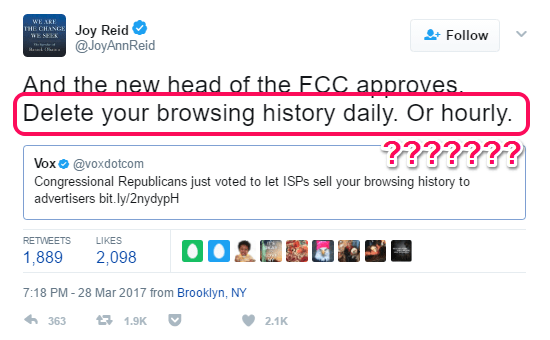
There were not one but three excellent, informative, detailed comments, one after the other,  in response to the post about the GOP’s elimination of the recent Obama FCC regulations of Big Data gathering by broadband providers. Technology competence is, I believe, the greatest looming ethics issue for the professions, and it is important for the general public as well. All three of these Comments of the Day are educational. If only the news media and elected officials were as well-informed as Alex, John Billingsley, and Slick Willy.

I am very proud of the level of the discourse on Ethics Alarms, and these three Comments of the Day on the post Ethics Quote Of The Month: Tech Dirt’s Mike Masnick On The Internet Privacy Bill are prime examples.

First, here’s slickwilly:

How to be safe with electronic data

First rule: anything online is vulnerable, no matter who secures it. It follows that any computer/device connected online is also vulnerable.

Second rule: Public WiFi is hack-able, and doing so is not that difficult. Someone just has to want to. Using it for playing games could make you vulnerable, and using it to access your financial information (banks, brokers, etc.) is stoopid

Third rule: Anything you do electronically is forever. Any tweet, snap chat, Facebook post, cell phone text or conversation, email, web post, browsing activity, and anything else may be saved by someone. Some of those are harder to get than others: browsing activity takes a snooper on the data line, or a court order to set a snooper up at your ISP. For instance, all cell phones activity is now all saved by the NSA, including where the phone was when. No, no one looks at it, not until they have a reason to research a person, perhaps years later. ‘Smart’ TVs can record you in your own home, without your knowledge, unless you take steps to stop it (electrical tape over cameras/microphones is a start, but still not enough)

Fourth rule: Any public activity can be recorded today. Besides CCD cameras everywhere and license plate readers on many roads, facial metrics can track you in most urban and many rural areas. Even going into the desert or mountains could be spotted via satellite, should the motivation be enough to look your way.

So don’t leave your computer connected to the Internet 24/7 (a power strip that stops electricity from reaching the computer helps cut connectivity when ‘off’), do nullify the ability of other devices to spy on you in your home, and never say anything electronically you do not want going public. Use complex passwords, and never the same for multiple sites. Password safes are better than written notes (and Apple Notes are silly to use for this.) How much you protect yourself depends on your level of paranoia.

Do you have something to hide? A secret you would rather not be made public? Do not document it electronically! Or use the method below.

Now, how to be safe with electronic information: Place it exclusively on an air-gapped (no network connection at all) computer. Place that computer in a heavy steel safe. Encase that safe in concrete, take it out to a deep ocean trench, and drop it overboard. Forget the coordinates where you dropped it.

The point is, nothing is fool-proof

You can take steps to lower the probability that your information gets out, but even using paper and quill pen was only so good as the physical security the document was placed under. Learn some simple steps and you will remove yourself from the radar of most predators. People are careless, apathetic, and just plain dumb, so anything you do helps keep you safer.

I keep such information in a secure, encrypted flash drive that is not stored in a computer USB slot. Could someone break the encryption, should they find the drive and wish to spend the effort? Sure. But if they want me that badly they will get me, one way or another. Why would they? I do not have any deep dark secrets or hidden crimes in my past. Even so, why should my business be available to anyone just to browse through?

Your mileage may vary, but doing nothing is unethical in my responsibilities to my family.

Now John Billingley’s contribution:

Continue reading

Ethics Quote Of The Month: Tech Dirt’s Mike Masnick On The Internet Privacy Bill

“We don’t solve problems by misrepresenting what the real scenario is. It’s true that ISPs have way too much power over these markets, and they can see and collect a ton of information on you which can absolutely be misused in privacy-damaging ways. But let’s at least be honest about how it’s happening and what it means. That’s the only way we’re going to see real solutions to these issues.”

Mike Masnick on Techdirt on the ignorance of  supporters, critics, and the public regarding consumer broadband privacy protections, which were just repealed by straight party line votes in Congress, as part of the Congressional Review Act, which allows the legislative branch to eliminate regulations and limits an agency’s ability to issue similar rules to the ones being struck down. President Trump is expected to sign the bill.

I can see both sides of the Internet “privacy” debate. All I ask is that the average screaming head on TV knows what she’s talking about, and that the news media try to educate citizens on the issue, not portray it as another Obama did it so it’s wonderful, Trump is overturning it, so it’s the end of the world. This morning I watched Morning News Babe Robin Meade roll her eyes while “describing’ what the bill does completely inaccurately. The bill, her unhappy face broadcast is baaaad like everything the Trump Administration and Republicans do is baaaaad. Then she explained that the bill would allow internet service providers, browsers and “search engines” to take your internet history and sell it to big corporations.  Then she giggled about how Max Temkin, inventor of some card game* I have never heard of, promised in a tweet…

“If this shit passes I will buy the browser history of every congressman and congressional aide and publish it.”

Robin, not having the foggiest idea what the bill really did, thought this was so funny and cool. She did not inform her audience, some of whom were actually seeking reliable information and not just tuning in to ogle, that..

  • The bill only undoes the Obama FCC regulations that stopped ISPs from gathering data on its customers’ internet use, and they hadn’t taken effect yet. In other words, it changes nothing.
  • Google, Amazon, Facebook, and other browsers and internet services still can gather anything they get their grubby cyber paws on. The FCC doesn’t regulate them.

You can’t buy Congress’ internet data. You can’t buy my internet data. You can’t buy your internet data. That’s not how this works. It’s a common misconception. We even saw this in Congress four years ago, where Rep. Louis Gohmert went on a smug but totally ignorant rant, asking why Google won’t sell the government all the data it has on people. As we explained at the time, that’s not how it works*. Advertisers aren’t buying your browsing data, and ISPs and other internet companies aren’t selling your data in a neat little package. It doesn’t help anyone to blatantly misrepresent what’s going on.

When ISPs or online services have your data and “sell” it, it doesn’t mean that you can go to, say, AT&T and offer to buy “all of Louis Gohmert’s browsing history.” Instead, what happens is that these companies collect that data for themselves and then sell targeting. That is, when Gohmert goes to visit his favorite publication, that website will cast out to various marketplaces for bids on what ads to show. Thanks to information tracking, it may throw up some demographic and interest data to the marketplace. So, it may say that it has a page being viewed by a male from Texas, who was recently visiting webpages about boardgames and cow farming (to randomly choose some items). Then, from that marketplace, some advertisers’ computerized algorithms will more or less say “well, I’m selling boardgames about cows in Texas, and therefore, this person’s attention is worth 1/10th of a penny more to me than some other company that’s selling boardgames about moose.” And then the webpage will display the ad about cow boardgames. All this happens in a split second, before the page has fully loaded.

At no point does the ad exchange or any of the advertisers know that this is “Louis Gohmert, Congressional Rep.” Nor do they get any other info. They just know that if they are willing to spend the required amount to get the ad shown via the marketplace bidding mechanism, it will show up in front of someone who is somewhat more likely to be interested in the content.

That’s it.

Got that, Robin?

Probably not. Continue reading

Ethics Quote Of The Day: Supreme Court Justice Stephen Breyer

breyer

“The state has a reason? Yeah, it does. Does it limit free speech? Dramatically. Are there other, less restrictive ways of doing it? We’re not sure, but we think probably. . . . Okay. End of case, right?”

—-Supreme Court Justice Stephen Breyer, during oral argument in the case Packingham v. North Carolina, describing how state laws are traditionally seen by the Court as infringing on freedom of speech.

Lester Packingham was registered as a sex offender in 2002 after pleading guilty to statutory rape with a 13-year-old girl (he was 21). He served his time and probation, and then, in  2010, Packingham posted on Facebook to thank the Lord for a recently dismissed parking ticket, writing, “Man God is Good! How about I got so much favor they dismissed the ticket before court even started? . . . Praise be to GOD, WOW! Thanks JESUS!”

Jesus, however, did not stop him from being prosecuted for that message under a 2008 North Carolina law that prohibits registered sex offenders from accessing social media, on the theory that it gives them access to minors.

Packingham appealed the resulting conviction, arguing that the law violated his First Amendment rights. The Supreme Court accepted the case, which could  determine whether access to social media sites like Facebook, Youtube, and others are a fundamental right.

In oral argument this week, observers got the distinct impression that this is where the Court is headed. At least five justices, a majority of the temporarily reduced court, suggested during argument that they would rule against North Carolina and for Packingham , whose lawyer says that more than 1,000 people have been prosecuted under the law.

Reading various reports of what was said, I am stunned by how out of touch everyone involved sounds. The Washington Post story describes Justice Kagan like she’s a web-head because she’s “only” 59.  “So whether it’s political community, whether it’s religious community, I mean, these sites have become embedded in our culture as ways to communicate and ways to exercise our constitutional rights, haven’t they?” Kagan asked North Carolina Deputy Attorney General Robert C. Montgomery, who was defending the law.

Do we really have to ask that question today? The law was passed in 2008, which in technology and social media terms makes it archaic. Legislators can be forgiven for not understanding the central role of social media in American life nine years ago, but in 2017, when we have a President tweeting his every lucid thought (and many not so lucid), how can anyone defend the argument that blocking a citizen from social media isn’t an extreme government restriction on free speech? Laws related to technology should all have sunset provisions of a couple years (a couple months?) to ensure that they haven’t been rendered obsolete by the evolving societal use of and dependency on  the web, the internet, and new devices. Continue reading

Fast Food Ethics: Subway’s Chicken TASTES Like Chicken—Isn’t That Enough?

OK, what's in this Teriyaki Sweet Onion Chicken sandwich? (Hint: It's a trick question...)

OK, what’s in this  Sweet Onion Chicken Teriyaki sandwich? (Hint: It’s a trick question…)

DNA researcher Matt Harnden at Trent University’s Wildlife Forensic DNA Laboratory, working out of  Peterborough, Ontario, analyzed six popular chicken sandwiches served at various fast food chains. Unadulterated chicken should have 100% chicken DNA, or close to it. Seasoning, marinating or processing meat  bring that number down some , so fast food  wouldn’t be expected to have a perfect score.

The chicken in the following sandwiches were tested: McDonald’s Country Chicken – Grilled,Wendy’s Grilled Chicken Sandwich, A&W Chicken Grill Deluxe,Tim Hortons Chipotle Chicken Grilled Wrap, Subway Oven Roasted Chicken Sandwich, and Subway Sweet Onion Chicken Teriyaki, which is made with chicken strips.

The lab tested two samples of five of the chicken meat fillings, and one sample of the Subway strips. From each of those samples, the researchers isolated three smaller samples and tested each of those. The scores were then averaged for each sandwich. The results? Continue reading

Vintage Fake News: The Ridiculous Doomsday Clock

Doomsday clock showing 3 minutes to midnight

I’m sure you have noticed that the scary Doomsday Clock, which tells us how long we have until “midnight,” aka. nuclear Armageddon, has been on the move again.

NBC News recently announced that the dreaded Clock was ticking like the soundtrack of “24 Hours, proclaiming: “Thirty seconds closer to global annihilation!”   The New York Times, which now averages at least eight “President Trump is a menace to civilization!!! ARGGH!!!” columns, editorials or news stories every…single…day, duly announced, “Thanks to Trump, the Doomsday Clock Advances Toward Midnight.” Across the pond, the UK’s Independent stated as fact, “We’re closer to doom than any time since the Cold War!”

Why? Because the Doomsday Clock says so!

Can we officially make that “The Ridiculous Doomsday Clock?” This has to be the most useless and malfunctioning timepiece in recorded history.  Even a stopped clock is right twice a day: this damn thing is never right.

The Bulletin of The Atomic Scientists dreamed the gimmick up back in 1947 , and its initial setting was “seven minutes to midnight” as in…

What sense did it make to have a clock already set at seven minutes to 12? Why wasn’t it at least a seven-minute stopwatch? What was its setting during the Black Plague? Did the dinosaurs have a Doomsday Clock? Did a wise Diplodocus and a precocious Stegasaurus see a meteor coursing through the Jurassic skies and conclude, “Oh oh. Eventually one of those is going to land here, and we’re all toast. Move the Doomsday Clock to 80 million years before midnight, let’s settle our affairs, and tell the rest of the gang that the mammals are coming…”?

The group of egg-heads devising the clock explained that it symbolized ” the urgency of the nuclear dangers that the magazine’s founders—and the broader scientific community—are trying to convey to the public and political leaders around the world.” OK, I can see that as a minor, fear-mongering news item in 1947—kind of like the climate change hysteria is now—but I would also say that when a group describes a peril as urgent and it hasn’t urged in 70 years, that isn’t just old news, it isn’t newsworthy at all. Continue reading

The 8th Annual Ethics Alarms Awards: The Worst of Ethics 2016: The Last Of The Worst

how-lead-gets-injpg-1e9d798a1edee129

Ethics Alarms wraps up the Worst in 2016 Ethics with the usual education and journalism breaches, Ethics Dunce of the Year, and more delights for the sadistic…

Unethical Government Fiasco Of The Year

The Flint, Michigan water crisisA failure of competence, diligence, responsibility and honesty, compounded by bureaucrats, elected officials, the city of Detroit, Michigan Governor Rick Snyder and the EPA made people sick and cost billions.

Good job, everybody!

Scam of the Year

Sen.Ted Cruz’s fake “official” mailer before the Iowa Caucus. Cruz’s campaign  sent out mailers labeled in all capital letters, “ELECTION ALERT,” “VOTER VIOLATION,” “PUBLIC RECORD,” and “FURTHER ACTION NEEDED.” On the other side, the mailer said, in red letters at the top, “VOTING VIOLATION.” The text read:

You are receiving this election notice because of low expected voter turnout in your area. Your individual voting history as well as your neighbors’ are public record. Their scores are published below, and many of them will see your score as well. CAUCUS ON MONDAY TO IMPROVE YOUR SCORE and please encourage your neighbors to caucus as well. A follow-up notice may be issued following Monday’s caucuses.

This is why Trump’s nickname for Cruz, “Lyin’ Ted,” was crude but accurate.

Ethics Dunces Of The Year

All the social media users and others who ended Facebook friendships, genuine friendships and relationship over the 2016 election. Haven’t they ever seen “It’s A Wonderful Life”? Morons. Shame on all of them.

Weenies of the Year

The college students who demanded that exams be cancelled, therapists be available, safe spaces be found, puppies be summoned and cry-ins be organized because the awful candidate they supported in the Presidential election lost, as candidates often do.

How embarrassing.

Unethical University Of The Year 

Liberty University.  This is the most competitive of categories, with all the schools that railroaded male students based on questionable sexual assault claims while quailing in fear of the Dept. of Education’s “Dear Colleague Letter,” and all the schools that signaled that the results of a simple election justified PTSD treatment for their shattered charges, as well as making it clear to any students who dared to tilt Republican that they were persona non grata. Nonetheless, Liberty University takes the prize with its unique combination of greed, hypocrisy, and warped values. From the Ethics Alarms post:

Last week, with great fanfare, Liberty hired Ian McCaw as its new athletic director. “My vision for Liberty is to position it as a pre-eminent Christian athletic program in America,” McCaw said during a news conference.

This is his first paying assignment since May, when he left his job as the athletic director at Baylor, also a Christian university. His departure was made essential after a thorough investigation that found that those overseeing Baylor’s  football team as well as the management of  the athletic department—that is, McCaw— had been informed of multiple gang rapes and sexual assault by team members and had ignored it, as any good football-loving Christian would….especially when a star was involved.

Continue reading

Self-Driving Car Ethics: Who Do They Decide To Kill? You?

av-choice

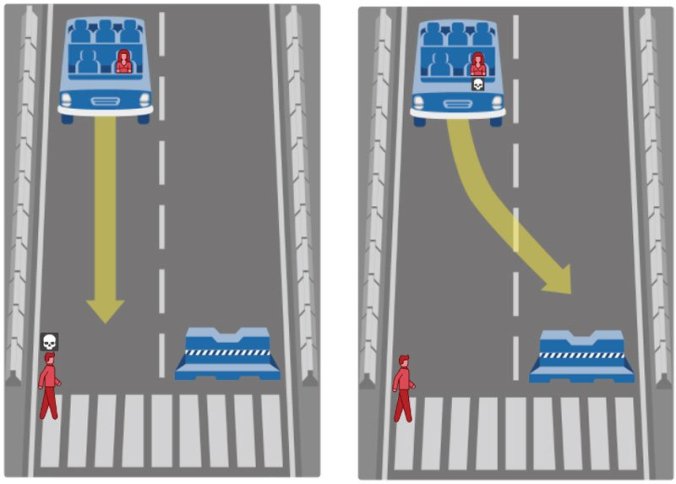
CBS’s “Bull,” a drama about a jury consultant (played by “NCIS” alum Michael Weatherly) is an ethics mess…but then, so is the former jury consultant Weatherly’s  character is loosely  based on: “Dr.” Phil McGraw. The show does find some interesting ethics issues, however. A couple of weeks ago the story involved the programming in an experimental self-driving car. The issue: is it ethical for such a car to be programmed to kill its passenger if it has to make a life or death choice?

The ethical conflict involved is the so-called “trolley problem,” which is, as the name suggests, over a hundred years old. British philosopher Philippa Foot developed it into series of hypotheticals in 1967. In 1985, American philosopher Judith Jarvis Thomson scrutinized and expanded on Foot’s ideas in The Yale Law Journal. Here is one of Thompson’s scenarios:

“Suppose you are the driver of a trolley. The trolley rounds a bend, and there come into view ahead five track workmen, who have been repairing the track. The track goes through a bit of a valley at that point, and the sides are steep, so you must stop the trolley if you are to avoid running the five men down. You step on the brakes, but alas they don’t work. Now you suddenly see a spur of track leading off to the right. You can turn the trolley onto it, and thus save the five men on the straight track ahead. Unfortunately,…there is one track workman on that spur of track. He can no more get off the track in time than the five can, so you will kill him if you turn the trolley onto him.”

The problem: Now what, and why?

A. Throw the switch in order to maximize well-being (five people surviving is greater than one).
B. Throw the switch because you are a virtuous person, and saving five lives is the type of charitable and compassionate act a virtuous person performs.
C. Do not throw the switch because that would be a form of killing, and killing is inherently wrong.
D. Do not throw the switch because you are a Christian, and the Ten Commandments teach that killing is against the will of God.
E. Do not throw the switch because you feel aiding in a person’s death would be culturally inappropriate and illegal. Continue reading

Finally! A Complete List Of Argument Fallacies…

Finally!

Finally!

Logical fallacies are as pernicious as rationalizations, and also as popular. Ethics Alarms been searching for a comprehensive list of the former that is as complete as this site’s constantly growing list of the latter-–I can’t compile both, and EUREKA! I found one, the excellent work of scientist and prolific blogger Don Lindsay. He goes far beyond the most commonly referenced fallacies, such as “No True Scotsman” and  “The Texas Sharpshooter,” “Equivocation,” “Straw Man Arguments, “Appeal to Authority,” and the one so many people get wrong, “Ad Hominem.”  Don has identified, complied and described 93 of them, each an obstacle to productive discourse and honest inquiries into ethics and other topics.

Wonderful.

They are… Continue reading