Ethics Dunce: Oprah Winfrey

If enough of these tune in to your TV show, the number of real viewers don't matter. Which gave Oprah an idea...

Oprah Winfrey’s new cable network, OWN, is foundering, so the much-worshipped icon of female empowerment empowered herself to rig the ratings system by sending out this tweet to her gazillion Twitter followers ( all right, she has only 9, 253, 598) Sunday night:

“Every 1 who can please turn to OWN especially if u have a Neilsen* box.”

OWN was debuting a new show called “Oprah’s Next Chapter.” Since a Nielson household is one of the 25,ooo Americans whose viewing habits are extrapolated to calculate the estimated viewers of any program nationwide, a direct appeal to someone with a Nielson box is an attempt to cheat. Those boxes count as many thousands of viewers in the ratings process, which is why the identity of the Nielson household is carefully protected. It is also why the penalty for trying to manipulate the ratings (if only the Nielson households and nobody else watched Oprah’s show, the ratings would inaccurately indicate that the program was a sensation) is to have the offending program’s ratings erased entirely. Continue reading

The Perils of Ignoring Professionalism

Robert Stack as Eliot Ness with the rest of TV's "The Untouchables." Now THOSE guys were professional. You'd never see THEM text messaging jokes to Al Capone...

The Washington Post ran a story Tuesday describing how the defendants in an elaborate FBI sting operation escaped conviction as a consequence of the revelation of racy text messages between the agents and their undercover informant. Agents and their key informant bantered “about sex, booty calls, prostitutes, cigars, the Village People, the informant’s wives and an agent’s girlfriend.”  When the arrests were first announced by the Justice Department, the operation was regarded as a model law enforcement success. But federal prosecutors failed to win a single conviction,  in large part because defense lawyers used the text messages to raise juror doubts about the credibility and professionalism of FBI agents. Now the Justice Department says that in light of the first two trials, the government is evaluating “whether to continue to go forward” with the remaining prosecutions of 16 defendants, seven of whom had their cases end in hung juries.

During the most recent trial of six men and women on charges of paying bribes to win business with a foreign government, the defense attorney used the FBI’s texts both to attack the character of the informant and to suggest that the lead agent was an untrustworthy, bigoted, anti-gay misogynist. The FBI believes this was unfair, and an example of a lawyer’s trick defeating justice. Informants, almost without exception, are sleazy characters, and managing them takes skill and guile. The agents felt it was essential to build trust, which meant working to develop a collegial  relationship, at least in the informant’s mind. The text banter, they say, was designed to ensure the loyalty of a low-life, which required the agents to sometimes act like low-lifes themselves. Thus they texted messages back and forth that included bawdy jokes, innuendos about sex, anti-gay stereotypes and more, all in a buddy-buddy tone that the jury found troubling. “The texts were one of many things that point to an absolutely amateurish operation,” the jury foreman told the Post. Continue reading

Comment of the Day: “‘Who Ya Gonna Call?'” Paranormal Ethics, and the Irony of Same”

"I'm sure there's a perfectly rational explanation for this. Let's go figure it out in a motel."

The Comment of the Day is an interesting one from Melissa Leath, a psychic who is published on the topic of psychic ethics. She is responding to the recent post here about proposed standards for paranormal investigators.

Her measured response forces me to confront my own ambivalence on this issue. I am, as she says, a skeptic; more than a skeptic, really, as I intellectually am committed to the position that all paranormal, psychic and spiritual phenomenon, including those in the realm of religious believe, are imaginary at best and fraudulent at worst. I would have said “unshakably committed, ” but emotionally, I have to confess am not as sure as I would like to be, or should be. Perhaps I watch too many horror movies. I don’t like Ouija boards, and won’t have the damn things in the house. If my kitchen furniture suddenly rearranged itself like it does in “Poltergeist,” or if my ultra-rational son started telling me that an old man in 1940s clothes kept appearing in his room at night and saying that he was going to hurt him, or if I saw dark, inky shadows crawling up the wall like in “The Grudge,” I can say with conviction that I would not be the one insisting that there must be a rational explanation and hanging around waiting for the bed to start raising off the floor. I would be the one out the door and checking into a motel, and from the safety of which  insisting that there was a rational explanation, but also secretly fearing that my house had been built over a Native American burial ground.

I realize that this is inconsistent and silly.  But I have a good friend who is as normal and sincere as someone can be who is a serious astrologer. And when I see the late Telly Savalas finally tell his personal ghost story in a YouTube clip, after personally watching him refuse to repeat it on TV talk shows for decades because “it was too scary,” I do wonder, even as I rebuke myself for wondering. Knowing that I wonder, however, it is only fair to give Melissa her say.

Here is her “Comment of the Day” on “‘Who Ya Gonna Call?'” Paranormal Ethics, and the Irony of Same.” Continue reading

Ethics Hero Emeritus: Roger Boisjoly (1938-2012)

Roger Boisjoly’s death was originally just reported locally when he died in Utah last month at the age of 73. Only now is the media reminding the public of Boisjoly’s life, his tragic role in a national tragedy, and how he tried and failed to avert it.

In 1986, Boisjoly was a booster rocket engineer at Morton Thiokol, the NASA contractor that, infamously, manufactured the faulty O-ring that was installed in the Space Shuttle Challenger, and that caused it to explode. Six months before the Challenger disaster, he wrote a memo to his bosses at Thiokol predicting”a catastrophe of the highest order” involving “loss of human life.” He had identified a flaw in the elastic seals at the joints of the multi-stage booster rockets: they tended to stiffen and unseal in cold weather.  NASA’s shuttle launch schedule included winter lift-offs, and Boisjoly  warned his company that send the Shuttle into space at low temperatures was too risky. On January 27, 1986, the day before the scheduled launch of the Challenger, Boisjoly and his colleague Allan J. McDonald argued for hours with NASA officials to persuade NASA to delay the launch, only to be over-ruled, first by NASA, then by Thiokol, which deferred to its client.

And the next day, on a clear and beautiful morning, the Shuttle’s rocket exploded after take-off, killing the crew of seven and mortally wounding the space program. Continue reading

Nipping A Terrible Idea In the Bud

God bless America.

In policy debates over contentious issues like abortion, national health care, and capital punishment, a common argument, brandished like a flag , is that the United States is out of step with the rest of the world. My reflex reaction to that claim, when I can resist the impulse to say, “Good!”, is to point out that the rest of the world has never lacked for enthusiasms for terrible ideas, and the United States, by going in its own direction, has often been unique, innovative, and right.

Still, a bad idea abroad will inevitably inspire some enterprising social architect here to propose it, and a legislator to try to make it law. Thus, when possible, it is wise to try to identify and reject the most sinister examples of Europe being Europe before anyone here starts trying to play “me too.” In the case of Europe’s current push to create a so-called “right to be forgotten” on the internet, some very effective critics are on the case. Continue reading

Incompetent Elected Official of the Month: Indiana State Senator Dennis Kruse

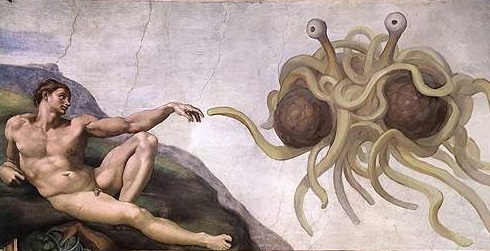
Time to reconsider the Greek Gods...because the oldest theories are the best theories.

Indiana State Senator Dennis Kruse is responsible for Senate Bill 89, recently passed by the Indiana Senate, which would allow schools to teach “creation science” — the oxymoron that really means “The Bible” —as an alternative to the scientific Theory of Evolution. Of course, the U.S. Supreme Court specifically outlawed this fundamentalist aganda in the 1987 court decision Edwards v. Aguillard. Kruse however, thinks that the bill could lead to a court challenge, and a Supreme Court reversal. “This is a different Supreme Court,” he has said. “This Supreme Court could rule differently.”

It isn’t that different, Senator. They all have law degrees, they’ve all read the Constitution,they’ve all seen “Jurassic Park.” They all have IQs above freezing, unlike…well, never mind. By the way, Kruse is a Republican, as if you hadn’t guessed. Continue reading

Ethics Dunces: Administrators at Mustang (Oklahoma) Mid-High School

"No whistles allowed in class, kid. You're suspended!"

In Mustang, Oklahoma, a ninth-grader used his cell phone to snap a photo of  his substitute teacher who was sleeping on the job, in class. Guess what happened?

The student was suspended for violating a school policy prohibiting the use of electronic communication devices during school hours.

This combines the irresponsible unfairness of “no-tolerance” policies with old-fashioned retaliation against whistle-blowers.  The student did the only thing he could do to record a breach of duty by the snoozing teacher, who was cheating students out of their education, cheating the school out of work it had contracted for, and cheating Mustang tax-payers out of their hard-earned cash. Using a cell phone for this purpose was not only ethical but essential to solving the problem. In a business, an employee who used a camera to record on-the-job misfeasance or malfeasance would be protected from adverse job action no matter what policies he broke, because he would be a whistle-blower. The 9th grader was also a whistle-blower. An ethical and responsible school would have thanked him, and held him up as a good citizen of the school.

What does that make a school, then, that uses a strict interpretation of a policy to justify retaliation against the student, and by so doing sends a clear message to other students that the administrators and educators will protect their own, even when they are in the wrong?

It makes that school corrupt and corrupting. It means that the school chooses to teach students the lesson that one should look the other way when wrong-doing occurs, rather than take remedial action.

Just who does Mustang Mid-High School think it is?

Penn State?

Photography Ethics on Trial

Two photography technology ethics cases erupted this week.

The Case of the Fake Amputee: A recently unveiled New York public health campaign warning against Type 2 diabetes uses a photo of an overweight man who is missing his leg.  The man, however, had both legs when the photo was taken. One was digitally removed to make it appear that his right leg had been amputated. The American Beverage Association, fighting the city’s efforts to reduce consumption of sweetened soft drinks and fast food, seized on the photo to press its case. “Clearly, the straight facts don’t support their singular attacks on our products, so they keep falling back on distortions and scare tactics that are over the top,” association spokesman Chris Gindlesperger said in a statement. “That’s disappointing.”  Well, diabetes does increase the risks of amputations, and a fake amputee is no more scary than a real amputee. Real amputees do exist; having a graphically-created one doesn’t change the accuracy of the ad’s message one bit. What does the association’s argument have to do with the photo-manipulation? Nothing. Continue reading

The Corruption Problem

“Maybe, just maybe, the legislative and judicial systems have been corrupted, by, dare I say it, corporations?”

—Ethics Alarms commenter and OWS warrior Jeff Field, in his comment regarding the weekend post, The Marianne Gingrich Ethics Train Wreck

I don’t know how Jeff reaches the conclusion that the judicial system has been corrupted by corporations. Judges, unlike legislators, do not grow rich as a result of their inside knowledge and corporate connections. Judges, unlike revolving-door Congressional staffers and lawyers, do not generally come from corporate backgrounds. The fact that a judicial decision benefits the interests of some corporations, and many do not, does not mean that the decision was not just or was influenced by more than persuasive legal arguments. Those who believe that begin with the biased and untenable position that any decision that benefits a corporation must be, by definition, wrong.

So let me put that dubious assertion aside as the result of excessive reformer’s zeal and crusader’s license, and deal with the general proposition that corporations corrupt the legislative system, and society generally. Well, sure they do, but the statement is misleading, and, I would argue, meaningless because it places disproportional importance on the corrupting influence of this one, admittedly important, societal force.

Yes, corporations can be corrupting influences. So can government, and the lure of public office. The news media is a corrupting influence on the legislature, and upon society generally. Religion corrupts; as does popular culture, with its celebration of empty celebrity, glamor and wealth. Non-profits and charities are corrupted by their tunnel vision of specific worthy objectives to the neglect of others; the civil rights movement corrupts, as does feminism and all other advocacy efforts, which often, if not usually, succumb to an “ends justify the means” ethic, which is unethical. Indeed, freedom corrupts, as does dependence. Cynicism corrupts, and corrupts with a vengeance. Ignorance corrupts; so does the belief, however well-supported, that one knows it all. Ideological certitude and inflexibility corrupts.

Education, and the cost of it, corrupts. Sports, both professional and collegiate, corrupt people, students, and institutions. Science corrupts; technology corrupts. Heaven knows, the internet corrupts. Leisure and success; triumph and defeat; wealth and poverty, love and hate, desperation, patriotism; kindness, loyalty, sex, lust; intellectual superiority, beauty, physical prowess, passion. Talent corrupts. Kindness and sympathy too.

Self-righteousness. Fear. Worry. Envy. Stupidity. Zealotry.

And, as we all know, power and the love of money.

All of these and more corrupt human beings and the institutions, organizations and governments that they make up. If individuals are corruptible, something will corrupt them, as sure as the sun rises and the quinces ripen. To focus upon any one of the limitless and abundant sources of corruption and to say, “This, above all, is the cause of our problems” is naive and unfair. By all means, we must seek ways to limit the opportunities for corruption and the damage it can do, but we must also recognize that the ability to corrupt does not mean that something or someone does not or cannot contribute much good to society as well. Heroes can corrupt, as we saw in the tragedy of Joe Paterno, but we need heroes. Leaders can corrupt, and often do, but we still need leaders.

Ultimately,  the best way to stop people and things from corrupting us is to understand what corruption is and how easy it is to be corrupted. Our inoculation is ethics, understanding right and wrong and how to recognize both, and learning to recognize when we are biased, conflicted, or being guided by non-ethical or unethical motivations. Shifting the blame for corruption away from ourselves is comforting, but intimately counter-productive. We have the power to resist corruption, just as it is within out power to select public servants who are not likely to be corrupted. It is our responsibility to do so.


Ethical Lawyers? There’s an App For That!

At least in New York.

The New York bar has launched a Mobile Ethics App that allows judges, lawyers and law students to access legal ethics advice from their smartphones.

The State Bar has made its catalog of more than 900 legal ethics opinions,available on an app for iPhones, Android phones and BlackBerrys, as well as iPads, through their respective app marketplaces. “Ethics questions can arise in many different contexts. The NYSBA Mobile Ethics App will allow judges, lawyers and others to access the opinions of the Association’s Professional Ethics Committee on the spot from the convenience of their mobile devices,” said Association President Vincent E. Doyle III of Buffalo (Connors & Vilardo). “The State Bar is pleased to provide this service to its members and the legal community.”

This is a terrific idea, and it is to be hoped that other bar associations follow suit.

Now if someone will  develop an app for government ethics…

[Thanks to Robert Ambrogi for the news]

UPDATE: Shortly after this was posted, I learned that another bar association has an app for ethics: the Alabama Bar, which launched the first organized code of professional responsibility that was adopted by the American Bar Association in 1908.