Joanna Wietrzyk is the world champion of Hyrox, a sport I had never heard of before today and was not the worse for it. It is an indoor fitness competition where athletes alternate between completing eight 1km runs and eight workout stations until they win or drop. Wietrzyk won the age 16-24 elite event in Beijing over the weekend, but the stress of the ordeal caused her to have a diarrhea attack mid-race. Video online shows Wietrzyk with brown stuff running down her legs as she ran.
It isn’t that rare for athletes to have such accidents while competing in high-stress endurance events. Severe stomach cramps forced Paula Radcliffe, a champion marathon runner, to, uh, relieve herself by the side of the road during the 2005 London Marathon. In 1998, Ireland’s Catherina McKiernan had the same mishap while winning the same race. It isn’t only the endurance competitions either where such involuntary occurances happen. Kansas City Royals pitcher Craig Kimbrel vomited on the pitcher’s mound this month while playing baseball in extreme heat.
Oddly, participants and fans of an athletic event that they know puts competitors under extreme conditions revealed themselves as weenies after the Wietrzyk episode. One male competitor in Beijing wrote on Instagram: “For people who were exposed to that situation, there could be genuine physical and psychological consequences. I paid Hyrox to provide a professionally organised and safe event. [Yes, competitors pay an entrance fee] So while I understand the athlete perspective, ultimately my contract and expectation is with Hyrox. If the organisation accepts that something went wrong, why not offer affected participants refunds, credits, or some meaningful form of compensation?”
Other social media mobsters attacked the organizers and Joanna Wietrzyk. What, exactly, did they expect the competition to do in the name of avoiding “genuine physical and psychological consequences”? Drop a tarp over her? Call in a HAZMAT team? Hose her down as she ran?
Baseball has been doing a bang-up job lately validating my baseball ethics posts. My conviction is that the game is and has always been a cultural ethics microcosm, revealing and clarifying ethical dilemmas and conflicts with applications far removed from the game itself. Yesterday there was another example.
Behold…
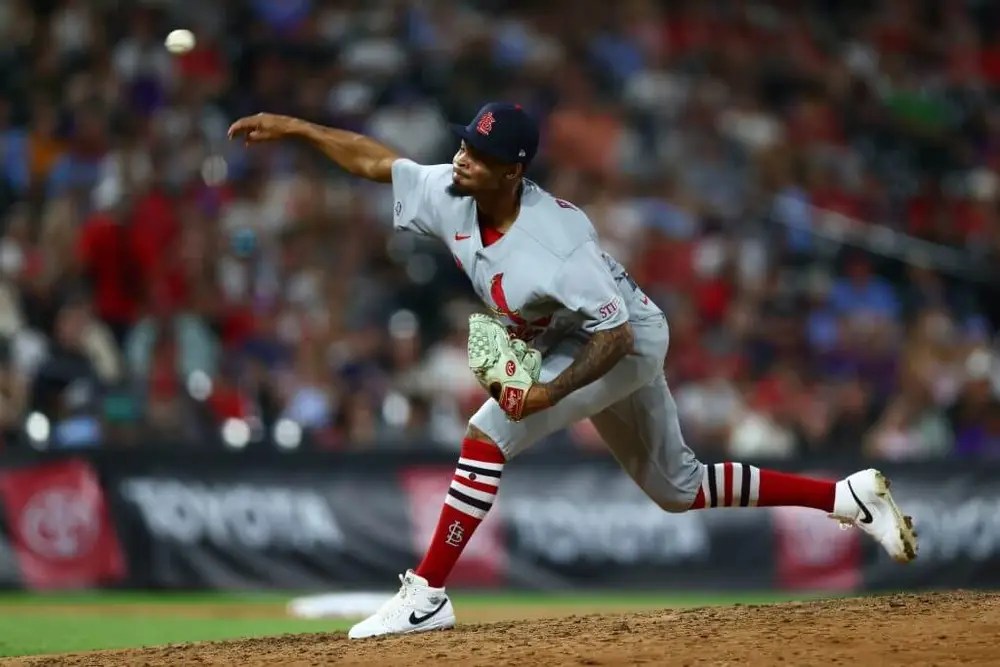
During the sixth inning of the St. Louis Cardinals’ 7-6 victory over the Colorado Rockies last night, Cardinals rookie reliever Hancel Rincon, making his first appearance in a big league came, wore his cap rakishly askew. Rincon was pitching to Rockies batter Cole Carrigg when home-plate umpire Doug Eddings decided to react to the query of the previous Rockies batter, who had asked Eddings, “Hey, can he wear his hat like that?”
Batters since the dawn of baseball time have tried to find ways to wage psychological warfare against pitchers; EA had an earlier example this season, here. This one worked: the comment inspired Eddings to join the fashion police. Eddings halted the game, motioned to Cardinals catcher Leo Bernal, and told Rincon to fix his cap, punctuating the request with “Grow the fuck up!” Rincon complied. Three pitchers later, Carrigg hit an inside-the-park home run and Rincon exited the game shortly thereafter.
Later in the inning, Cardinals manager Oli Marmol was ejected from the game by Eddings. Marmol explained: “We have a kid making his debut, and in between an at-bat, he tells him that he needs to fix his hat and, ‘The kid’s not going to wear his hat like that on my field.’ Last I checked, this is Coors Field, so I took issue with it.” Not only did Eddings eject Marmol, but he also called a pitch-clock violation that gave Rockies designated hitter Troy Johnston a 1-0 count to start his at-bat against the new Cardinal pitcher. That was not a valid use of the rule, but umpires think they are God sometimes. It’s tradition!
“And then the pitch violation while I’m out there having a discussion, that’s also stupid, in my opinion,” Marmol said later. “So there’s a lot of moving parts to that one. At the end of the day, I thought they handled it poorly, and I’d like an explanation at some point.”
Playoff creep has made the regular season almost irrelevant in the NHL and the NBA, and Major League Baseball has been struggling with how to avoid a similar fate ever since it stopped automatically sending the two teams with the best records in the American League and the National League directly to the World Series. That last happened in 1968 when there were just ten teams in each league: now there are 15, with six divisions. The champs of each get into post-season play-offs, with three Wild Card teams, mandatory because otherwise random luck can have a mediocre and inferior team making the play-offs by winning a weak division while teams with a better records are left at home watching the games on TV, just because they happened to be competing with stronger teams in their division.
Fairness and perception are the issues at hand, as well as maintaining the quality of the World Series. Last year’s edition, with the L.A. Dodgers squeaking out an extra-inning, deciding game victory over an evenly matched Toronto team, gave the sport a boost that carried into this season. Pairing the Dodger with a mediocre team is a recipe for embarrassment on baseball’s biggest stage. No team with a losing record has ever represented its league, but this season that situation could indeed occur. That highlights a flaw in the system. Now what?
In “How to keep losing teams out of MLB playoffs,” ESPN’s Bradford Doolittle does an excellent job explaining the problem and analyzing potential fixes. Right now, there are just five teams (out of 15) in the American League with winning records: the leaders in the three divisions, and two more teams (including the Red Sox) in the Eastern Division. Those two teams, Boston and the Yankees, seem to have wrapped up the first two Wild Card slots, but six teams, all with losing records, are in contention for the third Wild Card, and a single losing streak by the leaders in the Central and Western divisions could give those losing champions as well. If the American League playoffs started today, the top three records in the league would all reside on one half of the bracket, with the Tampa Bay Rays awaiting the winner of a wild-card series between the Yankees and Red Sox. On the other side of the bracket, the leaders in the Central Division, the Chicago White Sox ,would receive a bye to face the winner between the Astros (72-69), winners in the West, and the Cleveland Guardians (70-70), the third Wild Card.
FanGraphs projects Chicago to win the Central with 84 wins, with Cleveland taking final wild card with 82 wins and Houston winning the West with only 82 wins. Those would be three of the six worst records to ever qualify for the postseason in a full season, yet one of those teams would be guaranteed to play for the AL Championship in the ALCS.
Here are Doolittle’s candidates for remedies going forward. This season, of course, all baseball fans can do is cross their fingers. Doolittle’s commentary will be in quotes:
If I have learned one thing writing Ethics Alarms since 2009 is that I don’t know anything, particularly regarding which posts will spark the most interest or the most lively debates. I never expect the usual volume of commentary on my baseball ethics posts (the first ethics post I ever wrote, on the old Ethics Scoreboard, was on baseball: Pete Rose), but yesterday’s quiz regarding Red Sox pitcher Peyton Tolle’s impulsive hug of an opposing player as he applied an inning ending tag spawned commentary that raised some aspects of the incident that I never considered.
[Oh: I’m from Old School Boston. I have always been uncomfortable with hugs of any kind, from any one, for any reason. I have learned over the years when to submit and also when taking the initiative in a hug is expected of me and therefore only polite.]
***
For transparency purposes, I have to disclose that I am a big fan of hugging.
It took a very long time for me to realize that not everyone likes to be hugged, though. Also, that there is a time and a place to hug people.
A workplace setting, for example, that wants to be taken seriously might want to discourage hugging among colleagues and, especially, between superiors and subordinates. An employee that wants to be taken seriously might decide that hugging people in the office undermines that goal. One never knows how another person may react to spontaneous hugging, after all. It might be welcomes, it might be spurned, it might give you an unwanted love interest or it might get you reprimanded by HR.
During a baseball game, a player is expected to be professional. Is it any different from being in a boardroom, a classroom or an examining room?
Peyton Tolle is a Boston Red Sox rookie and already a team mate and fan favorite for his big extrovert personality that matches his huge frame (6’6,” about 260 pounds), highlighted by Tolle’s obvious joy at playing a kid’s game for a living.
In yesterday’s Red Sox 9-8 extra-innings win over the Seattle Mariners (The Red Sox are having one of their most entertaining seasons ever), Tolle, was Boston’s starting pitcher, did something that nobody could recall any previous major league baseball player doing. As you can see above, when the hulking Tolle went to tag out Mariners player Dominic Canzone on the first base line after fielding a bouncer back to him on the mound, he preceded his tag with a smile and a hug.
Some old timers gag when they see opposing team players even chatting cordially at first base. The unwritten rule of baseball was that on the field the other team was literally a mortal foe, and its players were to be treated as such. In the 1960s a player who did what Tolle did would be excoriated, fined, exiled to the manager’s “dog house” and probably demoted to the minors.
Last night the Red Sox players seemed to get a kick out of their exuberant rookie’s latest surprise—he also likes playing tricks on team mates—saying, “That’s Tolle!” as the agreed-upon answer when questioned by reporters after the game. The sports media was all positive, with ESPN calling The Hug “The most wholesome play of the season.”
Milwaukee Brewers shortstop Cooper Pratt has a bright future ahead of him, but it is brighter now because his manager, Pat Murphy taught him a lesson about what it means to be a professional in general and a Major League Baseball player in particular.
As you can see in the video, Pratt hit what looked like an easily caught pop-up in the fifth-inning of last night’s game against the New York Mets, so he jogged down the baseline more slowly than Pete Rose used to run to first after a base on balls. The Mets, because they stink this year, managed to mess up the play and the ball dropped in for what would have been a double if the kid had been running hard. Standing on first, he looked surprised to see that Murphy was replacing him with a pinch-runner, pulling him off the field in an old-school public rebuke for unprofessional play.
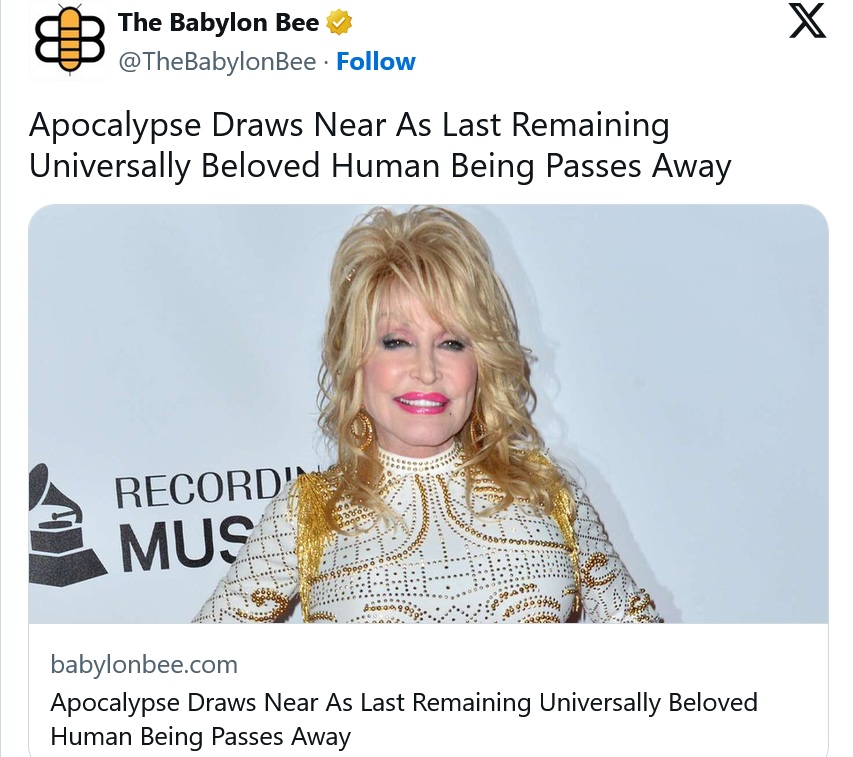
As you must know by now unless you have been in a submerged submarine with a broken communications system like the one in “Crimson Tide,” Dolly Parton died yesterday at 80. Why her death is being described as a shock is a mystery: as my father said when he hit 80, “It’s the Red Zone, son. I can kick off any second from here on!” Nonetheless, the public and official outpouring of grief, love and admiration is unlike anything we’ve seen at least since Princess Diana’s demise in 1997.
The tectonic reaction is certainly not based on Dolly’s singing, acting or song-writing. Personally, I was never a fan; Dolly’s singing voice always sounded to me like someone who has inhaled helium. Her songs were pleasant but unremarkable to my ear. As an actress, I place Dolly Parton in the large category of experienced public performers who can project their own personalities effectively into roles and stories where their personalities seem appropriate, a diverse group that ranges from the late Fred Thompson to the late Bob Newhart to the not-quite-late Ringo Starr.
Clearly, the reason Dolly is being mourned so vigorously is that her public persona was entirely benign, virtuous and lovable, even aggressively so. She literally gave nobody any reason not to like her. In 2020, as the Great Stupid was grabbing American society by the throat, Hollywood producer Rob Long wrote an appreciation of Dolly in “Commentary” exploring her universal popularity. He wrote in part,
Last night the Milwaukee Brewers tied the MLB record for the most lopsided shutout in modern history with a 22-0 rout of the Seattle Mariners. Once upon a time and not so long ago, the Brewers would have been shamed for “running up the score” because a very old unwritten rule of the game held that doing so was unethical: unprofessional, cruel, pointless, sadistic, and a Golden Rule breach. When the Texas Rangers defeated the Baltimore Orioles 30–3 on August 22, 2007, the most one-sided wipe-out in professional baseball since the 19th century, the Rangers were widely condemned for inflicting such a humiliation on another team and its fans. I think, with the Brewers win yesterday, we can officially pronounce the silly unwritten rule repealed. It never was ethical. Good riddance.
The unwritten rule probably dates back before professional baseball. Running up the score in Little League and pick-up games is cruel, pointless and, yes, a Golden Rule breach, but carrying it into games where spectators pay money and the players are compensated for their performance never made sense. It is a violation of integrity for professional athletes not to exert maximum effort. The score won’t stop, or shouldn’t stop, a player from making a spectacular fielding play, or hitting the ball into orbit. Real baseball fans love the game, not just a team. For a winning team to stop trying to score runs is unethical. Fans are being cheated.
A game with so many runs scored is long? Hey, nobody’s forcing a spectator to stay. If I pay to see a game, I pay to see the whole game. Moreover, one of baseball’s inimitable charms is that weird and wonderful things happen that have never happened before all the time, even though there have been roughly 243,700 baseball gamesplayed over the entire history of the sport since 1876. Just this week, a rookie hit three home runs in his first three trips to the plate in his first game ever, something that is unprecedented.
Is it really so hard for officials in the Womens National Basketball Association to come clean and admit “Of course we don’t think males who just decided one day “POOF! We’re females!” should play against women in sports. We were just virtue-signaling to knee-jerk progressives and we don’t want to publicly agree with anything the Trump Administration supports. That would put the WNBA out of business!”?
Apparently. Now the league looks like silly bunch of hypocrites and woke morons, which it is. Permit me to mock and excoriate them.
White, 35, a Republican candidate for US Senate, announced, “I’m transgender! I’m a woman… I identify as sometimes identifying as a woman for purposes of… professional basketball,” to Fox News. “I think I’d be unstoppable,” White continued, tongue sort-of in his metaphorical cheek. “But I’m a team-first guy. I’m a pass-first kind of player. I do the little things. I led my team in all five major stat categories at Iowa State University, so I do a little bit of everything. I’ll do whatever the coach needs me to do. I’ll do whatever the girls need me to do.”
Freedom, in his own “POOF!” moment, had been all technical and stuff, which is no fun. He said he had reviewed the WNBA’s eligibility criteria, and and that he meets all the requirements. Article XIII of the WNBA’s 2026 collective bargaining agreement says, “Only players who are women are eligible to play in the WNBA,” but the 409-page document diesn’t define “women” and has no policy on transgender eligibility, including never stating whether self-identification alone is sufficient sufficient to make everyone call a player “she” or “they” and allow the biological male to change in WNBA locker rooms and smash the girls on the court.
Royce took the pass and scored. The WNBA just has to be honest about the absurdity of biological men playing in women’s sports, Royce said. “I think the WNBA could come out and make a definitive statement about guys with a pair of balls playing in the Women’s Association,” he said. His plan: he is serious about wanting to be drafted and will proceed until the WNBA’s leadership stops trying avoid throbbing reality.
If he isn’t drafted, Royce says, he vows, he’ll sue. “I have to file a discrimination lawsuit, right? I mean, that’s, that’s ridiculous,” he told the Fox New. “We’re gonna have to have a huge legal battle about discrimination if I can’t play.”
Gotcha!
The WNBA only ethical and practical option now is to admit it, but its pusillanimous leadership doesn’t have the integrity, intelligence, courage and respect for the public to do it. Instead, it released a rare example of official “huminahumina.”
“I know many of you have received questions in recent weeks regarding transgender athlete participation in women’s basketball, and I expect this topic will continue to receive significant attention. I wanted to reach out to share how we are approaching these conversations at the league office and to thank those of you who have responded to questions from the media with thoughtfulness and professionalism. [The WNBA will] always approach this topic thoughtfully, respectfully, and in alignment with the longstanding values of our league. Second, our player eligibility rules, unlike the eligibility rules of some other leagues and governing bodies, are collectively bargained. Lastly, preserving the integrity of our game and ensuring fair competition will always remain among the league’s highest priorities. We recognize that this is a complex and nuanced topic, and we will continue to have important conversations with all of you and the Players Association in the weeks and months aheadWe also plan to convene additional discussions and offer listening sessions for any team leaders who would like to participate. Your perspectives and feedback are invaluable, and I appreciate those who have already reached out to share their thoughts.”
Ramalama ding-dong! The statement means absolutely nothing. Ralph Kramden’s famous “huminahumina” is actually more articulate. It isn’t a complex or nuanced topic at all, and Engelbert’s league epitomizes why, as Royce and Freedom make crystal clear. If males can be female just by deciding that they are, the WNBA is toast. If men can’t do it, boys can’t do it. She is defaulting to the infamous but ancient tactic of avoiding an inevitable conclusion with unpleasant ramifications (like admitting that people she hates are right, and obviously so) by calling for “discussions” when there isn’t anything to discuss other than “How the hell do we get out of this?”
Players who have responded to questions from the media with thoughtfulness and professionalism number exactly two: Caitlin Clarke, who said she didn’t want to talk about it, and the now iconic Sophie Cunningham, who has repeated her opposition to biological males playing against women in all sports because it is unfair, dangerous and stupid. The rest, if they said anything at all, echoed Indiana Fever coach Stephanie White, who blathered that she didn’t have the scientific background to have an opinion on the issue. Minnesota Lynx coach Cheryl Reeve said earlier this month, fatuously,”We need to protect trans kids. To me, it’s a human rights issue. Every kid has a right to sports.”
Are you willing to let biological men squash your female players flat to “protect trans kids,” you idiot? Are you willing to wipe out women’s basketball and sacrifice girls to protect them? Do you think before you speak?
The WNBA players union also resorted to self-contradictory gibberish:
“We embrace justice, equity, diversity, and inclusion .Those are the values that unite this Union and allow it to protect women’s sports while creating transformational change. Hate, abuse, and demonization of any person or group of people, including transgender people, only fuel fear, division, and harm. We will continue to have hard conversations. But we will not be used as political pawns.”
Translation: “We embrace slogans that keep us aligned with the radical progressive bubble, but have no interest in living up to them when they are adverse to our own self-interest. We know we can’t simultaneously protect women’s sports and allow trans-women top dominate them, but we’re hoping the public is so stupid that they won’t see the obvious hypocrisy in our rhetoric. As with the rest of the ideological Left, we’re going to attack the messengers who carry the facts that reveal our absence of integrity, and hope it works for as long as possible. We trying the “pawns” analogy because it distracts from reality, which is that we leaped into this hopeless cause to signal our virtue, and made the WNBA combatants on the losing side of one of the Left’s dumbest obsessions.”
Popcorn popped, as the saying goeth. I can’t wait to see how the WNBA tries to extricate itself from its self-made mess.
Jefry Yan, a minor league pitcher renowned as an oddity for his bizarre and unique manner of celebrating strikeouts finally got to perform on the major-league stage this week. In the New York Mets’ 6-5, 10-inning win over with the Cleveland Guardians this week, Yan preserved a one-run New York lead in the sixth inning, striking out two Guardians in the process and punctuating each strikeout with his characteristic, er, flair.
Not long ago, maybe a couple of decades, a rookie pitcher who acted like that during a game would be taken to the metaphorical woodshed by a coach or a veteran player and told, “Kid, that’s not how we act in the Big Leagues. Don’t do it again.” One reason would be that the team he “showed up” by celebrating would make sure their pitcher hit his team’s star player in the ribs with a fast ball as soon as the player came to bat. Before the Designated Hitter, when pitchers had to bat, a hurler who behaved like Yan would be taking his life into his hands.
Now MLB has adopted the attitude of “let the kids play” to appeal to younger fans. Being a “Get off my lawn” guy, I don’t like Yan’s antics much, and I suspect a lot of batters don’t either. But I also remember how Dick Radatz, aka “The Monster,”the huge Red Sox closer in the Sixties who for three years may have been the greatest relief pitcher ever, used to throw up both arms over his head in a victory gesture when he ended a game with a swinging strike-out, as he inevitably did. It wasn’t as outrageous as Yan’s split, but at the time it was considered audacious.
And the fans loved it.
Mets Manager Any Green isn’t worried that Yan’s antics will cause any issues with the opposition. “I worry far less (today) than 20 years ago,” Green said. “I think he has developed a reputation throughout the game that this isn’t showing up anybody else, and people have accepted, largely, that this is a good-natured human who’s enjoying being on the field playing baseball. We didn’t have many minor-league teams take issue with his enthusiasm. They end up smiling at it if they’re not the one getting punched out.”
Yan is a bit defiant. “I’m going to continue to go out there the same way, to go out there with the same emotion to have fun as if I’m playing a kids’ game, like I always have,” Yan said before his Mets debut. “I’m going to enjoy that first (strikeout), like it’s my first and last one. I’ve worked a long time for that moment.”
I would offer two points. One: his displays of joy will become less tolerable if he doesn’t have consistent value to his team. The second is that I worry about the gimmick becoming a slippery slope. At what point do such eccentricities constitute “making a travesty of the game,” an offense that remains in the rulebook? What’s next? Pitcher’s doing “the worm” after strikeouts? Trotting out a home run backwards, as emotionally-troubled baseball star Jimmy Piersall once did? Cultural norms exist for reasons. Sometimes we don’t remember those reasons until it’s too late.