Lunchtime Ethics Snack, 1/17/2020: Dirty Money, Dirty Baseball, And “Parasite”

Yum or Yecchh?

1. And the baseball cheating scandal is still roiling! I feel sorry for ethics enthusiasts who are missing out on this fascinating episode because they shut down when baseball is mentioned. One emerging issue that focuses on “woke” (and in some quadrants, sadly, female) leadership models has become evident. The two managers fired in the sign-stealing scandal were part of the “new wave” of “collaborative” baseball managers that teams embraced in recent years. They are sensitive to the players’ needs; they don’t give orders as much as set flexible boundaries; they are not confrontational, and they absorb and guide the culture of the clubhouse rather than dictate it. Then we learn, in MLB’s report on its investigation, that when Houston’s A.J. Hinch discovered (in 2017) that his bench coach and his players were operating an elaborate sign-stealing operation that he knew violated the rules , he made it known that he disapproved, but never ordered them to stop. Now baseball commentators are saying that the Astros need to hire an “old school” manager (like the ones who have been put out to pasture over the last five years) who will be leader, who will lay down the law, and who won’t shy away from confrontation for fear of not being “collaborative.”

Duh. How did anyone come to think effective leaders should do otherwise? Leaders need to lead. Leading doesn’t have to be autocratic, but a leader who acts like Hinch did in this matter is no leader at all.

In another revelation regarding the scandal, the report by Baseball Commissioner Rob Manfred states that when Manfred put teams on notice in a Sept. 15, 2017 memo that using electronic means to steal and relay opposing teams’ signs during games would henceforth be  severely punished, Houston General Manager Jeff Luhnow “did not forward the memoranda and did not confirm that the players and field staff were in compliance … Had Luhnow taken those steps in September 2017 it is clear to me that the Astros would have ceased both sign-stealing schemes at the time.”

This is gross managerial negligence, and it puts Lahlow’s self-serving statement that he had no involvement in his team’s cheating in perspective. Continue reading
Afternoon Ethics Refresher, 1/15/2020: Firing, Tweeting, Protesting, Talking Friends Into Suicide…

Hello?

Traffic here inexplicably dead yesterday and today. Is there a secret ethics convention nobody told me about? There is, isn’t there? I’m hurt…

1. It’s too bad so many readers don’t pay attention to the baseball posts, because a lot of fascinating ethics issues with general applications arise…like right now. Yesterday, as already mentioned in an update to yesterday’s post and a couple of comments, the Boston Red Sox “parted ways with Manager Alex Cora by mutual agreement.” (He was fired.) In a press conference I just watched, the Red Sox brass said that Cora, who was both successful and popular in Boston, was let go solely because of the MLB investigation report regarding his involvement in cheating while serving as a coach for the Houston Astros in 2017, and the allegations of cheating  while managing the Sox in 2018, still under investigation, played no part in the decision. What they meant is that the Astros cheating was going to result in a long suspension for Cora anyway, so the team didn’t need to wait for the bad news regarding his cheating in Boston.

The weirdest thing about the press conference is that none of the four Sox officials would do anything but praise Cora, his character, his judgment, his dedication to the team, his devotion to baseball. Gee, why did they fire this saint, then? Alex Cora’s character is obviously flawed, or he wouldn’t have masterminded major cheating schemes that cost the Astros 5 million dollars and four key draft choices while losing the jobs of two men who advanced his career. Cora’s judgement also stinks, because his actions have now cast a shadow over two teams, their championships, and the records of the players his schemes benefited.

If he was so dedicated to the team, why is  it now facing a public relations and competitive disaster because of his actions? If he was devoted to baseball, how did he end up at the center of a scandal that undermines the perceived integrity of the game? Continue reading

Apologies And Other Fallout From The Baseball Cheating Scandal (Updated, And Updated Again)

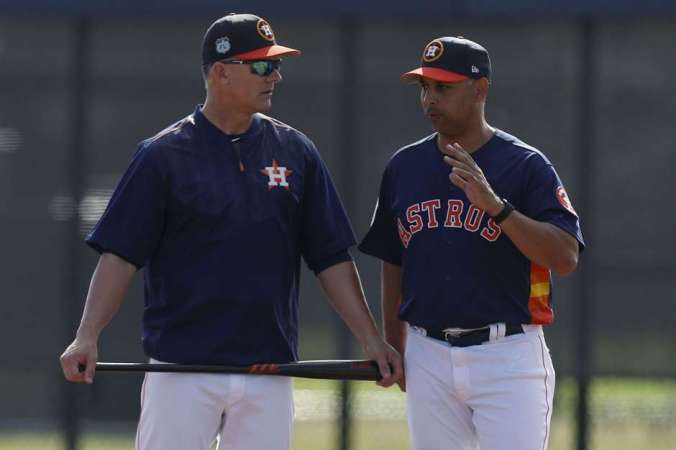
Ex-Astros manager Hinch and “dead man walking” Alex Cora, the cheating mastermind.

Since I posted the initial commentary on Major League Baseball’s tough punishment of the Houston Astros for their illegal sign-stealing (there are legal ways to steal signs too), there have been some interesting developments with ethical implications.

The full MLB report  can be read or downloaded here.

  • One promising development is the widespread discussions of organizational culture that have been taking place in the media. When Astros owner Jim Crane announced that he was firing GM Jeff Luhnow and manager A.J. Hinch, both suspended for a year by the Commissioner of Baseball, he made it clear that the team needed to reform its culture, which had metastasized from  “play to win”  into a “win by any means necessary.”  There were signs of this in Houston long before the sign-stealing was known, when in 2018 the team traded for relief pitcher Robero Osuna while he was suspended for domestic abuse and facing trial—even though the Astros had previously announced a “no-tolerance” policy regarding players and domestic abuse. The team really needed a closer, you see.

The Astros culture, we now can see, was thoroughly compromised by ethics rot, and eliminating one or two managers won’t fix the problem immediately.

  • A prime enabler of that rot was Jeff Luhnow, who traded for Osuna. After he was fired yesterday, he issued this apology:

Continue reading

Breaking: Major League Baseball Clobbers The Houston Astros For Their Sign-Stealing Scheme, And Red Sox Manager Alex Cora Is In The Cross-Hairs

In November, I proposed that the Houston Astros should be punished severely for their sign-stealing during the 2017 and 2018 seasons, the first of which resulted in a World Series Championship. Major League Baseball’s investigation is complete, and today the wrath of the Baseball Gods rained down on the team. MLB didn’t take my advice (stripping the team of its titles), but the actions it dis take were surprisingly and appropriately tough.

The Astros, you will recall,  used illegal cameras and video monitors to steal the signs of opposing catchers at Houston’s Minute Maid Park, then signal those signs to their hitters before pitches by banging on trash cans. This occurred throughout the 2017 regular season and postseason, and during the 2018 season as well. Baseball’s Commissioner Rob Manfred suspended Astros Manager A.J. Hinch and General Manager Jeff Luhnow, fined the team $5 million (the most allowed under the MLB rules)  and took away the team’s top two draft picks in both 2020 and 2021. Hours after the announcement, the Astros fired both Hinch and Luhlow, with owner Jim Crane  saying, “We need to move forward with a clean slate. [We] will not have this happen again on my watch.”

All of this is as it should be. The MLB investigation indicated that Hinch had not been involved in the sign-stealing, but was aware of it and allowed it to continue.

Now the saga moves on to, <sigh>, the Boston Red Sox. Continue reading

In The Dead Of Winter, Welcome Baseball Ethics News

The Athletic’s Jayson Stark reports  that automated ball and strike calling is now inevitable, and we may see it as early as 2022. He writes, “The mental games used to inch the strike zone this way or that has long been a tool of the game’s best – from the hitters whose impeccable eye define it, to the pitchers’ whose pinpoint control push to expand it – but an automated zone will all but abolish the in-game politicking of the strike zone, giving hitters a new advantage they have long been without: certainty. Robot umpires will define the strike zone with better precision than their carbon-based forerunners – but first the humans must decide what they want that strike zone to be. For those particularly fond of strike zone drama, appreciate it now, because deciding on the parameters of the automated zone might be one of the last great strike zone debates before the robots take over.”

Good.

Once computer graphics allowed TV viewers to see blatantly botched ball and strike counts in real time, this development became a serious matter of trust and integrity. The baseball Luddites who continue to argue that missed ball and strike calls are part of baseball’s charm and should be retained  as “the human factor” have sounded progressively more desperate and ridiculous as the seasons pass.

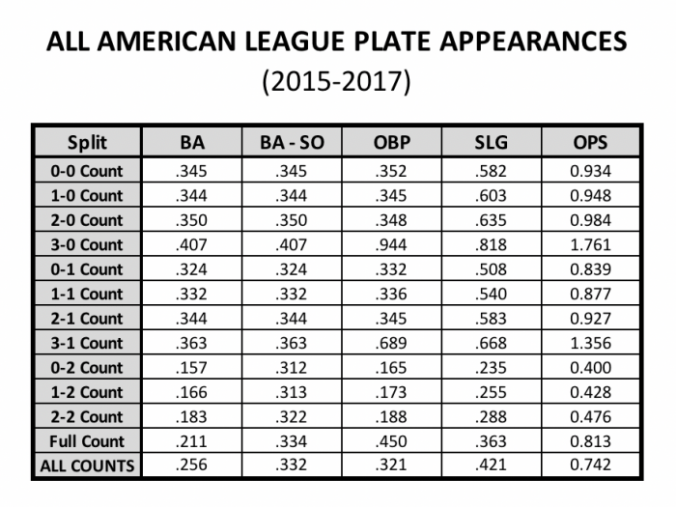
Statistical analysis has shown decisively how much a bad ball or strike call even early in the count can change the outcome of an at bat and a game. Look at this chart:

Continue reading

The Olympics Gets More Specific About Banning Protests, But Remains Vague About Punishments. Let Me Suggest Something…

And the gold medal for obnoxious virtue-signaling goes to…

The International Olympic Committee’s rule on protests at the Olympics Games has been confined to one sentence in the Olympic Charter, and since that didn’t define what a “protests” were (the Committee appeared to be against them) that sentence had no practical effect. It reads, “No kind of demonstration or political, religious or racial propaganda is permitted in any Olympic sites, venues or other areas.”

.Recognizing, however, that the athletes of one of the teams likely to win a lot of medals also had a growing proclivity for protests against it own government and  President—guess which country that would be?—the IOC published a detailed list of prohibited actions that would not be welcomed at the 2020 Tokyo Olympics. Among them…

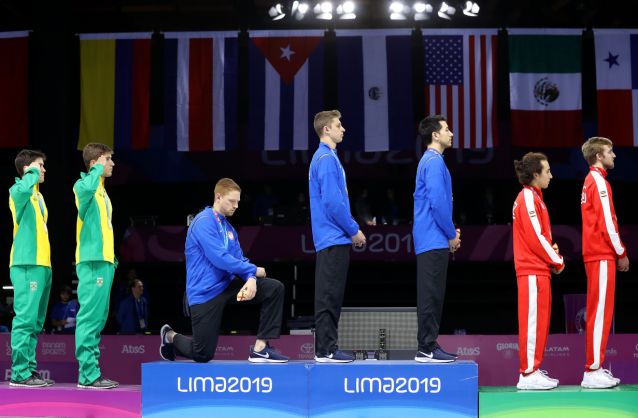
Kneeling during national anthems.

No fist-raising.

No use political signs or armbands.

None of the above  in stadiums, pools or at a finish line, not on podiums during medal ceremonies, norduring opening orclosing ceremonies.

No such protests in the Olympic Village, either.

This list was described as a “non-exhaustive list,” meaning that violations of the spirit of the prohibitions could also be judges a violation. The documents said that merely “expressing views” was not necessarily a protest.

Boy, I guess the Committee is counting on not many athletes being lawyers. Or Bill Clinton. Continue reading

Morning Ethics Warm-Up, 1/7/2020: Oh, Great, A Red Sox Ethics Scandal….

Bad Morning.

1. Fire this copy writer: Boll and Branch sheets informed me this morning that their product is “loved by THREE American Presidents.” Well, that settles it: I’m running right out and buying these sheets if Presidents—well, three, anyway, love them. Actually, I’m making the sheets an early target of my new rule to personally boycott any product that insults my intelligence with their ads or packaging.

So much for Chex-Mix.

2. I just realized what climate change hype is like. I’m slow, I guess. I was reading a typical Paul Krugman column about how we are doomed by climate change and only the mean, stupid Republicans refuse to accept it. (The runaway brush fires in Australia, he said, can’t be proven to have come about by climate change, the brilliant economist said, but everybody knows its climate change. All Democrats, anyway.) It then hit me: climate change is like all the reflex explanations for bad things that primitive civilizations, cults and Machiavellian leaders have used to relieve public fears of  random misfortune since the beginning of time. The devil, angry gods, witches, Jews…anything to be able to rationalize events that otherwise have no explanation.  If you sacrifice people to the gods, hang the witches or exterminate the Jews, you’ll feel better—you’re doing something by addressing the cause of all your pain. Of course, these imaginary “causes” aren’t really responsible for what’s happening, but its comforting to “do something.” In the case of climate change, the proxy trouble-makers are capitalism, personal liberty and democracy. Just get rid of them, and everything will be all right again.

I don’t know why it too so long for me to figure this out. I think it’s because I persist in the romantic notion that we all get smarter over time. I certainly don’t. Continue reading

Sunday Ethics Round-Up, 1/5/2020: “Day After Cosmic Justice Eliminates The Patriots From The NFL Play-Offs” Edition

Greetings!

Last night the New England Patriots and their habitually unethical coach and star quarterback were eliminated from the NFL play-offs in the first round by the Tennessee Titans. Good. I say this despite being from Boston, where my Dad and I once routed for the AFL Pats of Gino Capelletti, Babe Parilli, Nick Buoniconti and Jim Nance. The modern day Patriots made me embarrassed to be a New Englander, even before I realized what a sociopathic organization the NFL was.

1. Noted with amusement: A while back there was a kerfuffle over some conservative publication using a photo of Rep Elijah Cummings (D-Md) when the story was about Rep. John Lewis (D-Ga), or vice-versa. This was, of course, attributed to racism of the “all those people look the same” variety.

I pointed out that while it was of course the kind of mistake that a publication shouldn’t make, the two House members were about eh same age, both heavy-set, both African-Americans, and both hyper-partisan Democrat race-baiters whose careers rested on civil rights protest creds many decades old. Thus it was satisfying to see that “CBS Evening News” accidentally used a picture of the now deceased  Rep. Elijah Cummings while reporting on Lewis’ recent cancer diagnosis.

2. Signature significance. If you want definitive proof that an elected official or a pundit is untrustworthy pond scum, mark those who claim that President Trump  ordered the hit against Iranian terror master Qasem Soleimani in order to distract from Trump’s impeachment trial. The latest self-identified hack: Elizabeth Warren, who today said on CNN’s “State of the Union,”

“Next week, the President of the United States could be facing an impeachment trial in the Senate. We know he’s deeply upset about that, and I think people are reasonably asking why this moment…Why does he pick now to pick this highly inflammatory and highly dangerous action that moves us closer to war? I think people are reasonably asking about the timing, and why it is that the administration seems to have all kinds of different answers.”

This “Wag the Dog” theory made some sense when it was first applied to Bill Clinton, who launched a failed strike against Osama bin Laden in the middle of his impeachment drama, since Clinton was guilty and knew it. Trump’s impeachment has raised his poll numbers and further exposed Democrats as abusing the impeachment process: there is no reason for him to try to distract from it.

Warren’s question about timing is also absurd. Why now? Gee, do you think it might be that the murderer of many Americans who had just engineered an attack on our embassy and who was planning more deadly attacks happened to be in Iraq, where the U.S. has an approved military presence, and was virtually asking to be brought down?

Warren’s poll numbers and fundraising are sinking fast (Good!), so her demagoguery is shifting into high gear. Once again, her likely fate proves Lincoln right: you can’t fool all of the people all of the time. Or enough of them. Continue reading

Shrugging Off Cheating: It Is As I Feared…[Corrected]

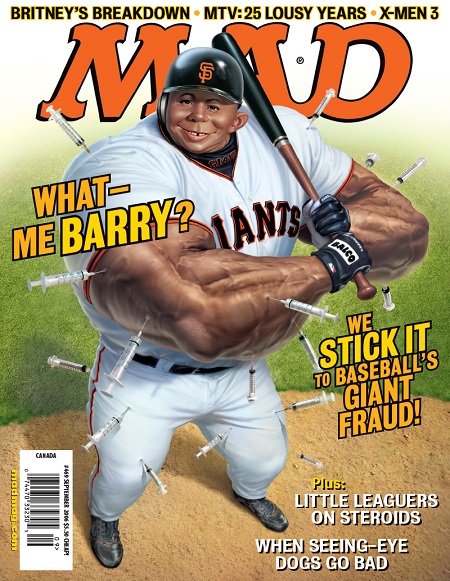
Unfortunately, MAD is no longer around to protect our values…

My favorite Christmas gift this year, as it has been in recent years, is the new Bill James Baseball Handbook, which will be my primary bathroom reading for the next ten months. Oh, it’s not as much fun as the old Bill James Abstracts, but in those days, three decades ago, Bill was revealing then-unknown nuances of the game that spawned  the elaborate (and still developing) analytical tools that have changed how baseball is played, watched, and understood.

James typically writes a few long, Abstract-like articles for the Handbook, which has many contributors, and he is, as always, fascinated by the selection criteria for the Major League Baseball Hall of Fame in Cooperstown. My gift is especially timely, because his observations in the Handbook dovetail nicely with the recent voting by sportswriters on the latest entering class, including Derk Jeter, naturally, and perhaps others. The results won’t be announced for a while.

Bill did research this past year to determine who the public wanted to see elected to the Hall among players who had not yet been deemed worthy ( meaning that they hadn’t been listed on at least 75% of the ballots cast, or are not yet eligible for various reasons, including players who are still active. The results, as he explored the gap between public opinion and past voting, were disturbing, if not exactly shocking. Continue reading

The Ethics Of Wasting Money


The position here has always been that nobody has any business telling you how to spend your money. This  topic usually comes up in the context of charity, as in, “How dare that individual spend money on what they think is important when they should be spending money on what I think is important!” A couple of recent developments have raised the issue in a different context, however: incompetent and irresponsible expenditures of large amounts of money.

Take “Cats,” for example. The already immortal flop film cost a reported $100,000,000 to make, and marketing costs are on top of that. It is sure to lose many, many millions of dollars, and the question becomes, “How could movie professionals make a blunder like that?”

I always assumed that “Cats” could not be a successful movie because of its purely theatrical nature. Surely the lesson of the film version of “A Chorus Line,” another Broadway musical that never should have move to the screen, was guide enough. Yet it happened. The fiasco put me in mind of other infamous and avoidable screen disasters, like 1978’s “Sgt. Pepper’s Lonely Hearts Club Band” starring Peter Frampton and the Beegees. Before the film’s release, Robin Gibb of the Bee Gees announced: “There is no such thing as the Beatles now. They don’t exist as a band and never performed Sgt Pepper live in any case. When ours comes out, it will be, in effect, as if theirs never existed.”

Good prediction. The huge MGM film with dozens of celebrity cameos was instantly and universally reviled. Even worse, a few years later, was “The Pirate Movie,” another misbegotten big budget musical. The idea here was to do a new version of “The Pirates of Penzance” but without the dialogue, plot and music that has made the Gilbert and Sullivan show popular for more than a century….and to star Kristy MacNichol, the androgynous, non-singing teen star, as the heroine. How could such a brilliant concept fail? Continue reading