Phtography Ethics, Parenting Ethics, Face-stomping Ethics

no photographs

Item:

“A 32-year-old city resident was arrested for allegedly stomping on the face of a college student who was taking pictures at a Liberty Heights park on Tuesday afternoon. Victoria M. Torres, of 211 William St., was taken into custody for assaulting a 22-year-old student who was taking snapshots for a “photography class project” near the water park in Van Horn Park, Springfield police spokesman Sgt. John Delaney said.”

The student was taking photos of Torres’s young daughter, among other subjects.

More…

“Torres approached the photographer and “demanded in a threatening manner” that she delete any pictures containing images of her children, according to Delaney. The student, who wasn’t publicly identified by police, tried to avoid a confrontation and started to leave the park.”As she was walking out, the outraged female came over and punched her twice in the face, grabbed her by the hair and pulled her to the ground,” Delaney said. Torres then “kicked the victim and stomped her face” after the photographer had fallen to the ground, Delaney said.Torres also tried to take the woman’s camera and equipment, valued at about $4,000. Torres grabbed hold of the camera strap in effort to pull the camera from the student’s neck, Delaney said.”

Let’s stipulate that stomping on the student’s face…indeed, stomping on faces generally, is per se unethical. Now that this is settled, did the t mother have a legitimate objection? Was the student behaving ethically?

Yes, and no. Continue reading

Unethical Website Of The Month: OKCupid…The First Corporate Fick!

cupid5af

The ignominy of mere Ethics Dunce status is too good for OKCupid CEO Christian Rudder and his online dating service, and Unethical Website of the Month doesn’t do it justice either. The online dating website has revealed itself as an ethics outlaw, and a smug one. It is lying to its customers,  toying with the lives of vulnerable people who trust it, and doesn’t see anything wrong with its conduct.

That qualifies OKCupid as a Corporate Fick, the first ever so-identified here. As stated in the blog glossary of terms and concepts, a fick is someone who openly and blatantly violates social norms of responsibility, honesty or fairness without shame or remorse. That description fits OKCupid to a fare-thee-well.

In case you missed the story, the website revealed—proudly, in fact—that it intentionally set up users with bad dates, or mismatched by its own compatibility formulas, to see how people would behave. The uproar over Facebook’s undisclosed manipulation of users’ moods prompted the disclosure.Facebook’s experiment violated research ethics standards, and the company was misrepresenting both law and ethics when it claimed that they had Facebook user’s consent to use them as cyber lab rats. That was bad. This is infinitely worse. Continue reading

Ethics Quiz: Four Young Children Locked In A Hot Car

kid-in-hot-car

Mom and mom advocate Lenore Skenazy writes the Free Range Kids blog, which I have to remember to check out regularly. She is the source of today’s Ethics Quiz, which she obviously believes has an easy answer. We shall see.

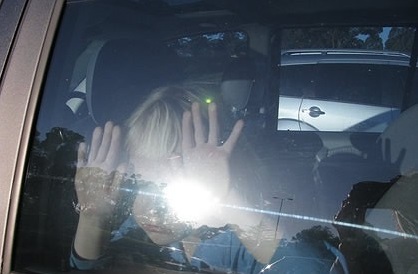
Charnae Mosley, 27, was arrested by Atlanta police and charged with four counts of reckless conduct after leaving her four children, aged 6, 4, 2, and 1, inside of her SUV with the windows rolled up and the car locked.  It was 90 degrees in Atlanta that day. The children had been baking there for least 16 minutes while their mother did some shopping. A citizen noticed the children alone in the vehicle and reported the children abandoned.

Skenazy believes that the arrest is excessive—that the mother made a mistake, but that compassion is called for, not prosecution:

“[T]he mom needs to be told that cars heat up quickly and on a hot summer day this can, indeed, be dangerous. She does not need to be hauled off to jail and informed that even if she makes bail, she will not be allowed to have contact with her children…No one is suggesting that it is a good idea to keep kids in a hot, locked car with no a.c. and the windows up. But if that is what the mom did, how about showing some compassion for how hard it is to shop with four young kids, rather than making her life infinitely more difficult and despairing?The kids were fine. They look adorable and well cared for. Rather than criminalizing a bad parenting decision (if that’s what this was), how about telling the mom not to do it again?”

Do you agree with her? Here is your Ethics Alarms Ethics Quiz of the day:

Was it cruel, unfair, unsympathetic or unkind for Atlanta police to arrest Mosely for leaving her four young children locked in a hot car?

I am an admirer of Lenore Skenazy, but her pro-mother bias led her seriously astray this time. I think she is applying rationalizations, consequentialism and dubious, indeed dangerous reasoning to let this mother off a hook that she deserves to stay on. In her post, she even suggests that the car’s air conditioning was on, though there is no reason to believe that it was based on the reports. If the A-C was on, that changes the situation: I very much doubt that a mother would be charged with leaving four children in a locked, hot car if the car was not, in fact, hot. (One report states that the SUV windows were open, but that wouldn’t support the charges. If the windows were open, then Mosely left her children alone in public, which is a different form of child endangerment, but still dangerous. For the purpose of the quiz, I am assuming that the windows were shut, and that the air conditioning was not on. So does Skenazy.)

Let’s look at Lenore’s analysis errors:

  • She notes that the children were “fine.” What if they hadn’t been fine? That wouldn’t change what Mosely had done in any way, and what she did was irresponsible, dangerous and potentially deadly. Sixteen minutes, scientists tell us, is more than enough time for temperatures in a closed car to rise sufficiently high to cause heat stroke. Mosely, and obviously her children, were lucky—this is classic moral luck—and that shouldn’t be allowed to diminish the seriousness of what she did. (Aside: I just realized that to find that link, I made the same Google search that Justin Ross Harris made before leaving his infant son to die in his own hot vehicle, which has added to the circumstantial evidence causing him to be charged with murder.)
  •  The rationalizations peeking through Slenazy’s excuses for the mother’s conduct are quite a crowd. Along with #3. Consequentialism, or  “It Worked Out for the Best,” there is #19. The Perfection Diversion: “Nobody’s Perfect!” or “Everybody makes mistakes,” it’s twin, #20, The “Just one mistake!” Fantasy, #22. The Comparative Virtue Excuse: “There are worse things,” #25. The Coercion Myth: “I have no choice,”  #27. The Victim’s Distortion, #30. The Prospective Repeal: “It’s a bad law/stupid rule,” and #33. The Management Shrug: “Don’t sweat the small stuff!” There are probably some more, but that’s plenty.
  • If Skenazy believes that the “it was just a mistake” explanation should protect the mother from prosecution here, presumably she would make the same argument if all four kids (or just one) died. A lot of prosecutors feel the same way. I don’t.
  • If Mosley did this once, she may well have done it before, and is a risk to do it again. The best way to teach her not to do it again is, at very least, to scare her, inconvenience her, publicly embarrass her, and use the legal system to show how serious her wrongful conduct was, and how seriously society regards it. There is no guarantee that a lecture from a cop wouldn’t have just produced just an eye-rolling “Whatever…my kids were just fine, and I know how to take care of them” reaction, a repeat of the conduct, and eventually, a tragedy….followed, of course, by public accusations that the police were negligent and abandoned four children to the care of a dangerously reckless and incompetent mother.
  • I’m sorry, Lenore, but this-“How about showing some compassion for how hard it is to shop with four young kids, rather than making her life infinitely more difficult and despairing?” —makes me want to scream. How about not having more children that you can take care of safely? How about recognizing that your children’s safety comes first, with no exceptions, ever? How about meeting the minimum level of parenting competence, and not remaining ignorant about conduct that has been well publicized as cruel and potentially fatal to dogs, not to mention young children? In this case, compassion is a zero-sum game: compassion for the mother means showing none for her children.

When ethics fails, the law steps in. Too many children die every year from this tragic mistake that arises from distracted parenting, ignorance, and poorly aligned priorities. Prosecuting parents like this one for non-fatal incidents is exactly how the law serves as a societal tool to increase public awareness and encourage better conduct. It is in the best interests of Mosely’s four children as well as the children of every parent who reads about or hears her story to prosecute her to the full extent of the law.

_______________________________

Pointer and Source: Free Range Kids

Facts: Yahoo!, WSB

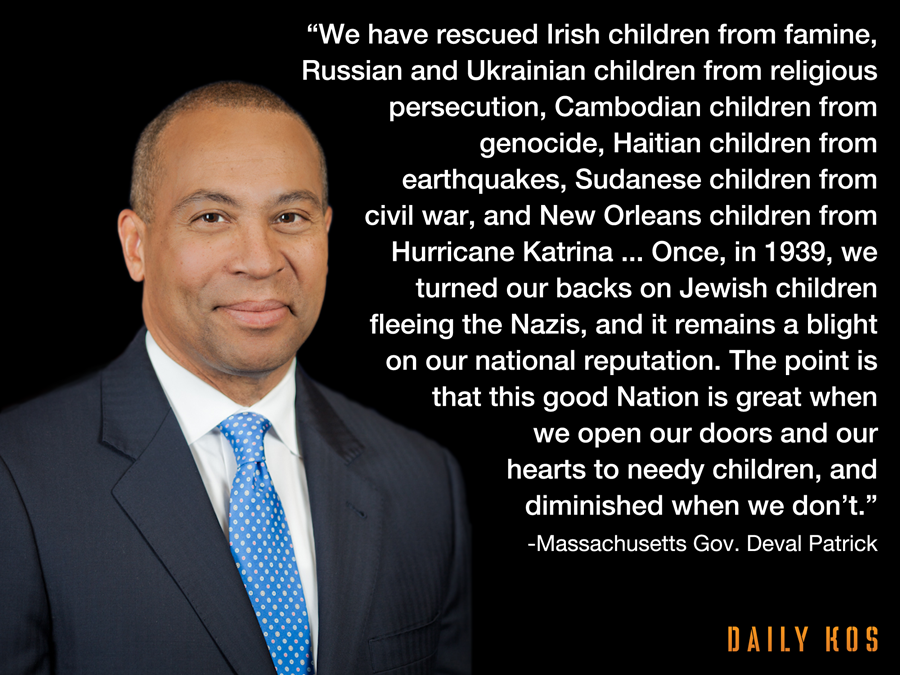
Flunking Responsibility, Honesty, Common Sense and Ethics: Gov. Deval Patrick, Sen. Patrick Leahy, Daily Kos, and Anyone Else Who Repeats This Idiotic Analogy

Deval Patrick

I thought I might run an ethics quiz asking whether this current and mind-bogglingly stupid argument that keeps popping up from my sentiment-addled Facebook friends is more unethical than the pro-Hamas hashtags being appended to twitter comments by the “Think of the children!” saps led by celebrities like Jon Stewart, Selena Gomez, and John Cusack. Pondering on it, however, I realized that as ethically misguided as Stewart at al. are, the above quote and its ilk are worse….especially since state governors and U.S. Senators have more credibility than comedians and Disney pop tarts. Not that they should, mind you.

If I really have to make a detailed argument explaining why Deval’s quote and  Leahy’s ( “Think of all those Jews that went to the ovens because we forgot our principles. Let’s not turn our backs now.”) are unforgivably irresponsible, we are just as dim-witted as those demagogues (or, more likely, as dim-witted as they hope and think we are.) The statements are no more nor less than an invitation to every parent of every child in every poor, war-torn, politically foul, culturally poisoned, dangerous, corrupt nation in the world to somehow get them to the U.S. border, paying shady and often treacherous agents to do so, because the United States will not “turn its back,” and turn them back. The question isn’t whether this is a legitimate, responsible or sane position worthy of debate and serious consideration: of course it isn’t. The question is how anyone can think it is. Continue reading

Ethics Quiz: Blaming the Messenger

"Hey, I just deliver the boxcar contents to someplace called "Aushwitz." It's not my business what's in them..."

“Hey, I just deliver the boxcar contents to someplace called “Aushwitz.” It’s not my business what’s in them…”

In 2013, the United Parcel Service Inc  agreed to forfeit $40 million in fees that it had received from illegal internet pharmacies shipping bootleg prescription drugs using UPS services, in exchange for a non-prosecution agreement with the U.S. Department of Justice. UPS also agreed to put policies and procedures in place to prevent illegal online pharmacies from distributing drugs through its shipping services in the future. Naturally, the faux pharmacies moved over to FedEx, and when that shipping service refused to cut a similar deal with DOJ under threat of prosecution, the government persuaded a Federal grand jury to indict the company for delivering drugs associated with internet pharmacies, and thus being a willing party to a criminal enterprise.

Now many are cheering FedEx as, in essence, an ethics hero for refusing to knuckle under to the government and accept responsibility where it has none. There are two arguments against the government’s prosecution of FedEx. One is that its natural result would be to require shipping companies to open every parcel and be certain that nothing illegal is inside. The other is that trying to eradicate crime and other misconduct by creating secondary service liability is inherently unjust. By pressuring credit card companies  to refuse payments to companies the government regards as breaking the law, for example, alleged illegal enterprises can be put out of business without the government having to meet its burden of proof to show they really are breaking the law. If the government can intimidate carrying companies into refusing the business of illegal pharmacies, then the illegal pharmacies never have to be prosecuted. There is a third argument, but it is irrelevant: that the government shouldn’t be prosecuting the crime of providing prescription drugs over the internet at all.  This is an entirely different and separate issue: The point is that the shipments are illegal now, and FedEx is facilitating them.

Your Ethics Alarms Ethics Quiz to begin what I sense will be a busy ethics week is…

Is FedEx an Ethics Hero?

Continue reading

Bulletin: It’s Unethical For Government Officials To Use Twitter

no-twitter

Many law firms and other companies specifically prohibit their employees from using social media.  The reasons should be obvious: social media use is inherently reckless and unacceptably risky for professionals and those with high profile jobs. This is especially, and I would say fatally true of Twitter. It is an accident waiting to happen, and the more powerful the user, the more damage the accidents will be.

The latest example is the saga of Richard Stegel, Under Secretary for Public Diplomacy and Public Affairs at the U.S. Department of State. He used his personal Twitter account yesterday to comment on the crisis triggered by the downed airliner in the Ukraine, prefaced the tweet with the State Department’s Twitter handle, and ended it with the hashtag #UnitedForGaza, which would appear to indicate his support of the Palestinians in its violent clash with Israel.

This is disturbing and diplomatically harmful for several reasons: Continue reading

A Proposed Guide To Spoiler Ethics

"It SINKS??? You spoiled the ending!!!"

“It SINKS??? You spoiled the ending!!!”

I was just admonished on Facebook by a friend (a real friend, not just the Facebook variety), for referencing the end of the last episode of Season One of “Orange is the New Black.”  He hadn’t finished viewing the season yet, and this was a breach of spoiler ethics. Or was it?

Ever since I encountered for real someone who was angry with me for “spoiling” the end of “Thirteen Days,” ( “Yes, World War III started and everybody died”), I have been dubious about spoiler etiquette. The advent of DVDs and Netflix has made this all the more annoying. If I’m in a group of five, and one individual hasn’t kept up with “House of Cards,” are the rest of us obligated to censor our discussion? As a devotee and fanatic devourer of popular culture, I admit that my first instinct is to say, “Keep up, get literate, or pay the price.” If I actually live by that rule, however, I will be a walking, talking, writing, spoiler machine.

Chuck Klosterman, “The Ethicist” in the world of the New York Times, recently pronounced himself an anti-spoiler absolutist:

“I’m an anti-spoiler fascist. I don’t believe that any conversation, review or sardonic tweet about a given TV show is more valuable than protecting an individual’s opportunity to experience the episode itself (and to watch it within the context for which it was designed). I’ve never heard a pro-spoiler argument that wasn’t fundamentally absurd.”

Even Klosterman, however, excepted sporting events (the question posed involved mentioning World Cup scores to a friend who was annoyed that the game had been “spoiled” for him) from his fascism, writing, reasonably:

“I must concede that live, unrehearsed events are not subject to “spoiler” embargoes A live event is a form of breaking news. It’s not just entertainment; it’s the first imprint of living history. …Because this guy is your buddy, you might want to avoid discussing the games’ outcomes out of common courtesy — but not out of any moral obligation. It’s his own responsibility to keep himself in the dark about current events.”

For once I agree with Chuck. But what are reasonable ethics rules for dealing with the other kind of spoiler, involving literature and entertainment?

Luckily, this is not new territory, though it is evolving territory. The underlying ethical principles include fairness, trust, consideration, compassion, and empathy, which means that the Golden Rule is also involved.

Back in 2010, an erudite blogger calling himself The Reading Ape proposed a draft “Guide to Responsible Spoiling.” That blog is defunct; the promised successor is not around, and so far, I haven’t been able to discover who the Ape is. Whoever he is (Oh Aaaaape! Come back, Ape!) , he did a very good job, though some tweeks might  improve his work, especially in light of the emergence of Netflix.  (I have edited it slightly, not substantively…I hope he doesn’t mind, or if he does, that he’s not a big ape.) His approach is to frame the problem as an ethical conflict, in which two competing ethics principles must be balanced. I think that’s right.

Here is his “draft”—what do you think?

“A Brief Guide to Responsible Spoiling”

by The Reading Ape (2010)

The objective is to balance two ethical principles:

I. The Right to Surprise: The inherent right of any viewer or reader to experience the pleasure of not knowing what’s
going to happen next.

II. The Right to Debate: The inherent right of any viewer or reader to engage in public discourse about the content of
a given work of narrative art.

Part 1: When Spoiling is Fair Game

In the following circumstances, one can discuss crucial plot details and reveal endings with a clear conscience. Continue reading

Ethics Dunce: Federal Judge Richard G. Kopf

"Oh dear...and he looks like such a NICE federal judge!"

“Oh dear…and he looks like such a NICE federal judge!”

Richard G. Kopf is a senior district court judge on the U.S. District Court for the District of Nebraska, and a blogger. He is also,I would say obviously, an Ethics Dunce. Why?

He told the U.S. Supreme Court to shut the fuck up.

He really did.

That he did this on his blog, Hercules and the Umpire, doesn’t matter. It was in print, in public, and he’s a Federal judge. The obscenity came in the context of Judge Kopf’s criticism of the recent Hobby Lobby decision, but the context doesn’t matter either. There is no context in which it would be appropriate, judicial and ethical for a member of the judiciary to tell the Supreme Court of the United States to shut the fuck up. Nor does it matter that he used the texting code stfu rather than spelling out the words.

For a Federal judge to be openly disrespectful, uncivil and abusive to the top of the nation’s judicial branch is an assault on the rule of law, and undermines public respect for our institutions. As lawyer and blogger Rich Hasen wrote, Continue reading

On Mockery, The Streisand Effect, Incompetent Lawyers And The Sleeping Yankee Fan

ESPN cameras caught Andrew Rector sleeping in his seat in the fourth inning of  the April 13 Boston Red Sox-New York Yankees game. In the time-honored tradition of TV play-by-play when something funny, weird or, most especially, sexy is spied in the stands, ESPN commentators Dan Shulman and John Kruk  began making fun of him. The clip ended up on YouTube, naturally, and thus on various sports websites, followed by the various idiotic, cruel, gratuitously mean-spirited insults, usually composed by brave anonymous commenters.

This is a familiar pattern of unethical public mockery, and we have become inured to it. Though the ESPN team’s jibes were rather mild in nature, and Rector’s legitimate embarrassment quota would be far, far less than, say, that of George Costanza when this happened at the U.S. Open, let me say for the record that picking fans out of the crowd at sporting events and making fun of them, whatever they are doing, is generally a rotten thing to do. I know: it’s public, you know you might be on camera, and the fine print on the ticket stub puts you on notice. Unless, however, the conduct involved is actually newsworthy or despicable (as in instances where an adult has snatched a baseball from a child), the Golden Rule applies. Who knows why Rector was sleeping? Maybe he was up all night with a dying relative or a grievously ill child—Shulman and Kruk don’t know. And if he chooses to pay for a ticket and nap during the game—and it wasn’t exactly a scintillating game, I should add—so what? Continue reading

Ethics Strike Three And Four Against Facebook In Its Creepy Mood Manipulation Study

Facebook is so out.

"Meh. Look at this neat picture of my dog!"

“Meh. Look at this neat picture of my dog!”

Ethics Strike One was the research itself, using its own, trusting users as guinea pigs in a mad scientist experiment to determine whether their moods could be manipulated by secretly managing the kind of posts they read from Facebook friends.

Ethics Strike Two was the lack of its subjects informed consent for the study, violating the basic standards of human subject research. A boilerplate user agreement that makes a vague reference to using data for “research” in no way meets the requirements of informed consent for this kind of study.

This brings us to Ethics Strike Three.  In justifying the legality and ethics of the research, Facebook’s researchers explained that leave to perform such experiments was consistent with the user agreement (See Strike Two):  “[the experiment] was consistent with Facebook’s Data Use Policy, to which all users agree prior to creating an account on Facebook, constituting informed consent for this research.” As I pointed out above and in my previous post on this topic, this isn’t informed consent as the research field and various ethics codes define it. But even if it was, this statement is a lie. Continue reading