Bret Stephens’ Capitulation To New York Times’ Anti-Second Amendment Culture

The New York Times, to nobody’s surprise, is all-in to assist its progressive compatriots in using  every tragedy involving guns to strip away the core individual right to bear arms.  The op-ed pages and website , have, once again, become an oppressive barrage of anti-gun fanaticism and disinformation. Take this morning, for example. There is Timothy Eagan’s claim that the Second Amendment is a “cancer in the Constitution.” “The Second Amendment,” he writes, in the process of declaring the individual right enshrined in the Amendment abd confirmed by the U.S. Supreme Court as null and void, “as applied in the last 30 years or so, has become so perverted, twisted and misused that you have to see it now as the second original sin in the founding of this country, after slavery.”

Other aspects of American ideals, traditions, values and cultures that Eagan’s allies on the Left also consider cancers would include, I imagine, the Electoral College, Due Process (see: the Obama Education Department’s now defunct “Dear Colleague” letter), Freedom of Speech (“Hate speech kills!”), Freedom of Religion,  Equal Protection,  the Commerce Clause and, of course, the requirement that impeachment has to be based on a substantive crime. We get it, Tim: the Constitution is an infuriating roadblock to turning the U.S. and its culture into a clone of Sweden.

Then there is David Brooks, once the token conservative among the Times otherwise leftist columnists until his brain was removed while he slept and thoroughly washed. In today’s exhibit of Brooksian pseudo-intellectual gobbledygook, he bemoans “the left’s massive failure to persuade.” (The failure to persuade in this case is based on an escalating failure to be honest, vilifying adversaries, and the fact that the left’s strategy is based on emotion a biased presumption that the right to bear arms is “a cancer on the Constitution.”) Brooks also begins with that assumption, but as usual buries his motives in false objectivity: he writes, for example,

“The research doesn’t overwhelmingly support either side. Gun control proposals don’t seriously impinge freedom; on the other hand, there’s not much evidence that they would prevent many attacks.”

Then he declares the controversy an “epiphenomenon”—I think I know what that means, but I don’t trust writers who use words like that—to end with,

“Today we need another grand synthesis that can move us beyond the current divide, a synthesis that is neither redneck nor hipster but draws from both worlds to create a new social vision. Progress on guns will be possible when the culture war subsides, but not before.”

Brooks began with the presumption that “progress on guns” means acceptance of the anti-gun position on guns. Of course he did.

The day before, the New York Times’s new token conservative columnist had thrilled the anti-gun Left with his latest column, ‘Repeal the Second Amendment.

He deserves credit in one respect: unlike his liberal colleagues who would kill the individual right to gun ownership by incremental cuts, at least Stephens is honest. His arguments, however, are lazy and shallow. Indeed, the entire piece reads like clickbait , or perhaps something written with an editor’s gun—well, crossbow—at his head.

He writes, “From a law-and-order standpoint, more guns means more murder. “States with higher rates of gun ownership had disproportionately large numbers of deaths from firearm-related homicides,” noted one exhaustive 2013 study in the American Journal of Public Health.”  This is a fake and misleading stat arrived at by including suicides among actual murders. Since 1990, the homicide rate has dropped like stone while gun ownership has risen. “More guns mean more murder” is not even a defensible opinion; it certainly isn’t fact. He should have checked with David Brooks on that.

The whole essay is like this, however, He begins by writing, “I have never understood the conservative fetish for the Second Amendment.” It’s not a “fetish,” and it’s not intrinsically conservative. Belief in the Second Amendment springs from a commitment to individual liberty and inherent suspicion and distrust of expanding governmental power that insists that only the State, and not the citizens it is supposed to serve, should possess deadly force.

In a terrific rebuttal in The Federalist, David Harsanyi writes, “As an American-Jew whose ancestors came here escaping both Nazism and communism, I totally ‘get’ the Second Amendment ‘fetishists.’And when I read columns like the one Stephens wrote today, I definitely get it.”  For Stephens’ argument reduces to “Resistance is futile”–Come on, he asks, how are a bunch of pathetic citizen gun owners going to resist the government? Better to just submit: I swear, we can trust these people! I work with them every day! They only want the best for everyone!” Stephens writes like he has Stockholm Syndrome. Continue reading

Comment Of The Day: “Morning Ethics Warm-Up, 10/3/2017: In the Wake Of Las Vegas…”

Michael R. has been a stand-out commenter at Ethics Alarms since the blog’s inception. He also has been missing in action for more than a year. Thus it was a pleasure not only to see him back on the field of ethics battle, but arriving with a Comment of the Day. Michael takes off from the discussion of the national reaction to Stephen Paddock’s puzzling rampage to examine the state of trust in our society. Here is his Comment of the Day on the post, Morning Ethics Warm-Up, 10/3/2017: In the Wake Of Las Vegas…

I think the worst part of the aftermath of this tragedy is I don’t know who to trust. Should I trust reporting on this event that comes from CBS after their vice president announced on social media that she had no sympathy for the victims because many were Republicans? When President Obama tweeted “A violent felon can buy the exact same weapon over the internet with no background check, no questions asked.” — @POTUS #StopGunViolence”, the media fact-checked this and stated it was ‘mostly true’, so should I trust any of them? What news outlet can I trust to give me a truthful account of what happened?

Should I trust the FBI? James Hodgkinson was a member of numerous anti-Republican newsgroups (like “Terminate the Republican Party”), believed Donald Trump was president because of Russian collusion, took photos of the baseball field after the New York Times published an article on where and when the Congressmen would practice as well as the fact that there would be little security, traveled to the D.C. area and was living out of his van right next to the baseball field for days before the attack, Googled “2017 Republican Convention” hours before the attack, and asked “Is this the Republican or Democratic team?” before firing on the Republican Congressmen. This man shot up a bunch of Congressmen and what did the FBI say about all this? They said that Hodgkinson “…had no target in mind” when he shot them, that they didn’t know who he planned on targeting, and that he may have just “happened upon” the baseball game and “spontaneously” started shooting. Should I trust the FBI on this one? All the information at the beginning of this paragraph was from the FBI and the latter part is the conclusion they drew from the info. The FBI also said they didn’t wiretap Trump Tower, then admitted that they did…at least twice. Continue reading

Assorted Observations On The Sandy Hook Ethics Train Wreck, Las Vegas Strip Edition

  • I was serious about directing anyone seeking ethics commentary in reference to the Las Vegas massacre to all of the posts tagged with the Sandy Hook Ethics Train Wreck tag. So far, there is nothing new being said or proposed, just an unleashing of the same tactics, same fake “facts,” and same rending of garments and tearing of hair, whatever that is. I suppose this is healthy as a cultural release, though not in nay other respect. That tag wasn’t on this basic Ethics Alarms post, however, and it is the starting point for any of my commentary on gun control-related matters. The intentionally stark title: The Inconvenient Truth About The Second Amendment and Freedom: The Deaths Are Worth It.

Oh, hell. I’m just going to re-post it. Be back in a second.

There. It’s up.

  • So much of the blather everywhere is naked virtue signaling. One commenter here who should know better wrote on one of the other posts that I was criticizing those who were decrying gun violence. Who doesn’t decry gun violence? Why is it necessary to proclaim the obvious? Oh, you really are horrified that 59 innocent people were killed and 500 were wounded? What a sensitive person you are! You are so good, I must take your insistence that we have to do something as a substantive contribution to the discussion.

Decrying senseless violence and wanting gut the Bill of Rights in response are not the same thing, not even close. The first is gratuitous and obvious, and the second is emotional and irresponsible.

  • I would not be surprised at all if President Trump further muddled this already incoherent debate by endorsing some new (or old) gun control measures. He would do this, presumably, as he seems to make most decisions, from the gut, or the seat of his pants, or because it seemed like a good idea at the time. The chances that he has thought deeply about the issues involved are nil; the chances that he is familiar with the jurisprudence on the matter is less than nil. It would almost be worth it to watch the reshuffling of loyalties and support among the pundits and commentariat.

Real Nazis, after all, want to confiscate guns.

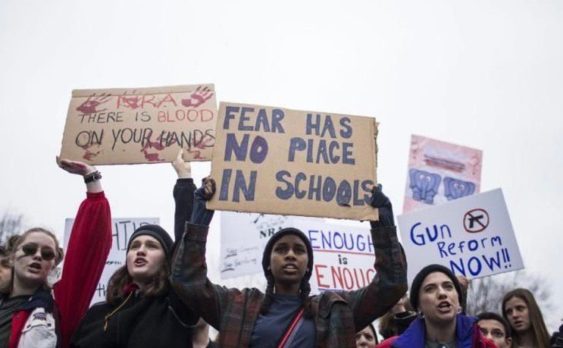
  • Once again, the NRA is being vilified, with the disgusting “blood on their hands” cry. The NRA isn’t sort of like the ACLU; it’s exactly like the ACLU, but with more integrity. If only the ACLU fought to defend the First Amendment as vigorously as the NRA defends the Second. Organizations that take the extreme position on any of the sections of the Bill of Rights create a necessary counterweight to fanatics who would tear them out of our Constitution and culture.

The NRA is extreme. It has to be extreme. The ACLU isn’t extreme enough, and because it will not take an absolutist stance (Like late SCOTUS justice William O.Douglas, who repeatedly wrote that no restriction on speech was justifiable or Constitutional), it has made itself vulnerable to bias, and harmed its credibility.

  • It is astounding to me—I guess I foolishly expect people to learn—that the eruption on the latest anti-gun fervor is again being led by ignorance, hyperbole and finger-pointing. The argument of  the Federalist essay I posted the link to this morning should be clear as glass: making this a partisan issue guarantees that nothing will get done. Democrats sounding like they are seeking a slippery slope leading to the banning of all firearms guarantees no action whatsoever, dooming even reasonable measures. Forever. Do they really not understand this? Do they really want to try to fix the problem, to the extent it can be fixed? I wonder.

Progressives mostly refuse to read conservative publications like The Federalist. They would rather be pure and stupid than informed and effective.  And this, my friends, is why Donald Trump is on his way to a second term.

  •  The tenor of much of the blather from elected officials and pundits reaffirms my belief that adulthood is a myth.  I keep hearing various versions of the lament, “We can’t let this go on! How can we stop it from happening?”

Continue reading

Comment Of The Day: “Ethics Essay Of The Month: Andrew Sullivan”

luckyesteeyoreman‘s first comment here was in 2012. He has participated in our colloquy with passion humor and perception through over a thousand comments He has had Comments of the Day before, but not like this one—I’m note sure anyone has made a comment like this one. His catalyst was Andrew Sullivan’s essay on tribalism, and the comment was lost for a day in WordPress Hell, then languished as my time to spend on Ethics Alarms was taken up by transportation and the annoying things called “teaching ethics” and “making money, though not nearly enough.”

I’m sorry it took so long to post this. It’s thoughtful and pure, unadulterated luckyesteeyoreman, which translates loosely into “worth the time to read it.”

Here is luckyesteeyoreman‘s epic Comment of the Day on the post, Ethics Essay Of The Month: Andrew Sullivan:

(I don’t have a title for this – only sub-section titles. I beg pardon in advance for unreadability. Maybe it should be titled “Lucky’s Madcap Mangled Manifesto #1 of 2017.”)

Andrew Sullivan, in his essay “America Wasn’t Built for Humans” (alternately titled, “Can Our Democracy Survive Tribalism?”) did not address two particular opposed tribes. I will discuss them, giving them my own choices for labels. I will blame one of the two tribes entirely for the current state of human affairs. I cannot envision any resolution of the conflict, other than the virtual annihilation of one or both tribes. Make no mistake: The conflict and its impacts are historically cyclical, humanity-wide, and universal – not some uniquely American problem.

TRIBES IN CONFLICT

In one tribe are the “governists.” One might be more comfortable with calling that tribe “governmentalists.”

Members of the governist tribe view governance and its machinations – created, continually reformed, and sustained by an ever-omnipresent government, a source and repository of ultimate power – as the sole institution that is essential to the fulfillment of human needs. To the governists, governance must embody ultimate means of power and control over all people, over all other life forms, and over all resources known to be required for (1) sustainment of the lives that are subject to control, and (2) sustainment of the needed means for such power and control.

In the tribe that is irreconcilably at conflict with the governists are the “ownwayists.”

Ownwayists view themselves, as individuals, as sources and repositories of need-fulfilling power – power independent of the powers of government. Ownwayists view their individual power largely as sufficient for need fulfillment, but, limited by their own individual human limitations – where that power is not additionally limited by external forces. Thus ownwayists are unavoidably and eternally conflicted within themselves, over the need for government – powers external to themselves – to combine and orchestrate individuals’ powers synergistically.

A PAUSE: A reader might perceive that statists and individualists are synonyms for governists and ownwayists, respectively. I would have used those terms, if I had felt confident that they are accurate for the tribalism I am aiming to discuss here. I leave to others smarter than myself the resolution of any issue about the best, or correct, labels for the two tribes. In this essay, I will proceed using forms of governist and ownwayist.

The conflict between governists and ownwayists is exposed when ownwayists perceive (correctly or incorrectly) that governists are creating, or have created (knowingly or unknowingly) what I am calling Synergy Despoliation (SD). I could elaborate further here on that specific phenomenon, but have chosen not to. SD can evidence itself in, for examples, inefficiencies of governance; failures of governments to enable the meeting of human needs; and impositions of insufficiencies upon governed individuals which often, but not always, stem from excessive government control of the powers of those individuals.

TRIBES AND TRIBALISMS 

DUALITY…

BLENDING, EVEN SWITCHING

Taking of power from individuals by governments happens, whether those so deprived are ownwayists or governists, and whether those with the power to deprive are ownwayists or governists operating within governments. Acquiring, holding and wielding of governance powers is not necessarily more coveted by any given governist than by any given ownwayist. Nor are there (yet) any inherent obstacles to access to governance powers that completely preclude any ownwayist from holding a position in government that is coveted by any governists. Any given individual can be conflicted internally, between co-opting oneself to governism and relying tenaciously and exclusively upon ownwayism, and on what extents one would embrace both.

Governments will hire from both tribes. In some cases governments will “spawn,” even transition and transform, governists and ownwayists such that some individuals re-set, and even switch, tribal affiliations. In the long run, however, any given government and its governance will eventually favor the existence, pre-eminence, and ways of the most “pure” governists.

In the final outcome, throughout history, governments and their governance continue to rise and fall, regardless of their tribal demographics. The conflict between the two tribes continues throughout history, too, regardless of the forms or tribal demographics of governments.

NATURAL SELECTION AND ITS RESULTS Continue reading

Ethics Alarms Encore: “The Inconvenient Truth About The Second Amendment and Freedom: The Deaths Are Worth It”

[ I wrote this piece in 2012, in response to the reaction at the time from the Second Amendment-hating Left to the shocking murder-suicide of of the Kansas City Chiefs’ Jovan Belcher. Jason Whitlock, then a thoughtful sports columnist iin KC, wrote a much linked and publicized column calling for private ownership of guns to be banned. I was going to update my post, but decided to just put it up again. Some of it is obviously dated (the reference to juvenile Carl in “The Walking Dead,” for example), but I have re-read it, and would not change a word of its substance.]

The shocking murder-suicide of of the Kansas City Chiefs’ Jovan Belcher has once again unleashed the predictable rants against America’s “culture of guns” and renewed calls for tougher firearms laws. Yes, reasonable restrictions on firearms sales make sense, and the ready availability of guns to the unhinged, criminal and crazy in so many communities is indefensible. Nevertheless, the cries for the banning of hand-guns that follow these periodic and inevitable tragedies are essentially attacks on core national values, and they need to be recognized as such, because the day America decides that its citizens should not have access to guns will also be the day that its core liberties will be in serious peril.

Here is Kansas City sportswriter Jason Whitlock, in the wake of Belcher’s demise:

“Our current gun culture ensures that more and more domestic disputes will end in the ultimate tragedy and that more convenience-store confrontations over loud music coming from a car will leave more teenage boys bloodied and dead. Handguns do not enhance our safety. They exacerbate our flaws, tempt us to escalate arguments, and bait us into embracing confrontation rather than avoiding it… If Jovan Belcher didn’t possess a gun, he and Kasandra Perkins would both be alive today.”

I don’t disagree with a single word of this. Yet everything Whitlock writes about guns can be also said about individual freedom itself. The importance of the U.S. “gun culture” is that it is really individual freedom culture, the conviction, rooted in the nation’s founding, traditions, history and values, that each citizen can and should have the freedom, ability and power to protect himself and his family, to solve his or her problems, and to determine his or her fate, without requiring the permission, leave or assistance of the government. Guns are among the most powerful symbols of that freedom. You can object to it, fight it or hate it, but you cannot deny it. Guns are symbols of individual initiative, self-sufficiency and independence, and a culture that values those things will also value guns, and access to guns.

Whitlock’s statement argues for building a counter-America in which safety, security and risk aversion is valued more than individual freedom. There is no doubt in my mind, and the results of the last election confirm this, that public support for such a counter-America is growing. The government, this segment believes, should be the resource for safety, health, financial well-being, food and shelter. It follows that the government alone should have access to firearms. This requires that we have great trust in central government, a trust that the Founders of the nation clearly did not have, but one that a lot of Americans seem ready to embrace. Giving up the right to own guns and entrusting government, through the police and the military, with the sole power to carry firearms represents a symbolic, core abandonment of the nation’s traditional commitment to personal liberty as more essential than security and safety. I would like to see the advocates of banning firearms admit this, to themselves as well as gun advocates, so the debate over firearms can be transparent and honest. Maybe, as a culture, we are now willing to make that choice. If so, we should make it with our eyes open. Continue reading

Morning Ethic Warm-Up, 10/3/2017: The Las Vegas Strip Shooting.

Not a good morning.

Not good at all.

I was preparing the notes for two business ethics seminars I’ll be running today when the news of the mass shooting in Las Vegas came on HLN. There are several items I had planned for today’s Warm-Up, but they all  seem trivial right now. 50+ dead, and over 200 wounded, the worst mass shooting in U.S. history.

Random thoughts, as I simultaneously watch reports:

1 The shooter has been killed. His name is Stephen Paddock. Are you relieved that he doesn’t have a Muslim name?

2. It sounds like the gun used was no ordinary automatic weapon, but possibly a belt-fed machine gun. I wonder if that fact will restrain the inevitable politicization of this tragedy, as it once again sets off the anti-gun ownership activists.

3. President Trump tweeted out the obligatory condolences. I assume he will make public statement in person. Twitter has the advantage of being quick, but there is something off about tweets as official reactions to such deadly national disasters.

4. I have believed for some time that the relentless escalation of 24-7 anger, political hate, fear-mongering and vicious partisan rhetoric in the news media and social media are creating an environment that risks driving the weak, the ill, the stressed and the vulnerable over the edge. Of course, this shooter may have had a brain tumor like Charles Whitman; the shooting may have no political connection whatsoever. Still, this is not a healthy culture right now. It can’t have helped.

Morning Ethics Warm-Up, 10/1/2017: Puerto Rico, Baseball Ethics, And Good Riddance To Hugh Hefner

Gooood Morning October!

1 And with October comes the wonderful post-season of that all-American sports that does not leave its athletes with brain disease, that requires some erudition and an attention span longer than a terrier puppy’s to appreciate, and that does not subject its fans to incoherent political theater as part of the price of watching a game. Yes, “it’s baseball, Ray.”

Yesterday the Boston Red Sox finally clinched the America League East title, the first time in over a century that this perverse team has won a championship in consecutive years. In other words, nothing can spoil my mood today.

There are a couple of baseball ethics notes, too:

  • In Miami, Giancarlo Stanton has one last game to hit his 60th home run, which would make him the sixth major league to reach that mark in baseball history. Two of the six, Babe Ruth, whose 60 homers in 1927 stood as the season record for 34 years, and Roger Maris, the Yankee who broke the record with 61 in something of a fluke season, reached the mark fairly. The other three, Mark McGwire, Sammy Sosa, and Barry Bonds, were steroid cheats. Ever since Stanton caught fire after the All-Star break and looked for a while as if he would exceed 61, wags have been saying that he would become the “real” record holder, since the totals of Mark, Sammy and Barry ( 73, the current record, in 2001) shouldn’t count. Of course they should count. They have to count. The games were official, the runs counted, the homers are reflected in the statistics of the pitchers, the teams, and records of the sport. Bonds should have been suspended before he broke any records, but baseball blew it. Saying his homers (and Sosa’s, and McGwire’s) don’t count is like arguing that Samuel J. Tilden, Al Gore and Hillary Clinton were elected President.

Integrity exists in layers, and the ultimate integrity is accepting reality. The 1919 Reds won the World Series, fixed or not. O.J. is innocent in the eyes of the law, and Roger Maris no longer holds baseball single season home run record.

  • In Kansas City, manager Ned Yost did something gracious, generous, and strange. The Royals, a small market team that won two championships with a core of home grown, low-visibility stars, now face losing all or most of them to big free agent contracts that the team simply cannot afford. Fans are often bitter about such venal exits, and teams usually fan the flames of resentment: better that the market be angry at the players than the organization. After Red Sox fan favorite Johnny Damon, a popular symbol of the 2004 World Series winning club, left for greener pastures in the New York Yankees outfield, he was jeered every time he came to bat in Fenway Park for the rest of his career.

But Ned Yost, who will be left with a shell of his team and a new bunch of kids to manage in KC next year, was not going to let the players who made him a winner depart amidst anger and recriminations. During yesterday’s 4-3 victory in front of the home crowd at Kauffman Stadium, Yost engineered an emotional curtain call for all four of the players who were probably playing their last games as Royals.

He pulled them from the game, one by one, all while the team was in the field or the player on the bases, so each could get a long standing ovation: Eric Hosmer in the moments before the fifth inning; Mike Moustakas with one out in the sixth. Lorenzo Cain for a pinch runner. Alcides Escobar in the middle of the seventh.

Nice.

And none of them took a knee on the way out…

2. I have been researching to find any objective reports that support the claim that the federal government and FEMA are not doing their best to help Puerto Rico. There aren’t any. There are plenty of videos of the devastation, but even the New York Times, which is the head cheerleader for anti-Trump porn, has only been able to muster headlines about the relief effort being criticized. All of my Facebook friends writing—it’s really dumb, everybody—about how Trump is uncaring as they signal their virtue by telling us how their hearts go out to the residents of the island literally know nothing about the relief efforts. They don’t know anything about the planning, the logistics, the problems or what is feasible. Nonetheless, they think they have standing to say that it is incompetent, or slow (which means, slower than it has to be), or, and  anyone who says this better not say it to me, based on racism. Their assertions arise out of pure partisan bias, bolstered by convenient ignorance.

Vox’s Matt Yglesias, one of the knee-jerk doctrinaire leftists in the commentary world who does an especially poor job hiding his malady,  attempted to take a shot at the Trump administration by tweeting,

“The US government supplied Berlin for nearly a year by air despite a Soviet blockade using late-1940s technology.”

This is only a valid comparison for the willfully obtuse. You can’t airlift electricity and water, or a communication and transportation infrastructure that is necessary to distribute supplies. Berlin was surrounded, but it had all of these. Continue reading

Morning Ethics Warm-Up, 9/30/2017: The Price Is Wrong, Traveling Men The Trump Cabinet,And The Return Of “Will & Grace”

Good Morning!

1 Under pressure from President Trump, who shouldn’t have appointed him in the first place, Health and Human Services Secretary Tom Price resigned  yesterday. He, along with other Trump officials, was under Congressional scrutiny for using expensive charter and military flights unnecessarily, costing taxpayers at a time when the administration is supposedly watching the budget. Under Federal Travel Regulations, officials are told to take the “most expeditious” means of transportation which “by no means should include personal use,” Chairman Trey Gowdy and ranking member Elijah Cummings had written to  letter to Price, 23 other agency heads, and the White House. Price has spent more than $400,000 on taxpayer-funded private jet travel since May.

Price’s abuses included a $17,760 round trip on a charter jet to Nashville, where the HHS Secretary stayed less than six hours, including lunch with his son. The day before he resigned and a day after the President publicly expressed displeasure over the travel abuses, Price had apologized. “Today, I will write a personal check to the U.S. Treasury for the expenses of my travel on private charter planes. The taxpayers won’t pay a dime for my seat on those planes,” Price said in a statement, adding that he will no longer take private planes while serving as Secretary. “No exceptions.” This was deceit, however. The repayment was just $51,887.31, a fraction of the true cost to the government. That was, as Price said, the cost of  the secretary’s “seats” if had flown commercial.

Price is not the only Trump official whose travel practices and expenditures raise at least the appearance of impropriety, but if one had to be the symbolic whipping boy, Price was a great choice. He was also my choice back in January for “Trump Cabinet Appointee Most Likely To Make Money Off Of His Position.” In a post expressing disgust at Price’s appointment, I wrote,

“Last year, Price purchased shares in Zimmer Biomet, a medical device manufacturer right before he introduced  legislation that would have directly benefited the company. Price bought between $1,001 to $15,000 worth of shares in the company last March, and then, less than a week after the transaction,  introduced the HIP Act…to delay until 2018 a regulation that industry analysts believed  would significantly hurt Zimmer Biomet, one of two companies most affected by a regulation that limits payments for joint implant procedures. Not only did Price have a financial stake in the regulation he tried to stall,but after Price introduced  his bill, Zimmer Biomet’s political action committee donated to the Georgia congressman’s reelection campaign.”

2. Losing one arrogant, travel-abusing high official may not be enough. It’s an interesting problem: is it fair to make one miscreant the focus of abuses that involve many? No; it’s also not practical, and therefore not responsible, to behead a significant portion of the Executive Branch because oversight was lax and an unethical culture had been allowed to take hold. I think Veterans Affairs Secretary David Shulkin would be an excellent and deserving candidate to join Price as metaphorical head on a pike.

Shulkin took a 10-day trip to Europe this past July, for meetings with Danish and British officials about veterans’ health issues. He treated much of the trip as a vacation, taking in a Wimbledon championship tennis match, touring Westminster Abbey and taking a cruise on the Thames with his wife, whose expenses were also paid for by you and me. The federal government paid for the commercial flights for Shulkin and his wife, and provided a per-diem reimbursement for their meals and other expenses. How did Mrs. Shulkin rank reimbursements and taxpayer-funded airfare? A VA spokesman explained that she was traveling on “approved invitational orders” and had “temporary duty” travel expenses.

In other words: “Huminahuminahumina…” Continue reading

Call Me An Alarmist, But This Alarms Me Greatly: The Censorious On-Line Anagram-Maker [UPDATED]

In a recent thread—the context is unimportant—commenter Chris facetiously wrote that “Auntie Yang’s Great Soybean Picnic” is an anagram for “Hitler Did Nothing Wrong.” My mind working the way it works, and being incapable of anagrams myself, I immediately went to an online anagram generator, and typed in “Hitler Did Nothing Wrong.”

The page, Wordplays’ Anagramer, told me that there were no anagrams for that phrase, which is, of course, isn’t true.  [UPDATE: See below] “Auntie Yang’s Great Soybean Picnic” isn’t one of them, but there are thousands, my favorite being (courtesy of a the ethical anagram generator here), “Deriding Hog-thrown Lint.” I always deride hog-thrown lint myself.

I amguessing that the only reason Wordplays refused to give me the anagrams I requested was that it decided that I shouldn’t have the right to even write or think the phrase “Hitler Did Nothing Wrong.” Somewhere in programming their site the social justice warrior totalitarians have decided that “bad words” and “bad ideas” can’t be used or thought about, even in jest. Even in an anagram!

‘First  they came for “Hitler Did Nothing Wrong, ” and I did nothing. Then they came for “Deriding Hog-thrown Lint.”‘

This isn’t funny, this is scary. There is a large and growing segment of the American public, many quite powerful, who believe in social change by constriction of words and thought. They see technology as their ally, and those who run technology companies show every sign of being such.

These are enemies to democracy and our liberties as defined by our Founding documents, our traditions and history.

They aren’t enemies because they block anagrams due to their crippling political correctness and arrogance.  That just means they are silly fools. They are enemies because they don’t think using their power to interfere with the speech and thoughts of others is wrong. They think they are doing good.

And if they can–if we let them—they will warp our culture  using laws, intimidation, indoctrination and, of course, technology until everyone believes that controlling words and thoughts is good.

If you think this is just about anagrams, you’re dangerously naive.

UPDATE: Commenter/Blogger Windypundit, who is surely more savvy in these matters than I am, writes in the comments,

I went over to the Wordplays Anagrammer site to play with it. The thing is, I can’t reproduce your results. When I enter the phrase “Hitler Did Nothing Wrong” it displays hundreds and hundreds of anagrams.

Maybe it was just a glitch? …I thought maybe it didn’t work in some browsers, but it worked in all five I tried.

I don’t know what’s going on. I tried twice, and got a “No anagrams found” message. I will assume that it’s me, not them.

The general position of my post stands, however. Even if the web isn’t censoring anagrams, there is a lot of manipulation going on.

Many thanks to Windypundit for the research and the report.

____________________

Pointer: Chris

Ethics Essay Of The Month: Andrew Sullivan

I used to read Andrew Sullivan’ blog regularly: he was smart, gutsy,a good writer, and willing to buck conventional wisdom> then the gay marriage controversy heated up—Sullivan is gay– and Andrew lost it. His focus and once-reliable rationality became distorted by anger, bias and emotion. He eventually gave up blogging because he determined that it was emotionally unhealthy; maybe he finally recognized that he needed a break. By that time, I had stopped reading him.

His brilliant essay in New York Magazine suggest that Andrew has his groove back, which means that his observation are thoughtful and worth pondering. The topic is tribalism, and he writes in part,

Over the past couple of decades in America, the enduring, complicated divides of ideology, geography, party, class, religion, and race have mutated into something deeper, simpler to map, and therefore much more ominous. I don’t just mean the rise of political polarization (although that’s how it often expresses itself), nor the rise of political violence (the domestic terrorism of the late 1960s and ’70s was far worse), nor even this country’s ancient black-white racial conflict (though its potency endures).

I mean a new and compounding combination of all these differences into two coherent tribes, eerily balanced in political power, fighting not just to advance their own side but to provoke, condemn, and defeat the other.

I mean two tribes whose mutual incomprehension and loathing can drown out their love of country, each of whom scans current events almost entirely to see if they advance not so much their country’s interests but their own. I mean two tribes where one contains most racial minorities and the other is disproportionately white; where one tribe lives on the coasts and in the cities and the other is scattered across a rural and exurban expanse; where one tribe holds on to traditional faith and the other is increasingly contemptuous of religion altogether; where one is viscerally nationalist and the other’s outlook is increasingly global; where each dominates a major political party; and, most dangerously, where both are growing in intensity as they move further apart.

Sullivan goes on to explain that this development is antithetical to the model the Founders intended for their new nation:

The project of American democracy — to live beyond such tribal identities, to construct a society based on the individual, to see ourselves as citizens of a people’s republic, to place religion off-limits, and even in recent years to embrace a multiracial and post-religious society — was always an extremely precarious endeavor. It rested, from the beginning, on an 18th-century hope that deep divides can be bridged by a culture of compromise, and that emotion can be defeated by reason. It failed once, spectacularly, in the most brutal civil war any Western democracy has experienced in modern times. And here we are, in an equally tribal era, with a deeply divisive president who is suddenly scrambling Washington’s political alignments, about to find out if we can prevent it from failing again.

Bingo.

Sullivan explains the evolutionary basis of tribalism and why it is so deeply rooted in the human psyche. Then he writes, Continue reading