I have never heard of even one customer of any company losing his job as a consequence of that company’s refusal to address legitimate complaints. That is why Comcast gets its Corporate Asshole of the Year award early. Nobody’s going to top this.
In any normal consumer setting, a customer able to prove that he was induced by a company representative to purchase a service under false pretenses would immediately receive an apology, and the service promised for the price offered. In this case, however, as you can see in the excruciating video, Comcast’s reaction is, “Sorry, we won’t honor what you were told.” Translation: Screw you. Sue us. Good luck with that.
The is reminiscent of the running gag that was once famous on “Rowan and Martin’s Laugh-In,” the chaotic Sixties comedy show, in which comic Lily Tomlin would play a cruel, smug, nasal-voiced and snorting Bell telephone operator named Ernestine (above). Her specialty was telling infuriated customers who were receiving rotten telephone service that their complaints were futile. “We don’t care. We don’t have to care. We’re the telephone company!” she’d say.
Apparently this is Comcast’s attitude. Horror stories about Comcast service are all over the internet and social media, and heads aren’t rolling, the Board isn’t screaming, press releases aren’t issuing, and documented customer abuse keeps turning up. The company has nurtured a culture of carelessness, callousness and arrogance, and apparently believes that its services are too essential to suffer significant consequences.
Chevy Chase Circle is the official border separating the District of Columbia and Chevy Chase, Maryland. The inscription on the fountain at the center of Chevy Chase Circle honors Francis Griffith Newlands, saying, “His statesmanship held true regard for the interests of all men.” He was a three-term senator from Nevada, serving from 1903 until his death in 1917, but more important to this controversy, founded the Chevy Chase Land Co., which created neighborhoods on the Washington and Maryland sides of the circle. Yes, the founder of Chevy Chase is honored with a fountain in Chevy Chase Circle. What could possibly be wrong with that?
The problem is that Senator Newlands was a racist, and a proactive one. He was a white supremacist who described blacks as “a race of children” too intellectually handicapped for democracy. In 1912, he attempted to have the 15th Amendment, which granted voting rights to African American men, repealed. Not surprisingly, his vision of Chevy Chase did not include black residents, or Jewish ones for that matter.
The Advisory Neighborhood Commission that represents the D.C. section of Chevy Chase wants to remove Newlands’ name from the fountain, and has introduced a resolution calling on the D.C. Historic Preservation Office to rename the landmark “Chevy Chase Fountain.” The reason is his advocacy of anti-black policies.
This is a classic ethics conflict, a problem in which valid ethics principles oppose each other. There are so many conflicting ethical principles and objectives at work here: Continue reading →
Forty six rationalizations have been added to the Ethics Alarms Rationalizations List, and today I not only stumbled upon a carelessly omitted one, but realized that it belongs near the top.
Ethics Surrender, or “We can’t stop it,” is the rationalization that argues that if society is incapable of effectively preventing unethical conduct, for whatever reason, we might as well stop regarding that conduct as wrong. This is yet another variation on the most common and insidious rationalization of them all and #1 on the list: “Everybody Does It.”
The Golden Rationalization has many variations, among them…
“It’s done all the time.”
“It’s always been done this way.”
“It’s tradition.”
“Everybody is used to it.”
“Everybody accepts it.”
“Nobody’s complained before.”
“It’s too late to change now.”
…and others. Ethics Surrender, however, warrants particular attention, as it encourages moral cowardice and ethics complacency. “We can’t stop it” is a lazy capitulation that assumes cultures can’t change, and we know they can and do change, both for better and worse, all the time. One society has been convinced, though legitimate, persistent, coherent and ethically valid arguments, that a common practice or conduct is bad for society, society can stop or seriously inhibit that unethical practice of behavior, either by law, regulation, or best of all, the evolution of cultural consensus. The examples of an Ethics Surrender resulting in undesirable societal consequences are too numerous to list, and many of them are still controversial. I would assign having children out of wedlock, adultery, lying by elected leaders and the use of illegal recreational drugs to the “We can’t stop it, so let’s say it’s not so bad” category. The most obvious and currently significant example is illegal immigration, wrong, but increasingly being rationalized by both advocates and lawmakers who have run out of ideas and principle. At this moment, we are hearing the defenders of dubious police shootings making that argument to avoid examining possible changes in law enforcement policy so there will be fewer deaths without putting police in peril.
Ethics is hard. Rationalization 1A, Ethics Surrender, or “We can’t stop it,” wrongly concludes that it is impossible.
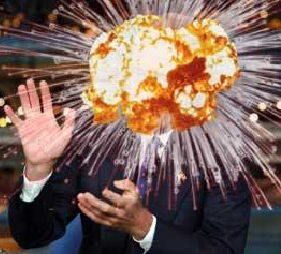
That explosion (see Kaboom!) was based—I’m guessing now, since I don’t control when my brain blows—-on my shock that the President actually could be President and believe that, as well as not be aware how deluded he appears to assert such something so contrary to evident reality. Is he really that estranged from what is happening in the country he leads? Frightening. Is he really incapable of comprehending the single biggest, most damaging, most unexpected and most dangerous failing of his entire administration? Pathetic. Does he not watch TV? Read blogs? Does he exist in a separate, narcissist parallel reality where everything is as he wills it to be? Wow.
I know that the networks he watches and the newspapers he reads didn’t report them for the most part, but every poll shows that the public overwhelmingly believes that race relations have worsened. You can dispute the value and accuracy of polls with considerable justification, but these are the kinds of polls most likely to be accurate. How plausible is it that race relations, defined as how the races feel about each other and how they are getting along, could improve with the public believing they have worsened? Here’s polls from Pew, Gallup (“The percentage of Americans naming “race relations” or “racism” as the most important problem in the U.S. has climbed dramatically to 13%, the highest figure Gallup has recorded since a finding of 15% in 1992, in the midst of the Rodney King verdict.”), NBC, IDB ( “By an almost 3-1 margin, Americans say race relations have worsened under the man who was supposed to usher in a golden era of “post-racial” relations.”), Bloomberg, and Politico, and there are many others, all with the same message. Moreover, all of them were taken before the ‘killer racist cops ‘ campaign by Sharpton and his cohorts culminated in the assassination of two police officers by a deranged African American seeking to take “two of theirs for one of ours.” Let’s see a show of hands: how many think race relations have improved in the last two weeks?
The leaders and participants in the protests related to incidents of excessive police force and violence—real, imagined, manufactured or equivocal—are creating an environment of racial distrust, fear and hate that cannot avoid resulting in violence. Yet astoundingly, they not only deny the natural consequences of their words and rhetoric but feign indignation (and racism, of course) when the effort, long underway with the assistance of such accomplices as Eric Holder, Barack Obama and Bill De Blasio, is properly condemned as the dangerous and reckless attack on society that it is.
I am not sure which amazes me more: that demagogues like Al Sharpton would have the audacity to proclaim that his organized campaign of hate against police, accusing them of being both racist executioners and the embodiment of a racist justice system, or the caliber of pundits who have rushed to Sharpton’s defense. How can this be? African-Americans are told, for years now, that whites with guns are hunting them; that police are determined to kill them, that the justice system is rigged to let the carnage continue. The carriers of this message includes members of Congress, celebrities, civil rights activists, the Attorney General and the President of the United States. False accounts that support this gross characterization of disparate incidents, each with unique circumstances, are turned into rallying cries, such as “Hands up! Don’t Shoot!” The left-biased media openly endorses the narrative, which says that black Americans are being hunted coast-to-coastby an armed force, determined to kill their children.
Prof. Turley is a lawyer, of course, and trained to express himself with precision. Thus I have to ask: what the heck is he trying to say here?
Is he wishing good tidings only those who, like his family, are celebrating Christmas, and rotten times to the rest? Is he editing the humanist message of Christmas to “Peace on Earth, and good will to those who are putting up Christmas trees and giving gifts, other wise you’re on your own”?
Or, as I fear greatly, given the fact that he is part of the U.S. education establishment and thus prone to have a spine of cream cheese, just observing the trendy political correctness that infects our times, and bowing to those who contrive to take offense when anyone smiles at them and offers a greeting that only says, at minimum, “We’re all in this together, so let’s try to be as good to each other as we can, OK?”Continue reading →
This is a rare collaborative Comment of the Day, as texaggo4 and Penn combined for a fascinating discourse on the trend in Christmas holiday music and its significance in response to my December 23 post, prompted by listening to one too many renditions of “I Saw Mommy Kissing Santa Clause” and “Santa Baby.” It’s a wonderful job by both participants here, reinforcing my conviction that the the debates following the posts are as valuable, or more so, than the posts themselves.
First up is tex, followed by Penn’s response. Here is their combined Comment of the Day on “Remembering Christmas Music”:
Christmas only exists because of Christ. That being said, pull the religion out of the holiday and ultimately the holiday disappears and all of its associated trappings.
Christmas music has several “genres”, not classified nor exclusive:
1) Theological or religious: directly communication the story or the theology of the Incarnation.
2) Modern references to the festivals associated with the Christ-Mass.
3) Modern references to the neo-pagan Christmas folklore…Santa Claus, Saint Nick, Father Christmas, etc.
4) Modern references to the American folklore… Frosty the Snowman, etc
5) Modern references to the post-materialist Capitalist associations with Christmas— Christmas party songs.
6) Modern references to the post-narcissist associations with Christmas…songs about sex….
great.
We all saw this coming…it is predictable. take the religion out of a religious holiday and you can only assume that artistic messages (songs included) pertaining to the Holiday will have less and less to do with the ethical message of the holiday until eventually, watered down, it isn’t even worth playing the secular versions of that Holiday’s music.
What are the secularists complaining about? They asked for this.
The Ferguson Ethics Train Wreck, which encompasses the shooting of two police officers in New York City, is just the second section of the Trayvon Martin-George Zimmerman Ethics Train Wreck. The coordinated effort to represent the American justice system as hostile to blacks, and white society as determined to harm them, was launched in Florida in early 2012, nearly three years ago. It might have failed then, as it deserved to since there was no genuine racial element in the actual Martin-Zimmerman episode, had not the President of the United States used his bully pulpit, credibility with black Americans and the power and influence of his office to declare the local incident as emblematic of societal hostility to African-Americans, and Obama personally. This, as I wrote earlier this week, lit the fuse that exploded into racial violence against police this past week.
I saw it then. I have seldom seen anything more clearly. So I wrote:
What does {Obama] think he’s doing? Teens, children and adults are murdered every day, many of them right where Obama lives, in Washington, D.C. Aren’t all of the violent deaths “tragedies”? Why is this one, and only this one, worthy of specific presidential attention? Is it because black leaders called for the President to overstep his proper role? Who cares what activists call on the President to do—certainly he shouldn’t. Does this now justify their calls for retribution and violence, or validate high school students who are staging walk-outs to protest law enforcement officials investigating a case before they make any arrest? (Are high school students now empowered to dictate law enforcement policy? Suspend every single one of them.)
What earthly difference does it make what Trayvon looked like, who his death makes the President think about, or whether he looked like the son Obama never had? So what? What if he looked like my son? Not good enough? When a white, Hispanic or Asian kid in a hoodie is shot by some gun-wielding hysteric, can those parents also count on a statement of concern by Obama? What if they are just run down by a drunk driver, or killed by being left in an over-heated car? Not tragic enough? Doesn’t strike the same chord of of “seriousness”? Or will these tragic deaths not be viewed as sufficiently important to the President’s “base” in an election year? Do you think these questions are unfair? Who laid the groundwork for them?
Misusing his office and prestige in such matters simultaneously diminishes the presidency and warps its function. The position has always included the role of Mourner-in-Chief, at times of genuine national tragedies, such as the Twin Tower bombings, the Challenger disaster, and Pearl Harbor. Cheapening this solemn function by intervening in local crimes and contentious race-charged controversies accomplishes nothing positive: it is divisive, intrusive, and dangerous.
Got that? Dangerous. I chose that word deliberately. March 12, 2012.
Reading the comments again now is fascinating: readers conservative and liberal denounced my criticism as unfair, after the usual “Bush did it too” spin from the reflex Obama defenders.
It is slowly dawning on me that Christmas music, one of the annual joys of my childhood and perhaps yours, is in a perilous state, both culturally and aesthetically. The best of the songs musically are religious in nature, which means that schools won’t pass them along to their charges as happened routinely when I was a child, and even playing them on the radio is likely to be regarded as a religious statement. I just loved the music, as I think most kids would if they ever got the chance before they were brainwashed into believing the ancient songs were subversive.
A full court cultural press is underway to make those songs as rarely heard outside of church as hymns, and I don’t see the trend as reversible. One obvious bar to a comeback: current pop stars don’t have the pipes to sing most of them without causing a sound pollution emergency. Or, if one of the few singers who could actually hit the notes dared to cover a carol like “O Holy Night,” he or she would feel required to apply flourishes of the sort that make every rendition of “The Star Spangled Banner” at a major sports event an invitation to PTSD.
Even for the more secular Christmas repertoire, the clock is running out. The most listenable versions, and the definitive ones in most cases, are by performers of the past who are not just dead, but also long forgotten by the current culture. An hour of classic Christmas recordings on the radio is now a reminder of how old I am and close to joining great singers like Bing Crosby, Judy Garland, Andy Williams, Nat King Cole, Jo Stafford, Burl Ives, Gene Autry, Frank Sinatra, Dean Martin, Elvis—dead, dead, dead. I guess Brenda Lee is still alive, so “Rockin’ Around The Christmas Tree” is a little less depressing, but it’s a minor classic at best. It’s gotten so bad that when I hear “The Little Drummer Boy,” I find myself wondering if the whole Harry Simeone Chorale is dead too—Harry died in 2005, and the recording is 56 years old, after all.
Meanwhile, our post-modern culture is sneering at the whole idea of Christmas songs, and Christmas itself. Most modern Christmas songs either are making fun of Christmas, about sex, or just lousy. The tradition is being undermined in more creative ways, too: this week I watched a 2012 straight-to-video movie called “12 Disasters of Christmas,” based on the loopy premise that “The Twelve Days of Christmas” was really a coded recipe for stopping the 2012 apocalypse predicted by the Mayan calendar. “The Mayans knew that the knowledge would have to be preserved for centuries, so they devised a song that would carry the secret and would be passed on and learned by children for generations,” explains the old codger who’s figured it all out. (But why would they choose such a monotonous and stupid song?) Come on, guess: How does the “Chosen One” stop the end of the world?[Answer below.]*
The movie is on to something, though. The Christmas songs that have the best chance of persevering though this age of cynicism and cultural illiteracy may be those that either tell a story or that have an interesting one related to their creation. The simple and beautiful tune of “Silent Night,” for example, as one of those films they used to show in school assemblies every year before some anti-religious hysteric sued, was composed for guitar in response to a Christmas Eve crisis for a small church in the Austrian alps in 1818: the church organ wasn’t working. I have found that Irving Berlin’s “White Christmas” affects me far more deeply since I learned that the Berlins’ infant son died on Christmas day, and that while his children celebrated Christmas as a cultural holiday, Berlin and his wife did not. They spent each Christmas after their son’s death in mourning. The song is a wistful remembrance of a happier time that the composer will never experience again.
Maybe another Christmas song will persevere if its origins are remembered; I was reminded of its history this week as a result of the thaw in U.S. relations with Cuba. Though my wife hates it, the song is one of my favorites, perhaps because it brings back warm memories: I watched the song’s first national broadcast with my sister and parents, and the Marshalls bought the recording the next day.
It was 1962. Noel Regney and Gloria Shayne were a husband and wife songwriting team of modest success. They were saddened by the lack of any spiritual content in popular Christmas songs then; imagine what they would think today.
Like all Americans, they were petrified during the thirteen days of the Cuban Missile Crisis, when the world stood on the brink of nuclear annihilation. As the crisis intensified, Regney found himself inspired to write down a simple poem with a Christmas theme. (Later, the couple would say that neither of them could ever sing the song through, because of the strong emotions it recalled.) When the nation could finally take a deep breath of relief as the threat ended, Gloria devised a melody for her husband’s words, though he had always been the composer when he and wife wrote songs together.
The result of this unique variation on their collaboration was recorded before the end of 1962, but it wasn’t until the following year, when Bing Crosby sang the team’s creation live on ABC’s “Hollywood Palace,” that it became widely known. The song written during the Cuban Missile Crisis became a best-seller, Crosby’s last hit Christmas record, and also the last popular Christmas song to have a religious theme.
It was, and remains, a prayer for peace.
____________________________
* By finding and wearing FIVE GOLDEN RINGS, of course!
Mark Draughn, a.k.a Windypundit and the Ethics Alarms 2013 “Blogger of the Year,” has swallowed the Kool-Aid, apparently, and decided to defend the race-baiters, from the tippety top of our government to the stygian depths of MSNBC, who have finally managed to get police killed in retaliation for the “racist murders” of Michael Brown, Eric Garner, and others. In his most recent post he challenged my analysis, and ended up making me feel pretty good about it. I love Mark’s blog and admire Mark’s mind, and if can’t do any better than this, I am obviously on firm ground.
I want you all to visit Windypundit, for Mark is terrific (usually), so I’m not going to go through the whole post, which you can read here. I will make a few salient observations though. Let’s play “Mark Says”:
Mark Says:
“I knew there would be people who would take Brinsley’s reputed motive and use it to smear protesters and activists who had spoken out against police abuse.”
1. Mark wrote this before my straw man post, and sure enough, he followed the script. It’s about “police abuse.” Right. Not race. Not the racism of whites, the hunting down of black men; not about how blacks can’t get justice even when they have been gunned down with their hands in the air. Indeed, it’s not “about” any of the irresponsible, exaggerated, inflammatory accusations that we have been hearing since Trayvon Martin was shot…and not by a cop, either.
2. “Reputed motive.” Mark thinks I am unfair to conclude that a killer who wrote online that he was going to kill some “pigs” in retaliation for police killing Mike Brown and Eric Garner killed the two police officers in retaliation for police killing Mike Brown and Eric Garner. Got it.
3. I’m smearing protesters! These are, recall, protesters who, by their use of the “hands up, don’t shoot” theme, were smearing a specific police officer with the false claim that he was a racist and a murderer, though the evidence says otherwise, and smearing the integrity of the citizens on the grand jury who refused to indict him. By extending this smear to police generally, they were also asserting that this—that is, the fictional racist murder of that “harmless, unarmed black teen” who had just tried to take the officer’s gun and was charging all 300 pounds of his body at Officer Wilson—was the potential orientation of all white police. I was smearing them by pointing out that this was divisive, inflammatory, dishonest and irresponsible. Continue reading →