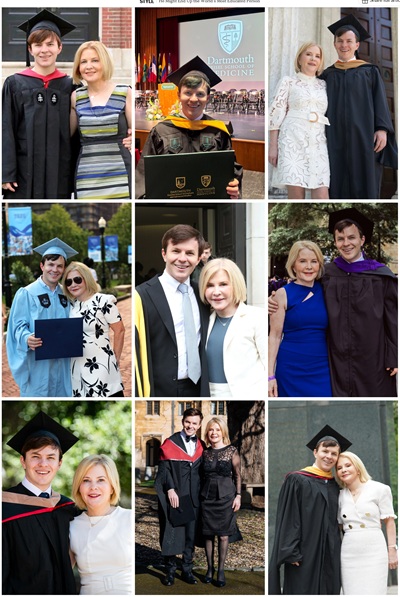
That’s New Zealander Jamie Beaton above, posing for photos during graduation days at Harvard, Dartmouth, Princeton, Yale, Cornell, Oxford, Stanford, Columbia, and King’s College, London. He’s the subject of a profile in the New York Times (gift link), chronicling his status as a “perpetual student.”
“A 5-foot-6 personification of naked ambition whose LinkedIn profile has been the subject of memes and Reddit threads, Beaton has gone to the head of a rarefied class — perpetual students,” the Times relates. “If he continues collecting advanced degrees at such a swift pace, he will surpass Benjamin B. Bolger, who has racked up 16 at age 50. He might even beat Michael Nicholson, an octogenarian forever scholar with more than 30 degrees to his name.”
With me, this resonates exactly like the Guinness Book of Records item about the only man to eat a whole automobile. One of my favorite oddball baseball players and historical figures was Moe Berg, a man who spoke Latin, Greek, French, Spanish, Italian, German, and Sanskrit, had degrees from Princeton and Columbia (in law), read ten newspapers a day and put all those skills to work playing major league baseball as a third-string catcher, never married, never owned a home, never started a business or earned a regular salary after retiring from the game. Beaton is more productive than that (arguably: Moe was recruited as a spy during World War II), but I still regard spending so much time and money accumulating academic credentials as pathological.
On the other side of the argument, of course, is the refrain of The Animals: “It’s my life and I’ll do what I want!” I endorse such autonomy and eccentricity, but still find the spectacle of someone with obvious ability, talent and work ethic spending so much of it on himself rather than the betterment of society, creation, and leadership as less than admirable.
At my undergraduate school, there were notable permanent students, mostly chubby middle-aged bachelors who arrived as undergrads, proceeded to graduate school, kept adding degrees, chased Masters and PhDs and never left the academic womb. They became “resident advisors” or “resident scholars” in the Harvard House system. They all gave me the impression that if they walked off the campus they would crumble to dust like vampires in sunlight.
I have an unmarried nephew who is 37, unmarried, and has been living in a university town for more than a decade as he pursues an elusive PhD. He does some teaching at the school, but he is, or was, a lively, funny, brilliant young man who had so many options after he graduated from college. As I increasingly regard higher education, in its current state of rot, a blight on American society, the phenomenon of the perpetual student seems increasingly indefensible, or at least tragic.
Now heeeeere’s Eric….!


1. As long as these perpetual students aren’t avoiding paying for school loans by continuing to be a student and they, or their family, are actively paying off their continuing education, then I really don’t care. Let them waste their entire life learning and do absolutely nothing productive with it.
2. As for these perpetual students not using their accumulated knowledge for some kind of perceived productive betterment to society, I do think it’s rather narcissistic and selfish of them but I also don’t care. Let them waste their entire life learning and do absolutely nothing productive with it.
3. It’s their life. As long as these perpetual students aren’t wracking up massive amounts of school loan debt that no one is paying for, or becoming some kind of burden to society, I just don’t care. Let them waste their entire life learning and do absolutely nothing productive with it.
People like this are simply going to fall within that “they also lived” category that no one really remembers or gives a shit about.
Education isn’t just for individual betterment. The reason we have public universities is not so that people can go get advanced degrees for themselves. We have them to train the people we need so that society will function. We need engineers, we need physicists, we need physicians and nurses. Many of these programs are expensive and have limitations on the number of students who can study them at one time. That is what makes the ‘status’ degree an issue.
Let’s look at an example. We admit a traditional student (age 22) to medical school. At 26, they finish medical school and start their residency. Let’s say they do 3 years and decide to become a GP who works at a rural hospital (now aged 29). The continue to practice medicine until they are 70 years old. That is 41 years of medical service.
Now let’s look at a ‘late’ admit. Let’s say a college professor decides to go to medical school after their college closes. The enter medical school at 52, graduate at 56, spend three years in residency and begin practice at 59. They practice until they are 70 after 11 years of practice.
There are no empty seats in medical school. We have had a shortage of physicians for 40+ years thanks to the AMA. By admitting a 52 year old over a 22 year old, we reduced the amount of medical care that position provided to society by 73%. Now, if it is a state medical school, the state probably spent over $500,000 for each student. Gee, why are medical costs so high?
The ‘fashion’ student provides essentially no benefit to society and took spaces away from the students who would have. It is a drain on society’s resources.
A controversial consequence that is just on fire: Male physicians practice, on average, for 15 years more than female physicians. Women are 55% of medical school students. Todays medical school class only provides 75% the medical care as an all male medical school class would. We actually have to increase the medical school spaces by 33% over an all-male class just to make up for the women in it.
”Male physicians practice, on average, for 15 years more than female physicians.”. I am uncertain if that’s true anymore or not. I’m on the tail end of genX and I can say with certainty that millennials and younger do not stick with careers like we and other generations past did male or female. They routinely switch careers, at least all of them I’ve known. Occasionally it’s within the same fields, but often it’s completely separate. I guess what I’m trying to say is I doubt many, male or female stay a doctor, or anything else, as long as they used to.
They told me that when I started my career too, and it didn’t happen. I don’t think I know anyone who changed careers after 30. But that isn’t what we are looking at here.
What the average hides is that women aren’t leaving medicine 15 years earlier than men. They are either working as long as the men are or they are leaving as soon as they pay off their student loans. There aren’t many in-between. This is indicative of an advising and admissions problem. Med schools vet students carefully to make sure that they are going to be satisfied as physicians and not leave before retirement, death, or disability. The reason is the extreme cost, the shortage of physicians and the small number of med school seats. They seem to do this well for men, the average age of men retiring as physicians is 64. For women, almost half leave quickly. This indicates that medicine just wasn’t a good fit for them. Are the same methods to screen male candidates not effective for women? Are we pushing women into medicine for DEI reasons when they really don’t want to do it? Half the women are working as long as the men, so it isn’t that women can’t or don’t want to work as physicians.
I know few people who are doctors, but I know several nurses and quite a few of them took a bit to get through nursing school, probably because they had young children while attending classes, and working full time, so I agree with that. Guys don’t tend to attend school part time while raising their children and working another job. It takes longer to get there. I don’t know many under 45 who stayed with the same profession more than 5 years. They just flit around. Medical, teaching, trades, whatever. Maybe Gen Z will be different.
Not to mention the female physicians who don’t leave the field entirely but switch to part-time work. No shade to those women for prioritizing motherhood and work/life balance, but I’d be surprised if even a 33% increase in med school classes would be enough to make up for the number of female physicians who work just a couple of days per week.
This describes many humanities professors, except they are basically professionals in nonsense rather than a jack of general trades.
If someone is going to live off of a trust fund their entire life and they want to spend their entire life in college collecting a variety of humanities degrees on their own dime, I don’t really care. If their choices were ‘play video games all day for the rest of my life’ or ‘go to school and learn cool stuff for the rest of my life’, I guess the latter is better.
The article got me to list my post nominal letters:
BS(chem); BS(nursing); CRNA, MSN(nursing): MS (anesthesia);
MA( Human relations); MA(Sacred Scripture); MA (Relgion and Society); MCL ( Canon Law); JCL ( Licenciate Canon Law) and Maj (USA ret.)
Never got past Master’s level but I worked for a lving, was married, raising two sons into responsible adulthod.
A perpetual student who racks up unpaid debt – unethical. Or one who takes the place of another qualified candidate with no intention of ever using the degree (as in medicine) – unethical. A student who uses perpetual study as an excuse to avoid human relationships and life’s responsibilities – sad. Really sad.
Michael R says: “I don’t think I know anyone who changed careers after 30”. I’m not trying to sound like a jerk here, but I think it happens more often than you may think. Granted I suspect in the medical profession most likely the percentage who bail out and radically change career paths is small.
Allow me to introduce myself. I started my career in 1983, taking various jobs as an auditor, accountant, financial analyst, and market analyst. Essentials a ‘numbers guy’ (and admittedly I wasn’t too happy in my career). In the year 2000 at age 41, I was laid off, and due to good fortune and diligence, started a career as a software engineer, which evolved in 2001 to becoming a software salesman. I was quite successful at it until the job market deemed me too old to maintain that career at age 60.
Please don’t take offense, just wanted to point out that there are many of us out here that through happenstance or desire, do change careers in middle age.
also, to Grandma Lisa. Right on!