Ethics Quiz: Is “Hidden City” Flying Unethical?

Hidden City

Last month, United and Orbitz filed a lawsuit against a website called Skiplagged, which among other things helps consumers plan trips with cheaper airfare using a tactic called “Hidden City.” Hidden City travel is when a traveler wants to go to a city that costs more to fly to directly than another city that uses the real destination as a connection. Thus, if you want to go to Charlotte, you book a cheaper flight that involves a change of planes in Charlotte, and just take your carry-on luggage and skip the last leg of the trip. Anyone can search and book Hidden City flights, but it is a chore.  Skiplagged makes it relatively easy.

Airlines punish frequent flyer passengers who use the method. They argue that gaming the system this way makes it difficult to track passengers and unfairly takes advantage of the hub-and-spoke system, where airlines fly to hub cities and add connecting flights from there. The lawsuit is trying to shut down Skiplagged,  alleging “unfair competition” that promotes “strictly prohibited” travel. The suit seeks $75,000 in damages, and 22-year-old site creator Aktarer Zaman is fighting it, seeking funds, so far successfully, on GoFundMe, where he originally sought  $20,000 to afford his legal bills and is closing in on twice that amount. My guess? If this gets to a jury, Zaman will win. The Streisand Effect is also in play: the airlines risk making everyone aware of this cost-saving maneuver, while getting bad publicity as well.

Zaman argues that the Hidden City ploy is legal. You know my answer to that ( Rationalization #4. Marion Barry’s Misdirection, or “If it isn’t illegal, it’s ethical”)and it’s also the first  Ethics Alarms Ethics Quiz of 2015:

Is the Hidden City tactic ethical?

Bloomberg refers to Hidden City flying as a “scam” and “cheating.” Is that a fair description? The ticket purchaser has paid for the whole flight, so why is it cheating to get off half-way through it?

I think it’s a close call, but I have to side with the airlines.  The closest analogy that I can come up with is card-counting in blackjack: it’s not cheating, and it’s not illegal, but the casinos have a right to prohibit it in their own interests. The rationalization (Rationalization # 18. Hamm’s Excuse: “It wasn’t my fault.”) is that the existence of a loophole is the airline’s problem to fix, and if they can’t fix it, taking advantage of it is fair. But it isn’t fair, any more than it is fair for travelers to avoid baggage fees by taking large bags through security to the gate, and then passing them off, at no cost, on the way into the plane. It’s dishonest, and the Hidden City trick is also dishonest. You pay the airline to take you to a specific destination. How they get you there is irrelevant: a ticket to Minneapolis is a ticket to Minneapolis, and if you use it to get to Chicago instead because the airline charges more to go there, you engaged in bad faith negotiation.  The ploy is also unethical because if it becomes widespread, airlines will have to raise fares, and all air travelers will suffer.

One of Zaman’s arguments also positions him on my bad side: he points out that his site merely shows the airfares, and that the passengers book the tickets. Right. That was the same argument made by radical pro-life websites that posted the names and addresses of abortion practitioners so fanatics could track them down and kill them. Pro-anoerexia websites don’t starve young women, they just encourage them to starve themselves. If Hidden City flying is cheating, he’s facilitating it.

Reluctantly, I have to agree that it’s unethical.

______________________________

Ethics Alarms attempts to give proper attribution and credit to all sources of facts, analysis and other assistance that go into its blog posts, and seek written permission when appropriate. If you are aware of one I missed, or believe your own work or property was used in any way without proper attribution, credit or permission, please contact me, Jack Marshall, at jamproethics@verizon.net.

The State Of Ethics Alarms, 2015

Driving on an empty road towards the setting sun 2014

The 2014 Ethics Alarms Best and Worst of Ethics Awards will be along shortly, but right now I want to provide an overview of the blog itself as 2015 dawns.

Posts: There were slightly more than 1,000 posts to Ethics Alarms in 2014.

Traffic: Ethics Alarms had 1,195,812 page views, up about 6% over 2013.

Most Viewed Posts: Outside of the home page, the Rationalizations List remained the most popular. The top ten 2014 posts that drew the most interest were, in order of most visits; Continue reading

Comment of the Day: “Hard Lesson Of The Walmart Tragedy: Bad Ethics Kills”

First The Washington Post suggests that my commentary on the tragic shooting death of Veronica Jean Rutledge by her two-year old son in an Idaho Walmart as using “the accident as an excuse to grandstand on gun rights,” then the website Raw Story writes that my post is a talking point for both sides in the gun rights debate.”  Neither is true; neither is remotely true. The post wasn’t even about guns: the topic is accountability for reckless and irresponsible conduct by parents and their consequences. Do journalists even read the stuff they link to?

The comments to the post, however, are another matter. Naturally some of them opine on gun policy, and an interesting query arrived from a reader in India, who wrote:

Hello all… I’m from India and we don’t have such gun laws here.. but it looks like, the only news that I see concerning America are “school shootings” and “accidental ones” every week. I have nothing against America and I love your country .. but owning a gun, seems to be a sign of insecurity to me. and I repeat, the only news I see is a regular pattern: “kid goes on shooting spree” or “kid accidentally discharges weapon”.. Don’t you see what’s happening b’coz of these Gun laws ? anybody can be careless about anything… nobody is perfect. I’m only airing my views about this.

This prompted an excellent Second Amendment explanation from 2014 New Prolific Commenter of the Year joed68. Here is his Comment of the Day on the post, “Hard Lesson Of The Walmart Tragedy: Bad Ethics Kills”: Continue reading

Oddly, Though Ethics Alarms Had Already Named Comcast “Corporate Asshole Of The Year,” The Company Felt It Had Something Left To Prove…

ernestine

I really don’t understand this at all. In October, when the viral story of how Comcast managed to get a customer fired from his job for insisting that the communications giant address his legitimate complaints, I wrote:

I have never heard of even one customer of any company losing his job as a consequence of that company’s refusal to address legitimate complaints. That is why Comcast gets its Corporate Asshole of the Year award early. Nobody’s going to top this.

Yet amazingly, Comcast has managed to have yet another tale of atrocious service and customer abuse get widespread publicity. This video, by YouTube exhibitor Sweetlethargy, tells the whole  jaw-dropping story:

In any normal consumer setting, a customer able to prove that he was  induced by a company representative to purchase a service under false pretenses would immediately receive an apology, and the service promised for the price offered. In this case, however, as you can see in the excruciating video, Comcast’s reaction is, “Sorry, we won’t honor what you were told.” Translation: Screw you. Sue us. Good luck with that.

The is reminiscent of the running gag that was once famous on “Rowan and Martin’s Laugh-In,” the chaotic Sixties comedy show, in which comic Lily Tomlin would play a cruel, smug, nasal-voiced and snorting Bell telephone operator named Ernestine (above). Her specialty was telling infuriated customers who were receiving rotten telephone service that their complaints were futile. “We don’t care. We don’t have to care. We’re the telephone company!” she’d say.

Apparently this is Comcast’s attitude. Horror stories about Comcast service are all over the internet and social media, and heads aren’t rolling, the Board isn’t screaming, press releases aren’t issuing, and documented customer abuse keeps turning up. The company has nurtured a culture of carelessness, callousness and arrogance, and apparently believes that its services are too essential to suffer significant consequences.

What have you heard about Bell lately?

__________________

Pointer: Fark

The Ethics Conflict Of Chevy Chase’s Newlands Fountain and How To Resolve It

Chevy Chase Circle

Chevy Chase Circle is the official border separating the District of Columbia and Chevy Chase, Maryland. The inscription on the fountain at the center of Chevy Chase Circle honors Francis Griffith Newlands, saying, “His statesmanship held true regard for the interests of all men.” He was a three-term senator from Nevada,  serving from 1903 until his death in 1917, but more important to this controversy, founded the Chevy Chase Land Co., which created neighborhoods on the Washington and Maryland sides of the circle. Yes, the founder of Chevy Chase is honored with a fountain in Chevy Chase Circle. What could possibly be wrong with that?

The problem is that Senator Newlands was a racist, and a proactive one. He was a white supremacist who described blacks as “a race of children” too intellectually handicapped for democracy. In 1912, he attempted to have  the 15th Amendment, which granted voting rights to African American men, repealed. Not surprisingly, his vision of Chevy Chase did not include black residents, or Jewish ones for that matter.

The Advisory Neighborhood Commission that represents the D.C. section of Chevy Chase wants to remove Newlands’ name from the fountain, and has introduced a resolution calling on the D.C. Historic Preservation Office to rename the landmark “Chevy Chase Fountain.” The reason is his advocacy of anti-black policies.

This is a classic ethics conflict, a problem in which valid ethics principles oppose each other. There are so many conflicting ethical principles and objectives at work here: Continue reading

Introducing Rationalization 1A: Ethics Surrender, or “We can’t stop it”

White Flag: Last LapForty six rationalizations have been added to the Ethics Alarms Rationalizations List, and today I not only stumbled upon a carelessly omitted one, but realized that it belongs near the top.

Ethics Surrender, or “We can’t stop it,” is the rationalization that argues that if society is incapable of effectively preventing unethical conduct, for whatever reason, we might as well stop regarding that conduct as wrong. This is yet another variation on the most common and insidious rationalization of them all and #1 on the list: “Everybody Does It.”

The Golden Rationalization has many variations, among them…

“It’s done all the time.”

“It’s always been done this way.”

“It’s tradition.”

“Everybody is used to it.”

“Everybody accepts it.”

“Nobody’s complained before.”

“It’s too late to change now.”

…and others. Ethics Surrender, however, warrants particular attention, as it encourages moral cowardice and ethics complacency. “We can’t stop it” is a lazy capitulation that assumes cultures can’t change, and we know they can and do change, both for better and worse, all the time. One society has been convinced, though legitimate, persistent, coherent and ethically valid arguments, that a common practice or conduct is bad for society, society can stop or seriously inhibit that unethical practice of behavior, either by law, regulation, or best of all, the evolution of cultural consensus. The examples of an Ethics Surrender resulting in undesirable societal consequences are too numerous to list, and many of them are still controversial. I would assign having children out of wedlock, adultery, lying by elected leaders and the use of illegal recreational drugs to the “We can’t stop it, so let’s say it’s not so bad” category. The most obvious and currently significant example is illegal immigration, wrong, but increasingly being rationalized by both advocates and lawmakers who have run out of ideas and principle. At this moment, we are hearing the defenders of dubious police shootings making that argument to avoid examining possible changes in law enforcement policy so there will be fewer deaths without putting police in peril.

Ethics is hard. Rationalization 1A, Ethics Surrender, or “We can’t stop it,” wrongly concludes that it is impossible.


KABOOM! or Unethical Quote of The Month? You Decide…I Can’t, Because My Head Just Exploded All Over The Christmas Tree

merry_bloody_christmas

“I actually think that it’s probably in its day-to-day interactions less racially divided.”

—President Obama on National Public Radio, giving his assessment of race relations in the U.S. today compared to when he was elected in 2008.

It’s kind of pretty, really.

That explosion (see Kaboom!) was based—I’m guessing now, since I don’t control when my brain blows—-on my shock that the President actually could be President and believe that, as well as not be aware how deluded he appears to assert such something so contrary to evident reality. Is he really that estranged from what is happening in the country he leads? Frightening. Is he really incapable of comprehending the single biggest, most damaging, most unexpected and most dangerous failing of his entire administration? Pathetic. Does he not watch TV? Read blogs? Does he exist in a separate, narcissist parallel reality where everything is as he wills it to be? Wow.

I know that the networks he watches and the newspapers he reads didn’t report them for the most part, but every poll shows that the public overwhelmingly believes that race relations have worsened. You can dispute the value and accuracy of polls with considerable justification, but these are the kinds of polls most likely to be accurate. How plausible is it that race relations, defined as how the races feel about each other and how they are getting along, could improve with the public believing they have worsened? Here’s polls from Pew, Gallup (“The percentage of Americans naming “race relations” or “racism” as the most important problem in the U.S. has climbed dramatically to 13%, the highest figure Gallup has recorded since a finding of 15% in 1992, in the midst of the Rodney King verdict.”), NBC, IDB ( “By an almost 3-1 margin, Americans say race relations have worsened under the man who was supposed to usher in a golden era of “post-racial” relations.”), Bloomberg, and Politico, and there are many others, all with the same message. Moreover, all of them were taken before the ‘killer racist cops ‘ campaign by Sharpton  and his cohorts culminated in the assassination of two police officers by a deranged African American seeking to take “two of theirs for one of ours.” Let’s see a show of hands: how many think race relations have improved in the last two weeks?

Other than the President, that is. Continue reading

The “Non-Violent Protest” Lie

Image:

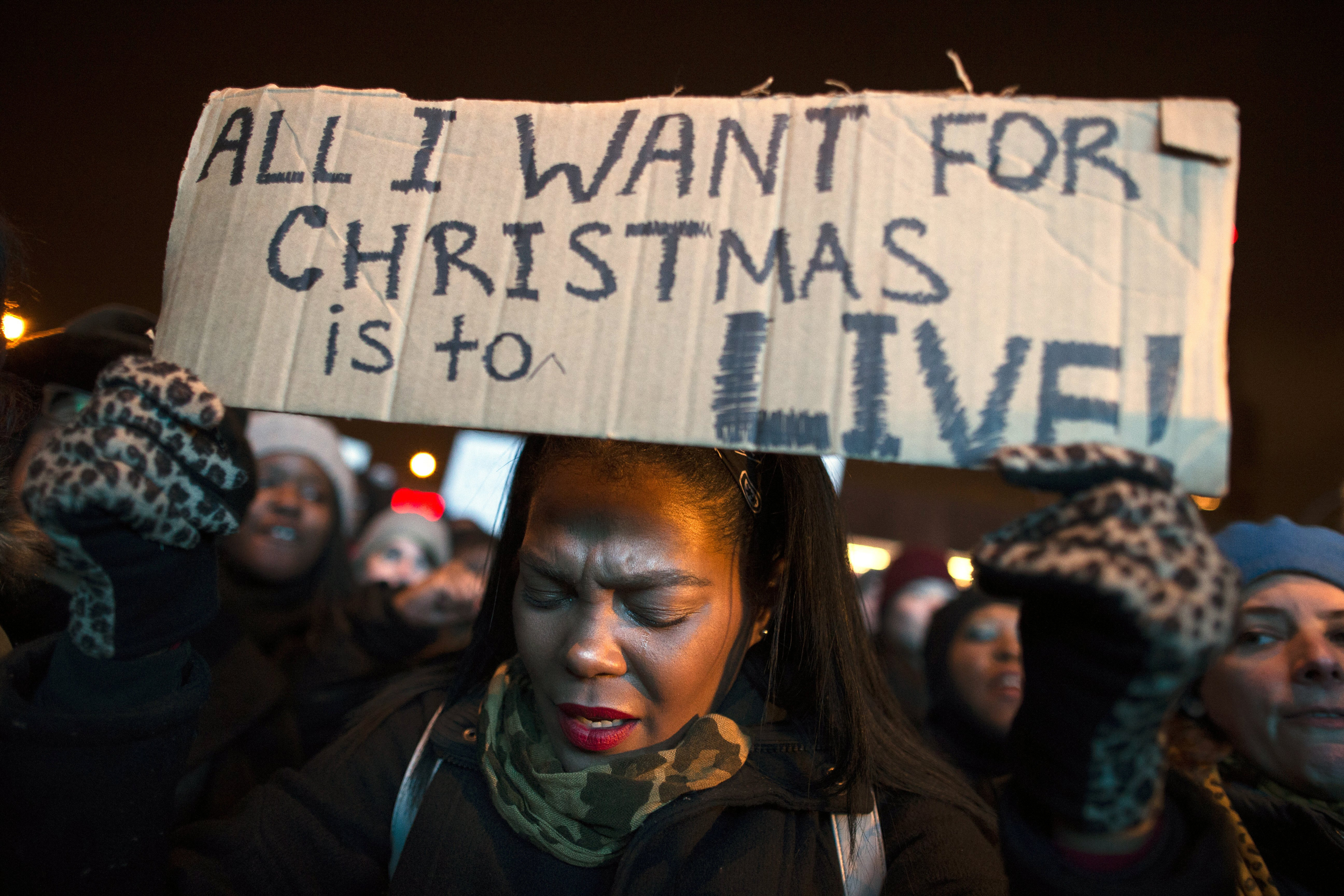
The leaders and participants in the protests related to incidents of excessive police force and violence—real, imagined, manufactured or equivocal—are creating an environment of racial distrust, fear and hate that cannot avoid  resulting in violence. Yet astoundingly, they not only deny the natural consequences of their words and rhetoric but feign indignation (and racism, of course) when the effort, long underway with the assistance of such accomplices as Eric Holder, Barack Obama and Bill De Blasio, is properly condemned as the dangerous and reckless attack on society that it is.

I am not sure which amazes me more: that demagogues like Al Sharpton would have the audacity to proclaim that his organized campaign of hate against police, accusing them of being both racist executioners and the embodiment of a racist justice system, or the caliber of pundits who have rushed to Sharpton’s defense. How can this be? African-Americans are told, for years now, that whites with guns are hunting them; that police are determined to kill them, that the justice system is rigged to let the carnage continue. The carriers of this message includes members of Congress, celebrities, civil rights activists, the Attorney General and the President of the United States. False accounts that support this gross characterization of  disparate incidents, each with unique circumstances, are turned into rallying cries, such as “Hands up! Don’t Shoot!”  The left-biased media openly endorses the narrative, which says that black Americans are being hunted coast-to-coastby an armed force, determined to kill their children.

But the protest is “non-violent.” Continue reading

Ethics Quote Of The Day (Christmas Confusion File): Jonathan Turley

“Best wishes to everyone celebrating Christmas.”

—- Law Professor and blogger Jonathan Turley, wishing at least some of his readers a merry Christmas.

Get ready to duck, Fred!

Get ready to duck, Fred!

Prof. Turley is a lawyer, of course, and trained to express himself with precision. Thus I have to ask: what the heck is he trying to say here?

Is he wishing good tidings only those who, like his family, are celebrating Christmas, and rotten times to the rest? Is he editing the humanist message of Christmas to “Peace on Earth, and good will to those who are putting up Christmas trees and giving gifts, other wise you’re on your own”?

Or, as I fear greatly, given the fact that he is part of the U.S. education establishment and thus prone to have a spine of cream cheese, just observing the trendy political correctness that infects our times, and bowing to those who contrive to take offense when anyone smiles at them and offers a greeting that only says, at minimum, “We’re all in this together, so let’s try to be as good to each other as we can, OK?” Continue reading

Comments Of The Day: “Remembering Christmas Music”

Xmas music

This is a rare collaborative Comment of the Day, as texaggo4 and Penn combined for a fascinating discourse on the trend in Christmas holiday music and its significance in response to my December 23 post, prompted by listening to one too many renditions of “I Saw Mommy Kissing Santa Clause” and “Santa Baby.” It’s a wonderful job by both participants here, reinforcing my conviction that the the debates following the posts are as valuable, or more so, than the posts themselves.

First up is tex, followed by Penn’s response. Here is their combined Comment of the Day on “Remembering Christmas Music”:

Christmas only exists because of Christ. That being said, pull the religion out of the holiday and ultimately the holiday disappears and all of its associated trappings.

Christmas music has several “genres”, not classified nor exclusive:

1) Theological or religious: directly communication the story or the theology of the Incarnation.

2) Modern references to the festivals associated with the Christ-Mass.

3) Modern references to the neo-pagan Christmas folklore…Santa Claus, Saint Nick, Father Christmas, etc.

4) Modern references to the American folklore… Frosty the Snowman, etc

5) Modern references to the post-materialist Capitalist associations with Christmas— Christmas party songs.

6) Modern references to the post-narcissist associations with Christmas…songs about sex….

great.

We all saw this coming…it is predictable. take the religion out of a religious holiday and you can only assume that artistic messages (songs included) pertaining to the Holiday will have less and less to do with the ethical message of the holiday until eventually, watered down, it isn’t even worth playing the secular versions of that Holiday’s music.

What are the secularists complaining about? They asked for this.

Here is Penn’s reply: Continue reading