Social Science, Group Research and Bigotry: The Most Slippery Slope

Typical...

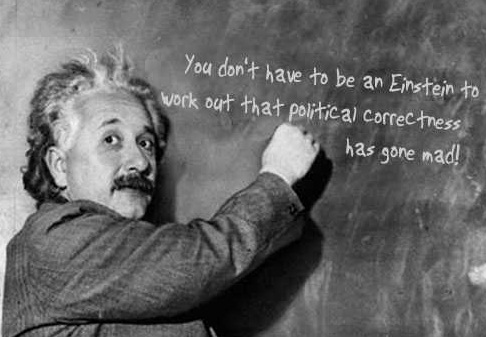
Decades ago, Arthur Jensen became a target of critics and a pariah in his field by publishing a controversial study that indicated that differences in racial performance on intelligence tests probably had a genetic component. He was, and is, called a racist, though Jensen has continued to produce respected research. Since the publication of the 1969 Harvard Educational Review article that made him infamous, Jensen has won the prestigious Kistler Prize in 2003 for original contributions to the understanding of the connection between the human genome and human society.

The problem with Jensen’s research results, whatever the legitimacy of the data and his methods, was this: What do you do with it? Like other studies that show women, as a group, with less aptitude for the sciences, or those that show superior traits in other races and ethnic groups, this information just serves as a catalyst for bigotry. Whatever the trends within a large group may be, they tells us nothing about any individual in that group. Yet the existence of a study creates a natural tendency to apply the claimed group characteristics to every group member. Most people think like that, always have and always will. This is similar to the problem with stereotypes. Many, perhaps most, stereotypes have some truth in them. I was raised in a Greek family, and Greeks are reputed to be clannish, cheap, bigoted, and gifted in the kitchen. Well, that would describe a large proportion of my relatives, too, but not all of them. My Aunt Bea is fanatically liberal. My Mom couldn’t cook a lick.  All right, they all were cheap, but the point is that it would be foolish and unfair to assume what any of them would be like without knowing them.

Knowledge is an absolute good, but perversely, some knowledge also guarantees abuse, and thus results in more bad than good. Jensen’s study, as far as I can see, has no good use in a democracy where every individual has the right to be assessed according to his or her conduct and character. Nor do any studies that “prove” character or ability differences in broadly defined groups.

This is all a prelude to my conclusion that the now widely publicized National Academy of Science study that has this conclusion-“Higher social class predicts increased unethical behavior”—is just throwing gasoline on a fire, and has no useful or benign purpose at all. Continue reading

Weekend Ethics Catch-Up

If you took an ethics break this last weekend of February, here’s your Ethics Alarms make-up assignment:


Robot Ethics: Let’s Not Get Silly About It

Today seems to be “Ethics Questions That We Shouldn’t Have To Ask Day,” and Andrew Sullivan, over at the Daily Beast, phrases his entry this way:

“Is Sex With A Robot Adultery?”

Sherry Jackson as a robot on the original "Star Trek." Lovely, convincing, but still basically a toaster.

Gee, I don’t know, Andrew: is sex with a toaster adultery? What has Sullivan asking such nonsense is a new book called Robot Ethics, which has some legitimate issues to explore, and then some other phony controversies included to get publicity and interviews. The field of robot ethics still includes little that hasn’t been thoroughly explored by Robert Heinlein, Isaac Asimov and on “Star Trek: The Next Generation,” but as a few of these dilemmas are likely to enter reality from science fiction in the foreseeable future, it is reasonable to dust off the issues again as long as we don’t get silly about it. Getting overly excited for the Boston Globe, however, Josh Rothman writes: Continue reading

Comment of the Day: “Charles M. Blow’s Anti-Mormon Tweet, Chapter 2…”

Michael, who is now the Ethics Alarms all-time leader in the Comment of the Day category, scores another with a thought-provoking post inspired by the New York Times’ stunning disinterest in its columnist tweeting a religious slur about Mitt Romney. I’ll have some added reflections at the end. Here is his Comment of the Day onCharles M. Blow’s Anti-Mormon Tweet, Chapter 2…”:

“I remember an article about this when I was in college. In analyzing how the news media treated different races, they came up with the PC Hierarchy. Anyone higher on the hierarchy can criticize or be insensitive to anyone below them. If there is a conflict between two groups, the one higher on the PC scale is assumed to be right”

PC Hierarchy of RacesContinue reading

Unethical Quote of the Week: The Washington Post Editors

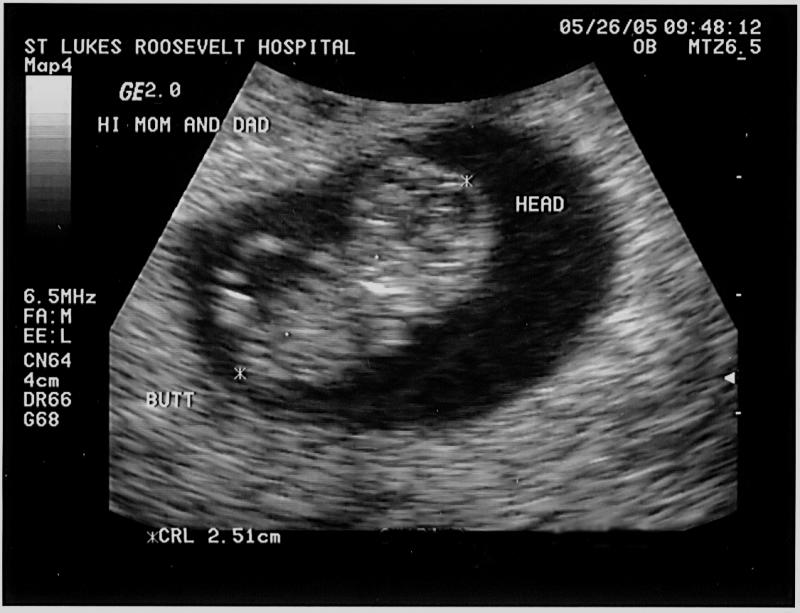
“In their anti-abortion fervor, they thought that requiring ultrasounds, even transvaginal ones, was justified if it would change the minds of some women who’d considered ending their pregnancies”

The Washington Post, in an editorial condemning the efforts of Virginia’s Republicans to pass a measure requiring an ultrasound scan of the fetus before a woman could get an abortion. The bill, which had been poised for passage, evaporated after it was revealed that women in the earliest stages of pregnancy would be required to suffer an invasive procedure, and Republican Governor Bob McDonnell announced that he would not sign it in its current form.

Seldom has an editorial managed to be so frighteningly dismissive of human life while being entirely correct on the issue it was discussing. Continue reading

Albert Pujols, Stan the Man, and the Shameless Jeremy Lin Censors

THIS is "El Hombre." Stan's Polish, by the way. Do you care? Does the Asian American Journalists Association?

If you don’t know who Albert Pujols is, you should: he’s probably the best hitter in baseball, a slugging first baseman whose career so far has already guaranteed him a spot in baseball’s Hall of Fame. Over the winter he left his original team and the city that worshiped him, St. Louis and its Cardinals, because, though the team he professed to “owe everything” offered him a deal that would guarantee that his great-grand children could be beach bums all their lives, a team in Southern California, the Angels, offered him even more, so he can light his cigars with C-notes and pave his driveway with gold.. I think elevating money over every other value to that extent is an unethical and culturally corrupting choice, and said so at the time.

Now Albert has re-endeared himself to me  by publicly objecting to the Angels’ pre-season promotional campaign calling him “El Hombre.” “What?” you say. “I thought you have been condemning political correctness in the discussion of athletes with ethnic identities! Don’t you think it’s ridiculous for Pujols, who is of Hispanic descent, to object to a nickname that plays on his heritage?” Indeed I have been condemning such political correctness and over-sentivity, and still do. But that isn’t why Albert is objecting.

Back in St. Louis, you see, they also tried to call Pujols “El Hombre,” in a deliberate evocation of the city’s most famous and celebrated slugger, the great Stan “The Man” Musial, one of the best and most admirable players in baseball history. Pujols put a stop to it. There was only one player in the city who could carry the title “The Man”, he said, and that was Musial, who is alive and in his 90’s. Just saying “the Man” in a different language didn’t change the fact that the honor was Musial’s, and shouldn’t be taken  away. Stan Musial was and is “the Man;” Pujols respected that, and defended it Continue reading

Facebook’s Weird Ethical Standards

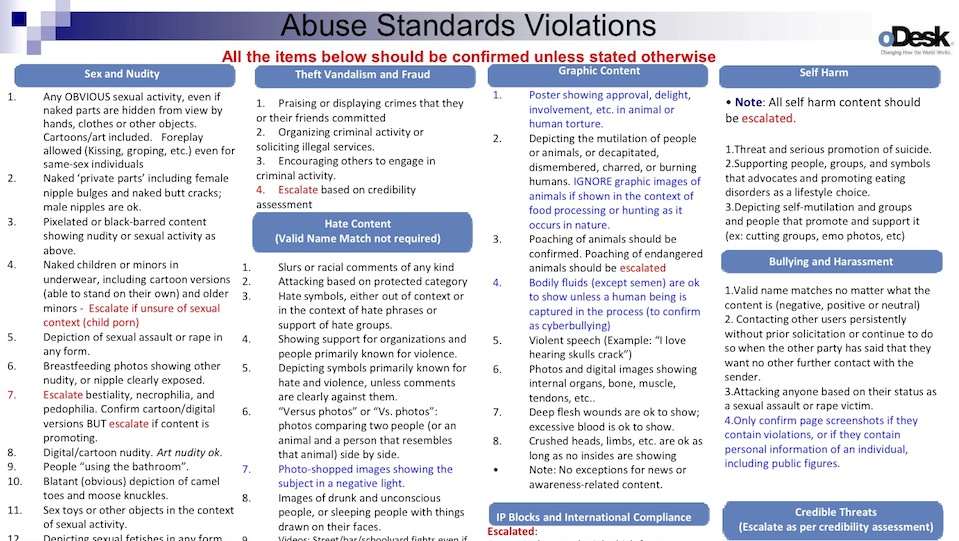
I know, they're too small to read. Never mind; they also don't make any sense

The idea of Gawker, a website that shares the ethical standards of the seamier denizens of “Rick’s” in “Casablanca,” doing a legitimate ethics expose gives me a brain cramp, but the gossip site has given a platform to a Facebook whistleblower, sort of.

I say “sort of,” because knowing Gawker, I wouldn’t be surprised to learn that he was paid to rat out his former employers-once-removed (he was hired by  Facebook’s outsourcing firm that handled his training—oDesk), making him ethically less of a whistleblower than a candidate for Gawker’s editorial board. The argument, I suppose, would be that a dollar an hour, which is what Gawker’s source says was his princely reward for doing Facebook’s dirty work, shouldn’t buy much loyalty and confidentiality, if any. Ethically, that’s false: you are obligated to abide by the terms of bad deals if you voluntarily agree to them. Practically speaking, it is true. A worker a company exploits is likely to harbor more animus than good will, and it isn’t the happy workers who blow whistles. Fine: neither Gawker’s source nor Gawker are ethically admirable. On to Facebook.

The whistleblower is Amine Derkaoui, a 21-year-old Moroccan who was recruited by an outsourcing firm to screen illicit Facebook content. This is what he was paid a dollar an hour for, which, when one considers the news reports flying around recently about how rich Mark Zuckerberg is, and after the company filed its record $100 billion IPO, seems unequivocally exploitive. His real exposé, however, involves what he was paid to do, which was to be Facebook’s censor. Derkaoui supplied Gawker with a bootleg copy of part of Facebook’s abuse standards, which lays out what the company believes is appropriate and what it believes should be banned from the web. Thus it is Facebook’s morality, revealing the ethical standards that the company embraces. Continue reading

“Forget Jobs, It’s You Passing Out In Public, Stupid!”

Well, maybe there’s something wrong with Wisconsin after all.

Mayor Ryan, behaving irrelevantly

In Sheboygan, Mayor Bob Ryan, is about to face Terry Van Akkeren in the first mayoral recall election in that Wisconsin city’s history. It was prompted after Ryan was caught on tape passed out in a bar after a drinking binge last summer. More than 4,000 Sheboygan voters signed petitions to force the recall.

As one would expect, the mayor who humiliated his community, set a wretched example for his public (and their kids), showed that he has allowed his alcohol problem to render him unfit to serve, and violated a pledge he had made in 2009 (when he was running for office) that he had given up drinking for good, now argues that the incident is irrelevant. He says that what matters is who can bring the most jobs back to Sheboygan. Continue reading

Ethics Hero: Pastor Thomas Keinath

Rev. Keinath on holiday, under the overpass

Thomas Keinath is the pastor at Calvary Temple in Wayne, New Jersey, a so-called mega-church with a 2,000-plus seat sanctuary in an affluent community. It was time for him to take some vacation time, so he did. And what did he do?

Keinath spent his week off living with the homeless in the very un-affluent community of nearby Paterson, New Jersey. During the day, he wandered through the streets along with desperate, sick and destitute. At night, he stayed with them as they built fires to keep warm in freezing cold,  and slept with them, under a bridge, surrounded by discarded hypodermic needles.  He wrote down the life stories of the people he met, so he could learn from their life stories.

“I needed to understand what they were experiencing, and I needed to feel their pain.  How could I bring help or healing to the streets if I did not know what their needs are?” the pastor told reporters. Continue reading

Ethics Alarms Recap: A Long Weekend of Ethics

If the long Presidents Day weekend took you hither and yon and away from ethical dilemmas and controversies, welcome back! Here is what went on here in a lively three days: