John Wayne paddling his wife (Maureen O'Hara) in "McClintock!" I love ya, Duke, but this isn't funny any more....if it ever was.
Violence inflicted by one partner in a relationship upon another is absolutely unethical, yet it is one of those embedded cultural habits from the bad old days that still flourishes. Over at the Whitney Houston post, where I am being over-run by the drug-legalization zealots, sicced on me by a sad website where people indulge their dreams of legally de-braining themselves on a regular basis, there is widespread contempt for the concept that cultural norms of what is right, wrong and worthy of shame controls our worst impulses. That contempt is as crippling as it is ignorant, for controlling behavior is what cultures do, and why they are essential. And our culture is still giving confusing signals about domestic abuse. Two recent examples: Continue reading →
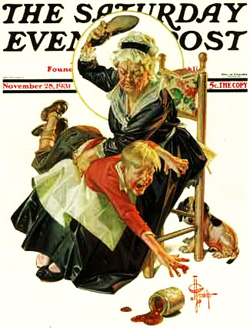
The societal approval pendulum has swung so far away from physically punishing children that a formal spanking risks an accusation of child abuse. The Hawaii Supreme Court, in the case of Hamilton ex rel. Lethem v. Lethem, in which a retraining order was issued against a father accused of abusing his 15-year-old daughter, pronounced guidelines for determining what constitutes reasonable and moderate corporal punishment of a child by a parent, ruling that such punishment is reasonable (and a Constitutional right ) when..
“…the parent’s discipline is reasonably related to the purpose of safeguarding or promoting the welfare of the minor,”
The punishment properly takes into account the nature of the misbehavior,
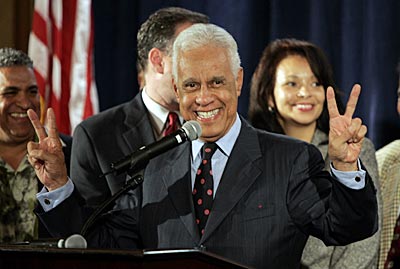
“Nearly 20 years ago, former Virginia governor Douglas Wilder announced that he wanted to create a museum that would tell the story of slavery in the United States. He had the vision, the clout, the charm to make it seem attainable, and he had already made history: the grandson of slaves, he was the nation’s first elected African-American governor.
“He assembled a high-profile board, hosted splashy galas with entertainer Bill Cosby promising at least $1 million in support, accepted a gift of some 38 acres of prime real estate smack along Interstate 95 in Fredericksburg and showed plans for a $100 million showstopper museum designed by an internationally renowned architect.”
And now? Now the U.S. National Slavery Museum project is bankrupt, filing for protection last fall. Claims against it total more than $7 million. The city of Fredericksburg has threatened to sell the land to make up for almost $200,000 in unpaid real-estate taxes. Officials have asked the court to either liquidate the organization or to appoint a trustee to oversee its finances. Through all of this, the Post reports, Doug Wilder has remained aloof, refusing interviews or even to answer phone calls. Having created the project, started an organization, induced collectors and other citizens to contribute priceless artifacts and documents to the aspiring museum’s collection, and accepted contributions, all in the justified belief that he, an established political leader, a powerful member of the African-American community and someone with access to resources and allies, would see the project through to a successful conclusion, whatever it took. Instead, Wilder abandoned the project he began completely, leaving to others the responsibility of organizing and guiding it, and making certain that its promises were fulfilled. Continue reading →
Whitney Houston, she of the musical gift we may see only once in a lifetime, is dead at 48. There has been no final determination, but there is little doubt: drugs killed her.
Houston, they say, and I have no reason to doubt it, was troubled by the pressures of show business, celebrity and stardom, and with a little help from her dead-beat, abusive husband, singer Bobby Brown, sought to relieve the stress with a variety of illegal substances, including cocaine. Over the past 15 years or so, Americans have been able to watch the relentless deterioration of Houston, once the epitome of a beautiful, intelligent, ebullient and charismatic presence, into an emaciated, ruined shell with only a hint of the glorious instrument that once, in the middle of a war abroad, delivered the most stirring rendition of the Star-Spangled Banner I have ever heard, or ever will hear.
This happened to Whitney Houston because when illegal drugs were among the options she could have chosen to accept or reject as a way to get through difficult days and troubled times, she did not have the instant reaction, hard-wired in her brain, that has to stop all of us from doing terrible, dangerous, irresponsible and anti-social things. There can be little doubt that some theoretical options would have triggered that reaction. They would be the options that did not seem like options at all, because the culture Whitney Houston lived in was unequivocal and unshakable in its verdict, a verdict virtually all members of that culture naturally adopted and accepted—because that’s what cultures do. And when that option presented itself, Whitney Houston, like the culture she was a part of, would have said “No.”
That she didn’t say no to drugs, and is dead because of it, was the direct result of an American culture that does not give its constituency a clear message and verdict. Instead, the clearest and most unequivocal signal from the culture, the fact that recreational drugs are illegal and that America enforces the laws against them, is progressively weakened by ridicule, attack, popular culture, and the defiance or hypocrisy of role models and public figures. Incredibly, though the deaths by drug-abuse among the tiny proportion of the world that is famous and talented—Michael Jackson, Amy Winehouse, Whitney—should make it obvious how massive the number of anonymous victims of drug abuse there must be, the destructive refrains grow louder: Legalize drugs! End the War on Drugs! And those calls weaken the cultural resolve further. Actually doing what they advocate would cripple it….and that day might come.
Whether they are preventing the culture from rejecting drug use because enforcement is expensive, or because they have a relative or friend in prison for drug-dealing; whether they are calling for legalization because they are libertarians and academics or Ron Paul, or because they are public officials who see a new revenue source; whether they are longing for the halcyon days of Haight-Ashbury and the Strawberry Alarm Clock, or just like getting stoned, these are the people whose advocacy continues to nurture a competing culture that killed Whitney Houston, as surely as if she had been shot her between the eyes.
I would say that if their insistence on legalization is followed, and the nation’s laws join the popular throng in pronouncing addictive and life-destroying drugs as legitimate “options,” many more like her will die….except there aren’t many more like her. But there are countless lives to destroy, and unimaginable losses to families, businesses and America to be endured.
I just watched the video of Whitney Houston’s glorious performance of our National Anthem at the Super Bowl, before the drugs had finished their work. She radiates confidence, strength and character, as well as that special joy that the fortunate few with magical gifts have. She brings a stadium full of Americans to their feet in cheers, with an exhibition of artistry that will continue to inspire forever. Drugs took all of that away, from Whitney Houston and from us.
Because our culture could not say no with enough conviction to save her.
Update (2/15/12): With some regret, I am closing comments on this post. Too many commenters refused to discuss the issue it was intended to raise, which was how cultural approval and disapproval of conduct is more powerful, ultimately, than the law in establishing standards. I have committed on this blog to responding to as many comments as possible, but the onslaught of pro-drug zealots whose tactic was to keep repeating the same arguments no matter how many times I gave my response led me into too many frustrated responses, too many nasty exchanges, and too many hasty replies that I wish I had stated more clearly. For those I apologize, both to the visitors involved and other readers. I also apologize for ending the discussion here, but I don’t have the time to monitor it. You are welcome to e-mail me personally.
"Thank you! And for my next number, 'Nobody Knows The Trouble I've Seen!'"
PETA’s cretinous and offensive lawsuit equating Sea World’s whales with enslaved human beings—just the latest in the organization’s irresponsible “look at us!” tactics—was laughed out of court, as everybody but a breathless NPR interviewer knew it would be. This was yet another example of a lawsuit that any common sense-imbued layman would accurately call frivolous, but a bar association discipline committee would not. A lawyer can ethically take on a lawsuit he or she knows is stupid, foolish, silly, or a “hail Mary” shot, as long as there is a good faith belief that it might/could possibly/ gee, with a little luck and they don’t think about it too carefully prevail. And looking at some of the rulings that come down from various benches and verdicts that creep out of some jury boxes, that means almost no case is unethically frivolous in a legal sense. That doesn’t mean that it is responsible and right for lawyers to help plaintiffs like PETA bring such wasteful lawsuits, just that it isn’t a breach of professional ethics to do so. Continue reading →
Actually, this is just a cartoon of the former Congresswoman from Erie, but then a Toon could have cast a vote for a bill without reading it too.
Former Democratic congresswoman Kathy Dahlkemper, a Catholic from Erie, Pennsylvania, voted for the health care mega-law in 2010. Now she says she would have never voted for the bill had she known that the Department of Health and Human Services would require all private insurers, including Catholic charities and hospitals, to provide free coverage of contraception, sterilization procedures, and the “week-after” pill .
In a press release sent out while the HHS ruling was still pending, the pro-life Dahlkemper said,
“I would have never voted for the final version of the bill if I expected the Obama Administration to force Catholic hospitals and Catholic Colleges and Universities to pay for contraception,. We worked hard to prevent abortion funding in health care and to include clear conscience protections for those with moral objections to abortion and contraceptive devices that cause abortion. I trust that the President will honor the commitment he made to those of us who supported final passage.”
The Christian Soldiers are on the wrong side of this argument.
A controversial rule, announced last month as part of President Obama’s health-care overhaul, requires religiously affiliated colleges and hospitals to provide female employees the full range of contraceptive coverage, including contraceptives, the “morning-after pill” and sterilization services. The measure has Catholic Church-run institutions up in arms over a system that would force them would to offer plans that contradict their teachings. Catholic bishops have been leading the growing criticism of the rule, distributing letters and other materials for distribution to millions of worshipers. Talk radio is abuzz with talk of Obama’s escalating “war on religion.” Even the Washington Post editorial staff criticized the move.
As for simple-minded me, I don’t think this is an especially difficult problem from an ethical point of view. Politics? Practicalities? Culture wars? Yes, those are all extremely difficult considerations in this argument, but they are also not my proper realm. The ethics are clear.
In policy debates over contentious issues like abortion, national health care, and capital punishment, a common argument, brandished like a flag , is that the United States is out of step with the rest of the world. My reflex reaction to that claim, when I can resist the impulse to say, “Good!”, is to point out that the rest of the world has never lacked for enthusiasms for terrible ideas, and the United States, by going in its own direction, has often been unique, innovative, and right.
Still, a bad idea abroad will inevitably inspire some enterprising social architect here to propose it, and a legislator to try to make it law. Thus, when possible, it is wise to try to identify and reject the most sinister examples of Europe being Europe before anyone here starts trying to play “me too.” In the case of Europe’s current push to create a so-called “right to be forgotten” on the internet, some very effective critics are on the case. Continue reading →
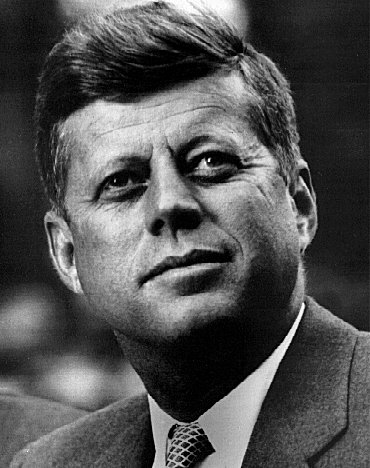
The new memoir by Mimi Alford, the former White House intern whom President Kennedy made his sex toy (though not his only one), hardly comes as a surprise to anyone who didn’t accept the fabricated, idealized version of JFK sold to the public by the likes of Arthur Schlesinger, Jr. and Chris Matthews. Still, her account of Kennedy’s revolting conduct is infuriating, because it continues his corruption of American ethics and leadership standards, the real legacy of his presidency.
Kennedy was a thoroughly fraudulent human being, a cynical and arrogant leader who used soaring prose about freedom, aspiration and the human spirit while masquerading as a devoted father and husband, betraying his wife, abusing his power for selfish personal gratification, and in the process, putting his country at risk during the height of the Cold War. Only moral luck, combined with the failure of a complicit media to tell the public what they really had a right to know—that their President was a sexist, reckless, ruthless, SOB—allowed Kennedy to escape with his myth intact long enough to be regarded as a heroic figure. Now, as the truth relentlessly emerges, the product of his devoted image-makers collides with the ugliness of JFK’s behavior, creating cognitive dissonance of the most destructive sort. After all, if the great John F. Kennedy abused drugs in the White House, used his office and power to lure employees into illicit sexual relationships, degraded and pimped-out women devoted to him, and did all of this with the full knowledge that it would bring down his administration and his party if anyone ever revealed his secrets, then this must mean that character doesn’t matter in our leaders, that we should tolerate a wide range of misconduct, and that the abuse of the power of the President is just a traditional perk. Continue reading →
“A plan to move Presidents’ Day to the Monday after the Super Bowl. For football. For hangovers. For America.”
The proposal is unethical in many ways, beginning with its dishonest presentation. “We the people, in order to form a more perfect holiday, seek to take what should be one of our most patriotic holidays and actually give it more meaning, make it more American,” the argument begins. Make it “more American”? How, exactly, does moving a holiday that already minimizes the national recognition of the birthday of George Washington by making it a floating annual date to manufacture a three-day weekend make that holiday “more American”? Continue reading →