“It’s A Wonderful Life” Ethics, Part 3

Here is the final installment of the Ethics Alarms overview of the ethical issues raised in Frank Capra’s classic. Some of the comments on Parts 1 and 2 have suggested that my analysis is unduly critical. Nothing could be further from the truth. I love the movie, and have already said that I find it ethically inspiring. Noting that characters act unethically in a movie about ethics is no more criticism than pointing out that people in horror movies never just leave when things start getting weird (as I would). I know that their actions drive the plot and are necessary. This is, however, how an ethicist watches a movie with as many ethical choices as “It’s A Wonderful Life.” I can’t help it.

Now back to George, Mary, and Bedford Falls:

11. Uncle Billy screws up as we knew he would

11.  Christmas Eve arrives in Bedford Falls, and Uncle Billy manages to forget that he left the week’s deposits in the newspaper he gave to Mr. Potter. Thus more than $8,000 is missing on the same day that the bank examiner is in town. Why is Uncle Billy still working for the Savings and Loan? He’s working there because George, like his father, is putting family loyalty over fiduciary responsibility.  Potter, of course, is a thief; by keeping the lost money to trap George, he’s committing a felony, and an unnecessary one. As a board member on the Savings and Loan, Billy’s carelessness and George’s negligence in entrusting him with the bank’s funds would support charges of misfeasance. Mr. Potter, had he played fair, might have triumphed over George legitimately, and no Christmas miracle or guardian angel could have saved him. But this is the inherent weakness and fatal flaw of the habitually unethical: since they don’t shrink from using unethical devices, they often ignore ethical ways to achieve the same objectives that would be more effective.

12. George folds under pressure Continue reading
Comment of the Day: “Another Santa Assassin”

The Comment of the Day is a short and pithy one from Fred, inspired by the essay from 2005 I posted in response to yet another report of a Scrooge-like elementary school teacher taking it upon herself to enlighten young children about the non-existence of Santa Claus. That essay involved a substitute teacher named Theresa Farrisi.

Here is his Comment of the Day, on “Another Santa Assassin”:

“The three ages of man: He believes in Santa Claus; he does not believe in Santa Claus; he is Santa Claus.

Farrisi obviously never made it to the third stage and discovered the ultimate truth about Santa Claus. For me, each stage had its own appeal: First the magic; then maturing and being let in on the literal truth while protecting the magic for my younger brother; then being Santa and bringing the magic to my kids. That was by far the most rewarding.”

Was Butch Cassidy a Sexual Harasser?

The story out of South Boston about a young student who fought off a bully’s school bus attack by kicking him in the groin and is now being investigated by the school for sexual harassment (inappropriate touching, don’t you know!) made me think of many things.

It made me think of the Chinese proverb that “When the only tool one has is a hammer, every problem looks like a nail.” And its longer version, which adds “especially if you are a school administrator….”. And the even longer version, which concludes with “who has the IQ of a gerbil and the judgment of Lindsay Lohan”.

It made me think about how the education profession might end the long reign of journalism as the Ethics Alarms “Most Unethical Profession” winner this year. That would be remarkable, since journalists have been especially vigorous in disgracing themselves in 2011, but education is certainly making a spirited year-end rally.

Mostly, however, it made me think of Butch Cassidy. Continue reading

Another Santa Assassin

In Nanuet, New York, a teacher ruined Christmas for her  second-grade class this week by presuming to alert them that their parents were liars, and that there is no Santa Claus. This presumptuous act occurred during a lesson about the North Pole. You can read the whole story here. This occurs every Christmas season, in many locales and perhaps with increasing frequency. I stated my position on the matter in 2005, in an essay entitled, “The Attack of the Santa Assassin.” The recent story prompted me to revisit it. My opinion hasn’t changed:

“The parental conspiracy to support Santa Claus mythology as an excellent rebuttal to the Kantian contentions that all lies are unethical. Here is a fantasy told to the very young that imbues them with a sense of magic and wonder, and greatly enhances their enjoyment of a holiday having great social, historical, and cultural significance. It draws families together, and produces a uniquely memorable series of annual rituals that become a focal point of childhood: the late night parental setting of the scene around the tree, a child waking parents at dawn to see what Santa has brought, the first sight of the presents, and the subsequent ecstatic moments of unwrapping, surprise, and discovery. If there are children who feel that they had been mistreated by their parents perpetuating the Santa fantasy until it was no longer credible, they are a distinct and peculiar minority. Even Natalie Wood in “Miracle on 34th Street” wanted to believe in Santa Claus.

“But Theresa Farrisi, a substitute music teacher at Lickdale Elementary School in Lebanon, Pennsylvania, just couldn’t bring herself to participate in this vile falsehood. So as part of her assigned duty of reading “The Night Before Christmas” to a first grade class (!), Ms. Farrisi took it upon herself to explode the myth, spill the beans, and break the spell. Continue reading

“It’s A Wonderful Life” Ethics, Part I (of 3)

“It’s A Wonderful Life” made its now traditional holiday season appearance on network television, and naturally, I watched it. The movie is one of the great ethics movies of all time, as well as being one of the great American movies of all time, perhaps director Frank Capra’s masterpiece. One of the markers of a classic film is how one can find new things in it upon every viewing, and that is certainly true of “It’s A Wonderful Life.” I was struck this time around by how many ethics issues are raised in the screenplay, some, no doubt, unintentionally.

1. “If It’s About Ethics, God Must Be Involved”

The movie begins in heaven, represented by twinkling stars. There is no way around this, as divine intervention isat the core of the fantasy; heaven and angels were big in Hollywood in the Forties. Nevertheless, the framing of the tale advances the anti-ethical idea, central to many religions, that good behavior on earth will be rewarded in the hereafter, bolstering the theory that without God and eternal rewards, doing good is pointless.

We are introduced to George Bailey, who, we are told, is in trouble and has prayed for help. He’s going to get it, too, or at least the heavenly authorities will make the effort. They are assigning an Angel 2nd Class, Clarence Oddbody, to the job. He is, we learn later, something of a second rate angel as well as a 2nd Class one, so it is interesting that whether or not George is in fact saved will be entrusted to less than heaven’s best. Some lack of commitment, there—then again, George says he’s “not a praying man.” This will teach him—sub-par service! Continue reading

The Murderer and the Governor

When a politician announces that he is taking a "moral stand," watch out.

Guess who has more integrity: Gary Haugen, the convicted double murderer whose scheduled execution in Oregon had been scheduled for next week, or Oregon Governor John Kitzhaber, who blocked his execution?

It’s Haugen. The resident of Oregon’s death row had waived his appeals and was voluntarily submitting to his court-decreed fate when Kitzhaber stepped in, declaring his moral objections to capital punishment. But like many politicians’ objections to that other divisive social policy issue, abortion, Kitzhaber’s supposedly moral stand has more fine print than a gym membership. He didn’t commute Haugen’s sentence, or end the death sentences of the other men who have been condemned. The Governor went half way, essentially staying the executions for the term of his governorship, and pledging to seek reforms of what he called a “broken system” in 2013. Why 2013? It’s after the election, of course. Continue reading

Ethics Dunce: Sports Grid Blogger Dan Fogarty

Civility is doomed. Civilization is doomed. Propriety is doomed.

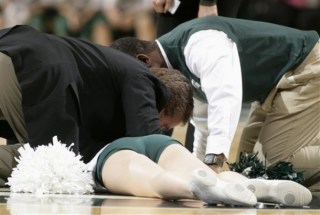
What's the concerned father of the injured cheerleader thinking about? Why, what any cool dad would think about---how good her butt looks!

And Taylor Young, a cheerleader for the Michigan State Spartans, may well be doomed, as it is impossible to tell how badly her character, values and common sense have been warped by being brought up in a household containing her father, Charles. After Young took a hard fall during the halftime show in a game against Florida State, requiring her to receive medical attention (she was OK), her father posted this astounding Facebook comment, which, naturally, has gone viral:

“I’m glad to see your booty isn’t gettin big ….. no one likes a chick with a big butt ….. love you.”

Idiotic? Check. Sexist? Check. Insulting to women? Check. Embarrassing to his daughter? Double check. Demonstrating a stunning lack of understanding of the internet? Check. Displaying a disturbing tendency to sexualize his own daughter?

Check, and Yuck.

But to Dan Fogarty, writing on Sports Grid, this offensive post proves that Young is a “cool Dad,” and Young goes on to cite other “experts” who believe this is “quite possibly the funniest ‘Dad Moment’ in Facebook history.”

Really? Is this really the current state of the culture? A father makes salacious comments about his daughter’s “booty,” suggests that “chicks” without similar booty quality are unloved and unlovable, and that’s cool?

If Fogarty is in step with the culture and I’m not, 1) then American society is coarsening faster than I thought, and 2) which way to Mars?

My condolences to Taylor Young for the boorish conduct of her father, and if she sees nothing wrong with it either, she has my intense condolences—because she has been severely damaged.

As, perhaps, have we all, if Fogarty is right.

The Fat Kid, the Slippery Slope, and the Cliff

"Bill! They're putting me in foster care! How will you make THAT funny?"

Several recent ethics issues have raised the slippery slope question, which is itself a slippery slope. The rationale for any reasonable principle or act can usually be ratcheted forward in degrees until it becomes malevolent, dangerous or repugnant, including freedom, trust, loyalty, charity and honesty. Thus the easiest argument, at least for the mentally dexterous, that anything is unethical is the dreaded slippery slope.

The simple rebuttal to this is usually “let’s wait and see.” To claim that conduct is unethical for what it might lead to rather than for what it actually does is often, perhaps even usually, based on an unwarranted assumption, or a worst case scenario specifically concocted to foil otherwise unobjectionable conduct. When it is not based on an unwarranted assumption, however, is when proposed conduct or a new policy permitting it shatters a social norm or cultural standard that had previously been considered sacrosanct. In these cases, the slope isn’t merely slippery—which suggests “Be careful where you step next!”—but greased, meaning there is no longer any traction at all to stop a rapid slide to the bottom. A better cliché to use in such cases is “opening the floodgates.” Or perhaps “off a cliff.”

The recent post about the Dartmouth researchers who suggested that all manipulations of graphic images of celebrities be labeled as such is, I would argue, more floodgates than slippery slope. There is no obvious delineation point to stop the principle behind this oppressive constraint on illusion from spreading far beyond its origin. Similarly, the argument being made by the family of the mother with Stage 4 cancer that US Air is ethically obligated to refund the non-refundable tickets they could not use because of her terminal illness has no clear limits or coherent application. Are the refunds required because the mother is terminal? If she goes into remission, would the family be obligated to give the money back? What if she was only paralyzed? If the whole family was squashed by a boulder, would the airline be obligated to refund the money to their next of kin? What if the mother wounded herself terminally in a suicide attempt—would that change US Air’s supposed obligation of compassion? If so, would that mean that if the mother’s Stage 4 breast cancer occurred because she neglected to follow a physician’s recommended treatment, US Air could then refuse to refund the money without being pilloried for it? Sometimes that greased slope carries us into a swamp.

Now from Cleveland comes the story of the 200 lbs. + 8-year-old Cleveland Heights boy who has been taken from his family and placed in foster care because county case workers decided that his mother wasn’t doing enough to control his weight.  Continue reading

Ethical Quote of the Week: Will Wilkinson

After the headlines and the drama, the real grunt work of democracy begins...or not.

“…now that the Occupy movement has succeeded in shining a spotlight on its primary concerns — rising inequality, political corruption, and debt peonage — Occupiers and their allies now ought to pull up stakes, give up their whimsically undemocratic semi-privatization of public spaces, and endeavor to reform public policy through the democratic institutions established to make the collective determination of binding public rules legitimate. Moving on to seek reform through established democratic channels would require giving up the insolent and frankly disrespectful presumption that these often radically left-wing congregations somehow represent not only a majority of Americans, but 99% of them. It would require Occupiers to square up to the fact that their movement’s implicit ideology is an ideology, and a minority ideology at that — just one among our society’s many rival moral and political worldviews. The intransigence of the Occupy movement suggests an unwillingness among its numbers to take seriously the fact of pluralism, and the corollary impossibility of consensus, which makes majoritarian democratic procedures necessary in the first place.”

Blogger Will Wilkinson, in his essay, “The Occupy Movement’s Enthusiasm and Contempt For Democracy” on bigthink.com (Think Big).

You can read the entire essay by Wilkinson, who is much more supportive of the Occupy movement than I am, here.

Good thinking, good work.

The Compassion Bullies Strike Again!

(I know everyone is going to hate this.)

"Be compassionate, damn you!!! This thing is loaded"

Having a terminal illness does not justify bullying corporations into waiving fair and valid contracts, and using the media and public opinion to extort money out of companies that they have no obligation to surrender is unethical.

Sorry. But it’s true.

US Air has capitulated to a classic example of compassion bullying and agreed to refund the non-refundable airline ticket Lynn McKain purchased as part of a family vacation to Belize. This occurred after the McKain family sicced the media on the airline when a recurrence of breast cancer caused Lynn to cancel the trip on doctor’s orders. She requested a refund based on her misfortune, although there was nothing in the deal that suggested that there were exceptions to the ticket’s non-refundable features. Then, after the airline politely declined to waive the terms the McKain’s had agreed to in order to pay discounted ticket fees, the family alerted the media, with predictable results. There were heart-wrenching stories about McKain’s cancer treatment, making out the airline as an avaricious, mean-spirited cabal of inhuman monsters.

Finally, the airline gave in. It had no choice; the media and the McKain’s would keep the pressure on, making the episode a full-fledged public relations catastrophe, unless it did. The Compassion Bullies won, as they almost always do. Don’t think for a moment that this is good triumphing over wrongdoing, however. It is the opposite. Continue reading