Barn Doors + Anger + Ignorance + Irresponsible Legislators = “Caylee’s Law”

When someone first mentioned the wave of support for “Caylee’s Law,” proposed legislation so far pending in four states making it a felony for a parent not to report a child’s death within an hour or a missing child within 24 hours, I responded that it “sounded like a good idea.”  Lots of dumb things sound good to me before I think about them. “Caylee’s Law,” is in fact a terrible idea, and about 10 minutes of quality thought illuminates why.

The law is the result of multiple factors more related to human nature than sound law enforcement. When something unpopular and frustrating happens, like the death of Caylee Anthony and her mother’s subsequent acquittal of murder charges, the response is often to try to fix the problem with a law. Such laws are often formulated in the heat of emotion and sentiment rather than careful reasoning and consideration, and the result is  bad laws that cause more problems that they solve.

These laws also embody the Barn Door Fallacy. Society passes broad-based measures to stop an unusual occurrence that has already done its damage, and that may be extremely unlikely to occur again. Nevertheless, society and the public saddle themselves with expensive, inconvenient, often inefficient measures designed to respond to the rare event. One shoe bomber, and millions of passengers have to remove their shoes to go through airport security. One adulterated bottle of Tylenol, and every over-the-counter drug bottle requires a razor blade and the manual dexterity of a piano virtuoso to open. Two sick boys shoot up Columbine, so third graders get suspended for bringing squirt–guns to school. Continue reading →
Wanted, Desperately Needed, and Lacking: Professionals, Adults and Values in the Media

What? Is there something wrong?

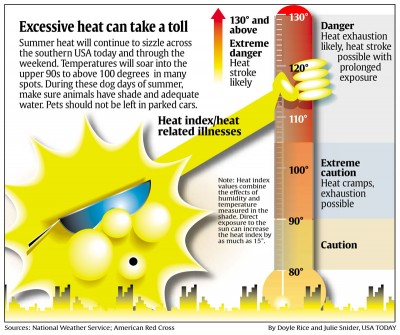
There is not a lot to say about the graphic above, other than:

  1. It is crude.
  2. It is funny.
  3. It is intentional.
  4. It is inappropriate for a general audience newspaper
  5. A competent editor should have caught it, and
  6. The graphic artist needs a warning and a reprimand.

The media, its staff, celebrities and assorted vulgarians and boors seem to be determined to make public square America as uncivil as a locker room, as crude as a peep show, and as juvenile as a junior high school farting contest. Professionals, including USA Today editors and publishers, can either do their duty and discourage this intentional rudeness in their products and services, or shrug it away. Similarly, our culture needs to decide if we are going to just define our deviancy down some more, and accept gratuitous sexual innuendo that will gradually make the whole population into a bunch of snickering Beavises. Continue reading →

“Twelve Angry Men,” A Million Angry Fools, and the Jury System

Their defendant was probably guilty too.

Ethics Alarms All-Star Lianne Best sent me this link about a member of the Casey Anthony jury who is going into hiding because of all the hate and criticism being directed at jury members and their controversial verdict. Her plight, which must be shared by other members of the much-maligned jury, highlights the unethical, not to mention ignorant, reaction of the public to the Florida ex-mother’s narrow escape from a murder conviction she almost certainly deserved.

The problem begins with publicity. We may need to re-examine the logic behind broadcasting high-profile cases. The combination of live courtroom feeds and quasi-semi-competent commentary gives viewers the mistaken belief that they are qualified to second guess the jury, and they are not. They are not because the jury is in the courtroom, and the viewers aren’t. The jury and TV watchers see different things; individuals communicate different emotions and reactions in person than they do on camera. There is only one fair and sensible way to answer those on-line instant polls that ask, “Do you think Casey Anthony should be found guilty?”, and that is “I don’t know.”

Most of all, the viewers and pundits are not present in the jury room. Continue reading →

Ethics Hero: Derek Jeter

Roger Clemens is now on trial facing perjury charges. Barry Bonds has been convicted of obstruction of justice. Pacman Jones has just been arrested again; Tiger Woods hasn’t won a golf tournament since he was exposed as a serial adulterer. Through the travails and embarrassments of all of these and many more tarnished athletes who were once looked upon as cultural heroes, Yankee shortstop Derek Jeter has remained a constant— a team player, a clutch player, and an undeniably great player who has maintained his integrity and high values of competition and sportsmanship, never betraying the trust of his fans, his city, his team, or his game.

Yesterday Jeter reached 3000 hits, the watermark of the greatest of the greats, becoming the only lifetime New York Yankee to do so. He achieved the magic number with the flair only special players can muster, rising to a grand occasion like Ted Williams, hitting a home run in his final at bat, or Cal Ripken, marking  his passing of Lou Gehrig’s “iron man” record for consecutive games with a homer. Yesterday, Jeter passed 3000 in a rush, going 5 for 5 with the hit # 3000 being, yes, a round-tripper. Continue reading →

Attention FCC: What the News of the World Scandal Reveals About Rupert Murdoch

Rupert Murdoch

Concluding that the News of the World scandal in Great Britain shows that Rupert Murdoch has less than a sufficient reverence for ethics, journalistic or otherwise, is an intellectual achievement well within the powers of Forrest Gump.  Concerns about the integrity of the Australian media magnate have been voiced since he first stuck his kangaroo’s nose in the American media tent. As is too often the case here, legitimate points were minimized by their linkage to political bias: was Murdoch bad for American journalism because he was unethical, or because he was conservative? His most vocal critics, being from the Left, regard the two as the same, which allowed Murdoch to accumulate defenders on the political right who should have been just as wary of his methods and ethical deficit.

Now his flagship tabloid, The News of the World, has folded in the midst of a still-unfolding scandal. You can read details here; the important thing to know is that the tabloid was essentially lawless. Continue reading →

Explain to Me Why We Tolerate Illegal Immigration, Again?

Yes, I'm in a rotten mood today! Wanna make something out of it??

My cranky Saturday continues with an issue that I increasingly find bewildering: the tolerance, denial, and enabling by so many Americans of illegal immigration, although its unethical character cannot be denied or argued away. I know why Democrats support it—pure electoral cynicism—and I know why the business community encourages it—greed. What I don’t comprehend is why anyone else with a modicum of logic, fairness, and common sense isn’t confronting both of these self-serving institutions and demanding real enforcement of anti-illegal immigration measures. Instead, we get outrageous legislation like the Maryland Dream Act, which institutionalizes incentives for aliens to defy our laws. Continue reading →

Ethics Quiz: Should Shannon Stone’s Family Sue the Texas Rangers?

One Thursday, a 39-year-old firefighter named Shannon Stone leaned over a stadium railing at a Texas Rangers game to catch a ball flipped into the stands by Ranger outfielder Josh Hamilton.  Stone’s son, 6-year old Cooper, was a big Hamilton fan, and the devoted father made an extra effort, catching the ball but falling over the railing down to the concrete 20 feet below. He went into cardiac arrest on the way to the hospital, and died.

The railing where Stone fell is 33 inches, seven inches more that the legally required 26 inches. Why is it that short? So people sitting in the front row can see the game without having to look through the railing. Is it dangerous? Well, it was dangerous this time.

Everyone, naturally, is horrified by the tragedy. The Rangers held a moment of silence for the firefighter at the game last night. Hamilton, who like all major league players has been instructed to toss inning-ending balls and retrieved fouls into the stands for fans to catch as souvenirs, is understandably distraught.

Your Ethics Quiz: Should the Stone family sue the Rangers? Continue reading →

Perspicacious Ethics: The Media Has A Duty Not To Make Us Dumber

Gore Vidal once said, “As societies grow decadent, the language grows decadent, too.” Certainly the media is accelerating the decadence of society; does it have to intentionally do in the language as well?

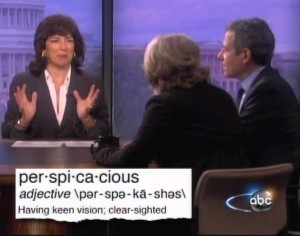
On ABC’s This Week, host Christiane Amanpour casually used the word “perspicacious.” Discussing the Constitution,  one of Amanpour’s guests mentioned that Benjamin Franklin wrote that he wouldn’t mind being preserved in a vat of Madeira wine in order to see if the Constitution held up 200 years later. Amanpour responded that Ben was amazingly perspicacious when the Constitution was signed.

Apparently  the word perspicacious stumped the 7th grade drop-outs in the booth, because suddenly a box appeared with the definition and pronunciation of the word under Amanpour. Then, commenting on the incident, the web site Mediaite wrote that Amanpour “might avoid using such fancy language so that viewers in the future don’t mistake her show for a Rosetta Stone class teaching the English language.” Continue reading →

A Harsh Lesson We Must Learn From Atlanta’s Teachers

There isn’t much enlightening to say about the unfolding Atlanta teacher cheating scandal, but its implications must be faced, as difficult as that is.

Georgia Gov. Nathan Deal revealed this week that award-winning gains by Atlanta students were based on widespread cheating by teachers and principals. The Georgia Bureau of Investigation identified 178 teachers and principals – 82 of whom have confessed – in the biggest cheating scandal in US history. Not the first one, however; there have been a lot of them recently, across the country. The media is pointing to the U.S. education system’s increasing dependence on standardized tests as “the problem.”

I see: the testing made them do it. Continue reading →

The Ethics of “No-Body” Murder Prosecutions.

Oh! THERE's the body!!!

Texas lawyer Robert Guest has opined that a Texas jury would have convicted Casey Anthony in a heartbeat, and cites as proof the February conviction of Charles Stobaugh in Denton County. He was accused of killing his  estranged wife, though no body has ever been found at all.

Maybe.  There are a lot of differences in the circumstances of the two cases, not the least is that finding a badly decomposed body with a piece of electrical tape across her mouth has a big advantage over never finding any body at all: at least you are certain that the victim is dead.  Stobuagh, like Anthony, engaged in a pattern of lies and strange statements; for example, he suggested that his wife, who suddenly vanished and stopped using her bank account, credit cards and cell phone, was “playing a prank.”  He also began seeing a new girl friend more or less the moment his wife vanished. I’d say the biggest difference is the presumption of a motive: husbands killing their wives, especially their estranged wives, is a common and well-recognized form of homicide, with a motive that any married person immediately understands. A mother killing her young child, in contrast, is very unusual, and the presumption is that no mother would do it. The Anthony prosecution was more difficult than the prosecution of Stobuagh, even with Caylee’s body. Continue reading →