The Great Norwalk Kindergarten Heist

The Tanya McDonald controversy

A homeless woman is facing 20 years in prison if she is convicted of stealing over $15,000 of Norwalk, Conn. taxpayer funds. The details of her crime are controversial: she lied about her residence to get her child into what she believed was a better school system, but one that, as non-resident, she was not entitled to use. The details also create a tangled mess of law, justice, ethics, fairness, compassion, public policy, finances, class and education.

Let’s try to unravel it, shall we? Continue reading →

Comment of the Day: “Osama’s Assassination: The Ethics Elephant in the Room”

First time commenter Margo Schulter delivers a powerful, passionate and eloquent absolutist rebuttal to my post asserting an ethical defense of Osama bin Laden’s targeted killing/assassination/execution by U.S. military personnel. My immediate response to her can be found in the comments to the original post here; I don’t want to re-post it with this post because Margo’s thoughtful comment should be read and thought about prior to considering my rebuttal. Ethics Alarms is blessed with many sharp and persuasive comments, and this is one of the finest. In the grand tradition of absolutism, her answer to my question about firing the bullet that would kill an unarmed and submissive Osama  is “I wouldn’t fire that bullet to save the whole universe.” And she explains why:

“Please let me try to put my best foot forward, and keep a spirit of civility and friendly inquiry, as I say that my whole being — my guts, heart, intuition, and intellect –cry out, “No exceptions! Executions, extrajudicial or legal, are _wrong_!” I wonder what an MRI might show, and what neuroethics might say, about how people in the U.S.A. and elsewhere have such different reactions to what I would call a consummately evil and dehumanizing act.

“Please let me also apologize for the length of this comment, nevertheless just the starting point for a dialogue with lots of ramifications. How do pacifists like me see the scale of moral evils in different kinds of violence, and when might we consider using certain forms of nonlethal force? Also, there’s a way that President Obama might have modified his strategy a bit to fit Frances Kamm’s Doctrine of Triple Effect (DTE), illustrating what I see as the dangers of this intellectually intriguing concept. I’d love to join a dialogue going in any or all of these directions.

“It’s curious. You write, “I assume you shoot him dead.” And my whole being cries out, “You assume wrong!” While I’m not a physicalist, I do recognize that while we’re in this world experience and behavior are mediated through the brain, so I wonder what an MRI or the like would show for
people who have these radically different intuitions. Continue reading →

Ethics Hero Emeritus: Marlene Dietrich (1901-1992)

The great Marlene Dietrich, Ethics Hero

It was on this date in 1992 that the magnificent Marlene Dietrich died, in her sleep, in her Paris apartment at age of 91. She had hidden her face from the world since she had stopped performing over a decade before, saying that the public should remember her as she had been. Sadly, Dietrich is one of those former icons of Hollywood whom the public is slowly failing to remember anything about at all; most are more familiar with Madeleine Kahn’s send-up of her in the Western spoof “Blazing Saddles” than they are with Marlene herself. That is wrong, for she deserves better. Not only was Marlene Dietrich a unique performer and important cultural figure, she was also an Ethics Hero.

She was a rising German stage and screen actress when director Josef von Sternberg cast her as Lola-Lola, the beautiful, cynical leading character in “Der blaue Engel,” (The Blue Angel), Germany’s first talking film. The movie made Dietrich a star. Von Sternberg took her with him when Hollywood beckoned and signed her with Paramount Pictures. There Dietrich built her image and legend by perfecting her femme fatale film persona in a series of classic films directed by her mentor: “Morocco” (1930), “Dishonored” (1931), “Shanghai Express” (1932), “Blonde Venus” (1932), “The Scarlet Empress” (1934), and “The Devil Is a Woman” (1935).

Meanwhile, she had already begun fighting Hitler’s regime. Continue reading →

Death Photo Ethics

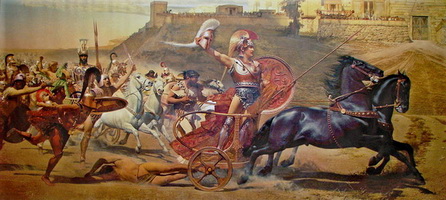
Even before Achilles dragged the corpse of Hector behind his chariot through the dust around the walled city of Troy, the tradition of demoralizing the enemy by degrading and displaying the bodies of its dead heroes was well-established. The United States was horrified when this was done to our fallen servicemen in Somalia, and it is one of the most barbaric and unnecessary practices of war.  While the Geneva Convention doesn’t mention the displaying of enemy corpses, a 2005 publication by the Red Cross called Customary International Humanitarian Law does. It was written to address issues that international treaties omitted, and its Rule 113 reads:

“Each party to the conflict must take all possible measures to prevent the dead from being despoiled. Mutilation of dead bodies is prohibited. Continue reading →

In Search of Accountability, Fairness, Justice and a Champion: the Unending Persecution of Anthony Graves

Job would pity Anthony Graves

Governments and other bureaucracies are capable of unimaginable callousness, stupidity, and wrongful conduct, allowing individual fools to multiply their power to harm exponentially, and then to see an inhuman computer-driven monstrosity run amuck as everyone denies responsibility. You could not devise a better example of this process than what Texas is doing to Anthony Graves.

He is an innocent man convicted of murder in 1994 who was released last October after spending 18 years in prison, condemned to death. He had been convicted with fabricated evidence and coached testimony employed against him by former Burleson County District Attorney Charles Siberia, and a state investigation got a Texas judge to set Graves free. But the maw of Texas bureaucracy wasn’t through ruining his life. Continue reading →

From First Amendment Outrage to Ethics Hypothetical: The Westboro Baptist Church vs. Brandon, Miss. Hoax

"Never mind!"

Bulletin: The story about how citizens and law enforcement personnel in Brandon, Miss. foiled the efforts of Fred Phelps’ homophobic Westboro Baptist Church to disrupt the funeral of a serviceman killed in Afghanistan never happened. The source of the hoax is unclear, but an enterprising Stars and Stripes blogger investigated and has determined that it never happened. The Church was never even in Brandon.

I detest fake web stories and the people who create them, as you probably know. The public is  confused enough by reality without having falsehoods, fabrications and hoaxes added to its database. Luckily, this is not a news site, but an ethics site, and my commentary about those who applauded this tale of a community conspiring to rob a group of their U.S. Supreme Court confirmed constitutional rights is as valid as when it was widely assumed that the story was real.

The foiling of Fred Phelps’ gang by “Mississippi Burning” tactics is not only an ethics hypothetical that most people flunked, but also an effective trap to lure the self-righteous into agreeing  that ends justify unethical means as long as the victims of those ends are sufficiently despicable.   This group includes one of the most quoted commentators on the story, who approved of the fictional response by the town and wrote,

“This is a template for how to handle the Westboro people. If lawsuits don’t work, other means will. Whatever it takes to keep them from harassing bereaved military families on the day their fallen loved ones are laid to rest.”

He was wrong then, and he’s wrong now.

Now THAT’s Hypocrisy: The Prosecutor and the Teenager

As part of Ethics Alarms’ continuing effort to clear up the rampant confusion among the American public and media regarding what constitutes hypocrisy, I offer this illustrative tale.

Former Rock Island County, Illinois State’s Attorney Jeff Terronez has already pleaded guilty to providing alcohol to a minor.  As part of his plea deal, which allowed him to avoid more serious charges, he resigned his position as State’s Attorney, forfeited his pension and agreed to never seek public office again. Now it appears that the circumstances of his misconduct may result in a mistrial in the case in which  Terronez first encountered his 15-year-old victim.

You see, the young woman to whom Terronez provided alcohol was the victim and complaining witness in a previous case Terronez prosecuted, in which high school teacher Jason Van Houtte was accused of inappropriate contact with a 15 years old female student. Terronez saw to it that Van Houtte was convicted and sentenced to ten years in prison. Meanwhile, he met with Van Houtte’s comely prey and plied her with liquor socially…at least.

That’s right: the prosecutor began an “inappropriate relationship” with the under-aged complaining witness in a case he was simultaneously prosecuting involving a teacher’s “inappropriate relationship” with the same girl!

Now that’s hypocrisy.

Comment of the Day: “The Ethicists, Backing Judge Walker and Gay Marriage, At An Unacceptable Price”

The motion to vacate Judge Walker’s ruling on Proposition 8 has been filed, you can read it here. Since the original post, I have detected some cracks in the formerly near-united front of legal ethicists and journalists deriding Walker’s critics. Some of them are finally, grudgingly, admitting that the Judge might not have handled his potential conflict so well after all, and that the motion is not a frivolous, anti-gay outrage as they originally labelled it.  The most rickety of the rationalizations put forth on Walker’s behalf, advanced by some his most respected defenders, is that he had no obligation to reveal his own sexual orientation by disclosing his domestic arrangement because of its intimate and private nature. Yet the judge voluntarily disclosed it after his decision was in the books, raising a rebuttable presumption that his original silence was to avoid suggestions of conflict, not out of a desire for privacy.

First time commenter Jada adds her Comment of the Day to the discussion: Continue reading →

Unethical Quote of the Week: Adam Dachis

“All posts that belong to the Dark Side are going to feature some ideas that might be a little evil or at least require some flexible ethics. Some things will be downright horrible, and you should not do them, but are either for your information or simply for the point of interest (and will be noted as such). Your judgment and actions are your own, so think before you do anything you read here and only use your dark side for good.”

—Adam Dachis, ethics corrupter, in the “Dark Side Disclaimer” that accompanies his column on the website Lifehacker, called “Secrets from the Dark Side.”

His current “Secrets from the Dark Side” column is entitled “How to Lie, Cheat, and Steal Your Way to a Perfect Flight,” which is an accurate description of its contents. Some of Dachis’s “tips” (scams? cheats?) are interesting, some are humorous, and all (well, maybe with one exception) are unethical. Dachis, for his part, doesn’t have the guts to advocate outright the conduct that he is explicitly promoting, nor does he condemn it. As his ethically incoherent ( “Only use your dark side for good”) disclaimer demonstrates, he thinks ethics is a game of some sort, and that being a “little evil” is cute, or trivial, or something.

A true ethics corrupter, Dachis wants to avoid personal accountability for the unethical acts of his readers spurred entirely by his post, while at the same time getting credit for his cleverness. This is the Richard Nixon approach to ethical corruption, planting seeds and disclaiming responsibility for the crop, telling followers, “We could do that, but it would be wrong.” Wink, wink.

Yechhh.

Geronimo Ethics

"GERONI-"--no, I'm sorry. Let's see...uh..."

Somewhere, I sometimes suspect, there is a mega-computer that scans all news, media, films, TV, video games and pop music offerings, alerting various minority groups to fresh new opportunities to manufacture complaints based on victim-posturing and absurd political correctness. The thought has passed through my brain once again, as I see reports such as the one that appeared in the Washington Post this morning, describing how Native American advocates are offended that the codename for the military operation that killed Osama bin Laden was “Geronimo,” named after the iconic Apache warrior.

A codename, as the term implies, is a word or name intended to stand for something other than its actual meaning and historical significance. Ergo, the Manhattan Project was not a plan to drop New York City on Japan. Many codenames have had absolutely no relationship to their military meanings; what is important is that they not be too hard to remember or too easy for enemies to figure out. The mission to get bin Laden could have been named “Meat Loaf,” “Lindsay” or “Charlie Sheen,” all of whom would have been honored and amused, presumably. The military picked “Geronimo.” Continue reading →