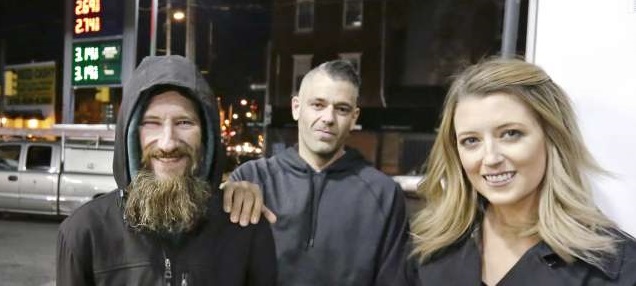
Kate, Johnny, and Kate’s boyfriend. I bet you can tell which is which…
I learned about this story days ago, and got so distracted by all the nauseating ethics news that I neglected to write it up. I apologize. This kind of story should always be the top priority.
Kate McClure of Bordentown, New Jersey, was driving through Philadelphia to visit a friend when her car ran out of gas in a tough section of the city. McClure pulled over, got out of her vehicle and began to walk to the nearest gas station. But Johnny Bobbitt, Jr, an ex-Marine who lives on the streets, saw her plight and immediately took charge. The neighborhood was a dangerous place for a woman to walk alone, he told her, and suggested that she get back in her car, lock the doors, and leave matters to him.
A few minutes later, Bobbitt was back with a full gas can, and gave Kate 20 dollars, the only money he had to his name, to make sure she could get home safely.
McClure said she did not have money to pay Bobbitt back that night, but she returned several times to the spot where he sits, offering him a few dollars and useful items.. Then McClure started a GoFundMe for her rescuer. She wrote,
I would like to get him first and last month’s rent at an apartment, a reliable vehicle, and 4-6 months worth of expenses. He is very interested in finding a job, and I believe that with a place to be able to clean up every night and get a good night’s rest, his life can get back to being normal.
The veteran has been homeless for over a year because of real problems. He has battled drugs, bad choices and probably emotional issues as well. I hope this story has a happy ending. So far so good, though. Johnny demonstrated exemplary ethics, sacrificing his own well-being for a stranger. Kate demonstrated genuine gratitude, empathy and concern, and took affirmative action to try to pay him back. And the American public, as it usually does, showed that when sufficiently alert, it knows how to reward good and selfless deeds.
I was hoping one of the Ethics Alarms military vets would on the issues raised by the recent West Point scandal, and frequent commenter Steve, among others obliged.
These issues are the result of the PC culture that civilian leadership has foisted on all things military. Results are demanded, not those of honor and integrity but of achievement of feminist and progressive goals.
I am retiring from the Marine Corps, things have changed and in terms of accomplishing the mission only a few changes have been good. The core of our military is the infantry, the best of the best of our officers strove to become infantry officers, the most demanding and dynamic job a young officer can have. To be successful you have to be in the top 10 percent of physical performance, be mature, have heart and character. The service academies strove to develop those types of leaders, the type that could be successful infantry officers. With that as the bar, our academies, all of them, have provided the nation with some of the best leaders has given the nation a steel core that helps strengthen the whole country and provides us with resolve and honor that has helped to drive the nation during times of strife.
Civilian control of our military is essential but is also the cause of the rot. Many of the issues such as DADT and the official acceptance of gays in the service doesn’t matter much, the fight and dissent on this issue was due to concerns of political correctness and social engineering effecting the performance of the military, creating a distraction from, in terms of gays in the military it has never hurt us and we have all know some, as a leader I don’t give a shit who you sleep with so long as conformity and uniformity is achieved where it matters most, that the chemistry of the unit is stable. That is that issue in a nut shell.
Now the issue that is very much hurting our academies and the military is the unattainable push for equality, again the core of our military is the infantry, the pinnacle of being a good soldier is to be an infantryman, it is where the bar is set the highest, success requires achieving and maintaining peak mental and physical condition. The infantry is the essence of the military and women can only be artificially successful as an infantryman.
Over the last couple of decades the push has been focused of the individual achievement of women, for achievements sake, not as a multiplier of available manpower or enhancement of performance but to be able to lay claim to being just as effective soldiers as men, it is a desire to be able to make a claim, not to realize it. Standards remain different, there is an acceptance that requirements must be flexible to the individual so as not to become the focus of ire from civilian leadership. It all flows from the top, civilian authorities select generals not solely based on merit or performance but more and more on politics, those who are willing to tow the political correctness line are promoted, those who focus on effectiveness and strive to be apolitical are shown the door or are passed over. Continue reading →
West Point graduate and infantry officer Spenser Rapone recently caused a sensation through his advocacy and support of communism, while being an “official socialist organizer” of the Democratic Socialists of America (DSA). Rapone recently posted a photo of himself as part of a declaration of support for professional football player Colin Kaepernick, including the phrase “Communism will win” with the tag “Veterans for Kaepernick.” Rapone later posted a second photo of himself in uniform with a Che Guevara T-shirt underneath his jacket.That led to scrutiny of the hundreds of pro-Communist tweets by the former cadet, including one calling Defense Secretary James Mattis “evil” and “vile” and another saying he will “happily dance” on the grave of Sen. John McCain.
This was not extensively covered by the mainstream media—After all, what’s the matter with Communists, as long as they don’t help Donald Trump?—though some attention was paid when Senator Rubio demanded that the Army remove Rapone. The Army said last week is it investigating and that the posts “in no way reflect the values of the U.S. Military Academy or the U.S. Army.”
I sure hope not!
Now the military community and others are asking how this is possible, and how West Point could produce a graduate like Rapone. In response to the episode, retired LTC Robert M. Heffington has written an open letter about what he sees as the deterioration of the culture at the storied military academy. Heffington was an assistant professor at West Point for several years, until this past August.
Note, please…
I. This is how one blows a whistle.
II. Heffington describes how cultures rot: inattention, poor leadership, refusal to apply standards, corruption from political agendas, silence from within.
III. Desperate and politically driven efforts to achieve diversity at the expense of integrity and quality are a major factor.
IV. West Point is a part of the higher education community. It would be surprising if it were immune from the same deterioration that the rest of America’s colleges and universities are suffering from. Thus this passage…
“…an entire semester of military history was recently deleted from the curriculum (at West Point!). In all courses, the bar has been lowered to the point where it is irrelevant. If a cadet fails a course, the instructor is blamed, so instructors are incentivized to pass everyone. Additionally, instead of responding to cadet failure with an insistence that cadets rise to the challenge and meet the standard, the bar for passing the course itself is simply lowered. This pattern is widespread and pervades every academic department.”
V. Before I read the letter, I guessed that it would have a passage like this one, and sure enough:
“The plebe American History course has been revamped to focus completely on race and on the narrative that America is founded solely on a history of racial oppression. Cadets derisively call it the “I Hate America Course.” Simultaneously, the plebe International History course now focuses on gender to the exclusion of many other important themes.”
VI. Repairing a broken culture is a long and difficult process. It involves…
Exposure
Acknowledgement
Intervention
Investigation
Transparency
Resolve
Punishment
Dedication to standards and values
Measurable goals
New leadership
Oversight
Refusal to compromise
Routine Assessment of progress
Robert M. Heffington is an Ethics Hero. Here is his remarkable and remarkably disturbing letter: Continue reading →
The overview of our latest Ethics Train Wreck continues from Part One…
Slate published an essay by African-American musician John Legend that itself makes an excellent case against the protests while supposedly glorifying them. Never mind the standard anti-Trump spin at the beginning about “Islamophobia” and the rest, though it is nice for any author to state up front that he’s completely biased and his opinion should be discarded as such. Legend and Slate have the audacity to evoke actual protests that were clear and targeted in comparison the all-purpose “knee”:
“Protest is patriotic. Protest has played a critically important role in elevating the voices of the most vulnerable in our nation. Protest in America has been essential to ending war, to demanding equal rights, to ending unfair practices that keep citizens marginalized. If we quell protest in the name of patriotism, we are not patriots. We are tyrants.
Would there have been a Civil Rights Act without the Birmingham protests? When Bull Connor unleashed his fire hoses and dogs on the schoolchildren taking to the streets, racial disparities and the violence facing people because of the color of their skin became the issues of the times. With savage images of the brutal attack in the news every day, President John Kennedy had little choice but to push for a Civil Rights Act that demanded equal services and equal rights.
Protests in Selma, Alabama, changed the trajectory of this nation and catapulted the Voting Rights Act into being.”
A recipe for tapioca would be as germane to the NFL protests as the Selma march. There is no definable law, principle or position these protests bring into focus. Let’s check the Ethics Alarms Protest Ethics Checklist against the NFL grandstanding:
1. Is this protest just and necessary?
No. How is it just? How is it necessary?
2.Is the primary motive for the protest unclear, personal, selfish, too broad or narrow?
Unclear and too broad by definition, since no two protesters make the same argument.
3. Is the means of protest appropriate to the objective?
Obviously not. What does football have to do with “racial justice”?
4. Is there a significant chance that it will achieve an ethical objective or contribute to doing so?
None whatsoever.
5. What will this protest cost, and who will have to pay the bill?
It’s already cost the NFL millions. But nobody is protesting the NFL…
6. Will the individuals or organizations that are the targets of the protest also be the ones who will most powerfully feel its effects?
No.
7. Will innocent people be adversely affected by this action? (If so, how many?)
Sure: every single fan who wants to just watch football.
8. Is there a significant possibility that anyone will be hurt or harmed? (if so, how seriously? How many people?)
The relentless politicizing of sports and entertainment harms U.S. society and frays the fabric of democracy. That means everyone.
9. Are you and your group prepared to take full responsibility for the consequences of the protest?
Clearly not: witness the constant complaining that NFL teams won’t hire Kaepernick so their season is dominated by racial politics rather than, you know, football..
10. Would an objective person feel that the protest is fair, reasonable, and proportional to its goal?
No.
11. What is the likelihood that the protest will be remembered as important, coherent, useful, effective and influential?
My guess: no chance whatsoever, unless unintended consequences count, like getting more votes for President Trump and crippling the NFL count.
12. Could the same resources, energy and time be more productively used toward achieving the same goals, or better ones?
It’s hard to imaging what wouldn’t be a better use of resources, energy and time.
Verdict: It’s an unethical protest. There is nothing patriotic about unethical protests. We have a right to protest; as with free speech, that doesn’t make all examples of exercising that right good, and certainly not “patriotic.”
However, let me argue in the alternative, as lawyers often do. Let’s say that, as Legend claims, all protests are patriotic. Fine. Then then Charlottesville protest against tearing down a statue of Robert E. Lee was also patriotic. Why, the, was the President attacked—by Legend and Slate, among others, for not condemning it?
The Left believes that protests are sacrosanct only when they are doing the protesting. There is nothing wrong or unpatriotic about accurately labeling a dumb, badly-conceived or destructive protest, and this one is all three.
“Football was down. The end. We, the good people who read the NYT, must say no to football. What is known cannot become unknown except by willful, immoral forgetting. No decent person can take pleasure in football. No fit parent can allow a child to take up the game. The era of American football is over. Bury it. We can end the misery through the simple and necessary refusal to watch anymore. Say no, America… or hey, wait a minute. Here’s that nasty President of the United States and he’s calling for a boycott of football…
So, watch the liberal media endeavor to save football from bad old President Trump. He’s a racist. This is his racism once again, stirring up the stupid people who voted for him. Here‘s the NYT today:
“The tweet suggested that the president, who used an expletive on Friday night to refer to players who kneel or sit in protest during the anthem — a practice that took hold last season among some African-American players after Colin Kaepernick, the now-former San Francisco 49ers quarterback, did so to protest racial and social injustice — is bent on deepening a bitter culture-war fight with the N.F.L.
It is a highly charged debate, with unmistakable racial undertones, pitting advocates of free speech who argue that professional athletes should have a right to use their positions to call attention to social issues against those who contend that refusing to honor the anthem disrespects the military and the nation, and that sports is no place for such displays.”
Ann’s line:
“Let the brain damage continue. We’ve got a culture war to fight.”
1 One comment thread over the last few days encompassed media fact-checkers and the consistent position here that they are intrinsically biased and untrustworthy. Law prof/blogger Jonathan Turley was so incensed (his term was “floored”) over one of the better factcheckers (Wapo’s Glenn Kessler) spinning for James Comey and against Trump press secretary Sarah Huckabee Sanders that he wrote a column for The Hill exposing it. (Hey! That’s MY job!) He writes on his blog about what prompted the column:
I have discussed previously how there has been a palpable bias in reporting on the Trump Administration. It is often that case that some journalists are not simply satisfied with disagreeing with the Administration. They sometimes take judgment calls or opinions and declare the Trump side to be simply factually incorrect. This relieves the need for readers to address the opposing view of controversies like the alleged misconduct of former FBI director James Comey. Those views are simply dismissed as untrue. This is a prime example.
The professor is right. It’s embarrassing. Read Turley’s whole piece, clearly prompted because Kessler refers to Turley’s repeated indictments of Comey (while saying that he does not believe Comey should actually be indicted). One respect in which the ever-polite and professorial Turley differs sharply from Ethics Alarms: he says that he has ” written for the Washington Post and [has] great respect for the publication. Indeed, I have objected to the attacks by President Donald Trump on the Post and the New York Times which remain two of our premiere journalistic organizations.”
Hmmm.
1) Turley obviously wants to keep writing for the Post, I guess, and 2) premiere members of a group that has become unprofessional and untrustworthy are still unprofessional and untrustworthy. Be that as it may, Turley concludes,
The Post concludes that the memos were, despite Comey’s denial, FBI material and that he violated FBI rules in removing and releasing such information. It also accepts that employees under Comey as director could well have been fired for such violations. It also agrees that the memos might have been either classified or privileged, even though there has been no final determination. Regardless, the Post awarded two Pinocchios for Sanders stating that Comey’s actions were “improper and likely could have been illegal.”
I have to give the Post two “Blue Fairies.” (I do not want to steal the Post’s Pinocchio signature motif so the Blue Fairy in the Disney story will do). After all, it was the Blue Fairy who said, “A lie keeps growing and growing until it’s as clear as the nose on your face.”
2. There are two items about Hillary Clinton in the Warm-Up today, because she is simultaneously a human ethics train wreck of a failed Presidential candidate, but also needs as little publicity for being so as possible. Continue reading →
I often point out to my ethics classes that when the ethics alarms don’t sound, one can make decisions that result in ethics zugswang, which is the hopeless bind where there are no ethical solutions, only unethical ones. Then the only practical objective left is damage control: determine which course is the least unethical. An ethical result is no longer possible. It was precluded forever by the original ethics failure.
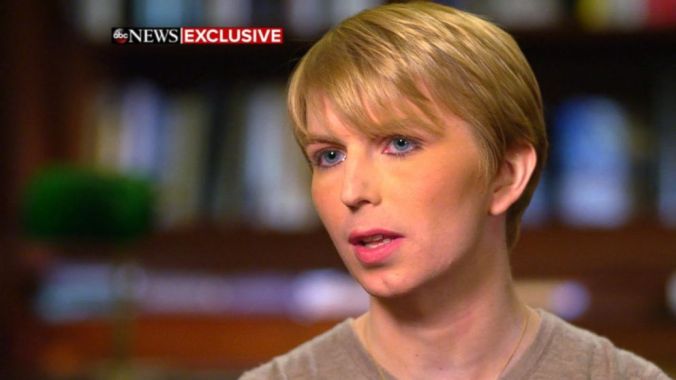
I can’t think of a better example of this process than the Kennedy School’s botched appointment of Chelsea Manning as a ” visiting fellow.” It was an incompetent, foolish, reckless decision that a half-wit should have known would cause an ugly and unnecessary controversy. What was the school thinking?
I can only speculate. Either the school was looking for “buzz’—it got that all right— , or was trying particularly odious progressive virtue-signaling to the anti-war crowd that still hangs out around Harvard Square clutching their love beads, or most indefensible of all, was giving a gratuitous nod to the current transgender fad. Whichever it was of these, it should have been obvious that the choice was a terrible idea, and it says a lot about the school’s leadership and procedures that nobody in a position of influence shouted, “Wait, are you kidding? Chelsea Manning? She’s a convict and a felon who leaked secret information to enemies of the United States!” Manning, as I noted in the Morning Warm-Up covering the story, isn’t a scholar, a deep thinker, or a stable or a trustworthy individual. Selecting her was bound to upset other more qualified teachers at the school as well as any American not partial to traitors, and it did. It also devalued every previous fellow at the Kennedy School, by demonstrating that being a Kennedy School fellow wasn’t a credential signifying special talent or admirable qualities. Not if Chelsea Manning qualified, it wasn’t.
The fury over the appointment erupted so vigorously in public, and, I suspect, even more vigorously behind the ivy-covered doors in Cambridge (my mother spent most of her working life at the University, and ended it as Asst. Dean of Housing: the Marshalls know how Harvard works), that the reversal wasn’t as big a surprise to me as it seems to be to some. Nonetheless, the criticism levied by many has justification. Wrote Jonathan Turley, for example,
“The only thing worse than Harvard’s Kennedy School of Government appointing Chelsea Manning as fellow was the school’s withdraw of the fellowship…My concerns are not really focused on Manning but the danger of universities tailoring its academic programs to public opinion. I have written extensively about the hostile environment for conservative speakers on campus. Invitations have been withdrawn due to opposition groups and protests. This case is even more concerning because it was a formal invitation to join the program as a fellow. The invitation and then the withdrawal leave total confusion as to the purpose and academic content of these fellowship positions. Harvard appears to have carefully avoided any principled ground in both the appointment and the withdrawal.”
1 Commenter Other Bill had to ruin my evening by posting this defense of Jamele Hill from a Sports Illustrated writer, which would be enough for me to cancel my subscription if I had one.
“I was going to give this a pass. Truly, I was. Jamele Hill, the gifted young woman who co-hosts ESPN’s The Six every night with my old Morrissey Boulevard running buddy Michael Smith, got on her electric Twitter machine and tweeted out her unremarkable—and damned near irrefutable—opinion that the current president of the United States is a racist and a white supremacist. This drew the usual screams from the political flying monkeys of the American Right. ESPN responded with a craven corporate response that I’ll get to in a minute, but let me just say right now that you will not believe that the response was written by anyone who ever came within a light-year of any newsgathering operation. OK, so I thought that was pretty much it. I agreed with everything Hill tweeted. I thought what she said should be obvious to everyone in America at this point. She delivered her opinion. There was the customary cyber-bullying pushback, and we all move on.”
This is a perfect example of why sports writers should be seen and not read or listened to on non-sports topics. Let’s see:
a) The fact that she is “gifted”—a matter of opinion: a smart ESPN broadcaster wouldn’t do something this stupid—is irrelevant to the controversy. So a bad sports journalist would be less justified in attacking the President like this?
b) A journalist calling the President of the United States a racist is in fact quite remarkable, and if an ESPN employee had called Barack Obama equivalent things, he or she would have been fired so fast her hair would have combusted.
c) OK, asshole, give me your closing argument about how President Trump is irrefutably a white supremacist. You can’t use the fact that he believes in enforcing immigration laws, or the fact that white supremacists tend to support him, when his political opponents are addicted to saying and writing things like “the whole white race is a virus.” You can’t use the fact that he doesn’t believe that tearing down statues of Civil War heroes is smart or valid, because I agree with him, and I am not a white supremacist. The fact that he implicitly defended the right of white nationalists to exercise their First Amendment rights makes him a supporter of the Constitution, as his oath of office requires, and not a nascent totalitarian like the hate-speech banning politicians you probably support.
So what have you got? I’d say nothing. It’s “irrefutable” to you because your left-wing friends say it is….
d) …not that whether Hill was right or not is the least bit relevant to whether ESPN is sending the message that gratuitous public anti-Trump, race-baiting grandstanding from employees is acceptable, but anti-Democrat/Muslim/Trans statements are not. It is sending that message, and that’s a double standard and obvious bias.
e) ESPN’s response was craven all right, but for the opposite reason that this guy says.
f) The fact that mostly conservatives correctly condemn Hill and ESPN only proves that the Left has lost its ethics alarms and professional compass, or broken them while stomping and screaming during their post 2016 election tantrum. It’s not a partisan or political verdict, except that “the resistance” would defend the Zodiac killer if he attacked the President. That’s their flaw, not ours.
2. Today’s “I was going to post on it but the story is so stupid that I don’t want to give it the prominence” note is this one. Continue reading →
1 President Trump stunned the political world and particularly the left’s “I hate him” news media by crossing party lines and cutting a debt deal with Democratic leaders in defiance of his own hyper-partisan party. One reason they were stunned is because this is what competent Presidents do and are supposed to do in order to govern, and we have just finished eight years with a previous President who was unwilling and incapable of doing it.
This single episode doesn’t make Trump a competent President, but it does show that he is competent in at least one aspect of democratic leadership (Obama was competent at exactly two: appearing Presidential and speaking coherently), and has some guts. The demonstrated ability to negotiate and the willingness to act in the teeth of furious opposition were two characteristics that the advocates of his candidacy cited as justification for electing him.
It is also dawning on some that the structure of the DACA executive order may well be to fashion the measure as a bargaining chip to be cashed in later. This is also the kind of thing competent leaders do.
2. There is a new website called Verrit, which appears to be an openly, proudly, left-biased news source which purports to “verify” news stories, obviously based on its own progressive world view. Verrit founder and CEO Peter Daou told the news media,
“We’re in a time now where you just no longer trust anything that you’re reading,” Daou said. “Facts are now in question. Reality is now in question. So we want to do something where we rigorously vet these facts and we actually stand by our research and put an authentication code on every fact that we put up.”
And what qualifies Verrit as a fair and objective “authenticator”? Apparently it is the virtue of being hard-progressive and anti-conservative to the bone. Here is a recent Verrit collection of its “cards”:
1. In a comment thread about Joe Arpaio’s pardon, the absurd assertion was made that Chelsea Manning was “tortured” at Leavenworth. In knocking down this anti-U.S. propaganda, courtesy of the U.N. and others, I noted that even the U.N. accuser based that assessment on the weird conclusion that Manning was “never convicted of a crime.”
Translation: military courts martial don’t count. Thanks for that opinion, U.N. guy! Why don’t you start your own country?
The other part of the phony torture accusation is the assertion that being held in solitary confinement is torture. Under international law, it is considered “cruel and unusual punishment,” not torture, but… surprise! The U.S. is not governed by international law, much as the globalists wish it were!
Solitary confinement has (rarely) been found by U.S. courts to violate the 8th Amendment when it is of indeterminate duration and without good cause, but that has nothing to do with Manning, who was considered in danger as a traitor in a military prison, and was in solitary for her own protection. The Supreme Court determines what is cruel and unusual punishment in this country, not the U.N., and not international law.
2. I also (I admit it: I knew I would) triggered a freak-out here, and some unfair insults that I will gracefully ignore, by stating that I would have supported execution for Manning, who was and is a traitor. (President Obama commuted her sentence, making the anti-war Left happy but oddly triggering a fraction of the condemnation in the news media that has followed President Trump’s pardoning an 85-year old man facing a minimal jail term. ) The U.S. has been historically reluctant to execute traitors, and in the era where a cyber-leaks can give more aid and comfort to the enemy than Julius and Ethel Rosenberg could have managed in a hundred years, a re-evaluation of that kind, merciful but dangerous policy is over-due for reconsideration. Manning avoided conviction on the worst of the charges against her (then, him) because prosecutors didn’t prove intent sufficiently. Manning claimed that she was just trying to start a “conversation’ about the Iraq and Afghanistan wars, and was willing to put classified information into the hands of terrorists in order to do it. If she knew she would be facing the death penalty with some certainty, it is likely that Manning would have thought twice, at least. It’s called deterrence, and in an age where self-righteous low-level types like Manning and Edward Snowden can get U.S. intelligence personnel exposed and killed with a few keystrokes, serious deterrence is called for.
3. Remember when I asked readers to alert Ethics Alarms when the first talking head suggested that out first major hurricane in 12 years was the result of climate change? It took longer than I expected, but the first reported fool was CNN anchor John Berman. He was interviewing Bill Read, the former director of the National Hurricane Center, and asked,
“Is there a why to this? Why there is so much water associated with this storm? One thing we heard from scientists over the last 10 years is that climate change does impact the intensity of many of the storms that we see.”
To his credit, Read assured Berman that the heavy rains had nothing to do with climate change, and everything to do with the typical behavior of this kind of storm. The episode shows 1) how little many journalists (I won’t say all, but it is very close to all) understand the science of climate change, but promote it anyway because it aligns with their partisan politics, and 2) how they will try to generate fake news, which is what “Hurricane Harvey Deadly Rainfall Possibly Caused By Climate Change, Expert Tells CNN” would have been. If Berman was interested in promoting public understanding of the climate change controversy, he would have asked, “Climate change models and Al Gore’s documentaries predicted more and more violent storms as a result of global warming, yet this is the first major hurricane we have seen in more than a decade. How do you account for this?”
4. In the teeth of this renewed attack on U.S. history and culture during the Confederate Statuary Ethics Train Wreck, I asked how long it would be before “Gone With The Wind” was banished from the airwaves. The Orpheum Theatre Group in Memphis, Tennessee just withdrew its annual screening of the classic 1939 film out of concern that some may find it ‘offensive’.
If no one has the courage to stand up for art, expression and history as “the offended” try to strangle cultural diversity out of existence, then Orwellian thought control will be the inevitable result. I don’t blame the “offended” for trying to suppress speech, thought and history as much as I blame the cowards who capitulate to it. Next in the line to oblivion: war movies, movies with guns, “Gettysburg” and John Wayne. Continue reading →
1. You cannot imagine how long it takes to prepare a post on WordPress when the internet connection is going out repeatedly, requiring a trip down a flight of stairs, re-booting the modem, scanning for a channel back up the stairs in my office, and furiously searching, reading and linking until Verizon kicks out again after three to ten minutes.
Since none of my 40 phone calls to the Verizon tech who promised that the three-months’ long problem was fixed and that he would sprint like a bunny back to our home to trouble shoot if the malady returned had received the courtesy of a response, I snapped, and got into my car to visit a Verizon wireless store about five minutes away that I didn’t know existed. For some reason the world, though sun-lit, was bathed in a weird light, and my neighbors were lying on the ground wearing what looked like 3-D glasses, but never mind: I had someone to yell at.
There were two young men about the age of my son manning the store, and I told one of them, through gritted teeth, the whole infuriating saga of how much Verizon DSL sucks and what useless customer service his employer provides, rendering both my business and my communications chaotic and unbearable. I didn’t expect anything, really. I just wanted to give hell to someone face to face.
To my shock and amazement, the young man actually did something. He got on the phone—I told him that I took sadistic pleasure in watching Verizon personnel go through the infuriating phone tree, get put on hold, get disconnected, end up in the wrong department, for all of this happened to him as I watched and listened—but he finally reached a supervisor, and told him that the story he had just heard from the gentleman in his office made him ashamed to work for Verizon, and he wanted to know how my problems could be addressed immediately. Yes, he knew that I had a tech visit already scheduled, “but since the same tech has been out there three times, each time assuring him that the problem was successfully addressed, why would he trust us to fix the problem now?”
“If I were him, I would have dumped Verizon and found another provider.”
After about 45 minutes, here was what he accomplished. He got them to agree to send a different and higher level tech this time. He set in motion the process of getting me fee rebates for the three months of intermittent service. And he gave me his card, with instructions to call him immediately if the problem wasn’t fixed. “If I have to, I’ll come to your house and personally see that you have functioning internet service from a new provider,” he said. “one way or the other, I will fix this problem.”
The men and women of our military operate as one team, with one shared mission and one shared sense of purpose. They transcend every line of race, ethnicity, creed and color to serve together and sacrifice together in absolutely perfect cohesion. That is because all service members are brothers and sisters. They’re all part of the same family. It’s called the American family. They take the same oath, fight for the same flag and live according to the same law. They’re bound together by common purpose, mutual trust and selfless devotion to our nation and to each other.
The soldier understands what we as a nation too often forget, that a wound inflicted upon a single member of our community is a wound inflicted upon us all. When one part of America hurts, we all hurt. And when one citizen suffers an injustice, we all suffer together. Loyalty to our nation demands loyalty to one another. Love for America requires love for all of its people.
When we open our hearts to patriotism, there is no room for prejudice, no place for bigotry and no tolerance for hate. The young men and women we send to fight our wars abroad deserve to return to a country that is not at war with itself at home. We cannot remain a force for peace in the world if we are not at peace with each other.
As we send our bravest to defeat our enemies overseas — and we will always win — let us find the courage to heal our divisions within. Let us make a simple promise to the men and women we ask to fight in our name, that when they return home from battle, they will find a country that has renewed the sacred bonds of love and loyalty that unite us together as one.
But as my Trump-deranged Facebook friends say, we know he doesn’t believe any of this. We know in his heart that he’s a racist Nazi. Besides, they don’t want to heal those divisions. They want to exploit them, and why would they want to be undivided from deplorable citizens they hate anyway? Continue reading →




I was hoping one of the Ethics Alarms military vets would on the issues raised by the recent West Point scandal, and frequent commenter Steve, among others obliged.
Here is Steve’s Comment of the Day on the post, The West Point Communist, How Cultures Rot, And The Whistleblower’s Letter…