(I am backed up three deep on the “Comments of the Day,” and I apologize to the deserving and patient commenters.)
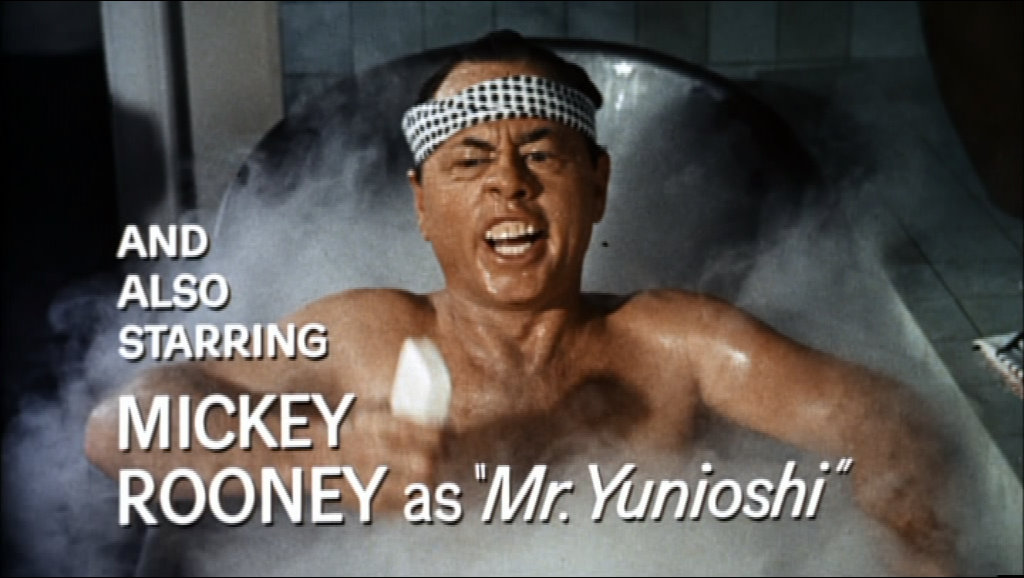
And who can forget Mickey Rooney’s hilarious turn in that beloved American film masterpiece “Breakfast at Tiffany’s”?
Alex Yuan raised an element of the revolting Jimmy Kimmel stunt discussed in my post, an extension of his penchant for using children as uncomprehending props for his often ugly comedy, that I glided right over: Why was showing a child suggesting that wiping out the Chinese was a viable solution to national problems even considered fit for broadcast, when a similar comment about Jews, gays, Hispanics or blacks would be considered instantly taboo? Why doesn’t the ethics alarm sound when the minority being slurred or threatened is Asian?
It is interesting that you should mention political correctness because I can’t help feeling that in deciding it appropriate to air this segment, ABC – perhaps as a reflection of societal attitudes at large – is illustrating the alleged double standard against Asians when it comes to how topics concerning minorities and other protected classes are handled in public. Continue reading →
“We’ve been told to make life as difficult for people as we can. It’s disgusting.”
—An unidentified U.S. Park Ranger, quoted by the Washington Times, in connection with a story about the Park Service shutting down the parking lot at Mount Vernon, George Washington’s home, which is not run by the Park service.
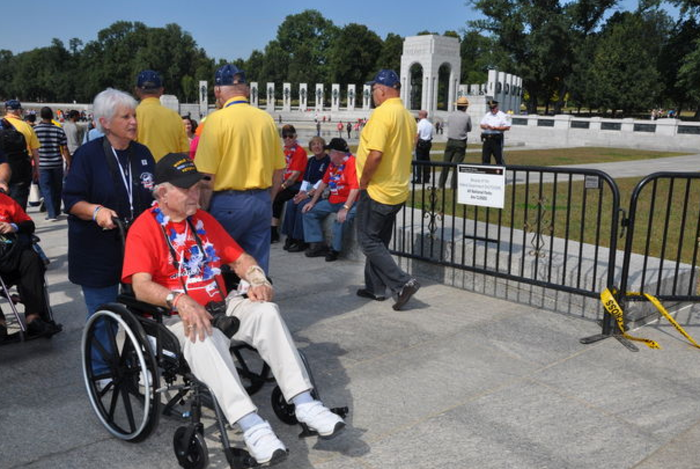
My Dad would have been in this picture. Having his own nation that he risked his life for intentionally target him as a pawn would have hurt and angered him deeply. For the first time since Dec. 1, 2009, I’m thankful that he’s dead.
My late father, a decorated World War II veteran, loved the World War II Memorial. He was an invited guest at its dedication, and I accompanied him. Up until a few days before Dad died, he would wear a vest covered with his patches, insignias and medals, including the Silver Star, and just hang out there, often signing autographs for young visitors who treated the real life World War Two relic as both part of the Memorial and as a celebrity. Sometimes I accompanied him. It is a large, wide open space, without a discernible entrance. No government employees were ever in evidence while I was there. Beyond routine maintenance and cleaning, there is no need for any. Security? Just try vandalizing that space with the veterans there, old as they are. I dare you.
So why has the Park Service expended extra funds to block access to that memorial, where visitors just wander in and out, as well as non-government attractions like Mount Vernon, and even private operations that serve visitors to government attractions, like the Pisgah Inn, a private hotel that holds a concession on the Blue Ridge Parkway? Continue reading →
The Child Soldiers Prevention Act of 2008 requires the United States to withhold any form of aid from nations that use children in their armies, a clear human rights violation. President Obama waived the provision in 2010, as Samantha Power, then the National Security Council senior director for multilateral affairs and human rights, assured the media and the nation that “the waivers would not become a recurring event.” By the terms of the law, the President has to notify Congress that he is waiving it within 45 days of making the decision. Monday afternoon, with Congress on the eve of a government shutdown and knowing that any such announcement would be largely ignored by the public and the press, the White House press announced yet another waiver of the law The new Child Soldiers Prevention Act waiver applies fully to Chad, South Sudan and Yemen. Congo and Somalia received partial waivers.
Washington Post Fact-checker Glenn Kessler finally couldn’t stand it anymore regarding Secretary of State John Kerry’s favorite lie, only trailing me by about nine years. As he was participating as a stooge in President Obama’s improvised vaudeville act regarding his “red line” and Syrian chemical weapons (but then, as Americans, so are we all), Kerry said this in an interview on MSNBC, where he knows any transparent and self-serving lie by a Democrat will be accepted as revealed truth:
“You know, Senator Chuck Hagel, when he was senator, Senator Chuck Hagel, now secretary of defense, and when I was a senator, we opposed the president’s decision to go into Iraq, but we know full well how that evidence was used to persuade all of us that authority ought to be given.”
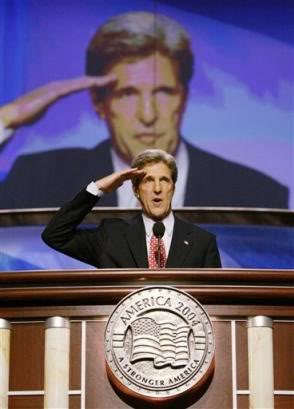
Now I, for one, am thankful when Kerry, who is not Irish (his heritage is primarily Jewish) * and was elected Senator in Massachusetts using campaign posters with green shamrocks on them, reminds us all why he never became President. This was yet another re-phrasing of the deception he kept hammering during his 2004 campaign—you remember, the one with John Edwards as his running mate, because Kerry is also a magnificent judge of character?—he didn’t support President Bush’s invasion of Iraq.
Of course, he did, and emphatically too. Kessler, who is inclined to go easy on Democrats for the same kinds of deceptions he slams Republicans for (I measure the discrepancy at just short of two “Pinocchios”) decided to give Kerry a full blast with both barrels: Continue reading →
Prof. Reynolds, the iconic conservative bloggers who wields considerable influence in the right-leaning blogospehere and beyond, has frequently displayed a dismaying affection for the unethical response of “tit-for-tat.” Has seldom done so as blatantly, however, as in a post yesterday, linking to a National Review article about CUNY students shouting down General David Petraeus, who is now a lecturer there.
“I think right-leaning groups should similarly hound Hillary and other Obama Administration apparatchiks — including Obama himself, when he ventures onto campuses, both now and post-Presidency. The standard of behavior has been established. Let them live with it.”
Even giving Reynolds the benefit of the doubt and assuming that he is speaking tongue-in-cheek or hyperbolically, as he often does, this is an irresponsible statement if he doesn’t mean it, and an unethical one if he does. He is considered a sage and an opinion leader among many conservatives, and for such a prominent figure to expressly approve of the downward behavioral tail-spin that inevitably results when each competitor or adversary re-aligns ethical standards according to the unethical acts of the other is embracing all-out culture war and chaos, with no standards at all.
“They started it, so let’s give them a taste of their own medicine and see how they like it!” is street gang thinking, (Jets:“Well they began it!”Sharks:“Well they began it!”Both: “And w’ere the ones to stop it once and for all…tonight!”— “Quintet” from West Side Story) as far from ethics as one can get, and this is exactly what Professor Reynolds is endorsing. That ethically bankrupt approach, and the fact that our political system has been operating by it at least since 2000, accounts for today’s poisonous culture in Washington D.C. It has crippled both the Bush and Obama administrations, paralyzed the government and divided the public. If political and intellectual leaders embrace this reaction to misconduct in one setting, they are implicitly accepting it as a justifiable strategy, and it is not. It is a brutal, unethical strategy.
Students who interfere with invited speakers’ efforts to challenge or enlighten university audiences should be disciplined; it doesn’t matter whether the speaker is an ex U.S.general or Ilsa, Wolf of Dachau. Interfering with speech isn’t protected speech, nor is it ethical protest. That behavior isn’t a “standard of behavior,” it is a defiance of civilized standards. The President, Hillary Clinton and other targets of the right should be allowed to speak, listened to politely, and then confronted, if they are confronted, with civil and articulate rebuttals on the basis of their words and ideas. For a university professor to advise otherwise is unconscionable. For one who is respected and followed as extensively as Reynolds to write this defies reason.
“Above all, a president has no business confessing to war-weariness. Sending soldiers to war is a hard business. But President Obama knew he was going to be a war president; if that duty was too trying for him, he should not have run for reelection, because, as he has discovered, he might have to fight new wars and not merely end old ones.
“For a president to confess to war-weariness is to confess weakness.
“It is the business of the commander in chief to inspire, either with tempered optimism or grim determination. He fails in his duty if he tells his subordinates, his people and the world that he is weary of the burden that he assiduously sought. In their dark moments, Abraham Lincoln and Franklin Delano Roosevelt, who presided over infinitely more consequential and bloodier wars than Barack Obama, were undoubtedly war-weary. Can anyone imagine them proclaiming it to the world? “
—–Eliot Cohen, a teacher at the Johns Hopkins School of Advanced International Studies, concluding a Washington Post op-ed titled (in the paper’s print version), “We have not earned war-weariness.”
If there is a silver lining to the President’s Syrian Ethics Train Wreck, other than convincing those still capable of independent thought that we who saw the weakness of President Obama’s leadership skills were the ones whose eyes were open all along, it is that it has provoked some perceptive writing and debate on the topics of leadership, character, and America’s role in the world. Continue reading →
“It is extremely dangerous to encourage people to see themselves as exceptional, whatever the motivation. There are big countries and small countries, rich and poor, those with long democratic traditions and those still finding their way to democracy. Their policies differ, too. We are all different, but when we ask for the Lord’s blessings, we must not forget that God created us equal.”
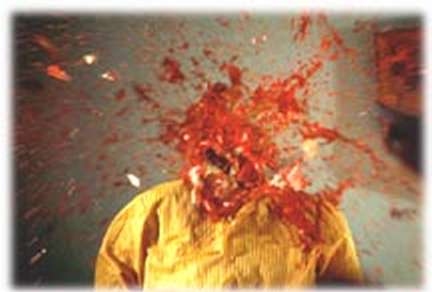
—-Former KGB officer and Russian leader Vladamir Putin, lecturing President Obama and the U.S. public on right, wrong, and human potential,in a New York Times op-ed that neatly exploits the stumbling White House diplomacy efforts regarding Syria. And yes, it made my head explode.
Oh-oh…this was bad one…
John McCain’s tweet in response to Putin’s cheeky op-ed was on target: “Putin’s NYT op-ed is an insult to the intelligence of every American.” [Aside:Of course, so was President Obama’s speech. As always these events give us a chance to gauge which journalists warrant ever regarding seriously again. On one side there are the likes of the Daily Beast’s toadying Michael Tomasky, who pronounced the President’s speech “great.” On the other is the Washington Post’s generally left-leaning Dana Milbank, who decided to be honest, pointing out how the President’s speech arising out of his contradictory and incoherent statement about Syria was…contradictory and incoherent: “The president, in the space of his 16-minute address, was often at odds with himself. He spent the first 12 minutes arguing for the merits of striking Syria — and then delivered the news that he was putting military action on hold. He promised that it would be “a limited strike” without troops on the ground or a long air campaign, yet he argued that it was the sort of blow that “no other nation can deliver.” He argued that “we should not be the world’s policeman” while also saying that because of our “belief in freedom and dignity for all people,” we cannot “look the other way.” He asserted that what Bashar al-Assad did is “a danger to our security” while also saying that “the Assad regime does not have the ability to seriously threaten our military.”In other words, “great.”] It was more than an insult, however. Putin’s screed was ethics poison: dishonest, manipulative, and malign. Continue reading →
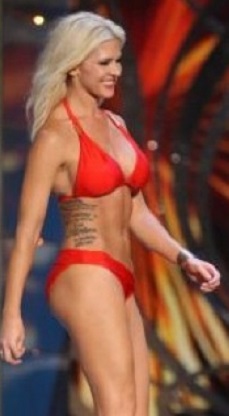
Miss Kansas, also known as Theresa Vail, would be a standout in current 2014 Miss America pageant just based on her unusual set of experiences and talents: the 22-year-old student at Kansas State is a member of the Kansas Army National Guard’s Medical Detachment, a serious bowhunter, a former motorcycle racer, an M16 marksman, a boxer, an auto mechanic, and an opera singer.* What is ethically of interest, however, is that she wore a bathing suit that revealed her two tattoos.
This just isn’t done in beauty pageants, not that many contestants are the tatooing sort. Tatoos have traditionally been regarded as ruining a contestant’s “perfection,” and aesthetically, I have to agree: a beautiful woman is still beautiful with something scribbled on her side, but it is hardy an enhancement. But Vial, in announcing her decision on her blog, made a compelling ethical argument for letting her tats show:
“What a hypocrite I would be if I covered the ink. With my platform, how could I tell other women to be fearless and be true to themselves if I can’t do the same?…But I am who I am, tattoos and all.”
That is as good a definition of integrity as you will find. Brava. Where integrity lies, you can usually find honesty, trustworthiness and courage as well. Continue reading →
Today, the anniversary of September 11. 2001, American minds should be occupied with thoughts of gratitude for heroes, the often anonymous and unknown people we may pass in the street every day, as well as the justly famous and celebrated, who make our lives and many others better by living their own selflessly and well. They are our salvation, role models and neighbors, and they teach us the lesson that all is never lost, and hope is always thriving, as long as there are good and courageous people who will do the right thing, no matter what the cost, when fate turns to them.
This seems like a propitious time to dedicate the Ethics Alarms Heroes Hall of Honor, the list of the Ethics Heroes Emeritus whose stories have been told here (and on this site’s predecessor, The Ethics Scoreboard.) Every current member of the Hall is now deceased, like the brave men and women who died this day, 12 years ago. Each of them, in a unique way, teaches how human beings can rise above the vicissitudes of mere survival, self-interest, personal benefits and the base desires of the species to live meaningful and virtuous lives. Some accomplished this over decades, some with one brilliant and transforming act of distinction.
There are currently 32 members enshrined in this virtual Hall. Obviously, it is far from complete. They are just symbolic representatives, worthy ones, of millions more who once breathed the same air we do today, and like those who perished twelve years ago, face the prospect of being forgotten over time, as we all go about the consuming task of getting from one day to another. Each one of us, I believe, is capable of emulating their example.
Here are the thirty-two members and their stories, as of this date,
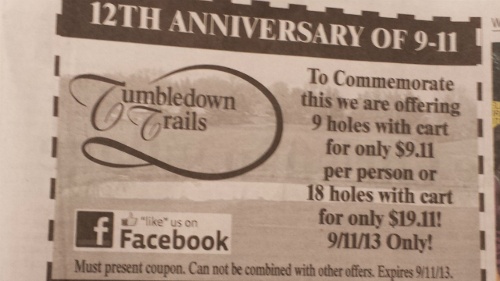
The owner of a Wisconsin golf course has apologized for using a national disaster and the deaths of nearly 3000 Americans as a commercial promotion. Apparently he has done this before and nobody complained. How is this possible? Isn’t this the very definition of exploitive, crass, and disrespectful? Has the golf course owner grown up with fond memories of November 22 sales and December 7 parades?
How could it be that nobody in his family or circle of friends or the golfers at the course alerted him that such a 9-11 promotion was tone-deaf? If I’m about to do something this stupid and wrong, I expect those around me to let me know before somebody, like me, gets hurt. The owner’s associates failed their obligations too: we need to help each other do the right thing, because everyone’s ethics alarms malfunction sometimes.



 Ethics Alarms