Ethics Quiz: The Conundrum of the Anti-Gay Marriage Diversity Officer

…But be sure to think about it who will see it before you do!

Ethics, law, fairness and common sense are locked in a complex battle in this story, which comes out of Gallaudet University, the famous Washington D.C. school for the deaf.

Dr. Angela McCaskill, Gallaudet’s chief diversity officer, has been put on administrative leave and may face dismissal because the school learned that she had signed a petition opposing Maryland’s same-sex marriage law.  McCaskill apparently signed the petition at her church after her preacher spoke against gay marriage. A measure is on the Maryland ballot that could overturn the recently-passed state law approving same-sex marriage.

Does she have an absolute right to sign a petition in favor or opposing any political or social policy? Yes. Is this a petition something a university official in charge of promoting diversity is wise to sign? No. Is a university whose diversity officer chooses to sign such a petition behaving fairly and responsibly to decide that it should have someone else in that position?

Hmmmm.

And that’s your weekend Ethics Alarms Quiz:

Is it fair and responsible for a university to fire its diversity chief because she signed a petition opposing gay marriage? Continue reading

One For The “Innocent Until Proven Guilty” Crowd

Stop scaring my dog!

A commenter recently pulled out the hoary and almost always misused “innocent until proven guilty” line, which reliably makes me scream, frightening the dog and the neighbors. Thus I was happy to see this September 28 ruling by the Louisiana Supreme Court, which found that Philip Pilie, a 2007 University of Georgia School of Law  who passed the bar examination in 2009, lacked the character and fitness to be admitted to practice in the state, despite the fact that he was not convicted of the crime that resulted in his disqualification.

Why? Because he did it, that’s why. Pilie contacted what he thought was a 15-year-old girl online and arranged to have sex. She was, unfortunately for Pilie, really a big, hairy, middle-aged man looking for predators who like to have sex with under-age girls. Pilie  was arrested at the planned rendezvous and charged with two  felonies,  computer-aided solicitation of a minor and attempted indecent behavior with a minor.

Pilie negotiated a deal with the district attorney to avoid prosecution. He completed a pre-trial diversion program including counseling, and all charges  were dropped. Pilie took and passed the bar exam, but was informed  in March 2009 that he lacked the character and fitness for admission to practice, because he trolled on computers for young girls to have sex with, by his own admission. His appeal to Louisiana’s highest court failed, twice.

In the latest decision, the court said that Pilie’s lack of a criminal conviction made no difference in its reasoning. “Had petitioner been a practicing attorney at the time of his misconduct, it is very likely he would have been permanently disbarred,” it wrote. “Given this fact, we can conceive of no circumstance under which we would ever admit petitioner to the practice of law.” Pilie was permanently barred from ever again seeking admission, without ever being “convicted in a court of law.” Continue reading

As Dean Wormer* Would Say To Bryan Craig: “Sex-Obsessed, Promiscuous and Stupid Is No Way To Be A High School Guidance Counselor, Son…”

The Rich Central High principal suspected something was amiss with the girls’ basketball coach when the team members began to act strangely…

A provocative variation on the “naked teacher” scenario has surfaced in Chicago suburb Olympia Fields. Bryan Craig was a guidance counselor and girls’ basketball coach at Rich Central High School until his self-published book “It’s Her Fault” came to the attention of parents and school administrators. Then he was placed on administrative leave, and finally, fired.  The book is for mature audiences only, and based on reports (I haven’t read it and have no intention of doing so) includes pick-up advice, analysis of female body types (including a discussion of the varying colors and temperature levels of the vaginas of various races, apparently the book’s highlight) and Craig’s insight into how women think, a perspective that appears to be muddled at best and sexist at worst. Here is a passage from the book (in an Amazon reader’s review—a favorable one, and from a teenage stripper):

“In some cases, strippers and dancers show the overall dominance a woman can have over a man. Not to say that stripping is what has to be done to truly establish dominance, but these women’s mind-set is in the right place in order to meet the true potential of the point of this book.” Continue reading

The NFL’s Replacement Ref Dilemma

There are some things even football fans won’t stand for. I think.

It was Week #3 of the NFL season, and there is a growing consensus that the replacement referees, the consequence of the NFL’s labor dispute with its regular refs, are making, if not a mockery of the game, a mess of it. The ethics issue: at what point is the quality of the NFL’s product so compromised by sub-professional officiating that the league is cheating the public by presenting it at all?

Airlines don’t use replacement pilots when pilots go on strike; they wouldn’t dare. Chicago didn’t hire street mimes to stand in for the striking teachers. In the NFL’s case, it is making the calculation that football fans will put up with lousy officiating if the alternative is no games at all on Sunday. Meanwhile, the NFL still charges the same outrageous prices for its tickets and still collects full value in merchandising and TV revenue. Translation: It is getting full price for a less than complete product. Is that ethical? Continue reading

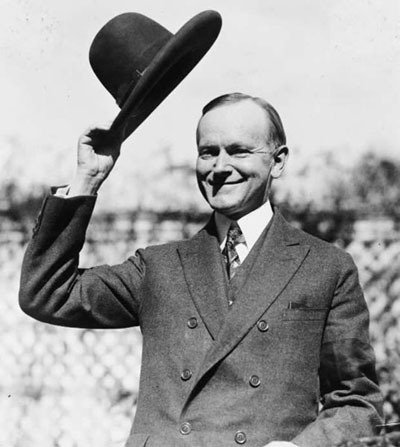
Ethics Quote of the Day: Calvin Coolidge

“There is no right to strike against the public safety by anybody, anywhere, any time.”

—-Calvin Coolidge, then Governor of Massachusetts, soon to be Vice-President and later President upon the death of Warren G. Harding, in a September 14, 1919 telegram to labor leader Samuel Gompers on the occasion of the Boston police department strike.

Cal made his words count.

The Boston police were fired for extorting the city, and Coolidge’s words were in the air when President Ronald Reagan responded to an illegal strike by air traffic controllers by firing the strikers and banning the union.

Now Chicago’s teachers are striking, not against the city management that is denying their demands, but against the children of the city and their families.

What would silent Cal say? I think I can guess. Harming children and families for higher wages is as much extortion as leaving a city unprotected against crime, and cannot be defended ethically. The defense will be, inevitably, “Well, management is unfair, and their offer is unjust. What are we supposed to do?”

The answer is: something else.

__________________________________

Facts: Chicago Tribune

Source: Wikipedia

Graphic: Washington, Jefferson and Madison Institute

Ethics Alarms attempts to give proper attribution and credit to all sources of facts, analysis and other assistance that go into its blog posts. If you are aware of one I missed, or believe your own work was used in any way without proper attribution, please contact me, Jack Marshall, at  jamproethics@verizon.net.

The Forgotten Meaning of Labor Day

Do you know who this is? You should! It’s Labor Day, dammit!

Labor Day commemorates one of the great ethical victories of American society, and not one in a hundred Americans know it. Labor Day marks the end of summer, and a time for retail store sales, and the last chance to get away to Disney World, but few of us think about the real meaning of the word “labor” in the name, and how it is meant to honor brave, dedicated men and women who fought, sometimes literally, the forces of greed, political influence, wealth and privilege in this country to ensure a measure of safety, consideration, fairness and justice for the hardest working among us.

Today labor unions are controversial, and with good reason. Many of them have been run as criminal enterprises, with deep connections to organized crime; many operate in a blatantly coercive and undemocratic fashion. Union demands and strong-arm tactics, while providing security and good wages to members, have crippled some American industries, and limited jobs as well. Today the unions  get publicity when one of them tries to protect a member who should be punished, as when the baseball players’ union fights suspensions for player insubordination or even drug use, or when school districts are afraid to fire incompetent teachers because of union power, or when the members of public unions protest cutbacks in benefits that their private sector counterparts would be grateful for. It is true that today’s unions often embody longshoreman philosopher Eric Hoffer’s observation that  “Every great cause begins as a movement, degenerates into a business and ends up as a racket.” *

That not what Labor Day honors, however. It is celebrating the original labor movement that began at the end of the 19th century, and that eventually rescued the United States from an industrial and manufacturing system that was cruel, exploitive, deadly and feudal. Why the elementary schools teach nothing about this inspiring and important movement, I do not know. I suspect that the story of the American labor movement was deemed politically dangerous to teach during the various Red Scares, and fell out of the curriculum, never to return. Whatever the reason, it is disgraceful, for the achievements of the labor movement are every bit as important and inspiring as those of the civil rights movement and the achievements of our armed forces in the protection of liberty abroad. Continue reading

Ethics Quote of the Month: Arthur Brisbane

“I had taken up the public editor duties believing “there is no conspiracy” and that The Times’s output was too vast and complex to be dictated by any Wizard of Oz-like individual or cabal. I still believe that, but also see that the hive on Eighth Avenue is powerfully shaped by a culture of like minds — a phenomenon, I believe, that is more easily recognized from without than from within. When The Times covers a national presidential campaign, I have found that the lead editors and reporters are disciplined about enforcing fairness and balance, and usually succeed in doing so. Across the paper’s many departments, though, so many share a kind of political and cultural progressivism — for lack of a better term — that this worldview virtually bleeds through the fabric of The Times.As a result, developments like the Occupy movement and gay marriage seem almost to erupt in The Times, overloved and undermanaged, more like causes than news subjects.”

Arthur Brisbane, New York Times’ “public editor” (that is, ombudsman), in his final column in that role. Brisbane’s tenure has been characterized by his defensiveness over accusations that the Times radiated a political agenda, and the lack of a willingness to be critical of his employers that is the hallmark of an effective ombudsman.

“By George, you’re RIGHT! There IS a dinosaur here! How could I have missed it?”

Yes, Arthur, it’s called “pervasive liberal or left-wing bias,” and it is good of you to finally notice, and honest of you to say so, even though you can’t bring yourself to do so directly. But your insistence  that such bias could manifest itself in the coverage of issues that are central to the presidential campaign without affecting the Times’ coverage of the campaign itself is laughable, touching, idiotic or sad, depending on how charitable a reader is inclined to be to a supposed professional who waits until his last gasp in a job before acknowledging the reason he should have been doing that job differently, which is to say independently, objectively, and competently.

Better late than never.

I suppose.

_________________________________

Pointer: Volokh Conspiracy

Source: New York Times

Ethics Alarms attempts to give proper attribution and credit to all sources of facts, analysis and other assistance that go into its blog posts. If you are aware of one I missed, or believe your own work was used in any way without proper attribution, please contact me, Jack Marshall, at  jamproethics@verizon.net.

Ethics Quiz: Is There A “Cop Who Paints Weird Naked Women Principle”?

I know we just had an Ethics Quiz, but this is too good to pass up.

San Francisco police officer Gared Hansen has filed a lawsuit against the city. He says he was unfairly suspended because in his non-uniformed down-time, he is an artist with an unusual passion. He photographs nearly-naked women dressed, made-up, or painted to evoke mythical creatures. You know, like this:

Or this…

..or, if you prefer, this:

So here is your Ethics Alarms Ethics Quiz for this Sunday:

Is such a hobby engaged in by one of its number sufficiently damaging to the credibility, dignity and image of the SF police force that it is reasonable for the officer to be disciplined? In short, should there be a corollary to “The Naked Teacher Principle” called the “Cop Who Paints Weird Naked Women Principle”? Continue reading

Conservatives Take Note: Media Bias Doesn’t Explain Everything

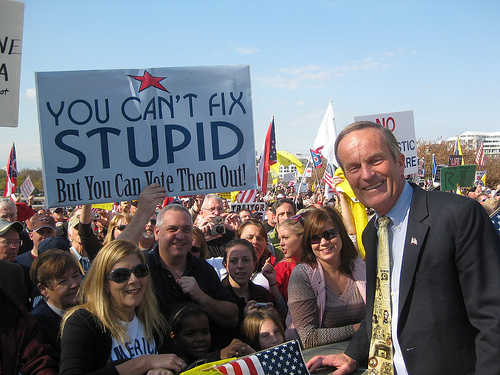
Rep. Akin and his fans.

Pervasive media bias against them has the added affect of making Republicans and conservatives both paranoid and less likely to perceive their own flaws. In this it is like racism: that black Americans know that elements of society refuse to treat them fairly makes it difficult for them to assess their own accountability when they fail. Given the opportunity to blame failure on ourselves or others, most of us are inclined to choose the latter: psychologists call it the fundamental attribution error. That tendency, however, undermines our ability to evaluate areas where we need to improve, and to improve them.

The news media’s leftward bias warps public opinion, tilts elections and distorts public policy. A few candid  journalists acknowledge this, like ABC’s Jake Tapper, who opined to Laura Ingraham yesterday that the media “helped tilt the scales” against Hillary and John McCain in 2008, saying that “Sometimes I saw with story selection, magazine covers, photos picked, [the] campaign narrative, that it wasn’t always the fairest coverage.” Weasel words for unethical media bias, true, but for a member in good standing of the liberal Beltway media like Tapper, an admirable confession. This is justly frustrating to conservatives, but they can’t let it drive them stupid, for this is the Catch 22 of all pervasive bias. If a group blames everything on bias, it begins to make the bias look justified.

Hypervocal, a snazzy blog that delves into such matters and much else, has an excellent analysis of a current example of this phenomenon, as conservatives complain that the news media is ignoring a juicy Minnesota scandal involving a gay Democrat while overplaying Rep. Todd Akin’s self-outing as an ignorant fool regarding rape, abortion, and female biology. This is such a regular refrain now any time an embarrassing event occurs involving a Republican that it is both predictable and laughable, and it is always unseemly. Continue reading

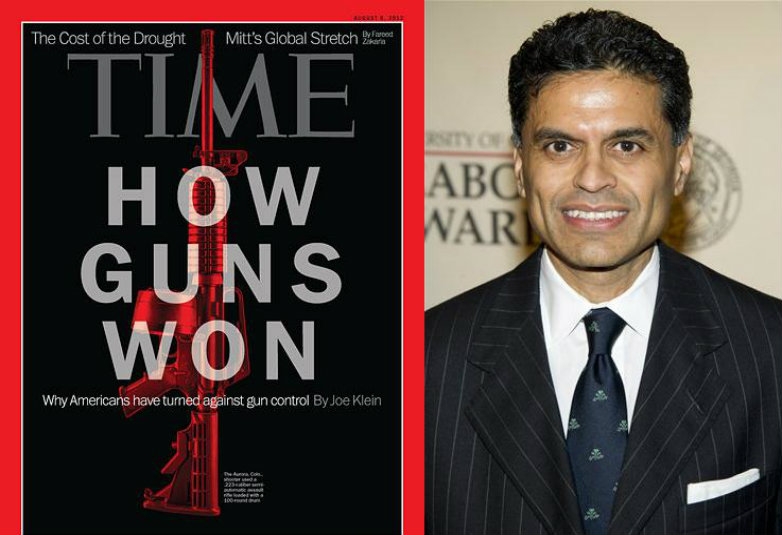
Of Fareed Zakaria, Scraping, Plagiarism and Hypocrisy

Is it “Oops!”, “Damn!” or “Better luck next time”?

I once had a dear friend in the DC theater community who committed an industry taboo when he mounted a play before, rather than after, obtaining the performing rights. His company was in the red, and his intent was to get some advance sales to pay the licensing fees that he otherwise couldn’t afford. It was a desperate, foolish scheme and an unethical one, as he readily admitted, and my friend paid dearly for it, as he was fired as the head of the theater company he had founded, and rendered a pariah in the community. What always infuriated him, however, was the instant condemnation and pious pronouncements he received from his peers in the theater world. “I know for a fact that everyone of them either would have done the same thing or had done the same thing, or worse, to keep their theaters running,” he told me.  “I was wrong and I know I was wrong, but for them to act as if I am some kind of a monster when I know they are really thinking, ‘Yikes! I better be more careful, that could have been me!’ is driving me crazy.”

I wonder if disgraced CNN host and Time writer Fareed Zakaria is thinking the same thing as his colleagues in the news media and assorted web commentators are describing him as a plagiarist and an untrustworthy fraud in the wake of his suspension for lifting a paragraph from another writer’s work  and putting it in his own Time essay without attribution. After the parallel passages were flagged on the conservative website Newsbusters (you didn’t think he would have been outed by a liberal site, did you—or that Newsbusters would have been looking for plagiarism from a rightward  journalist?) both Time and CNN suspended Zakaria indefinitely.

This was the appropriate response. Zakaria is an opinion journalist, or a pundit: the idea that he is surreptitiously cribbing from others undermines his credibility substantially and perhaps fatally. That is not an entirely fair description of what Zakaria did, however.  What he engaged in was “scraping,”  the web-age technique where an author cuts and pastes a passage or more from another work and uses it as the foundation for a portion of a supposedly original article. When the passage in question is substantive, contains the ideas and conclusions of the author  whose work is being scraped, or is the product of another writer’s research, that is indeed plagiarism. When the passage being scraped is something the borrowing author could have written himself, however, it is more accurately described as lazy. It is still wrong, but it does not necessarily rise to the level of intellectual theft that can reasonably justify calling the author untrustworthy. Continue reading