An Ethics Movie Review: “The Mule”

I was not eager to see “The Mule,” for many reasons. Stories in which the protagonist is a drug dealer don’t interest me at all; I avoided “Breaking Bad” and “Weeds” for the same reason. The popular culture, especially Hollywood, played a major role in breaking down society’s consensus disapproval of recreational drug use, and I hope they are proud of all the harm they have caused, and the greater harm yet to come.

Then there is the fact that seeing Clint Eastwood looking like the Cryptkeeper (from HBO’s “Tales of the Crypt”) depresses me. I remember Clint from his “Rawhide” days, and seeing his ruined beauty makes me feel like I’m watching the villain rot at the end of “Indiana Jones and the Last Crusade” when he “chooses poorly,” but for real. I admired Cary Grant’s decision to stop making movies when he began to stop looking like Cary Grant, and Marlene Dietrich’s determination not to appear in public so that people would remember her as one of Hollywood’s great beauties, and not as an old lady.

But as often in the case for me, having limited options of films to watch while stuck in in a hotel made Eastwood’s latest directorial and performing effort the best of a bad group of entertainment choices. The film is based on the  true story of a ninety-year-old man (Clint isn’t quite that old, but he looks it) who became a drug mule, transporting  cocaine for a  Mexican drug cartel. The film has an excellent supporting cast including Bradley Cooper, Laurence Fishburne, Dianne Wiest and Andy Garcia. (who also looks like hell), though none of them have much to do except be props for Clint’s star turn.

To do as little spoiling as possible, I’ll just say that the story involves an aging—aged—narcissist who has neglected his family outrageously, falls into a lucrative gig transporting drugs because he loves to drive, has never had a ticket, and is unlikely to attract attention. Then he suddenly decides to make the needs of his family a priority over work for the first time in his life, getting him arrested and almost killed.

Clint still has his screen presence and charm, which is fortunate, because the central character, Earl Stone, is a selfish jerk. His toxic personal habits don’t seem so bad when the victims are  drug smugglers, but when, early in the movie, he skips his daughter’s wedding without warning because he’d rather be at a sales convention partying with his colleagues, it is hard to care what happens to him.

We quickly learn that this betrayal was characteristic of Earl, and that he rationalizes them all, arguing that he was absent from his family to provide for them, and is blameless. It’s clearly a lie: his family bores him, and he does exactly what he wants to do, always. Sometimes Earl helps people and is randomly kind, as when we see him pause in one of his drug runs to help a couple stranded on the road. Other times, he doesn’t give a damn.

When a family argument breaks out as he attempts to attend his grand-daughter’s bridal shower, a guest overhears that Earl has lost his home and business (that’s really why he showed up at his granddaughter’s place—that and the fact that she was the only family member still on speaking terms with him) and gives him a phone number. These people will pay him well just for driving, Earl is told. Continue reading

Comment Of The Day: “Saturday Ethics Warm-Up, 10/12/2019…” Item #2, Dan Hudson’s Paternity Leave

“Wait, What??? YOU’RE SKIPPING THE GAME THAT WILL DECIDE THE PENNANT???”

In a post sparked by the the current National League Championship Series (boy, I hope I don’t have to add that the sport is baseball) I had written in part,

“The ethical thing would have been [for Washington Nationals relief pitcher Daniel Hudson, the team’s closer] to pass on the opportunity to take the game off. The Nationals major weakness is a terrible bullpen, and Hudson is one of the few reliable  relief pitchers on the team. As it happened, the Nats won a close game, but that’s just moral luck. They might have lost because of his absence. That loss might have cost the team its chance to go to the World Series. Millions of dollars would be lost to the franchise that pays Hudson seven figures to improve its fortunes. The careers, lives and family fortunes of his team mates would be affected; the jobs and income of hundreds of merchants and others who rely on the success or failure of the team would have been put at risk. How could anyone argue that the emotional support Hudson would lend his wife during childbirth outweighs all of that, or constitutes a superior ethical obligation?”

Who? Why reader Tim Hayes, that’s who, who not only argued thusly, but did so at a Comment of the Day level, and then responded to my subsequent challenges with equally excellent responses. This gave him the Ethics Alarms equivalent of a three home-run game, and I’m going honor him with the whole sequence.

Here is Ethics Alarms slugger Tim Hayes‘s three-dinger Comment of the Day, on Item #2 in “Saturday Ethics Warm-Up, 10/12/2019…” :

Counter-argument on the Hudson situation – For the Nationals to have placed themselves in a position where a single player taking advantage of a promised benefit at his job (the paternity leave) created a realistic chance of them losing the game (due to their lack of hiring sufficient healthy talent into their bullpen) is inherently unethical as an organization, because it creates a situation where all the groups you mentioned can be placed in dire straits by what happens to a single performer. Attaching the consequences for the team’s unethical staffing decision to Hudson’s personal behavior is unfair; The team did not choose to get him to negotiate away the benefit he invoked (which, for the appropriate compensation, they presumably could have), and was therefore at least aware of the possibility that something outside their control could sideline Hudson. That it was his wife giving birth, and not Hudson being hit by a self-driving car, which resulted in their not having access to him, was merely a result of luck (pregnancy and births being both notoriously difficult to plan, and the Nationals presence in the playoffs being, from the admittedly little I understand of baseball, something which was unexpected to say the least). Continue reading

Saturday Ethics Warm-Up, 10/12/2019: “If An Ethics Blog Expounds And Nobody Reads It…”


Like that proverbial tree falling alone in the forest...

Epic lack of interest in Ethics Alarms today…

Oh, well…

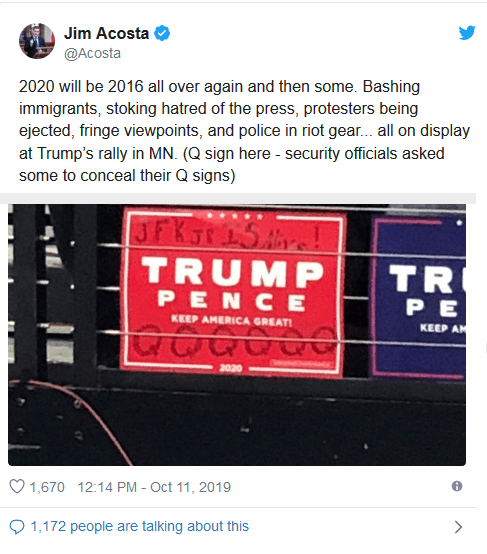
1 . Today’s “Nah, there’s no mainstream media bias!” note for the day. Here’s that objective, professional, fair CNN reporter Jim Acosta (I’m fooling: he’s really a toxic, partisan, grandstanding hack) tweeting about the Presidents rally in Minneapolis:

How can anyone who tweets such offal continue to be employed as a White House correspondent? How can a news network that employs such a biased, dishonest jerkbe taken seriously?

The Q sign reference is especially egregious. “QAnon” is a weird conspiracy theory-driven sect, and the fact that some attendees at a Trump rally seem to support the nonsense—which is not worth explicating—proves nothing at all. But the rest of Acosta’s tweet is embarrassing too: the Trump campaigns have never bashed immigrants, just illegal immigrants, who ought to be bashed; hated of the press is stoked by the conduct of unethical journalists like Jim Acosta, and disruptive protesters are properly ejected from the political rallies of candidates from both parties. Continue reading

Hypocritical Or Just Responsible And Competent? Hollywood’s LGBTQ Problem


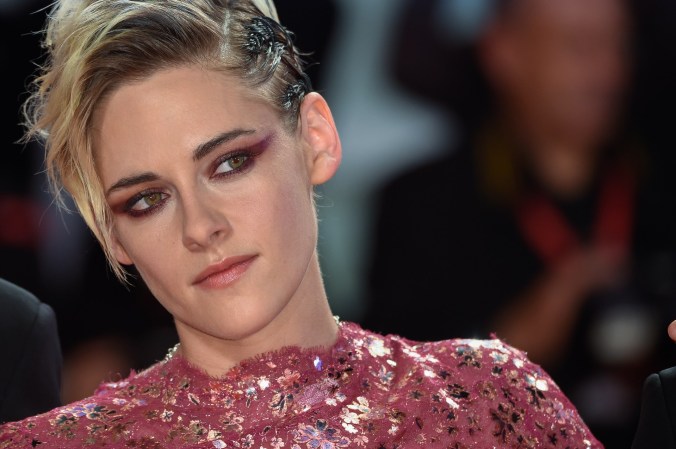
Before it went down the tubes, the leftist commentary website ThinkProgress posted a typical piece (that is, so crippled by bias and a progressive agenda that it was useless as advocacy unless the reader already agreed with it) bemoaning the fate of LGBTQ performers in Hollywood like Kristen Stewart. Stewart, once a rising young star with the “Twilight” Saga films, now approaching 30 without a clear career path.

You’ll get the article’s point of view from the kick-off:

“In an interview with Harper’s Bazaar UK, actor Kristen Stewart, who has been romantically linked to model Stella Maxwell since 2017, said, “I have fully been told, ‘If you just like do yourself a favor, and don’t go out holding your girlfriend’s hand in public, you might get a Marvel movie.’ I don’t want to work with people like that.” Stewart has said publicly she does not identify as bisexual or lesbian, and doesn’t want to choose a label for her sexuality. In the same interview she added, “I was informed by an old school mentality, which is — you want to preserve your career and your success and your productivity, and there are people in the world who don’t like you, and they don’t like that you date girls, and they don’t like that you don’t identify as a quote unquote ‘lesbian’, but you also don’t identify as a quote unquote ‘heterosexual’. And people like to know stuff, so what the fuck are you?’”

Although it may, at times, appear as though LGBTQ representation and participation in Hollywood has achieved some semblance of parity, Stewart’s experience is far from unique. Several young, openly LGBTQ actors such as Ellen Page and Ezra Miller have talked about how their gender and sexuality have affected how people talk to them about their careers.”

Well, of course it does. Continue reading

Ethics And The Joker’s Moustache

“The Joker,” opening this week and presenting Joaquin Phoenix’s portrayal of Batman’s arch-enemy as fitting the classic mass-shooter profile, has provoked all sorts of ethics- related debates. Is it responsible to release a film that may risk triggering the psychopathic loaners with access to guns we all know lurk in the shadows? Is the studio risking another Aurora-style theater shooting? Should such films be boycotted? Regulated?

These debates, which are retreads of the same old refrains the nation has been tortured by since dime novels through Warner Brothers gangster movies, EC comics, “The Untouchables” TV series, the Legion of Decency’s reign, Sam Peckinpah films and “A Clockwork Orange,” are all appeals to censorship using “Think of the Children!” rationalizations, and are essentially attacks on free speech. The contrived debate is alarming but not difficult to call: the would-be censors are wrong, motivated by emotion, and that’s that.

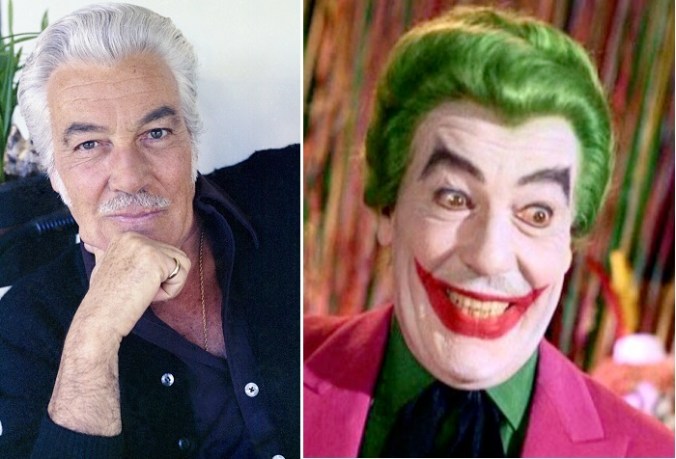
No, the really interesting ethics debate the new movie has revived is another old one: Was it ethical for actor Cesar Romero to keep his moustache when he played the Joker?

Cesar  Romero  (February 15, 1907 – January 1, 1994) is now largely forgotten, but he was a familiar presence in films, radio, and television for almost 60 years. Sort of a Grade B Riccardo Montalban, Romero had a rather narrow range, with his portrayal of dashing Latin lovers, historical figures in costume dramas, and characters in light  comedies all looking and behaving similarly. Romero’s trademark was his moustache, especially in the post-Errol Flynn era when leading men seldom wore them.

When the 1966 camp TV show Batman became a brief sensation in 1966, the casting of Romero as the Joker was a shock. He had never played any role remotely like it, nor was broad, silly comedy his typical milieu. Most shocking of all, when the Joker finally made his appearance on the show  it was obvious that Romero hadn’t shaved his upper lip. Reportedly the actor refused to eliminate  his moustache for the role, and so the supervillain’s white face makeup was thickly smeared over it throughout the series’ three-year run and for Romero’s co-starring appearance in the 1966 film. Continue reading

‘Thank God It’s Friday’ Ethics Dump, 10/4/2019: SCOTUS, Impeachment And Cannibalism…

Hi!

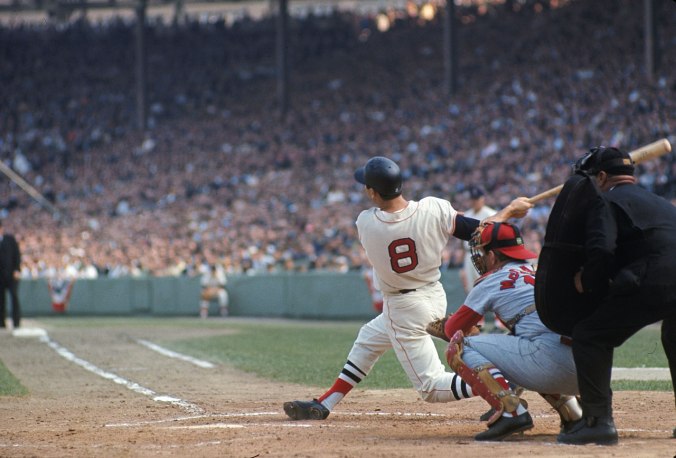
Usually, October might be my favorite month…New England foliage, the best of baseball, my sister’s birthday, the Monster Mash…

1. I hate this stuff. A woman  confronted Rep. Ocasio-Cortez during a town hall in Corona, Queens this week and ranted that  the Green New Deal wasn’t enough to save the world. She declared instead that “we must eat the babies” to stop climate change. “We got to start eating babies! We don’t have enough time! … We have to get rid of the babies! … We need to eat the babies!,” she exclaimed. Then she took off her coat to reveal a T-shirt bearing the phrase: “Save the planet, eat the children.”

The Representative  calmly responded that we have “more than a few months” to solve the climate crisis (“though we do need to hit net-zero in a few years”) and that “we all need to understand that there are a lot of solutions that we have.” Naturally, Tucker Carlson criticized her for not emphatically rejecting the woman’s cannibalism proposal.

The woman was a plant, and the disruption was a hoax. A right-wing PAC started by the late Lyndon LaRouche confessed, saying, “It was us. Malthusianism isn’t new, Jonathan Swift knew that. Sometimes, only satire works.”

Works at what? Interfering with legitimate civic discourse?

2. No, the latest SCOTUS abortion cases don’t pose a threat to abortion rights. The hysteria you may be hearing is more anti-Kavanaugh hype. The cases involve Louisiana’s law requiring abortion clinics to have admitting privileges at a hospital within 30 miles.  The Supreme Court granted certiorari to June Medical Services v. Gee, Secretary of the Louisiana Department of Health and Gee v. June Medical Services the U.S. after the 5th Circuit Court of Appeals ruled that the Louisiana law was permissible. However, in 2016 the Supreme Court struck down a nearly identical Texas law by a vote of 5-3. The theory in Louisiana is that the law there will not have the same restrictive impact as in Texas.

Even if the Fifth Circuit’s ruling stands, the cases are only tangentially related to Roe v. Wade. Continue reading

Saturday Night Ethics Fever, 9/21/2019: Crazy Stuff

1. A simple, factual, ethical rebuttal to Beto O’Rourke, who panders to the anti-gun Democratic base by saying that he’ll confiscate the weapons he thinks we don’t “need.” Lauren Boebert, who with her husband owns local restaurant Shooters Grill, where she and a lot of the staff  open carry a loaded firearm,  confronted  O’Rourke at a town hall in Aurora Colorado. “I was one of the gun-owning Americans who heard you speak regarding your ‘Hell yes, I’m going to take your AR-15s and AK-47s.’ Well, I’m here to say, ‘Hell no, you’re not!”

She was, of course, correct, just as Beto was grandstanding to the ignorant and fearful, in deliberate defiance of the Constitution.

To his credit, Beto tried to control the rabid anti-Second Amendment fanatics in his crowd  who tried to shout Boebert down, as she continued,  “We all have these stories. We all have the experiences. I was living in Aurora during Columbine. I had just recently moved when the Aurora shootings happened. Yet I have very close ties here. Yet all of those people were there defenseless.”

“They had no way to defend themselves against a crazed shooter, so I want to know how you intend to legislate the hearts of men and leave American citizens like myself, American mothers,” Boebert said. above the  abuse from the crowd. “I have four children. I’m 5 foot zero, one hundred pounds, and cannot really defend myself with a fist.”

Then she told a heckler near her that  she didn’t have her AR-15 with her, but  was carrying her Glock. “Well, you shouldn’t have that,” the man said.

Wrong again. It’s not his call, nor his business, whether she has a pistol or not.

2. From the wasteful and pointless protests files: “Hundreds of thousands” of 20-somethings and kids took part in a global protest against “inaction on climate change.” What do they know about climate change? Only what they have been told by agenda- driven activists, teachers and politicians, almost all of them without genuine scientific comprehension of the complexities, vagaries and uncertainty of the topic themselves. Are hundreds of thousands of people who don’t really know what they are talking about more persuasive than, say, one? Should they be?

No. Leading these innocents to believe otherwise is a cruel joke. Margot Guillen of Harvest Collegiate High School, told Yahoo News she was there to send a message, saying, “By protesting peacefully, it shows how committed our generation is to making a change and showing that we know what’s happening and we need to stop it.” They don’t know what’s happening, though, and they don’t know how to stop “it,” in part because they don’t know what “it” is, when “it” will occur, what the extent of “it” will be, and even whether “it,” whatever “it” is, will occur at all.

Good protest.

Typical. Continue reading

Afternoon Ethics Flotsam And Jetsam, 9/16/2019: Ethics Movies, Clowns And Harvard Professors

…As I prep for a CLE road trip…

1. I finally saw “Doubt,” the film adaptation of the John Patrick Shanley stage drama about a parish priest suspected of child abuse. It’s an ethics film, and unlike many ethics films, made a profit at the box office.

I had seen the play on stage, and found it didactic and contrived; the film did not, I’m sure because the cast was so excellent. Meryl Streep, Viola Davis and Phillip Seymour Hoffman as the priest were all wonderful, especially Davis, whose single scene in which she runs down a series of desperate arguments and rationalizations to justify allowing her son to be molested—maybe—is an ethics cornucopia. Unlike the stage production I saw, the movie benefits by having its protagonists appear less sympathetic than its apparent villain.

This goes on the ethics movie list, which is due for an update.

2.  Yet another ethics movie of more recent vintage is 2019’s “The Challenger Disaster,” a fictionalized recounting of how the decision was made to allow the doomed space shuttle to launch despite the warnings of Morton Thiokol engineers.  I wrote about this depressing ethics case study here , in a tribute to the primary Cassandra in the tragedy, Roger Boisjoly, and here,  about his troubled colleague, Bob Ebeling. The film’s hero appears to be an amalgam of the two. Here is an excerpt from a review on The Engineering Ethics Blog:

Even if you are pretty familiar with the basics of the story, as I was, the film is almost agonizing to watch as the launch time draws closer….The focus is always on Adam [the fictional hybrid of the engineers opposing the launch]: his belief going in that the truth is always a sufficient argument (it’s not, as it turns out), his doubts that he’s done enough to stop the launch, and his retrospective descriptions of what went on in the hours leading up to the launch…. the generally underlit atmosphere symbolizes Adam’s darkening mood as the critical conference call comes and goes, and the decision is made to launch. After Adam drives home that evening, he just sits out in the driveway in his car until his wife comes and gets into the seat beside him. …Later, during the  hearings that Adam and his fellow engineers attend, they come forward out of the audience and interrupt the proceedings after they hear a Morton-Thiokol manager lie about his knowledge of the seal problem. After the hearing, a sympathetic commission member finds Adam and reassures him that there are whistleblowing laws to protect him from repercussions of his testimony.

While it is never good to kick a man while he is down, I wish the film had taken time to show in more detail the intensity of the ostracism that forced the real-life Boisjoly to resign from Morton-Thiokol after his participation in the hearings made him persona non grata at work. … Boisjoly made a new career out of giving talks to engineering students about his experiences. …For a complex, historically accurate, and thought-provoking take on the Challenger disaster, I cannot think of a better medium than “The Challenger Disaster”  for conveying the seriousness of the emotion-laden decisions that have to be made at critical times. It is not a fun movie, but it’s a good one. And I hope it does well in video-on-demand release, because engineers need to see it.

Also lawyers, doctors, corporate executives, military officers, government officials, journalists, students… Continue reading

The Division Of Conscience And Religious Freedom Vs. Basic Workplace Ethics [UPDATED]

In May, the Trump administration issued a new rule  that gives health care workers the power to refuse to provide services their religion disapproves of, such as abortion, sterilization or assisted suicide. A religious conviction isn’t even essential to trigger the rule; a matter of conscience is enough. The measure essentially revived a Bush rule that the Obama administration reversed.

It’s a bad rule, and an unethical rule, as Ethics Alarms has held before. If you can’t perform all the duties of a job, then don’t take the job. If an employee can get his or her employer to agree that he or she is exempt from certain duties, that’s freedom of contract. Fine.  The Trump rule, however, like the Bush rule before it, breaches a basic principle of the workplace, and common sense as well. It also leads inevitably to messes like this one:

The federal government has accused  the University of Vermont Medical Center in Burlington, Vermont of violating  federal law by forcing a nurse to participate in an abortion despite her objections. The hospital denies it.

The nurse, who is Catholic, filed a complaint with the Office for Civil Rights. It  alleges, that she was misled by supervisors to believe she was assisting in a procedure scheduled after a miscarriage. “After [she] confirmed that she was, in fact, being assigned to an abortion, [her employer] refused her request that other equally qualified and available personnel take her place,” the complaint reads. She then participated in the procedure and “has been haunted by nightmares ever since.”

Now the Office for Civil Rights at the Department of Health and Human Services has filed a notice of violation against the hospital, the  first since the Division of Conscience and Religious Freedom was added to HHS in  2018. Continue reading

Sexual Harassment, Cancellation Culture, Anonymous Accusers, And Placido Domingo

A report last week revealed that nine women accuse towering opera figure Placido Domingo of sexual harassment.  None of the accusations have been investiaged or substantiated, and only one of them isn’t anonymous. Yet two American institutions, the Philadelphia Orchestra and the San Francisco Opera, immediately canceled their upcoming concerts with him, giving the now-familiar “safe environments” explanation. None of. Domingo’s many upcoming scheduled performances in Europe were canceled, however, as sponsors took what the New York Times calls  “a wait-and-see approach,” or what used to be known in this country as “Let’s not punish someone based on unsubstantiated  accusations alone.” Or fairness. Due process. The Golden Rule.

There are countervailing factors pulling every which way. As I understand it, #MeToo  and “Time’s Up” insists that female accusers must be believed, unless the accused is the black, Democratic Party’s Lieutenant Governor of Virginia, or the harassment is caught on camera repeatedly, as in the case of the Democratic Party front-runner for President. In the arts, these allegations have had mixed effect. Conductor James Levine has not performed in public since he was fired by the Metropolitan Opera last year after accusations of sexually abusive and harassing conduct were substantiated in an investigation, but when Pixar chief and creative muse John Lasseter was fired for being a serial hugger (rather like that Democratic Party front-runner) he was rapidly snapped up by a rival studio that gave him as much power and more money. Go figure.

There is the anonymous factor: it is my long held position that an anonymous accusation relating to the workplace should be regarded as no accusation at all, meaning that there has been one allegation of sexual harassment against Domingo. An accused individual cannot address claims when he doesn’t know their source or facts. I have been the target of false anonymous accusations—not of harassment—in my career, and as a manager in various businesses and associations, I told staff that unless they were willing to go on the record with an accusation of wrongdoing, I didn’t want to hear it. It is too easy to destroy careers and reputations with false accusations with no accountability attached.

The other issue is the multiple accusation factor. In sexual abuse and harassment, there are no one-time offenders unless there has been a massive miscommunication. The typical scenario is that a single accusation triggers several, often many, more with near identical facts. This is why I did not believe Anita Hill and Dr. Blasey-Ford, and why I did believe Bill Cosby’s many accusers.

Timing is also important. Ancient accusations of sexual misconduct—I would say anything more than five years old is dubious—arriving after memories have faded, evidence has vanished and seemingly timed to do maximum damage to the accused should be treated with skepticism and a presumption of  bad will, especially when the accused is a public figure.

And yet… Continue reading