Morning Ethics Warm-Up: 6/26/17

1. I am puzzled that no respected journalism source—assuming arguendo that there is one—hasn’t taken on the New York Times’ alleged list of President Trump’s “lies,” which was in my Sunday Times and released on-line earlier. I will do it today, but it shouldn’t fall to me, or other similarly obscure analysts. Why, for example, hasn’t the Washington Post taken this golden opportunity to prove how biased, dishonest and incompetent its rival is? Because, you see, the list is disgraceful, and smoking gun evidence of the Times’ abdication of its duty to its readers, except its own perceived duty to give them around the clock Trump-bashing.

The other thing I’m puzzled about is why I continue to subscribe to the New York Times.

2. One possible reason: The Sunday Times is now a weekly collage of the various derangements, false narratives and  obsessions of the Left, and worth reading just to witness how 1) bias makes you stupid and 2) how unmoored to reality one can be and still be judged worthy of op-ed space. Here, for example, is “Black Deaths, American Lies” (the print title), a screed by Ibram X. Kendi, a professor of history at American University in Washington, D.C. (Disclosure: I was also a professor at American University. But I was an honest and apolitical one.)

The first line is, “Why are police officers rarely charged for taking black lives, and when they are, why do juries rarely convict?” This is deceit: an honest scholar wouldn’t have written it, and an ethical editor wouldn’t have allowed it to get into print. The sentence implies that officers are less rarely charged and convicted when they take white lives, and this is not true. In the print version, the article is headed by a touching photo of a street memorial to Mike Brown, whom we now know got himself shot. The Black Lives Matter narrative that Brown was murdered is still carried on by racist activists, ignorant members of the public, cynical politicians  and unethical figures like Kendi, who lend their authority to divisive falsehoods.  Kendi then focuses on the Philandro Castile shooting, as if its facts support his thesis. They don’t. First, the officer was charged, though he shouldn’t have been. Second, we have now seen the video, which clearly shows that after telling the officer that he had a gun, Castile reached into his pocket and began pulling out his wallet as the obviously panicked officer shouted at him not to pull out his gun. Just as the video proves that the officer was unfit to be a cop, it shows that he was in fear of his life and why. He could not be convicted of murder on that evidence. Never mind: The professor writes, Continue reading
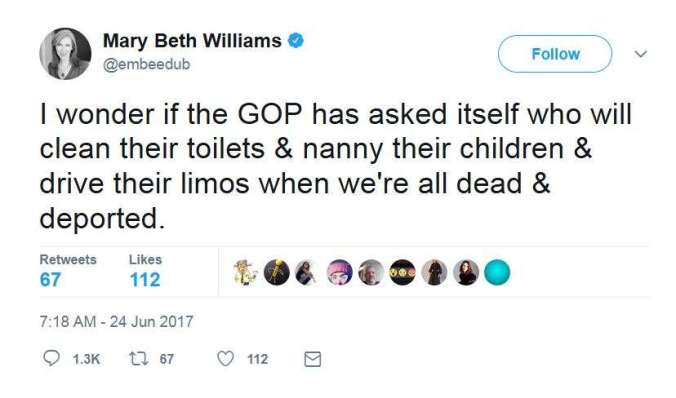
Now THAT’S An Unethical Tweet!

Let me count the ways…

1. The tweeter, a veteran Salon writer, assumes that nobody rationally supports enforcing the law unless they personally benefit from it. In other words, “Integrity? What’s that?”

2. Williams adopts the stereotype that Hispanics are all nannies, drivers and gardeners, and that this is their sole value to U.S. society.

Nice. Boy, if we didn’t have African Americans, where would we get our NBA stars, tap-dancers and banjo players?

3. Who’s advocating killing illegal immigrants?

4. And my favorite: Williams, who is as Hispanic as I am….

….refers to the group risking deportation as “we” to cover her condescension, or try to. Dishonest and cowardly. Also stupid.

The tweet is, however, accurately representative of the quality of thought being used by open-border advocates to justify the unjustifiable.

_______________

Pointer: Instapundit

Sought: An Ethical Reason Why This Professor Should Not Be Fired Immediately, And Never Hired For A Teaching Position Again, Anywhere


Meanwhile, for Trinity College, the countdown has started.

After Professor Johnny Eric Williams, associate professor of sociology at Trinity College in Hartford, approvingly posted a Medium article titled “Let Them Fucking Die” on Facebook, he went on to endorse the article’s thesis ( potential rescuers like those who helped Rep. Steve Scalise should let imperiled white people die as a form of combating white supremacy) in his own Facebook posts:

The Medium article concluded with this advice regarding one’s responsibilities as a citizen and a human being when a white person is in mortal peril… Continue reading

Morning Ethics Warm-Up: 6/22/17

1.  I’m trying to get this up while I prepare for a new legal ethics seminar, teaming once again with the brilliant D.C. actor Paul Morella who has toured the country in the Clarence Darrow one-man-show he and I collaborated on more than a decade ago, using Darrow’s career and courtroom oratory to analyze modern legal ethics.  Readers here have encountered a lot of those Darrow-related discussions already. For once, I’m grateful most lawyers don’t frequent this blog.

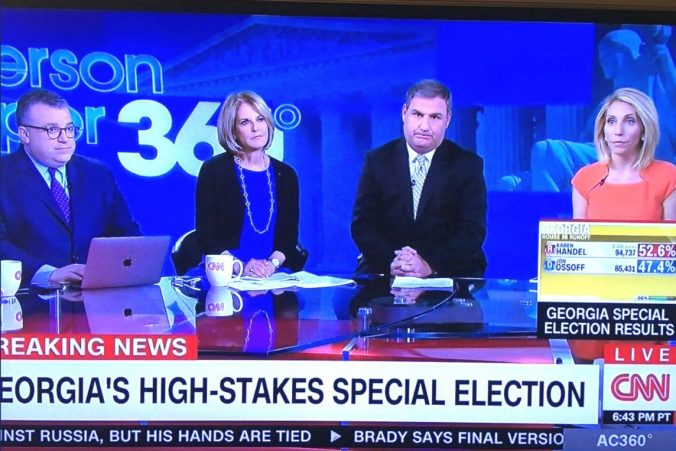
2. This now viral photo of the faces of CNN’s talking heads and analysts at the moment they realized that the Democrats had lost the Georgia Sixth District special House election that was hyped to be the beginning of a surge to the Left rejecting Donald Trump…

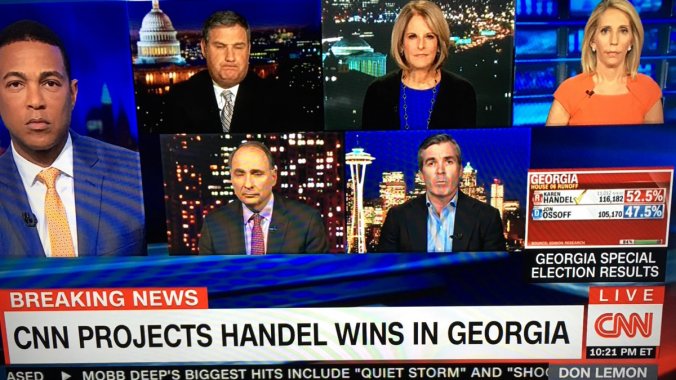
…and this one…

…are more than just gags. They are smoking gun evidence of the stunning lack of professionalism in journalism, and especially CNN. If there was any sensitivity or commitment to ethics on that set or in that production chain of command, every one of these arrogant hacks would have been told, “I want poker faces up there at all times. Objective and fair news reporting includes body language and facial expressions. Your attitudes warp your reporting. If anything about your demeanor betrays your personal preferences or political biases, you’re getting suspended. Got that? This isn’t a cheerleading squad.

3.  This warrants its own post, but today will be a squeeze, so I’ll focus on the astounding chutzpah of  that race’s loser here and now. Losing Georgia Six Democratic candidate Jon Ossoff was interviewed by NPR’s Rachel Martin, and this exchange resulted: Continue reading

Illegal Immigrant Ethics Do’s And Don’ts

DON’T do this:

A customer’s cell phone video caught  a  7-Eleven clerk on Tampa, Florida screaming at a customer and asking about his immigration status after the customer used the Spanish word for ‘green’ to ask the clerk for a specific brand of cigarettes. The clerk demanded Hernandez speak English, and is is heard saying, “Are you here legally? Do you have papers? Do you have papers?”

This isn’t the clerk’s job, and if the company has not directed that all customers should not be treated with dignity, courtesy and respect, no employee should be going free-lance ICE on anyone.

A spokesman for the 7-11 owner  wrote, “Every customer is important. The statements made by the sales associate were inappropriate and offensive. We are investigating the matter and will ensure it is handled appropriately.”

“Appropriately” means firing the clerk. In addition to acting ultra vires, the clerk is also making the store unpleasant and unwelcoming for other customers, risking an escalating confrontation, and being a jerk while representing the enterprise. Wrong, wrong, and wrong.

However…

Continue reading

California “Ethics”

California is not only rapidly exiting mainstream U.S. culture, it is forging its own distorted and unethical version of right and wrong.

Three alarming examples:

1. Forging ahead with single payer, and reality be damned.

The Sacramento Bee  pointed out that by replacing current state-run health programs with a single-payer system, the state would still need to come up with an additional $200 billion annually.This year’s state budget in California is about $180 billion. Yes, implementing a single-payer health care system would require doubling California’s current tax burden.

Oh, never mind! The state Senate voted 23 to 14 this month in favor of SB 562, a single-payer proposal that would guarantee universal health care to all Californians. “What we did today was really approve the concept of a single-payer system in California,” declared state Senator Ricardo Lara following the vote.

No, what they did was reaffirm the fact that progressive cant refuses to yield in the face of cold, hard facts, math, reason and common sense. The cheerleading from the Left is mind-numbing. Writes the Nation: If health care is a right—and it is—the only honest response to the current crisis is the single-payer “Medicare for All” reform that would bring the United States in line with humane and responsible countries worldwide.”

Well, let’s see: health care is NOT a right except in Left-Wing Fantasyland, and all of those “humane and responsible countries” have crushing tax burdens, reduced liberty, economic instability, crushing debt and completely different values, priorities and responsibilities than those of the United States.

Ethics is only ethical when it is practical and practicable in the real world. The ethical response to the fact that single-payer doubles the state budget is to say, “Oh. Well, obviously we can’t do that, then. On to plan B.”

2. That minimum wage increase that Gov. Brown said was based on principle rather than economics? Yeah, about that…

Continue reading

Case Study In How When Ethics Fail And The Law Steps In, The Law Will Screw Things Up Beyond Repair

Like Title IX, like Obamacare, like so many well-intentioned laws and regulations designed to assist and protect vulnerable citizens or traditionally oppressed groups, the Americans with Disabilities Act (ADA) opened the door for abuse, absurd taxpayer costs, and unanticipated consequences. The ADA was rammed into law by activists compassion bullies who proclaimed that any attention to proportion and cost-benefit analysis was mean and heartless. Here is an example of what else came in that open door:

From the LA Times::

ADA lawsuits are now as common as sex-discrimination lawsuits, with more than 26,000 new claims filed against employers each year. The latest litigants have their sights on the most innovative segment of our domestic economy: e-commerce.In this trend, people sue businesses because their websites aren’t sufficiently accessible to the disabled — because the websites lack assistive technologies for the blind or hearing-impaired, say. It began in 2000, when Bank of America became the first entity to settle a web-accessibility lawsuit. Safeway and Charles Schwab soon followed suit. In 2008, Target paid $6 million to settle a class-action suit brought by the National Federation of the Blind, and nearly $4 million more to cover the plaintiffs’ attorney fees and other costs. More than 240 businesses across the country have been sued in federal court over website accessibility since the beginning of 2015. Similar litigation has been brought against universities on the grounds that the free online courses they offer aren’t captioned for deaf users, and against ride-sharing services because their smartphone apps lack text-to-speech capability for blind users.

…According to the demands of disabled users, in order for a website to be accessible, it must use fewer pictures, present text in a format that is compatible with text-reading software and employ design that allows for easy navigation. But the features that make a website more accessible for one disabled group are bound to be objectionable to another.

They may also conflict with other needs. Consider bank websites, which often employ timers that will shut down an online session for security reasons after a particular time period is exceeded. Such “timeouts” could present problems for some disabled users, but eliminating them in the interest of accessibility could impair security for all.

In the process of making a website accessible, questions invariably proliferate. Do certain color combinations violate the ADA because they confound the colorblind? Are certain layouts inaccessible if they’re confusing to users with a limited field of vision? Do the accessibility requirements apply only to the websites themselves, or do they also apply to Web content, such as advertising on a third party’s website? Will website hosts be responsible for the compliance of third-party sites? Must archived Web content be revised to comply? What about mobile apps? Do temporary technical bugs in an otherwise compliant website constitute a violation? What physical and mental conditions will require accommodation? So far, Web accessibility lawsuits have concerned the vision- and hearing-impaired, but future cases could be brought on behalf of plaintiffs diagnosed with dyslexia, ADD/ADHD, narcolepsy, cognitive impairments, paralysis and many other conditions.

The game is to sue deep pockets website owners and extort settlement pay-offs. That’s fine for the Bank of America, but not for, say, Ethics Alarms. This blog could be put out of business by such a lawsuit, and so could hundreds of thousands of others. Continue reading

The Comey Testimony, Part II

[Part I is here]

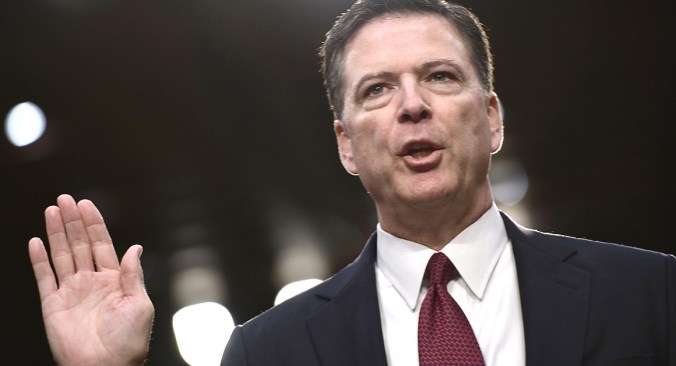
Now let’s look at some direct quotes from James Comey’s testimony: 

1. “Even though I was appointed to a ten-year term, which congress created in order to underscore the importance of the FBI being outside of politics and independent, I understood that I could be fired by a president for any reason or for no reason at all. And on May 9th, when I learned I had been fired for that reason, I immediately came home as a private citizen. But then the explanations, the shifting explanations, confused me and increasingly concerned me. They confused me because the president that I had had multiple conversations about my job, both before and after he took office, and he had repeatedly told me I was doing a great job and he hoped I would stay. And I had repeatedly assured him that I did intend to stay and serve out the remaining six years of my term. He told me repeatedly that he had talked to lots of people about me. Including our current attorney general. And had learned I was doing a great job. And that I was extremely well-liked by the FBI work force. So it confused me when I saw on television the president saying that he actually fired me because of the Russia investigation. And learned, again, from the media that he was telling privately other parties that my firing had relieved great pressure on the Russian investigation. I was also confused by the initial explanation that was offered publicly, that I was fired because of the decisions I had made during the election year. That didn’t make sense to me for a whole bunch of reasons, including the time and all the water that had gone under the bridge since those hard decisions had to be made. That didn’t make any sense to me. And although the law required no reason at all to fire an FBI director, the administration then chose to defame me and more importantly the FBI by saying that the organization was in disarray. That it was poorly led. That the workforce had lost confidence In its leader. Those were lies, plain and simple. And I am so sorry that the FBI workforce had to hear them and I’m so sorry the American people were told them. I worked every day at the FBI to help make that great organization better. As a help, because I did nothing alone at the FBI. There are no indispensable people at the FBI. The organization’s great strength is that its value and abilities run deep and wide. The FBI will be fine without me. The FBI’s mission will be relentlessly pursued by its people and that mission is to protect the American people and uphold the constitution of the United States. I will deeply miss being part of that mission, but this organization and its mission will go on long beyond me and long beyond any particular administration. I have a message before I close for the — for my former colleagues of the FBI. First I want the American people to know this truth. The FBI is honest. The FBI is strong. And the FBI is and always will be independent. And now to my former colleagues, If I may, I am so sorry I didn’t get the chance to say good bye to you properly. It was the honor of my life to serve beside you, to be part of the FBI family and I will miss it for the rest of my life. Thank you for standing watch, thank you for doing so much good for this country. Do that good as long as ever you can. And senators, I look forward to your questions.”

Observations: This entire statement is unworthy of the emphasis that has been placed on it by the wildly spinning news media, The key piece of information to frame the entire episode is  “I understood that I could be fired by a president for any reason or for no reason at all.” Comey also presumably understood that a sub-fact within that understanding is that he could be told some of the reasons he was fired, no reasons, or the reasons the President felt like talking about. He was told he was doing a great job and then fired? Welcome to the work force. Telling an employee that he is doing a great job when he isn’t may be good management, usually isn’t, but is still well within the range of management discretion, and certainly not illegal.

Comey said that he also concerned that the President was saying that firing “had relieved great pressure on the Russian investigation.” As we learn later, the President was not being targeted in that investigation, and we know that he regards it as a politically motivated effort to distract and derail his administration and its agenda. There was nothing sinister about the President’s desire that the investigation go away as quickly as possible. I would argue that he has an obligation to do whatever he can to speed it along. If he didn’t trust Comey’s judgment—and who would?—seeing his exit as a plus is reasonable. Naturally, Comey wouldn’t see it that way.

It is amazing to me that a fired employee saying that his superior’s assessment that his organization was in disarray, that he was a poor leader and that his staff had “lost confidence In its leader” is given any weight at all. What fired employee doesn’t think his firing is unjust and the criticism of him is unfair? Comey calls it a lie: how does he know what Trump had been told or heard? How does Comey know what his agents say behind his back?

Your opinion that someone’s negative opinion about you is wrong and based on erroneous information does not make that opinion a lie. As a lawyer, Comey should know that, and should not have thrown the word “lie” around to be misunderstood by people who don’t know what a lie is—that is, most of the public. Continue reading

Comment Of The Day (2): “Public Servant Ethics, Employment Ethics, Baseball Fan Ethics, And Senator John McCain”

The post about John McCain’s troubling performance during the Comey testimony inspired this thoughtful comment by dragin_dragon, a self-professed senior citizen (although I had no idea), on the related topic f officials knowing when age and/or infirmity create an ethical obligation to step down and retire in the interests of society. 

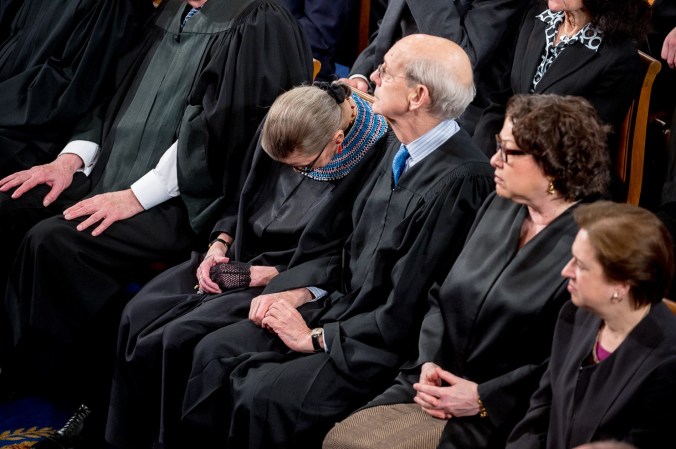
The confounding factor, and one that becomes a powerful rationalization for those who want to stay on in important positions long after their metaphorical pull-date, is that many of them can truthfully argue that their age-ravaged abilities are still better than most of the younger alternatives. Or, as my sister said during a discussion on this topic, “I’d rather have Justice Ginsberg with half her marbles than anyone Trump would nominate.”  I bet that’s how Justice Ginsberg is thinking too. Then there was that attorney with a drinking problem who everyone in the firm agreed was twice as good as any attorney in the firm when sober, and 50% better when drunk as a skunk.

Does that mean the firm should be satisfied if he’s drunk all the time? Isn’t this the same as the age diminished once-brilliant judge?

A topic for another time. Meanwhile, here is dragin_dragon’s Comment of the Day on the post, “Public Servant Ethics, Employment Ethics, Baseball Fan Ethics, And Senator John McCain”:

There comes a time in anyone’s life when it should be obvious that it is time to “Hang up the guns”. In my own life, I am but 71, and I am seeing numerous anomalies in my behavior (walking into a room and wondering why I am here) and in my rational thought (I suspect most who have read my comments sometimes have the same question). I am getting to where I lose debates to my wife on a regular basis (she’ll tell you I’ve always done that). More to the point, I am AWARE of the beginning deterioration. I am wondering if John McCain and Ruth Ginsberg are.

Another thought had occurred to me, however. After realizing that there was some slippage, I have refused an opportunity to run for Alderman and for Mayor of our little newly-incorporated city, because I honestly did not feel I would be able to do the job, either of them, justice, either mentally (what’d you say my name was again?) or physically. I’m winded some mornings after tying my shoe-laces. However, I am reasonably certain that narcissism plays little part in my personality. I suspect it is a BIG part of most elected officials (city, county, state, national) personalities. The idea being “Nobody but ME can do this job properly”, or in some cases, “Nobody but me can do this job, period, well or poorly.” Continue reading

From The “The Fish Rots From The Head Down” Files: The Uber CEO’s “Miami Letter”

You wonder why Uber has ethics problems?

This is why Uber has ethics problems.

Uber is being investigated by two law firms hired to make assessments regarding the corporate practices and culture at the ride-sharing giant, determine what created the toxic environment that led to sexism, sexual harassment, other unethical management conduct, and recommend remedial measures. Usually in such situations, the problem stems from unethical leadership. Guess what? Uber’s unethical conduct stems from not merely unethical leadership, but a leader with ethics alarms that have rotted into dust and rust.

The two law firms recently uncovered a 2013 e-mail sent to Uber’s staff by  CEO Travis Kalanick before a company outing in Miami.  Internally referred to as the “Miami letter,” this thing screams “What was he thinking?”, “Where were the lawyers?” and “This guy might get elected President of the United States!”

Here is the e-mail; I’m going to bold some important features: Continue reading