Case Study In How When Ethics Fail And The Law Steps In, The Law Will Screw Things Up Beyond Repair

Like Title IX, like Obamacare, like so many well-intentioned laws and regulations designed to assist and protect vulnerable citizens or traditionally oppressed groups, the Americans with Disabilities Act (ADA) opened the door for abuse, absurd taxpayer costs, and unanticipated consequences. The ADA was rammed into law by activists compassion bullies who proclaimed that any attention to proportion and cost-benefit analysis was mean and heartless. Here is an example of what else came in that open door:

From the LA Times::

ADA lawsuits are now as common as sex-discrimination lawsuits, with more than 26,000 new claims filed against employers each year. The latest litigants have their sights on the most innovative segment of our domestic economy: e-commerce.In this trend, people sue businesses because their websites aren’t sufficiently accessible to the disabled — because the websites lack assistive technologies for the blind or hearing-impaired, say. It began in 2000, when Bank of America became the first entity to settle a web-accessibility lawsuit. Safeway and Charles Schwab soon followed suit. In 2008, Target paid $6 million to settle a class-action suit brought by the National Federation of the Blind, and nearly $4 million more to cover the plaintiffs’ attorney fees and other costs. More than 240 businesses across the country have been sued in federal court over website accessibility since the beginning of 2015. Similar litigation has been brought against universities on the grounds that the free online courses they offer aren’t captioned for deaf users, and against ride-sharing services because their smartphone apps lack text-to-speech capability for blind users.

…According to the demands of disabled users, in order for a website to be accessible, it must use fewer pictures, present text in a format that is compatible with text-reading software and employ design that allows for easy navigation. But the features that make a website more accessible for one disabled group are bound to be objectionable to another.

They may also conflict with other needs. Consider bank websites, which often employ timers that will shut down an online session for security reasons after a particular time period is exceeded. Such “timeouts” could present problems for some disabled users, but eliminating them in the interest of accessibility could impair security for all.

In the process of making a website accessible, questions invariably proliferate. Do certain color combinations violate the ADA because they confound the colorblind? Are certain layouts inaccessible if they’re confusing to users with a limited field of vision? Do the accessibility requirements apply only to the websites themselves, or do they also apply to Web content, such as advertising on a third party’s website? Will website hosts be responsible for the compliance of third-party sites? Must archived Web content be revised to comply? What about mobile apps? Do temporary technical bugs in an otherwise compliant website constitute a violation? What physical and mental conditions will require accommodation? So far, Web accessibility lawsuits have concerned the vision- and hearing-impaired, but future cases could be brought on behalf of plaintiffs diagnosed with dyslexia, ADD/ADHD, narcolepsy, cognitive impairments, paralysis and many other conditions.

The game is to sue deep pockets website owners and extort settlement pay-offs. That’s fine for the Bank of America, but not for, say, Ethics Alarms. This blog could be put out of business by such a lawsuit, and so could hundreds of thousands of others. Continue reading
The Comey Testimony, Part II

[Part I is here]

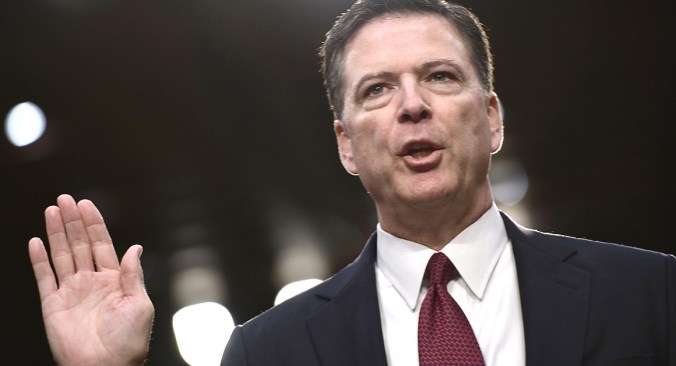
Now let’s look at some direct quotes from James Comey’s testimony: 

1. “Even though I was appointed to a ten-year term, which congress created in order to underscore the importance of the FBI being outside of politics and independent, I understood that I could be fired by a president for any reason or for no reason at all. And on May 9th, when I learned I had been fired for that reason, I immediately came home as a private citizen. But then the explanations, the shifting explanations, confused me and increasingly concerned me. They confused me because the president that I had had multiple conversations about my job, both before and after he took office, and he had repeatedly told me I was doing a great job and he hoped I would stay. And I had repeatedly assured him that I did intend to stay and serve out the remaining six years of my term. He told me repeatedly that he had talked to lots of people about me. Including our current attorney general. And had learned I was doing a great job. And that I was extremely well-liked by the FBI work force. So it confused me when I saw on television the president saying that he actually fired me because of the Russia investigation. And learned, again, from the media that he was telling privately other parties that my firing had relieved great pressure on the Russian investigation. I was also confused by the initial explanation that was offered publicly, that I was fired because of the decisions I had made during the election year. That didn’t make sense to me for a whole bunch of reasons, including the time and all the water that had gone under the bridge since those hard decisions had to be made. That didn’t make any sense to me. And although the law required no reason at all to fire an FBI director, the administration then chose to defame me and more importantly the FBI by saying that the organization was in disarray. That it was poorly led. That the workforce had lost confidence In its leader. Those were lies, plain and simple. And I am so sorry that the FBI workforce had to hear them and I’m so sorry the American people were told them. I worked every day at the FBI to help make that great organization better. As a help, because I did nothing alone at the FBI. There are no indispensable people at the FBI. The organization’s great strength is that its value and abilities run deep and wide. The FBI will be fine without me. The FBI’s mission will be relentlessly pursued by its people and that mission is to protect the American people and uphold the constitution of the United States. I will deeply miss being part of that mission, but this organization and its mission will go on long beyond me and long beyond any particular administration. I have a message before I close for the — for my former colleagues of the FBI. First I want the American people to know this truth. The FBI is honest. The FBI is strong. And the FBI is and always will be independent. And now to my former colleagues, If I may, I am so sorry I didn’t get the chance to say good bye to you properly. It was the honor of my life to serve beside you, to be part of the FBI family and I will miss it for the rest of my life. Thank you for standing watch, thank you for doing so much good for this country. Do that good as long as ever you can. And senators, I look forward to your questions.”

Observations: This entire statement is unworthy of the emphasis that has been placed on it by the wildly spinning news media, The key piece of information to frame the entire episode is  “I understood that I could be fired by a president for any reason or for no reason at all.” Comey also presumably understood that a sub-fact within that understanding is that he could be told some of the reasons he was fired, no reasons, or the reasons the President felt like talking about. He was told he was doing a great job and then fired? Welcome to the work force. Telling an employee that he is doing a great job when he isn’t may be good management, usually isn’t, but is still well within the range of management discretion, and certainly not illegal.

Comey said that he also concerned that the President was saying that firing “had relieved great pressure on the Russian investigation.” As we learn later, the President was not being targeted in that investigation, and we know that he regards it as a politically motivated effort to distract and derail his administration and its agenda. There was nothing sinister about the President’s desire that the investigation go away as quickly as possible. I would argue that he has an obligation to do whatever he can to speed it along. If he didn’t trust Comey’s judgment—and who would?—seeing his exit as a plus is reasonable. Naturally, Comey wouldn’t see it that way.

It is amazing to me that a fired employee saying that his superior’s assessment that his organization was in disarray, that he was a poor leader and that his staff had “lost confidence In its leader” is given any weight at all. What fired employee doesn’t think his firing is unjust and the criticism of him is unfair? Comey calls it a lie: how does he know what Trump had been told or heard? How does Comey know what his agents say behind his back?

Your opinion that someone’s negative opinion about you is wrong and based on erroneous information does not make that opinion a lie. As a lawyer, Comey should know that, and should not have thrown the word “lie” around to be misunderstood by people who don’t know what a lie is—that is, most of the public. Continue reading

Comment Of The Day (2): “Public Servant Ethics, Employment Ethics, Baseball Fan Ethics, And Senator John McCain”

The post about John McCain’s troubling performance during the Comey testimony inspired this thoughtful comment by dragin_dragon, a self-professed senior citizen (although I had no idea), on the related topic f officials knowing when age and/or infirmity create an ethical obligation to step down and retire in the interests of society. 

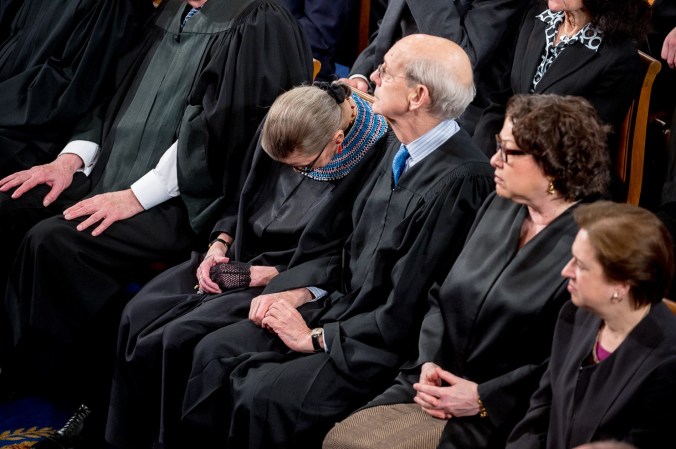
The confounding factor, and one that becomes a powerful rationalization for those who want to stay on in important positions long after their metaphorical pull-date, is that many of them can truthfully argue that their age-ravaged abilities are still better than most of the younger alternatives. Or, as my sister said during a discussion on this topic, “I’d rather have Justice Ginsberg with half her marbles than anyone Trump would nominate.”  I bet that’s how Justice Ginsberg is thinking too. Then there was that attorney with a drinking problem who everyone in the firm agreed was twice as good as any attorney in the firm when sober, and 50% better when drunk as a skunk.

Does that mean the firm should be satisfied if he’s drunk all the time? Isn’t this the same as the age diminished once-brilliant judge?

A topic for another time. Meanwhile, here is dragin_dragon’s Comment of the Day on the post, “Public Servant Ethics, Employment Ethics, Baseball Fan Ethics, And Senator John McCain”:

There comes a time in anyone’s life when it should be obvious that it is time to “Hang up the guns”. In my own life, I am but 71, and I am seeing numerous anomalies in my behavior (walking into a room and wondering why I am here) and in my rational thought (I suspect most who have read my comments sometimes have the same question). I am getting to where I lose debates to my wife on a regular basis (she’ll tell you I’ve always done that). More to the point, I am AWARE of the beginning deterioration. I am wondering if John McCain and Ruth Ginsberg are.

Another thought had occurred to me, however. After realizing that there was some slippage, I have refused an opportunity to run for Alderman and for Mayor of our little newly-incorporated city, because I honestly did not feel I would be able to do the job, either of them, justice, either mentally (what’d you say my name was again?) or physically. I’m winded some mornings after tying my shoe-laces. However, I am reasonably certain that narcissism plays little part in my personality. I suspect it is a BIG part of most elected officials (city, county, state, national) personalities. The idea being “Nobody but ME can do this job properly”, or in some cases, “Nobody but me can do this job, period, well or poorly.” Continue reading

From The “The Fish Rots From The Head Down” Files: The Uber CEO’s “Miami Letter”

You wonder why Uber has ethics problems?

This is why Uber has ethics problems.

Uber is being investigated by two law firms hired to make assessments regarding the corporate practices and culture at the ride-sharing giant, determine what created the toxic environment that led to sexism, sexual harassment, other unethical management conduct, and recommend remedial measures. Usually in such situations, the problem stems from unethical leadership. Guess what? Uber’s unethical conduct stems from not merely unethical leadership, but a leader with ethics alarms that have rotted into dust and rust.

The two law firms recently uncovered a 2013 e-mail sent to Uber’s staff by  CEO Travis Kalanick before a company outing in Miami.  Internally referred to as the “Miami letter,” this thing screams “What was he thinking?”, “Where were the lawyers?” and “This guy might get elected President of the United States!”

Here is the e-mail; I’m going to bold some important features: Continue reading

Morning Ethics Warm-Up: 6/10/17


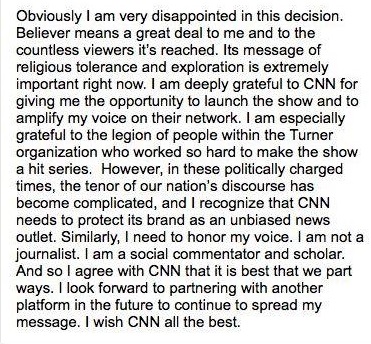
1. In the category of “Good!”, or maybe “Better late than never!” was the news that CNN, after a a full week of pondering, determined that maybe it wasn’t sufficiently professional for a host to call the President of the United States a “piece of shit,” or anyone a “piece of shit,” really, or use “shit”  under the CNN banner, so it fired “Believer” host Reza Aslan. I don’t know why CNN can’t figure out that an immediate firing sends the message that the organization has professional standards and enforces them, and the way CNN handled this says, “We were hoping this would blow over, but guess not.”

Aslan’s tweet after his hook raised other questions:

  • Wait, CNN is trying to be an unbiased new outlet???
  • Oh, is “piece of shit” how scholars express themselves now?
  • “I need to honor my voice” by being able to use vulgarity to express his measured views. Got it.
  • The “tenor” of discourse is entirely within the control of the speaker.
  • Why does CNN put people on the air who don’t understand or respect their professional obligations to the network or the audience?

2. Fox News’s Sean Hannity got web headlines yesterday by tweeting to Aslan: “I do not think you should be fired. You apologized.” Sean Hannity is really too dumb to be allowed out without a leash. His theory is that an apology magically returns everything to where it was before the conduct in question, as if there were no effects. This was serious breach of professionalism and responsibility showing the Aslan was too untrustworthy to be allowed to have his own TV show. It proved that he was a threat to CNN’s reputation (Crude News Network” is the current successor to “Clinton News Network,” and no organization can function if its announced policy is “Go ahead, do anything; as long as you apologize, your job is safe.” Continue reading

The Comey Testimony, Part I.

I have finally read the transcript, which you should do as well. By now I have also seen a lot of video clips. (James Comey really says, “Lordy!” Wow.)

First, some general observations, with more detailed comments to come in a subsequent post.

1. My earlier expressed opinion of James Comey when I defended him against conservative accusations that he was giving Hillary Clinton an undeserved break by not indicting her were revealed as too generous yesterday. I still believe he is honest and non-partisan. More than ever, I believe that he is untrustworthy. He was obviously in a difficult position—many, in fact—that he was not able to successfully manage, if anyone could have. However, his oft-repeated insistence that he (and his FBI) did not play politics was exposed as false, if not dishonest (a gracious interpretation of the sort that Comey denied the President in his bitter testimony.)

2. The fake Russia collusion narrative pushed by Hillary, Democrats and the news media to simultaneously excuse her loss and undermine the Trump Presidency was killed yesterday, but will wander around like a zombie for months if not years because Trump-haters will not have the integrity to admit they were wrong. Chris Matthews, a once astute and courageous liberal Democrat reporter who morphed into a partisan, knee-jerk progressive shill and anti-Republican scold as soon as he started getting paid by MSNBC, had a sudden flashback to his days of integrity when he pronounced yesterday,

“But the big story has always beenthe assumption of the critics of the president, of his pursuers, you might say, is that somewhere along the line in the last year, the president had something to do with colluding with the Russians. Something to do, a helping hand, encouraging them,feeding their desire, to affect the election in some way, some role they played, some conversation he had with Michael Flynn, or Paul Manafort, or somewhere. And yet what came apart this morning, was that theory, because in two regards the president said according to the written testimony of Mr. Comey, ‘go ahead and get anybody satellite to my operation and nail them, I’m with you on that,’ so that would mean Manafort, Carter Page, someone like that. And then he also came across today what was fascinating, Comey said that basically Flynn wasn’t central to the Russian investigation, that he was touching on it. That there was, of course, Flynn had an honest, we assume, wasn’t honest in his answer on the official forms that he had to fill out to become a national security head.”

But it only touched on that, it wasn’t really related to that. But he could be flipped for that, but in other words, they could flip him because they had him caught on something he dishonestly answered but he wasn’t central to the Russian thing, and I always assumed that Trump was afraid of was that he had said something to Flynn, and Flynn could be flipped on that. And Flynn would testify against the president that he had had some conversation with Flynn in terms of dealing with the Russians affirmatively. And if that’s the case, where’s the there there?”

There is no there there, and never has been. Thus the anti-Trump hysterics are left with what they have always believed was proof enough: Hillary lost, leaked hacks of e-mails that led the public to realize how sleazy the Democrats were should have never been seen by voters, Trump was the beneficiary of the leaks, he had said nice things about Putin, he’s an unethical creep, and a lot of his associates had business contacts with Russia, and besides, they just know Trump is guilty.

That’s not enough; in fact, it’s nothing at all. Matthews as both a lifetime Democrat and a romantic regarding the Presidency and democracy detests Trump to his Irish-American Boston liberal core, but he knows when to get off a bandwagon that will embarrass him if he stays on board, or make it impossible for Chris to look in the mirror.

3. For a lawyer, Comey’s loose use of the term “liar” and his stated belief that he assumed that Trump was a liar early on in their relationship shows a troubling inattentiveness to his own biases, as well as a classic misunderstanding of what it means to lie. Comey said Trump lied about why Comey was fired, for example. Comey has no way of knowing which of the many legitimate reasons for firing him played the biggest role in his firing. He does not know what Trump was thinking, so he cannot assert that Trump lied. He can say that he believes Trump lied, but that is only his opinion: it does not make Trump a liar, and it is not evidence. Last ditch bitter-enders among the Impeach Trump Lynch Mob will be arguing that Comey’s various opinions and reactions prove misconduct by Trump. But lying and obstruction of justice are not like sexual harassment, where a second party, by his or her reactions, determines whether misconduct has taken place. Comey stated that he took Trump’s words that he “hoped” that the FBI would drop the Flynn investigation as a “direction.” He also could have taken it as a marmoset, but that wouldn’t mean that the President meant it as one.

Any time a supervisor says “I hope you do this,” it is a statement of what will make that supervisor happy. (Did Obama ever say to his Treasury Secretary, “I hope the IRS is tough on those tea party groups: they are about as non-partisan as I am!”?) Nevertheless, it leaves the decision in the hands of the subordinate.

4. Comey came off like a classic disgruntled former employee, and I’ve interviewed many of them, angry that he was fired and determined to do as much damage to his former supervisor as possible on the way out the door.

I thought he was better than that.  Guess not. Continue reading

From “The Pazuzu Excuse” Files: The Justly-Fired TV Reporter’s Lament

Colleen Campbell, a local  Philadelphia television reporter, got herself fired for an obscenity-packed rant berating a cop  outside a Philadelphia comedy club. What she didn’t know was that the whole, ugly thing was filmed. You know that rule that says “ethics is what you do when nobody’s looking except your embarrassed companion and a policeman who you have no respect for anyway because he’s just a cop? That’s the one Colleen whiffed on.

Campbell ae was kicked out of the club for “loud whispering” throughout the show. Once outside, she denied being disruptive to an officer who removed her. The officer replied that Campbell and her male friend needed to just leave the scene. The reporter replied, charmingly,

Or what? Or what, motherfucker? Lick my asshole. How about that? Fucking piece of shit. That’s why nobody likes fucking police … idiots in this fucking town.”

Campbell, 28, didn’t know her act was caught on camera and posted to Facebook until after she received word from the station that she had been fired. Now she says…

“That’s not me or how I talk or act or anything at all…I don’t know what to do. I feel ruined and embarrassed for me and my family….I feel awful…That’s not me or how I speak or how I talk or how I was raised. I had to delete all my social media, because I’m getting threats….I wanna apologize to the officer. I don’t remember the whole altercation at all. I remember feeling attacked. I would never talk like that. It was like watching a whole different me.”

The Kathy Griffin episode sparked several of those currently popular blog posts and web essays about how social media destroys people who make “one mistake” and if it could happen to them, it can happen to you. Ethics Alarms has had several of these posts in the past, always about regular citizens who had an ugly e-mail distributed to the universe by an angry girl friend, or a tasteless or misunderstood tweet to a friend gone viral. No question: these web lynchings are out of proportion to the offense. Continue reading

Comment Of The Day: “The Ethics Of Responding To Inconvenient Truths: Colleges Aren’t Working…Now What?”

More thoughts on the U.S.’s college problem, from Ryan Harkins, in his latest Comment of the Day on the post, “The Ethics Of Responding To Inconvenient Truths: Colleges Aren’t Working…Now What?“:

Growing up in Casper, WY, the expectation among my peers was that after graduating high school, you either went to college our you stayed in your home community to work low-wage, service industry jobs. On very rare occasions, there was mention of going to WyoTech, if you really liked working on cars and could pay the tuition, which was quite a bit more than tuition at the University of Wyoming. I can’t say I ever heard anything promoted at my high school about apprenticeships in a craft, or any other kind of traditional skilled labor.

At the University of Wyoming, a great many people I met, a portion of which never made it past their freshman year, only went to college because it was expected, not because it was what they wanted to do or were interested in. I can understand going to college when you are searching for what you want to do with your life, and I think most people going to college either know what they want to do or want to find what they want to do at college. But for so many people that I saw, a trade school or an apprenticeship would have been worlds of improvement over drifting through campus, failing classes, drinking, partying, and essentially wasting thousands of dollars to go nowhere. Continue reading

Ethics Quote Of The Month: Judge John Boccabella

“[These defendants are] good people who made a terrible mistake…Why no one made a phone call to police is beyond me.”

—-Dauphin County (Pennsylvania) Court of Common Pleas Judge John Boccabella,  as he sentenced three former Pennsylvania State University officials, including  former university president  Graham B. Spanier, to jail terms last week for doing nothing after they were informed that told in 2001 that a former assistant football coach, Jerry Sandusky, had been seen molesting a boy in a locker room shower. Sandusky was found guilty of subsequently molesting many other children.

Of course he’s good person—just look at the guy!

This is, of course, the last act of the Joe Paterno/Penn State/Jerry Sandusky tragedy, which burgeoned into an Ethics Train Wreck and occupied as much attention on Ethics Alarms as any other event in the blog’s history. You can review all of that here, if you have the interest or the time.

Right now I want to ponder the judge’s statement with a few questions and observations….

1. By what standard can the judge call this “a mistake’? This is like George Costanza in “Seinfeld” asking his boss if having sex on his desl with the office cleaning woman was wrong, as if the option posed a legitimate puzzle at the time he did it. Was it a mistake because Sandusky turned out to be a serial child predator rather than just trying it out that one time? Was it a mistake because for once the justice system held a university president and other administrators criminally responsible when they looked the other way to protect their precious institution while endangering innocent children? Did Spanier et al. make a “mistake” in calculating the odds? Was the  alleged “mistake” not understanding that “I saw Jerry a huge 50-year old man naked in a shower with a little boy” meant that something was amiss? Do you really believe that was how these men were thinking? Did the judge?

2. Why does the judge say these were good people? Because they had responsible, prestigious jobs? Because people trusted them? Because they are white, or wealthy, or have no criminal records? There are millions of prison inmats who have done less damage than Spanier, Peterno and the rest. Are the good too? Better than the Penn State enablers?

3. It your ethics alarm fails when it is most essential that it ring like crazy, what good is it?

_______________________

Sources: Washington Post, New York Times

The President’s London Terror Tweets

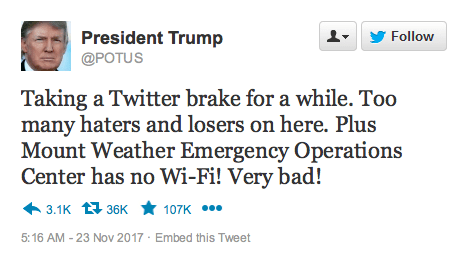
I’ve GOT it! Make Trump move to the Mount Weather Emergency Operations Center! Problem Solved!

Flat learning curve. That’s really the most alarming thing about President Trump’s tweet barrage over the weekend, as he responded stupidly, irresponsibly and offensively to the terror attack in London. It proved that he hasn’t learned a thing, despite repeated Twitter-assisted catastrophes that in the past have turned potential victories into embarrassments, mere mistakes into disasters, and whimsy into large clubs for his enemies to beat him bloody with. How could he not be wary when he considers a tweet? What happened to “Once burned, twice shy?” How about 6,348 times burned? How analytical do you have to be to think, after hitting yourself in the head squarely with a 2 X 4 and realizing that it is permanently dented (the head, not the board), “Wow! That hurt! I sure don’t want to do that again!”?

And yet here we are.

I can’t say I’m surprised, and that itself is depressing. But I’ve dealt with enough alcoholics in my life who I have asked, following particularly devastating relapses that placed everything they cared about (or should have cared about) in jeopardy, “Why would you do that, after all you have been through?”…and watched them shrug, shake their heads, and say, in various words, “I can’t explain it, and you’ll never understand.”

After the two attacks on Saturday, the President’s tweets weren’t all terrible. The second one read, “Whatever the United States can do to help out in London and the U. K., we will be there – WE ARE WITH YOU. GOD BLESS!” Then, like a binge drinker out of rehab who takes a small sip of chablis at a reception, POTUS was on a Twitter bender—a Twender. He began exploiting the tragedy to lobby for his stalled travel ban. He blamed the attacks on political correctness. He mocked the Mayor of London. He somehow saw the episode as revealing the hypocrisy of gun control advocates. Metaphorically, the President of the United States was reeling and staggering all over the street, singing “Barnacle Bill,” stopping traffic and vomiting on pedestrians. Continue reading