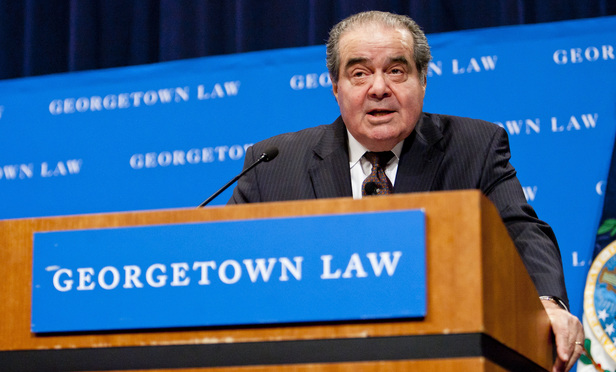
Ethics Observations On Georgetown Law Center’s Scalia Foofarah

Scalia-Georgetown

I am a Georgetown University Law Center grad, as well as a former administrator there. I also know and have personal relationships with several members of the faculty. None of this especially informs my ethical analysis of the community argument there that arose from a rather innocuous official expression of respect and mourning in the wake of Justice Scalia’s death, but if anyone wonders why I’m posting about this rather than many other ethics issues nipping at my heels, that’s part of the reason. The other reason is that this academic dust-up raises interesting ethics issues, and has received national publicity.

Observations on the tale as it has unfolded:

1.  Georgetown Law Center issued a press release mourning the death of Antonin Scalia, including a statement from Dean William M. Treanor that read:

Scalia was a giant in the history of the law, a brilliant jurist whose opinions and scholarship profoundly transformed the law. Like countless academics, I learned a great deal from his opinions and his scholarship. In the history of the Court, few Justices have had such influence on the way in which the law is understood. On a personal level, I am deeply grateful for his remarkably generous involvement with our community, including his frequent appearances in classes and his memorable lecture to our first year students this past November. The justice offered first-year students his insights and guidance, and he stayed with the students long after the lecture was over. He cared passionately about the profession, about the law and about the future, and the students who were fortunate enough to hear him will never forget the experience. We will all miss him.”

[Note: In the original post, I missed the first line, and kept missing it. Don’t ask me why. The text has been finally, after a couple botched attempts, been revised to include it.]

Is there anything inappropriate about the dean’s statement? Not in my view. This is nothing but a traditional expression of professional respect on behalf a prominent institutional member of the legal community. There is nothing in the statement, save for the last sentence, that anyone could argue is untrue. Countless academics, as well as Scalia’s more liberal colleagues, did learn “a great deal from his opinions and his scholarship.” He was an influential and significant figure on the Court. Scalia was generous with his time and passion as a teacher, and by all accounts he was a good one.

The opening statement,  “Scalia was a giant in the history of the law, a brilliant jurist whose opinions and scholarship profoundly transformed the law,”  seems to be what rankled Scalia critics. It shouldn’t have. At worst it is standard memorial puffery. But calling Scalia a giant “ in the history of the law” seems fair whether you agree with his jurisprudence or not: he is certainly among the 20 or so most quoted, most debated, and most provocative justices. The rest shouldn’t be troubling to anyone who isn’t suffering from Scalia-phobia. A Justice can be brilliant and transformational while being wrong.

None of the reports of the controversy ignited by this standard issue sentiment mention it, but Georgetown Law Center isn’t on the Georgetown campus. It has its own campus that is a 15 minute walk from the Supreme Court. Law students regularly attend oral arguments; I did: it was one of the great advantages of studying law there. More than any law school, the Law Center has good reason to feel a special affinity to the Court and all its justices.

2.  What about the last sentence? Is it appropriate for Treaner to speak for the law school community and say that “We will all miss him”? He was reasonable and fair to assume that.  Unfortunately, in today’s vicious partisan divide where opinions and sincere positions reached after thought and research are too often treated as proof of consort with Satan, and ion which even lawyers, who are trained not to take legal arguments personally, are frequently unable to respect a colleague for a well-reasoned argument that they may still think is completely wrong, it was not a safe assumption. Pillory the dean, then, for giving all members of his community the benefit of the doubt, and assuming they are capable of grace, compassion, fairness, professional respect and civility.

It’s still not unethical to assume one’s colleagues have some class.

3. They all don’t, unfortunately. Law Center professors Gary Peller and Mike Seidman (I know Mike, never met Gary) then used the Campus Broadcast system, usually used for event announcements, invitations and policy changes, to send a message  to all members of the student body titled, “Responses to Dean Treanor’s Press Release Regarding Justice Scalia.”  Peller’s statement reads,

Like Mike Seidman, I also was put-off by the invocation of the “Georgetown Community” in the press release that Dean Treanor issued Saturday. I imagine many other faculty, students and staff, particularly people of color, women and sexual minorities, cringed at headline and at the unmitigated praise with which the press release described a jurist that many of us believe was a defender of privilege, oppression and bigotry, one whose intellectual positions were not brilliant but simplistic and formalistic….That ‘community’ would never have claimed that our entire community mourns the loss of J. Scalia, nor contributed to his mystification without regard for the harm and hurt he inflicted.”

This was partisan grandstanding of the worst kind. The professors, of course, have a right to proclaim their opinions to the student body any time they want to, but their complaint here was petty and mean-spirited. It also models behavior that is poisonous both to the legal profession and the culture as a whole. The are saying, in essence,We don’t mourn him, we won’t miss him, and we’re glad to be rid of him, because his legal theories aren’t our legal theories, and we are on the side of the angels while he was an uncaring villain.” Such a message accomplishes nothing positive, and much that is destructive. The professors engaged in demonizing, when their profession and their duty is not to denigrate but reason. If they really think they can prove that Scalia was a defender of privilege, oppression and bigotry, they can make that case in a scholarly paper: I doubt that they can. Scalia often defended the rights to engage in conduct that he did not personally support, as well as some he did: the sloppy rhetoric of Seidman and Peller echoes the legally ignorant who accuse criminal defense attorneys of defending robbery and murder. Continue reading


Tech And Terrorism Ethics: Apple Is Right. The Government Is Wrong.

FBI-APPLE

If, in some future nightmare scenario come true, the FBI needs to break the encryption on a private i-phone to find the secret code to defuse the Doomsday Machine  President Donald Trump set up after his mind finally snapped and he thought he was the Stay-Puft Marshmallow Man, I assume that Apple won’t stand on principle and will do what needs to be done to save the world. The current dilemma, however, is not that dire.

Although President Obama announced last year that he had decided not to pursue legislation requiring tech companies to give law enforcement access to users’ encrypted data, he proved once again that if you don’t like Obama’s promises, just wait a minute.  For last week, the FBI persuaded a judge to order Apple to create software that would help federal investigators crack into the iPhone 5C that terrorist Syed Rizwan Farook was using before he and his wife slaughtered guests at his company Christmas party in San Bernardino last December. Apple has vowed to defy the order.

Good. Continue reading

Ethics Observations On Talia Jane’s “Open Letter” To Yelp

Talia Jane. Get used to seeing this face over the next 15 minutes or so...

Talia Jane. Get used to seeing this face over the next 15 minutes or so…

The story: A 25-year-old entry level Yelp (at Eat24, which is owned by Yelp) customer service agent named Talia Jane posted an article to the social media site Medium titled, An Open Letter To My CEO.  Addressed to “Jeremy,” Yelp Chief Executive Officer Jeremy Stoppleman, Jane’s epistle was a long. angry, often sad, more often snarky lament about her low compensation, current poverty, and lack of satisfaction with her job;  her personal hardship as she struggled with Bay Area living expenses like rent, food, electricity, internet, transportation; and her criticism of company policies and Stoppleman’s millions (Yelp was his creation.) The letter quickly went viral, especially among Bernie-files and on left-leaning websites, as the post was a rant against the lack of a living wage and greedy corporations generally. A couple hours later, Talia posted an update that she had been fired, and Stoppleman responded to some of her concerns on Twitter, protesting that he and his company were not as callous as she claimed. Stoppleman also tweeted that he was uninvolved in her firing and it was unrelated to the Medium post.

Observations:

1. Of course, Yelp had to fire her. Any company, large or small, would and should fire a low level employee who intentionally attacks her employer and the company’s CEO in a public forum. That the letter was read far and wide just sped up the process. The Bernie Brats, being so ignorant of the way of the world that they actually believe Sanders’ Socialist fantasies, naturally faulted Yelp for her fate. In Bernie World, you see, everyone is guaranteed a job, even after they go out of their way to embarrass the people who write their paychecks, or so they appear to believe.

2. Jane wrote that her firing was “unplanned” but not unexpected. I don’t believe that for a second; in fact, the statement is contradictory. She wrote a 2500 word attack on her employer and posted it online, and says she “expected’ to be fired. When you take deliberate action that you know will have a specific result, that’s a plan. The plan is to get out of a job she hates and that doesn’t advance her desired career—apparently to be a highly paid web commentator and wit—by making herself into a sympathetic celebrity long enough to exploit her fame and re-boot her ambitions. Isn’t that obvious? I’m sure that Talia is being booked on radio and TV shows as I write this. For her plan to work, however, she has to lie about her intentions in writing the letter. To some extent, I admire her audacity, and the plan may work. But this is The Saint’s Excuse: she made a deal with Yelp; they held up their end of it; she miscalculated, she was dissatisfied, so she made Yelp a public target for her own benefit.  Unethical. It is also the rationalization called Ethical Vigilantism: she thinks this is right because she deserves better, and is justified betraying her benefactor.

3. I wouldn’t trust Talia Jane to run my lemonade stand. Continue reading

The Ugly Truth About The Teaching Profession: Orlando Public Schools Division

Whiplash

Magnify this news report about public school teachers disciplined in the Orlando area, what, 10,000? 100,000? times, and the complete untrustworthiness of the U.S. teaching profession should come into sharp focus.

Highlights…

  • The teaching certificate of Jeanne Michaud, who taught math at Longwood’s Lyman High was permanently revoked in a settlement agreement approved last month by the Education Practices Commission, quasi-judicial group that levies penalties against educator’s certificates.

Michaud showed students a crude wooden carving of a penis and testicles. Michaud also kept an umbrella that students “regularly used to strike each other with,” according to the evidence. She spread gossip about teachers and administrators in class, denigrating them in front of students.

  •  Gregory Alan Sims, a former science teacher at Lake Brantley High in Altamonte Springs, was accused of putting tape on a girl’s mouth and taping her belongings to a pole. Sims claimed that he only mimicked putting tape on the girl’s mouth. Sims’ settlement agreement calls for two years of probation and completion of a classroom management course if he returns to teaching. He also was fined $750.

Continue reading

Jenrry Mejia, The Inexplicable Ethics Mega-Dunce

mejia

What is the explanation for this?

Jenrry Mejia is a young New York Mets relief pitcher who until recently had a bright future as a star closer and a guaranteed multi-millionaire.  Now, entirely on his own initiative, he has become the first player ever banned from baseball for using steroids .

This is not easy, though Mejia did it with ease…and speed.  After recovering from Tommy John surgery, Mejia was establishing himself as the Mets closer by the end of the 2014 season. But he began the 2015 season with an 80-game suspension for testing positive for a common PED (Performance Enhancing Drug), then, even before completing that punishment,  flunked another urine test and earned himself a 162-game suspension a few months later.

Knowing full well that a third positive test would end his career, Mejia tried a different banned steroid, was caught again, and that third strike triggered a lifetime expulsion from major league baseball under the sport’s rules. Nobody has been that reckless and stupid, not even Manny Ramirez (who was caught twice), and Manny’s picture is in the dictionary under “reckless and stupid.” Continue reading

Gloria Steinem Makes A Dishonest Apology For Telling The Truth

Steinem

If Gloria Steinem had integrity at all, she would have greeted the criticism over her undoubtedly accurate remarks about young women and politics by saying, “Oh, please. Isn’t feminism past the stage of treating reality like heresy yet?”

But no.

Steinem was discussing Democratic presidential candidates Hillary Clinton and Sanders. When Maher noted the Vermont senator’s popularity with young women, Steinem responded with her theory that women get more “radical” as they get older.

“When you’re young, you’re thinking, ‘Where are the boys?’ The boys are with Bernie,” she said. “Now if I said that… you’d swat me,” Maher replied,to which the “Ms.” founder insisted, “No, I wouldn’t!”

Of course, she was desperately making excuses for Hillary, who rots everyone she touches. Steinem disgraced herself  when she chose  to make excuses for Mr. Clinton, reversing her previous support for women who yielded to greater power and succumbed to predatory bosses. When then-President Clinton’s sexual harassment habits finally got him in trouble, Steinem denied that it was harassment at all. On Maher’s show, her intent was to avoid saying that young women quite appropriately reject the cynical feminism of Hillary, who now claims to champion the cause of victims of sexual assault while she knowing rode the coattails of one to power.  Once again facing the dilemma of having to choose between her alleged beliefs and a Clinton, she again threw women under the bus, though this time, she had some truth on her side: yes, there are times in most normal young women’s lives that boys are more important than politics. What a shocking revelation.  And now, a musical interlude…

Where was I?

Oh, right, Gloria…

So not being able to give the real reason a lot of women are supporting Bernie, silly as he is, rather than lying, tired, fake-feminist Hillary, and somehow extracting herself from the politically incorrect observation in radical feminist circles that girls like boys, Steinem spun a sort-of apology of stunning mendacity:

“In a case of talk-show Interruptus, I misspoke on the Bill Maher show recently, and apologize for what’s been misinterpreted as implying young women aren’t serious in their politics. What I had just said on the same show was the opposite: young women are active, mad as hell about what’s happening to them, graduating in debt, but averaging a million dollars less over their lifetimes to pay it back. Whether they gravitate to Bernie or Hillary, young women are activist and feminist in greater numbers than ever before.”

Let’s unpack this monstrosity, shall we? Continue reading

Ethics Alarms’ All-Time Greatest Hits

AllTimeGreatestHits

I am listing these because one of the past posts that keep drawing readers is going nuts today: the 2013 essay about the horrible Wanetta Gibson, who sent Brian Banks, a young man with a bright future to prison by falsely accusing him of rape when she was 15. If anyone has any idea why this would be, let me know; as far as I can find out, there are no new developments in the case.

It is gratifying that so many Ethics Alarms posts continue to find new readers. Here are the top ten that have “legs,” and my assessment of why.

1. The Rationalizations List. That’s no surprise, since I link to it so frequently, and it is also frequently updated.

2. Wanetta Gibson Is Even Worse Than We Thought

3.The Amazing Mouthwash Deception: Helping Alcoholics Relapse For Profit. I am proud of this one. The use of mouthwash by alcoholics is epidemic, yet now, as in 2010 when I wrote this, almost nobody who isn’t a drunk is likely to know it. This makes it easy for closeted alcoholics to hide their illness, and continue to harm themselves by gulping 54 proof liquor out of various convenient containers or their caps, which are coincidentally shaped like shot glasses. Incredibly, the Ethics Alarms post is still one of the few references on this problem on the web. As you will read, I think the makers of mouthwash intentionally keep it this way, because the alcoholic market is huge.

I regularly receive thanks from family members of alcoholics, who tell me that reading this post led to their discovering that a loved oned had relapsed. Continue reading

It’s Just One Small Episode In The Vast Accountability, Integrity And Competence Void That Is The Federal Government, But It May Answer Many Questions…

Kimberly Graves appealing her VA demotion, not because she denies gaming the system and sucking up taxpayer money, but because she feels she should get away with it.

Kimberly Graves, appealing her VA demotion, not because she denies gaming the system and sucking up taxpayer money, but because she feels she should get away with it.

As essential background, please read this excerpt from the Veterans Administration’s inspector general’s report regarding “Inappropriate Use of Position and Misuse of Relocation Program and Incentives,” from last fall:

As part of our assessment of VA’s relocation expense program (PCS program), we reviewed records related to the Veterans Benefits Administration’s (VBA) reassignment of 7 General Schedule (GS) Grade 15 employees who were promoted to Senior Executive Service (SES) positions and 15 SES employees who moved to different SES positions in fiscal years (FYs) 2013, 2014, and 2015. VBA management used moves of senior executives as a method to justify annual salary increases and used VA’s PCS program to pay moving expenses for these employees. Annual salary increases totaled about $321,000, and PCS relocation expenses totaled about $1.3 million. Additionally, VBA paid $140,000 in unjustified relocation incentives. In total, VA spent about $1.8 million on the reassignments. While we do not question the need to reassign some staff to manage a national network of VAROs, we concluded that VBA inappropriately utilized VA’s PCS program for the benefit of its SES workforce.

Ms. Kimberly Graves was reassigned from her position as the Director of VBA’s Eastern Area Office to the position of Director, St. Paul VARO, effective October 19, 2014. VA paid $129,467.56 related to Ms. Graves’ PCS move. We determined that Ms. Graves also inappropriately used her position of authority for personal and financial benefit when she participated personally and substantially in creating the St. Paul VARO vacancy and then volunteering for the vacancy.

Mr. Antione Waller, former St. Paul VARO Director, told us Ms. Graves initiated discussion with him about relocating to the Philadelphia VARO. Once he expressed a willingness to accept the reassignment, she did an apparent “bait and switch.” She told him that the Philadelphia position was no longer available and he would be considered for the Baltimore VARO Director position. When he said he was not willing to move to Baltimore, Ms. Graves told him, “you will probably get another call, this probably won’t be the last conversation about Baltimore.” In an email, Ms. Beth McCoy, who at the time was the Assistant Deputy Under Secretary for Field Operations and Ms. Rubens’ subordinate, told Ms. Graves that she spoke to Mr. Waller and told him his name was already submitted to the VA Secretary for Baltimore, so “saying no now is not a clean or easy option.” Once the St. Paul Director position was vacant, Ms. Graves said she contacted Ms. Rubens and said, “I’d like to throw my name in for consideration for St. Paul … I feel like I’ve done my time and I’d like to put my name in.”

Ms. Rubens’ and Ms. Graves’ reassignments resulted in a significant decrease in job responsibilities, yet both retained their annual salaries—$181,497 and $173,949, respectively. Based on Federal regulations, we determined VA could not reduce their annual salaries upon reassignment despite the decrease in the scope of their responsibilities. However, a senior executive’s annual salary can be reduced if the individual receives a less than fully successful annual summary rating, fails to meet performance requirements for a critical element, or, as a disciplinary or adverse action resulting from conduct related activity.

We made criminal referrals to the U.S. Attorney’s Office, District of Columbia, regarding official actions orchestrated by Ms. Rubens and Ms. Graves. Formal decisions regarding prosecutorial merit are pending. We provided 12 recommendations to VA to increase oversight of VA’s PCS program and to determine the appropriate administrative actions to take, if any, against senior VBA officials.

Got that? Graves gamed the system to reduce her responsibilities while keeping her salary, and received almost $130,000 in taxpayer money as moving expenses, which, as the rest of the IG’s report documents, are routinely inflated by the VA. Continue reading

Ethics Quiz: Second Thoughts About An Ethics Hero Emeritus

challenger-shuttle-disaster-crew

I periodically read random posts here from years ago, to check and see if I would make a different analysis today, and why. It almost never happens, which is good: though I may not trace all of the steps in every post, the systems, methods, models, values and priorities I use to assess various events and scenarios are established and consistent. I also check older posts when I am uncertain about a new version of an issue I have addressed before. Again, I am almost always struck by how closely my thinking then matches my approach now. I am also often struck by the fact that I don’t recall writing the earlier post at all. There are over 6000 of them, so I don’t feel too senile.

Today, however, I read this NPR story, about a previously unnamed engineer at NASA contractor Morton Thiokol who had been interviewed, with a promise of not being named, by NPR after the Challenger Space Shuttle exploded, 30 years ago. Now Bob Ebeling has finally come forward publicly, and allowed his name to be attached to his tragic story.The night before the launch, he and four other engineers had tried to stop it, because the weather was too cold—it was the coldest launch ever— and their research told them that that the rubber seals on the shuttle’s booster rockets wouldn’t function properly in the extreme temperatures. They begged for the launch to be postponed, but their supervisors and NASA overruled them.

That night, Ebeling told his wife, Darlene, “It’s going to blow up.” It did.

“I was one of the few that was really close to the situation,” Ebeling told NPR. “Had they listened to me and wait[ed] for a weather change, it might have been a completely different outcome…NASA ruled the launch. They had their mind set on going up and proving to the world they were right and they knew what they were doing. But they didn’t.”

Thirty years ago, when Ebeling didn’t want his name used or his voice recorded,  he said he feared losing his job but that,”I think the truth has to come out.” After the interview, the investigations, and the law suits, he left the company and suffered from depression and guilt that has lasted to this day. He told NPR that in 1986, as he watched that horrible video again on TV, he thought, “I could have done more. I should have done more.”

Reading and listening to the NPR story, I agreed with him. He should have done more. I was about to write a post from that perspective, when I realized I had not only written about another engineer who had tried to delay the launch, but inducted him into the Ethics Alarms Heroes Hall of Honor. His name was Roger Boisjoly, and of him I wrote in part…

Six months before the Challenger disaster, he wrote a memo to his bosses at Thiokol predicting”a catastrophe of the highest order” involving “loss of human life.” He had identified a flaw in the elastic seals at the joints of the multi-stage booster rockets: they tended to stiffen and unseal in cold weather.  NASA’s shuttle launch schedule included winter lift-offs, and Boisjoly  warned his company that send the Shuttle into space at low temperatures was too risky. On January 27, 1986, the day before the scheduled launch of the Challenger, Boisjoly and his colleague Allan J. McDonald argued for hours with NASA officials to persuade NASA to delay the launch, only to be over-ruled, first by NASA, then by Thiokol, which deferred to its client.

And the next day, on a clear and beautiful morning, the Shuttle’s rocket exploded after take-off, killing the crew of seven and mortally wounding the space program.

My ethics verdict then? This:

“Can we accurately call Roger Boisjoly an Ethics Hero, even though he didn’t stop the launch? I usually don’t like to call people heroes for doing their jobs. If Thiokol and NASA had behaved ethically, competently and rationally, we would not know anything about his memo or him. He did the right things, as his duties demanded. He alerted management to a deadly problem in plenty of time to address it. When they went forward, he argued and protested, until the decision was final. Afterwards, he told the truth to investigators, so the decision-making problems could be addressed. In his world, in that bureaucracy, this—doing his duty, doing the right thing—took courage. He knew, I am certain, that his career would suffer as a result of his actions. Yes, that makes Roger Boisjoly an ethics hero.”

If Boisjoly was a hero, then so is Ebeling, though Boisjoly spent the rest of his professional life lecturing at engineering schools around the world on ethical decision-making, trying to prevent future disasters.

So please help me resolve a Present Jack vs. Past Jack conflict, by considering this Ethics Alarms Ethics Quiz:

Are Bob Ebeling and Roger Boisjoly really heroes?

Continue reading

X-Files Ethics: There Is Nothing Weird About Offering Scully One-Half Mulder’s Contract

X-Files

Gillian Anderson reported that when the producers approached the actress about reprising her co-starring role in the re-boot of “The X-Files,” she was offered only one-half of the salary that her male partner, David Duchovny, had agreed to. From the Daily Beast’s shocking account:

The work Anderson put into securing equal pay back in the ’90s seemingly came undone when it came time to negotiate pay for this year’s event series. Once again, Anderson was being offered “half” of what they would pay Duchovny.“I’m surprised that more [interviewers] haven’t brought that up because it’s the truth,” Anderson says of the pay disparity, first disclosed in the Hollywood Reporter. “Especially in this climate of women talking about the reality of [unequal pay] in this business, I think it’s important that it gets heard and voiced. It was shocking to me, given all the work that I had done in the past to get us to be paid fairly. I worked really hard toward that and finally got somewhere with it.

“Even in interviews in the last few years, people have said to me, ‘I can’t believe that happened, how did you feel about it, that is insane.’ And my response always was, ‘That was then, this is now.’ And then it happened again! I don’t even know what to say about it.”

That’s all right, Gillian. I know what to say about it. This was not unfair, disrespectful. or an example of discrimination against women in the workplace. This is called negotiation, and there is nothing unethical about it at all.

Continue reading