No, Craig, Barry Bonds Wasn’t A “Great” Baseball Player. Bernie Madoff Wasn’t A “Great” Investment Manager, Either

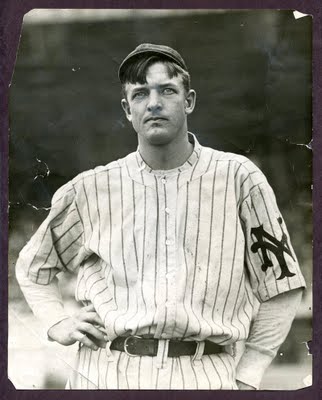
Christy Mathewson, a genuine hero. Barry Bonds would have made him want to throw up.

Christy Mathewson, a genuine hero. Barry Bonds would have made him want to throw up.

I like and admire Craig Calcaterra, who blogs entertainingly and perceptively about baseball on the NBC Sports website. I suppose I’m a bit jealous of him too: he’s a lawyer who now earns his living blogging about something he loves.

But Craig has always been a bit confused about how to regard baseball’s steroid cheats (they are cheats, which should answer any questions, but somehow doesn’t for a lot of people), and predictably, I suppose, he couldn’t resist reacting to the early results of Major League Baseball’s “Franchise Four” promotion, in which fans vote (until mid-May) for “the most impactful players who best represent each Major League franchise” as well as some other categories, including “Four Greatest Living Players.” The early results have Hank Aaron, Willie Mays, Sandy Koufax and Tom Seaver leading in the “Greatest Living Players” category, so Craig snarked that this is sad, because “it must mean Barry Bonds has died in a tragic cycling and/or Google Glass accident and no one thought to tell me.”

No, Craig, this is what someone failed to tell you: cheaters in any profession are not “great” by definition. Great baseball players, like great lawyers, writers, doctors, scientists and Presidents, bring honor on their profession, don’t corrupt everyone around them, don’t force people who admire them to embrace unethical conduct and turn them into aiders and abetters, and accomplish their great achievements while obeying the law, following the rules, and serving as role models for everyone who follows them. Barry Bonds was not a great baseball player. He had the ability to be one, but not the character.

Hank Aaron, Willie Mays, Sandy Koufax and Tom Seaver never once disgraced their game while they wore a uniform, and indeed made baseball stronger and better while they played. Good choices all.

The disgrace is that San Francisco fans voted Bonds as one of that team’s “Franchise Four,”  dishonoring great Giants of the past like Juan Marichal, as well as New York Giants greats like Christy Mathewson, Bill Terry, Carl Hubbell, and Mel Ott, Hall of Famers  and lifetime Giants who played with honesty and sportsmanship. But Giants fans warped values are among the casualties of Bonds’ career…and one more reason he can’t be rated anything but a great villain.

Ethics Dunce: Alexandra Robbins, The Mocking Nurse

Mockery

If you set out to defend ethically indefensible conduct in print, you better be able to do a better a job of it than this.

Alexandra Robbins, in an op-ed causing quite a bit of controversy in the Washington, D.C. area, attempted to not only justify the despicable conduct of medical professionals deriding and ridiculing their unconscious patients, but to sanctify it, arguing, lamely, that doctors and nurses are mocking the unwitting and vulnerable human beings who have placed their lives in their hands in order to “rejuvenate [the medical personnel] and bond them to their teams, while helping to produce high-quality work. In other words, the benefits to the staff — and to the patients they heal — outweigh occasional wounded feelings.”

Right.

Robbins’ protests of virtue amount to a desperate raid on the Ethics Alarms Rationalization List, which, as always, operates as virtual Rotting Ethics Detector, or RED. If you find yourself thinking these corrupting self-delusions, you’re on the verge of unethical conduct; if you find yourself saying them, you’ve applied for membership in the Dark Side, and if you are so rationalization-polluted that you proclaim them in print, like Robbins, you shouldn’t be trusted to mail the water bill, much less to cavort in the operating room.

Rationalizations aren’t the only ethical problem with her loathsome essay. The entire thing is a Jumbo, denying the blatantly undeniable. “Oh, no!” readers are told. “We aren’t being disrespectful to patients when we mock their weight, sex organs, or the maladies that placed them in pain, peril and in our care!” Robbins expects us to believe that insults constitute “non-destructive coping measures” that help nurses and doctors “provide the best possible care, even if those methods might seem unprofessional outside of the health-care setting.”

They seem unprofessional because they are unprofessional. Continue reading

Once Again, We Are Reminded That Beauty Is Only Skin Deep. Do ESPN Viewers Care? Should They?

Let me tell you, it's quite a shock when Britt's head spins around and that forked tongue starts flecking...

Let me tell you, it’s quite a shock when Britt’s head spins around and that forked tongue starts flecking…

Anyone who spends much time watching TV knows that “lookism” is the way of the world in the broadcast news business. From Nora O’Donnell on ABC to Robin Meade on HLN to Erin Andrews and the bevy of Fox blondes, it is obvious that if you are female, talent as a reporter won’t get you as far as some beauty contest creds. Plain, even conventionally pretty women are  at a great competitive disadvantage in this field.

One of the more blatant beneficiaries of this bias, ESPN’s Brit McHenry, has just been outed on the web as an ugly human being in a flashy disguise. Her car was towed, and a camera caught the reporter taking out her frustration on the poor clerk who was tasked with collecting her fee.

“I’m in the news, sweetheart, I will fucking sue this place,” McHenry says as the video opens.“Yep, that’s all you care about, is just taking people’s money,” she continues. “With no education, no skillset, just wanted to clarify that. … Do you feel good about your job? So I could be a college dropout and do the same thing? Why, cause I have a brain and you don’t?…Maybe if I was missing some teeth they would hire me, huh? ‘Cause they look so stunning … ‘Cause I’m on television and you’re in a fucking trailer, honey.”

“Lose some weight, baby girl,” she taunted as she left.

Yecchh. Continue reading

Ethical Quote Of The Month: Sgt. Shane Ortega

Trans Military Service Member

“You have to exercise patience with people, but people are not going to understand the subject overnight.”

—-Sgt. Shane Ortega, helicopter crew chief in the Army’s 25th Infantry Division, speaking to the Washington Post about his legal battle with the U.S. military, which continues to classify him as a woman despite his transition to a man.

The reason we say that “hard cases make bad law” is that the toughest cases fall between the cracks in rules and regulations, and they all have cracks. The law seeks consistent precedents, so anomalous fact patterns threaten the integrity and efficiency of otherwise effective laws and rules that work well in the vast majority of situations. Yet those hard cases usually indicate flaws in policies, rules and laws, and sometimes point to the need for change.

Often, an organization, especially a bureaucratic one like the military, will deal with such disruptive cases by simply looking past the actual facts, and treating them “by the book.” Ortega represents a particularly glaring instance of this phenomenon, which in his case not only harms his career, but also makes the military appear rigid to the point of absurdity.

Yet, as his Ethical Quote of the Month indicates, he understands. Change is painful, and it takes time. Continue reading

Ethics Over Compliance: The Dutch Banker’s Oath

bankers oath

“Professional ethics” is a never-ending battle between compliance and ethics, between rules and penalties on one side, and principles and values on the other. Compliance is easier: all you do is tell people with rules and regulations what they must or can’t do, and promise that there will be consequences if those rules are violated. For ethics to work, people actually have to understand ethical values and be committed to living by them in a professional context.

Compliance has little to do with ethics. Jack the Ripper will follow rules if they are clear, if he knows he’ll get caught if he violates them, and if the punishment when he does will be  harsh enough. That won’t make him ethical. In fact, compliance–rules-based professional conduct control—is often antithetical to ethics. Rules and laws are merely a challenge to the type that Oliver Wendell Holmes called “The Bad Man”-–which includes bad women—to find ways to do things that are wrong but that avoid violating rules sufficiently to justify punishment.  This is why most compliance codes have language in their introductions noting that it’s impossible to make a code that will cover every wrong someone can think of, so ethics are important too.

Pure compliance-based systems don’t improve ethical conduct. The financial collapse in 2008 was largely caused by financial manipulators operating in the grey areas of the rules and laws—that’s why so few of them could be prosecuted. In politics, The compliance mindset is extremely convenient for clever liars and cheats like the Clintons, which is why Hillary could try to explain her e-mail shenanigans by saying that “I fully complied with every rule I was governed by (heh-heh-heh!).” Unethical people will always find ways to get around rules. Ethical people, in contrast, barely need rules at all.

Another benefit of ethics over compliance is that ethics rules–compliance codes—have to be long and detailed, otherwise it’s too easy for Clinton-types to find loopholes, though they usually will find some anyway. Ethical values, on the other hand, can be stated very simply. An ethical employer thinks, “Hmm, that intern is cute, but I am married and have duties of loyalty and honesty to my wife and family, and it would be an abuse of power and influence as well as irresponsible for me as a leader to have an affair with someone under my supervision in the organization.” The Bad Man thinks, “Wow, she’s hot; my wife won’t care as long as I’m not caught; getting a hummer isn’t considered sex where I come from, and there’s nothing that says a President can’t fool around!” For the former, “A leader should not have sex with subordinates” is clear as a bell; his values tell him why. The latter, though, is thinking, “Hmmm. How can I get around this? That rule says “should” but not “shall”— that’s good. No punishment is specified. Sounds like more of a guideline than a rule. “Sex”—that must mean sexual intercourse: great! Lots of wiggle room there. And “subordinate”—is an intern really a subordinate? And I bet I could argue that this is personal, not official conduct. All good…now where’s that cigar?

Invoking ethics rather than compliance is a new oath required by the Dutch Bankers Association. It could be printed on a postcard, and if a banker is ethical, it is all he or she needs:

I swear within the boundaries of the position that I hold in the banking sector…

…that I will perform my duties with integrity and care;

…that I will carefully balance all the interests involved in the enterprise, namely those of customers, shareholders, employees and the society in which the bank operates;

…that in this balancing, I will put the interests of the customer first;

…that I will behave in accordance with the laws, regulations and codes of conduct that apply to me;

…that I will keep the secrets entrusted to me;

…that I will make no misuse of my banking knowledge;

…that I will be open and transparent, and am aware of my responsibility to society;

…that I will endeavor to maintain and promote confidence in the banking system.

So truly help me God.

And if a banker isn’t ethical,

it won’t matter anyway.

__________________________

Pointer: Legal Ethics Forum

Sources: Bloomberg, The Conglomerate

Graphic: Bloomberg

The Phenom, The Agent And The Cubbies: 2015’s First Baseball Ethics Controversy

No, I don’t count Pete Rose.

Kris Bryant, whose day will come.

Kris Bryant, whose day will come.

The lesson of the Kris Bryant dispute is that sometimes the result that seems the least fair is also the right one. Bryant, in case you don’t follow baseball or do not live in Chicago, is the hot Chicago Cubs minor leaguer—what used to be called a “phenom” in the old days—who will not be playing third base for the Cubs when the season opens despite everyone’s agreement that he is not just ready for National League, but ready to star in it. Last week, the young man was assigned  to  the Cubs’ Triple-A Iowa farm team.  Cubs fans are upset. Sports pundits are outraged. Bryant’s agent is furious.

What’s going on here?

A lot.

The MLB  collective bargaining agreement, negotiated and signed by both baseball management and the players union, gives teams control over players for six years before a player can enter free agency and sell his talents to the highest bidder. Thus most young players earn a small percentage of their true market value initially, and, if they are good, hit the jackpot after that. (The average salary in Major League Baseball is $4 million a year). There is a catch, however—and an unavoidable loophole. A full season is defined as 172 days, though the season is 180 days. If a young player is left off the roster until there are fewer than 172 days remaining in the regular season, that season doesn’t count as one of the six years; a player can’t become a free agent mid-season six years later. Before the demise of the reserve system that bound a player to one team until the team released or traded him, there was no reason not to promote a promising minor league star to the big team the second it looked like he was ready. Now, there is a big reason: delaying those few games will give the team an extra year of control, since under the rule, 6 years and 171 games is still just six years. That means an extra year of the player at bargain compensation, and possibly an extra year of the player, since he can fly the coop once the clock has run.

This is not a new issue: players and agents have been complaining about teams doing this for years, but the rules allow it. Since the rules allow it, and since the monetary and competitive benefits of waiting those extra nine days can be huge, there is nothing unfair or unethical about a team taking advantage of the provision. Indeed, it would be irresponsible and a breach of management’s fiduciary duties not to save millions and ensure the extra year of a star’s services. What, then, has made Bryant’s case so contentious?

It’s the Cubs, that’s what. Continue reading

Ethics Quiz: What’s Fair Punishment For The Chick-Fil-A Video Vigilante?

orestes

I previously wrote about Adam M. Smith, the ex-CFO of  a Tucson medical supplies manufacturer who filmed himself dressing down a Chick-fil-A drive-in employee and placed the video on YouTube. I said in part…

“He’s a vile bully and a jerk, who thinks it appropriate to embarrass and abuse an innocent employee of a restaurant because he happens not to agree with the politics and moral positions of the company’s owner…The video served to alert millions to beware of this rude, rabid and self-righteous champion of gay rights, who equates faith-based advocacy for the current law of the United States of America with “hate.”

I was more accurate than I knew. Now we learn that since that August, 2012 fiasco which cost him his job, Mr. Smith has fallen on hard times. His self-posted indictment of his own character has poisoned his reputation and career. When he found a new job, he was later fired for not alerting his employers about the incident. When he has raised the video to potential employers, they have declined to hire him. Where he was once earning a six-figure salary, had $1 million in stock options, and lived in a stylish home, he now lives in an RV with his wife and four children, and is existing on public assistance.

It all sounds like the plot of an Adam Sandler movie.

Your Ethics Alarms Ethics Quiz today is…

Is Adam M. Smith the victim of excessive social media punishment for one ill-considered act?

Continue reading

Tales of “The King’s Pass”: Pete Rose and Jeremy Clarkson

King

The King’s Pass has been much in the ethics news of late—Brian Williams, Bill O’Reilly, David Petraeus, Hillary. Let’s review, shall we?

11. The King’s Pass, The Star Syndrome, or “What Will We Do Without Him?”

One will often hear unethical behavior excused because the person involved is so important, so accomplished, and has done such great things for so many people that we should look the other way, just this once. This is a terribly dangerous mindset, because celebrities and powerful public figures come to depend on it. Their achievements, in their own minds and those of their supporters and fans, have earned them a more lenient ethical standard. This pass for bad behavior is as insidious as it is pervasive, and should be recognized and rejected whenever it raises its slimy head.  In fact, the more respectable and accomplished an individual is, the more damage he or she can do through unethical conduct, because such individuals engender great trust. Thus the corrupting influence on the individual of The King’s Pass leads to the corruption of others…

1. The BBC just demonstrated how the King’s Pass should be rejected—with courage and gusto.

Jeremy Clarkson, the main host of the popular BBC auto show “Top Gear,” spent March misbehaving. He got in a shoving match with a producer, verbally abused staff and was recorded trashing the network. When Clarkson topped it off with a physical altercation with a show staffer, the BBC decided not to renew his contract. BBC head Tony Hall said in a statement:

It is with great regret that I have told Jeremy Clarkson today that the BBC will not be renewing his contract. It is not a decision I have taken lightly. I have done so only after a very careful consideration of the facts…I take no pleasure in doing so. I am only making [the facts] public so people can better understand the background. I know how popular the programme is and I know that this decision will divide opinion. The main facts are not disputed by those involved.

The BBC is a broad church…We need distinctive and different voices but they cannot come at any price. Common to all at the BBC have to be standards of decency and respect. I cannot condone what has happened on this occasion. A member of staff – who is a completely innocent party – took himself to Accident and Emergency after a physical altercation accompanied by sustained and prolonged verbal abuse of an extreme nature. For me a line has been crossed. There cannot be one rule for one and one rule for another dictated by either rank, or public relations and commercial considerations… Obviously none of us wanted to find ourselves in this position. This decision should in no way detract from the extraordinary contribution that Jeremy Clarkson has made to the BBC. I have always personally been a great fan of his work and “Top Gear”…The BBC must now look to renew Top Gear for 2016. This will be a big challenge and there is no point in pretending otherwise. I have asked Kim Shillinglaw [Controller of BBC Two] to look at how best we might take this forward over the coming months. I have also asked her to look at how we put out the last programmes in the current series.

The show, without Clarkson, is toast, and Hall knows it. Nonetheless, he had the guts to do the necessary and ethical act: not allowing its indispensable star to abuse his power and popularity . Once Clarkson did that, “Top Gear” was doomed anyway; firing him now just minimizes the carnage. Although Hall has no responsibility to other networks and organizations, his decisive handling of the episode has saved other programs even as it destroys his own. It is a precedent and a role model for employers refusing to allow themselves to be turned into enablers  by stars assuming the King’s Pass works. When they say, “You can’t fire me, I’m irreplaceable! There’s no show without me!”, the response now can be, per the BBC: “If there’s no show without a jerk like you, then there’s no show. Bye!”

2. Once again, Pete Rose is sucking the ethics right out of people’s brains.

Ah, Pete Rose. He was the topic of the first ethics post I ever wrote, way back in 2004. Then, in 2007, he became my first and only Ethics Dunce Emeritus.

The Pete Rose case is simple. Baseball has an absolute, no exceptions rule that demands a lifetime ban of any player, coach or manager who gambles on major league baseball games. Such banned players can’t be hired by major league teams for any purpose, and cannot be considered for Hall of Fame membership., ever, even after they are dead. Everyone in baseball knows why this rule exists—baseball was nearly destroyed in 1919 when gamblers bribed the Chicago White Sox to throw the World Series—and the rule is posted in every clubhouse. Rose bet on baseball while a major league manager, and also bet on his own team. Thus he is banned.

The significance of the fact that he is, as a player, the all-time hits leader and was the face of the game is that it led Rose to believe that the game would never ban him, and that if caught, he would be treated with special leniency. His excellence on the playing field doesn’t mitigate his conduct, or justify minimizing the ban it earned, at all.

The New York Times published a story about Rose’s efforts to get baseball to lift the ban, now that a new Commissioner, Rob Manfred, is in office. You can read the article here, which is remarkable for the many jaw-droppingly unethical arguments put forth by the baseball people the article quotes, contrasted with the occasional quote that shows that a speaker comprehends the concepts of consequences, accountability, and why letting stars break the rules is suicidal to any culture. It would be an excellent ethics exam.

Here are the quotes; my comments follow in bold. Continue reading

Shortest Investigation Ever: Determining Whether It Was Inappropriate For The Middle School Vice Principal To Say In A Video, “I Don’t Like Black Kids”

"Wait, let's not leap to conclusions...maybe he's not dead."

“Wait, let’s not leap to conclusions…maybe he’s not dead.”

In Fresno, California, Scandinavian Middle School vice principal Joe DiFilippo was recorded on video by a student saying, “I don’t like black kids” in the cafeteria. The video was then posted on YouTube. Fresno Unified School District officials said DiFilippo has been placed on paid administrative leave pending an investigation.

Maybe I’m suffering from a momentary lack of imagination, but what else do they need to know? I understand union rules and the need for due process, but what findings could possibly, ever, under any circumstances, allow DiFilippo to keep his job? 11% of the school’s students are black. Why would they ever feel secure going to a school where an administrator said such a thing in the school? (I’m assuming the man didn’t really say, “I don’t like black kids any more or less than I like any other kids, as everyone in the school knows.” Watching the video would presumably make that possibility moot.)

District officials say they are investigating “the context in which the comment was made.”  What possible context could mitigate that statement? Let’s see…maybe he was talking about not liking them for special purposes, like snacks or as piñatas? “I don’t like black kids..when they’re on fire? When they are holding Uzis on my family? When they sing the Sponge Bob theme song”?

It doesn’t matter! If there is anything the man doesn’t like about black kids that he accepts about white kids, he’s not qualified to be a vice-principle.

Every second Mr.Fillippi doesn’t resign, he’s wasting time and money, and proving that he is just as big a fool as the video shows him to be. If no investigation can save  him, then he shouldn’t wait for an investigation to do the right thing.


I Suppose It Is Comforting To Know That I Wasn’t Unfair To Starbucks And Howard Schultz

Starbucks Quiz

If the Starbucks “Race Together” campaign had turned out to be carefully thought out, intelligent, sophisticated and responsible, and not  a facile, condescending and cynical effort to promote a brand while creating static and white noise in the midst of an important cultural discussion, I would be obligated to apologize for doubting CEO Howard Schultz’s wisdom and ethics. It would also have been an apology I would have enjoyed making.

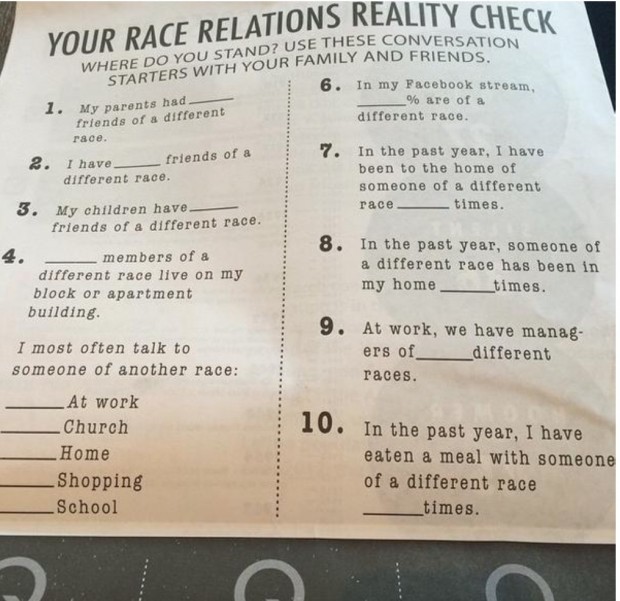
Sadly, I was not only correct in my assessment that this was a fiasco in the making, I was more correct than I suspected. Above is the “Race Relations Reality Check ” quiz that Starbucks has reportedly been distributing. The questions indicate a bottom-of-the-well level of comprehension about race and racism, not to mention demographics, culture and the human species. It appears that Starbucks favors some kind of affirmative action program on personal friendships, and believes that one can measure racism or incipient bias by how many individuals of other races one has regular contact with. I don’t even want to have a discussion with someone this shallow. A whole corporation this shallow is a nauseating thing to contemplate. A corporation this shallow that presumes to lead a national discussion on race is, oh I don’t know—Risible? Sad? Dangerous?

Starbucks seems to be thinking like George Costanza, during the period where he was trying to acquire black friends and managed to annoy and insult every African-American he met. The presumptions here are staggering, and so directly contrary to life, logic and the realities of human existence that i get angry just reading them. I was at an ethics conference in Nigeria, and met some of the most intelligent, charming, passionate people I have ever encountered in my life. I would be honored and enriched to have any of them in my life, and would hope that I could develop close friendships with them—but I can’t, because I live in the U.S. and they live in about 15 African nations, and it’s just too darn expensive to dine at each others’ homes. I live in an area, Northern Virginia, that is overwhelmingly white, not because it is white, but because it is convenient to my work and we found a great deal on a house. I work in two fields, theater and ethics, that do not afford a lot of contact with African Americans. The last time we had anyone other than immediate family to dinner was a decade or more ago; the last time anyone other than family, black or white, had us to dinner was longer ago than that—and I am a delightful dinner companion. Continue reading