Morning Ethics Warm-Up: 1/12/2018: Sigh. It Never Ends. (Part II) [UPDATED]

A Nigerian locale, and not an atypical one.

From the Washington Post:

President Trump grew frustrated with lawmakers Thursday in the Oval Office when they discussed protecting immigrants from Haiti, El Salvador and African countries as part of a bipartisan immigration deal, according to several people briefed on the meeting.

“Why are we having all these people from shithole countries come here?” Trump said, according to these people, referring to countries mentioned by the lawmakers.

Trump then suggested that the United States should instead bring more people from countries such as Norway, whose prime minister he met with Wednesday. The president, according to a White House official, also suggested he would be open to more immigrants from Asian countries because he felt that they help the United States economically.

In addition, the president singled out Haiti, telling lawmakers that immigrants from that country must be left out of any deal, these people said.

“Why do we need more Haitians?” Trump said, according to people familiar with the meeting. “Take them out.” 

Ethics Observations:

I. “According to several people briefed on the meeting”? What? Not even according to people AT the meeting?

Based on this, without any attributions, the news media is stating that Trump making those alleged comments are fact. Here’s the Times version,

“…according to people with direct knowledge of the conversation.“

No, they don’t have “direct knowledge.” What someone tells you about what someone else said at a meeting you were not attending is indirect knowledge. It is, in fact, hearsay. If the Times and the Post did not get confirmation on the record from someone who heard what he said, then this is not fact, but rumor, inadmissible in court because of extreme prejudice and lack of reliability.

Never mind. The Times headline is Trump Alarms Lawmakers With Disparaging Words for Haiti and Africa, as if the second-hand accounts were  confirmed fact. This is unethical journalism. Outrageously so, in fact. Meanwhile, all of the news channels, including Fox, were basing hours of reporting on it.

This is not acceptable. It is not professional, and it is not justifiable. It is a disgrace, and if you accept it, you should be ashamed of yourself.

II. Trump denies that he uttered those words, on Twitter, of course:

“The language used by me at the DACA meeting was tough, but this was not the language used. What was really tough was the outlandish proposal made – a big setback for DACA!…Never said anything derogatory about Haitians other than Haiti is, obviously, a very poor and troubled country. Never said “take them out.” Made up by Dems. I have a wonderful relationship with Haitians. Probably should record future meetings – unfortunately, no trust!”

The denials mean nothing, I know. The President has such a bizarre view of reality and such a record of misstatements and reversals that he has no credibility and deserves none. However, that doesn’t mean that he did make the alleged statements either. I wouldn’t be surprised if he did. I certainly wouldn’t be “shocked.” It sounds like something he would say, because nuances of language and tone, not to mention civility ande diplomacy, are alien concepts to him. In other words, it rings true. That doesn’t mean it’s ethical to report it as fact. Continue reading →

Morning Ethics Warm-Up: 1/12/2018: Sigh. It Never Ends. (Part I)

Good Morning.

Blecchh.

I can’t begin to describe how much I would rather discuss something else. But I don’t control the universe, why, I don’t know.

1 Is this Plan K? Oh, probably. Sigh.

With the rapid demise of Plan E, this time around, anyway—that’s the “let’s remove President Trump because he’s mentally disabled” plot, which was quickly reactivated once Plan J (“Let’s force the President to resign like Al Franken because of unverified sexual misconduct accusers that voters knew about when they elected him”), the over-heated reporting of alleged vulgar and arguably racist comments the President may have made in a non-public meeting would suggest that “the resistance” and the mainstream media (but I repeat myself) will be fulminating and demanding dire consequences for the foreseeable future.Plan K will be “Vulgarity and undiplomatic statements about immigrants pretty much exactly like how Trump began his Presiential campaign is grounds for impeachment” or something similar. Please send me the link to the first appearance of this argument, will you?

This obviously will never end, and I despair. Democrats will never accept their obligations as citizens and regard the elected leader of the Unites States as legitimate and entitled to do his job until he is either defeated or prevails in the next election. They would prefer to dangerously divide the nation and undermine its institutions, perhaps doing permanent damage.

Yesterday, Times op-ed writer Nicholas Kristoff wrote another Trump/hate/fear-mongering piece indistinguishable from dozens—hundreds?— that have been written and published since January of last year. “Trump’s Threat To Democracy,” it was called—ironic, since the only current threat to democracy is not the President, but Kristof and his fellow travelers seeking to overthrow an elected government “by any means possible,” via Plans A-J and whatever’s next. His screed is an appeal to the authority of two Harvard profs, because as we have seen in the sad cases of Larry Lessig and Lawrence Tribe, you can find previously distinguished Harvard professors who will say almost anything to polish their progressive creds in the age of Trump Derangement.

Steven Levitsky and Daniel Ziblatt have a book coming out–no, I won’t plug it—that argues that Trump displays what they call “the four four warning signs” that a political leader is a dangerous authoritarian:

1.The leader shows only a weak commitment to democratic rules.

2. He or she denies the legitimacy of opponents.

3. He or she tolerates violence.

4. He or she shows some willingness to curb civil liberties or the media.

“A politician who meets even one of these criteria is cause for concern,” they say. Of course, as the professors show  in their examples and  Kristoff proves in his column,  what constitutes evidence of those “warning signs” is a subjective judgment that can be manipulated and built on biased political calculations. He writes, Continue reading →

Discrimination Or Negotiation? The Phony “All The Money In The World” Pay Controversy

As usual, the headlines are misleading, and the reporting is soaked with emotion.. Michelle Williams Is Reportedly Worth 1500% Less Than Mark Walberg To Sony…

is a typical example. Fake news. Mark Wahlberg reportedly made 1500 times what Michelle Williams did for All the Money reshoots. True, but misleading. Here is what happened:

“All the Money in the World” is the film that had to be substantially re-shot after tyhe decision was made to make Kevin Spacey, in a major role, disappear, with his part taken by Christopher Plummer. This required far more re-shooting than a typical finished film requires. Most movie contracts require a certain number of reshoot days as a routine stipulation for the actors, who must make themselves available as needed. If more than the usual additional filming is needed, however, actors are not obligated to work beyond what they reasonably expected.  Michelle Williams and Mark Wahlberg had agreed to appear in “All the Money in the World” for less than their standard fee, but when they had to go an extra mile to let the film be completed, they each took a different tack.

Williams was nice, and quickly agreed to return, believing, without being told so,that other participants had made the same decision. She even worked over Thanksgiving,  arranging for her 12-year-old daughter, Matilda, to spend the holiday without her. “They could have my salary, they could have my holiday, whatever they wanted,” she Told the New York Times. “Because I appreciated so much that they were making this massive effort.” (…to get rid of Kevin Spacey!)

Her co-star Mark Wahlberg, however, realized that he had leverage over the production team. He was the only major cast member with no commitment to reshoot his scenes. The finished film was set to be released in theaters in about a month, on December 25, so he had terrific leverage. In Hollywood, leverage equals big bucks. He told his primary agent, Doug Lucterhand, to play hardball, and negotiate for as much money as he could get.

The production company ultimately agreed to a $1.5 million payment.

Is this gender discrimination? No. Is it an example of bias? No. Is it unfair? Well, only in that life is unfair, some people are more shrewd than others, Hollywood isn’t kindergarten, and nice guys finish last, as Leo Durocher said. Continue reading →

A Popeye: I Just Can’t Let This Ridiculous Quote Pass…

I could headline this as an Ethics Dunce, an Unethical Quote, a “Stop making me defend Donald Trump” or even a KABOOM!, but it’s really a Popeye. The upcoming statement by Matt Miller, previously a spokesperson for the Holder Justice Department, could be easily ignored—who the hell is Matt Miller?—except that it breaks my chutzpah meter, and more than that, is designed to be recirculated as an indignant talking point by Democrats who haven’t cracked a history book since they were 12, or who are just plain liars.

After the Justice Department announced that it was taking another look at Hilary Clinton’s shenanigans with her secret email server (and perhaps the Clinton Foundation), Miller told The Daily Beast (echoing Holder, who has made similar statements),

“The president’s ongoing campaign to tear down the wall between the Justice Department and the White House seems to be working.”

Wall between the White House and the Justice Department? If there had been such a “wall,” President Kennedy obliterated it in 1960 when he appointed his brother as  Attorney General while Bobby was also serving as JFK’s primary political advisor. Nixon’s Attorney General, John Mitchell, had been the director of Nixon’s 1968 presidential campaign, and was one of Nixon’s closest personal friends. Ronald Reagan’s second Attorney General was his longtime friend and political aide Ed Meese, who had previously served as Reagan’s Chief of Staff! Some wall! Continue reading →

Morning Ethics Warm-Up, 1/11/2018: “Clean-Up On Ethics Aisle 10!” Edition

Good morning…

1 “And the survey says…! The results of the polls in yesterday’s 1/10 warm-up (so far) are..

  • Chris Christie is the leader in the “most hubris” poll, with 38.53% of the vote, but its pretty close. I’m pretty sure “All of them” would be leading if I had included it.

(I voted for Steve Bannon.)

  • 50% voted that journalist interviewers should be trained to recognize and flag invalid rationalizations.

A solid second was the choice, “They couldn’t do it objectively,” at 43%

  • By a 2-1 ratio over either of the other choices, over 50% believe that Plan E, the 25th Amendment removal plot, should be thoroughly discredited but the news media won’t let it go.

2. I also worry about Bobby Darin…Yesterday’s lament about declining cultural literacy and how movie artists that we should remember for our society’s enlightenment, perspective and inspiration are increasingly falling into a dark memory hole is relevant to a current development on Broadway: “The Bobby Darin Story” will kick off the new “Lyrics” season from January. 20 to 22, with rising star Jonathan Groff as Darin. Bobby Darin, one of my favorite performers and an unusually versatile and eclectic one, died before he was 40 and just barely hangs on in the culture now, thanks to his classic recording of “Mack the Knife.” (Also this month, the jukebox musical about Darin, “Dream Lover,” opened in Sydney.) Everything about Darin has been unlucky, his bad fortune culminating in the weird 2004 biopic that starred Kevin Spacey as Bobby. The movie was a bomb, and Spacey’s ugly fall guarantees that the film will be seen  by future generations about as often as Annette in”Muscle Beach Party.” As the Cary Grant post noted, sometimes all it takes is a vivid reference to rescue a lost life of note.

Darin’s own lost life is itself an ethics thought experiment. He knew at a young age that he was not going to live long, because he had an irreparably damaged heart. His response was to be furiously creative and to live life at a mad and reckless pace. The new show’s director says, “He lived a gritty, driven life. He hurt people along the way and people hurt him.” Continue reading →

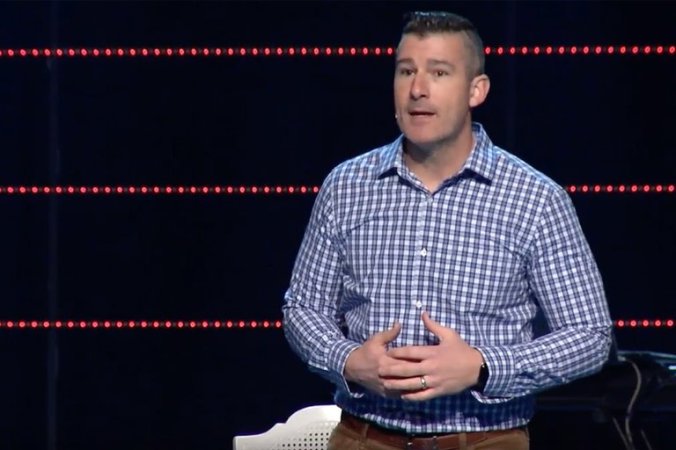
The Pastor’s Confession

Andy Savage confessing all. Well, not quite all. But the throng ate it up, and that’s what matters, right?

Jules Woodson accused Memphis magachurch minister Andy Savage of sexually assaulting her during a ride home in 1998. She was 17 at the time of the incident, and he was the 22-year-old youth minister at a Houston church. In a blog post on Watch Keep, Woodson described what happened. Savage had offered to drive her home, but took a detour into the woods.

“Suddenly, Andy unzipped his jeans and pulled out his penis. He asked me to suck it. I was scared and embarrassed, but I did it….I did it because I was scared and I was in shock and I didn’t understand what was happening. I remember feeling that this must mean that Andy loved me. He then asked me to unbutton my shirt. I did. He started touching me over my bra and then lifted my bra up and began touching my breasts,” she wrote.

“After what I believe to have been about 5 minutes of this going on, he suddenly stopped, got out of the truck and ran around the back and to my side before falling to his knees. I quickly buttoned my shirt back up and got out of the truck. Now I was terrified and ashamed. I remember him pleading, while he was on his knees with his hands up on his head, ‘Oh my god, oh my god. What have I done? Oh my God, I’m so sorry. You can’t tell anyone Jules, please. You have to take this to the grave with you.’”

Woodson said that she told another pastor at the church, and he told her to follow Savage’s demand and keep quiet.

She said felt compelled to take action in light of the “Me Too” movement, and emailed Savage last month reminding him of the incident.

Last Sunday, a few days after Woodson finally went public, Savage told his throng, “As a college student on staff at a church in Texas more than 20 years ago, I regretfully had a sexual incident with a female high school senior in the church.” The Highpoint Church congregation stood and applauded for 20 seconds, CBS News reported. Continue reading →

I Worry About Cary Grant [Updated]

…and James Cagney. And Kirk Douglas. And Bette Davis. And Rita Hayworth.

Seeing Kirk Douglas at the Golden Globes revived the concern that every Christmas season intensifies for me, when I realize that it is only Christmas that keeps such giants of entertainment past as Gene Autry, Bing Crosby and Dean Martin from fading into permanent obscurity.  The cultural figures who we remember are mostly the beneficiaries of moral luck, not a fair merit-based calculation. It is a random process, and culture, which is significantly defined by who and what we remember and who and what we forget, should not be shaped by coincidence, chance, and random amnesia.

It should not be, but it is. A classic example outside the realm of entertainment is the strange case of  Col. Joshua Lawrence Chamberlain, the hero of Little Round Top in the Battle of Gettysburg, and by some assessments the savior of the Union itself. When the story of Gettysburg was assembled by the battlefield commission, plaques erected and statues placed. Chamberlain’s desperate stand protecting the Union army’s flanks on Day Two of the battle didn’t make the cut. Despite as remarkable a career as anyone from Maine could have, and more than one shining moment of distinction during the Civil War, he was forgotten for more than a century. Then a brilliant, best-selling historical novel, “The Killer Angels,” recounted his heroics leading the 20th Maine so vividly that Chamberlain memory was re-animated, and began receiving the attention from historians that it deserved from the start.

In popular culture, whether a performer’s unique talents and contributions are remembered after more than a generation is now almost entirely dependent on whether there is a film featuring them that is regularly presented on television. Only a handful of performers who have permanently entered iconic status avoid that standard: I’d include Charlie Chaplin, Marilyn Monroe, Fred Astaire, Judy Garland, Shirley Temple and John Wayne in this category, with a few debatable others. (And even the Little Tramp, MM, Fred, Judy and The Duke aren’t necessarily  safe: once Rudolf Valentino, Laurel and Hardy, Lon Cheney, Greta Garbo, Boris Karloff and James Dean could be safely called icons. I doubt one Millennial in a hundred could identify any of them. Marlene Dietrich has a thumb-hold on her iconic status only because of  Madeline Kahn’s film-long send-up of her in “Blazing Saddles.”) Continue reading →

Morning Ethics Warm-Up, 1/10/2018: All Poll Edition [Updated and Corrected]

Good Morning, everybody.

1 The ancient Greeks in my family were pleased. Yesterday could be used in public schools to teach the concept of hubris. I doubt that public schools teach concepts like hubris, unfortunately. (I doubt that most public school teachers could explain hubris.) For in a single day..

  • We saw Steve Bannon dismissed from his kingdom, right-wing propaganda organ Breitbart.
  • We learned that Joe Arpaaio, who is only not facing prison time because of a generous pardon frm President Trump, and who lost his latest election for sheriff, and who is 85-years-old, announced his candidacy for the U.S. Senate in Arizona.
  • NJ Governor Chris Christie gave his farewell address, celebrating himself. Earlier this week he said that he would be President today if not for Donald Trump.

2. “What’s done is done.” Yesterday, a Democratic mouthpiece who sounded like Kristin Chenoweth on speed (looked like her too) was confronted with videotapes of the last two Democratic Presidents swearing that they were committed to strengthening the borders and enforcing immigration laws. “We are a nation of immigrants,” intoned Bill Clinton. “We are also a nation of laws.”

“What’s done is done,” blathered ‘Kristin.’

This is the unethical rationalization known on the Ethics Alarms list as #51 . The Underwood Maneuver, or “That’s in the past”: Continue reading →

Comment Of The Day: “Lies, Dunces, Fools, Villains, Hypocrites And Big Liars In The Resistance’s Plan E, “The President Is Disabled!” [Part 3]”

Here’s another one.

Regular readers here know I’m a sucker for Presidential history, even when I’m not the one expounding on it. I’m also a sucker for posts that I would otherwise have to write myself., and I was outlining a very similar post to this when Steve-O-in-NJ kindly produced this Comment of the Day. For of there is one thing my life-time love affair with the Presidency and the men who have had the audacity to try, always with mixed success, to fulfill its crushing challenges, has taught me, it is that these were all weird men, each in their own unique ways. You have to be weird to seek this job, or survive it.  The argument that Donald Trump’s undeniable weirdness is somehow deserving of less tolerance than any of the other Presidents is  bigotry mixed with ignorance. Leadership is itself abnormal, and has infinite guises.

Welcome to Steve-O-in-NJ’s Comment of the Day on the post, Lies, Dunces, Fools, Villains, Hypocrites And Big Liars In The Resistance’s Plan E, “The President Is Disabled!” [Part 3]

Washington was an inch away from leading an army personally to put down the Whiskey Rebellion. Andrew Jackson had a notorious temper (all his life), fought duels (though not while in office), and said he was going to hang the first South Carolinian who defied Federal law to the first tree he could find if bloodshed resulted from that defiance. LBJ gave interviews while on the toilet, more than once. Jimmy Carter talked about having consulted with his young daughter regarding policy matters and claimed to have seen a UFO. Calvin Coolidge brushed off a reporter who had made a bet that she could get more than two words out o him by saying “you lose.” Grover Cleveland had half his jaw cut out due to cancer and told the press he had two bad teeth extracted. He also married a woman who was young enough to be his daughter. Lincoln of course battled what we’d probably now recognize as clinical depression.

The two biggest offenders for presidential disability were Woodrow Wilson, who was actually completely disabled by a stroke and hid it, in effect making the nation an oligarchy ruled by his wife and closest advisors, and JFK, who hid the fact that he had Addison’s disease (why that didn’t keep him out of the Navy I don’t know), probably PTSD, and crippling back pain that sometimes left him unable to stand without drugs. I also wonder if it would be out of line to diagnose Clinton with satyriasis, given his behavior.

My main point is that some of the arguably best presidents like Washington and Jackson, others who were at least popular like Cleveland and Clinton, and some that official history is reluctant to examine too closely like JFK (although that is starting to change) all had issues of risky or extreme actions, bizarre behavior, or concealing disability from the public, and no one now calls any of them unfit for office, nor was that charge ever leveled to my knowledge at any of them with any level of seriousness. As far as I know no Republican leader has ever leveled the charge of mental or other unfitness at any Democratic president with any seriousness, although Clinton’s sexcapades, Carter’s incompetence and errors, LBJ’s open crudeness and weirdness, and JFK’s litany of problems presented the opportunity several times. Continue reading →

Comment Of The Day: “Morning Ethics Warm-Up, 1/7/2018: Lies, Dunces, Fools, Villains, Hypocrites And Big Liars In The Resistance’s Plan E, “The President Is Disabled!” [Part I]”

I am drowning, once again, in deserving Comments of the Day. This is a good thing in many respects, including the special circumstances that I am sick and have the energy of a spent battery. It is perplexing because it threatens to transform EA into an ethics version of Medium and put me out of a job.

One benefit of having such a diverse and erudite crowd here is that people who actually know what they are talking about have a tendency to interject when the discussion gets sloppy. John Billingsley just did this on the topic of dementia, which was much on everyone’s mind as a result of the embarrassing outbreak of  the anti-Trump coup plot known here as Plan E in the news media and among “the resistance.” (Here’s an especially revolting effort from yesterday by old Cross-Fire from the Left veteran Bill Press. When a opinion piece begins by calling a professor of psychiatry who has been rebuked by her own association “a leading psychiatrist” and asserts convincing authority in her announcing that the President’s mental health is “unraveling” based on a substantially debunked book, objective people can tell what’s going on, and it isn’t fair, dispassionate analysis.)

This is John’s Comment of the Day on the post, Morning Ethics Warm-Up, 1/7/2018: Lies, Dunces, Fools, Villains, Hypocrites And Big Liars In The Resistance’s Plan E, “The President Is Disabled!” [Part I]:

The word “dementia” is being tossed about here with little regard to what it actually means. It is a word that has a specific technical meaning and is not something that can be diagnosed by simply watching someone on TV or reading their tweets. There is no specific, single identifying symptom of dementia. Statements someone doesn’t like, decisions someone thinks are bad, slips of the tongue, lapses of memory, spelling or grammatical errors, calling another national leader “Rocket Man” and comparing your button to his, cutting off aid to Pakistan, enforcing the law as written, not believing in global warming, referring to yourself as a stable genius, acting like an idiot at times, doing inexplicable things, being unethical, etc. are not specific symptoms of dementia. Taken all together they do not make the diagnosis of dementia. To make a diagnosis in this manner is no more valid than diagnosing Hillary as having seizures based on a few movements seen on video.

Dementia is a syndrome, a group of symptoms that occur together, not a specific disease. There are many diseases that may result in dementia such as Alzheimer’s disease, Lewy body disease, and vascular disease to name only a few. The DSM V actually eliminated the term “dementia” and replaced it with the term “major neurocognitive disorder” but the diagnostic criteria are essentially unchanged and they are (taken from the DSM V):

Evidence of significant cognitive decline from a previous level of performance in one or more cognitive domains (complex attention, executive function, learning and memory, language, perceptual-motor, or social cognition) based on:

Concern of the individual, a knowledgeable informant, or the clinician that there has been a significant decline in cognitive function; and

A substantial impairment in cognitive performance, preferably documented by standardized neuropsychological testing or, in its absence, another quantified clinical assessment.

The cognitive deficits interfere with independence in everyday activities (i.e., at a minimum, requiring assistance with complex instrumental activities of daily living such as paying bills or managing medications).

There are a couple of other technical requirements that are not pertinent to this discussion.

As you can see the first criteria requires a “significant cognitive decline” in one or more areas of functioning. I don’t believe anyone can give specific examples from available sources to conclusively show there has been a significant decline. I don’t think there is any available evidence that even strongly suggests there has been a significant decline.

Has Trump himself, a knowledgeable informant (not an anonymous source), or a clinician who has actually examined him expressed concern that he has experienced a significant cognitive decline? Both Theresa May and Mike Pompeo, though not clinicians, have at least interacted with him in circumstances that would be likely to reveal significant cognitive impairment, and they say no. Has there been standardized testing or other quantified clinical assessment? If there is, it certainly isn’t public knowledge. Does he require assistance with taking his medications and paying his bills? I don’t know but I rather doubt it.

For anyone other than a qualified professional who has actually examined him to diagnose that he is demented is simply name calling and should be given the weight it deserves. Absolutely none. Now if you want to call him demented, a moron, an idiot, or anything else in the slang rather than technical sense of those terms, have at it, but don’t then try to pretend that you made a real diagnosis carrying any weight or satisfying the requirements of the 25th Amendment.