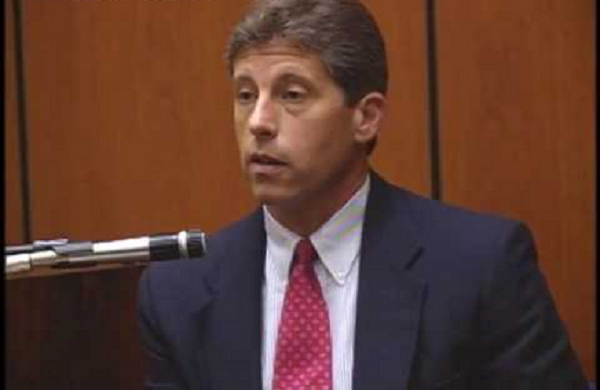
I challenged veteran EA commenter Jim Hodgson to respond to the oft-repeated accusation that “all cops lie.” Here is his response, a Comment of the Day on the post about the retired Boston detective who manufactured evidence to get more than a dozen (at least) innocent people convicted and jailed, “KABOOM!! Apparently There Is No Criminal Law To Charge This Police Detective Under”.…
Oh…I do want to make it clear that the choice of Mark Fuhrman to lead off this COTD is not in any way intended to subvert Jim’s points. I just believe that when asked for an example of a cop lying on the stand to avoid revealing information that might endanger a conviction, Fuhrman is who most Americans would think of first. My mind goes immediately to the corrupt detective played by Orson Welles in “Touch of Evil,” but you know me and old moves….
***
I think a lot of the phenomenon of police corruption (of all types) is dependent on where an officer works (the particular agency and its culture as well as the jurisdiction and its culture, crime rate, etc.), in addition to the moral character of the individual officer. I spent my whole career here in the mid-south, the so-called “Buckle of the Bible Belt,” in small cities and rural counties. The largest agency I worked for (27 years) had about two hundred officers and maybe forty civilian employees when I retired in 2014. Crime rates where I worked were nothing compared to major population centers. Our citizens were typically much more worried about residential burglary than violent crime. We usually had no more than two or three homicides per year, and perhaps six to ten armed robberies annually, mostly traveling criminals off the interstate highway.
I began my career in 1974. New York’s Knapp Commission had just released its final report on NYPD corruption (think “Frank Serpico”) a little over a year before I began. The report of the U. S. President’s Commission on Law Enforcement and the Administration of Justice report was pretty fresh, as well as the multi-volume report of the National Advisory Commission on Criminal Justice Standards and Goals. Most agencies in this region were trying to overcome the stereotypes of Southern “good-old-boy” knuckle-dragging law enforcement, and embracing new and higher standards in recruitment, hiring, training, retention and performance. Police corruption of all kinds was certainly at the forefront of concern for local politicians and police executives, and that trickled down throughout their agencies.






 Ethics Alarms