Welcome February Ethics Warm-Up, 2/1/22: Yes, Whoopi Is Officially An Idiot

A Janet Jackson movie is playing on cable, so of course we’re going to hear, again, how poor Janet was unfairly and cruelly blamed for “Nipplegate,” when the supposedly family-friendly Super Bowl half-time show featured an uncleared rapey bit of choreography in which Justin Timberlake “tore” Jackson’s costume, revealing her breast. It all happened on this date in 2004. CBS got fined and the NFL got in trouble. Timberlake lied, wink-wink, calling it a “wardrobe malfunction,” which everybody thought was cute. Historical revisionism has Janet as a victim of a sexist culture because she was the focus of most of the criticism and not the man in the plot. But it was her breast, after all. She also lied, and has been lying for almost 20 years.
Here is what I wrote about it in part on the Ethics Scoreboard the year it happened. I had forgotten: Janey Jackson got the very first Jumbo!
Janet Jackson has now appeared on the David Letterman Show to deny that her infamous Super Bowl breast-baring was anything but an accident. Before we discuss what a ridiculously transparent lie this is, let us also ask, “Why bother?” The damage, whatever it is, is done. Nobody is going to believe her. This was a fine opportunity for Jackson to stand up, admit an error in judgment, and use her celebrity to endorse some ethical values, like honesty, taking responsibility for one’s actions, and contrition.
But nooooooo.
Janet wants us to believe the incident was an accident, completely unchoreographed or planned. Never mind that:
- Justin Timberlake’s move uncovering Ms. Jackson’s breast occurred on a musical beat, corresponding to song lyrics referring to his “having her naked by the end of this song.”
- Her costume conveniently had a detachable flap that would expose the breast without doing any damage to the rest of her outfit.
- Her breast had a large, uncomfortable-looking decoration of some kind stuck to it, raising the obvious question of what it was doing there if it wasn’t intended to be seen.
- Timberlake’s comments immediately after the show confirmed that the moment was choreographed
Oh, just never mind. If this were a crime, any jury would find Jackson guilty beyond a reasonable doubt. Even the most dishonest people, when confronted with undeniable proof of their misdeeds, will usually confess. Not Janet Jackson.
Here’s your elephant, kid. This Jumbo’s for you!
1. Who can you trust? Justice Breyer was reportedly angry that his plans to retire at the end of the current SCOTUS term was leaked. Only close staff, family, his Supreme Court colleagues and the President had been made aware of his decision. He did not want to be a lame duck justice, and had asked his confidantes for confidentiality. Now the mystery of who betrayed Breyer’s trust is solved. Senate Majority Whip Dick Durbin (D-Ill.) told reporters yesterday that President Joe Biden’s chief of staff, Ron Klain, spilled the metaphorical beans.
If I were Breyer, my reaction would be to do what Donald Trump has done several times with leaks: make the leaker and the news media look foolish by changing course. I would not retire, after a betrayal like that, and make Democrats wait another term. Justice Breyer, however, doesn’t think this way Too bad. Continue reading
Ethical Quote Of The Week: Faculty Letter To GULC Dean Treanor In Support Of Illya Shapiro [CORRECTED]
So far, 106 professors from all points on the ideological spectrum have signed a letter to Georgetown Law Center’s Dean Treanor, telling him what should not have to be explained to a Top 20 law school dean: that “academic freedom protects [Illya] Shapiro’s views, regardless of whether we agree with them or not. And debate about the President’s nomination, and about whether race and sex play a proper role in such nominations more generally, would be impoverished—at Georgetown and elsewhere—if this view could not be safely expressed in universities.”
Shapiro, as discussed here, has been suspended (“put on leave pending an investigation”) by Treanor, and if past behavior by Georgetown Law Center is any indication, he is likely to be fired, forced to resign, or to have to humiliate himself by submitting to “sensitivity training” after a public confession of WrongThink.
Here is the letter, which appears to have been coordinated by the Foundation For Individual Rights in Education. Those seeking to add their names to the signatories can email facultyoutreach@thefire.org.
Disgracefully, no member of the GULC faculty has signed the letter to support their colleague—and the principles of freedom of expression and academic freedom at their own institution—as of this writing. Continue reading
It Reveals The Dire State Of U.S. Higher Education Culture That Dean William M. Treanor Of Georgetown University Law Center Isn’t The Most Unethical Law School Administrator Of The Past Year (It’s Close, Though…)
That distinction still has to go to Yale Law School Director of Diversity, Equity & Inclusion Yaseen Eldik and Associate Dean of Student Affairs Ellen Cosgrove, who persecuted, and and threatened a student in this infamous episode last Fall. Their victim is a student, which gives them an edge over Dean Treanor whose target is Ilya Shapiro, GULC’s newly hired director of the Robert A. Levy Center for Constitutional Studies and vice-president of the Cato Institute.
Just two days ago, I described Shapiro’s foray into the debate over President Biden’s looming Supreme Court nomination, which will have to be a black woman because race and gender are more important to the Far Left than qualifications, ability and experience in the branch of the government that protects the Constitution, but mostly because Joe promised he would while in Full Pander Mode as he fought for his party’s nomination to oppose President Trump in 2020. Shapiro issued a series of tweets that were crystal clear to anyone reading them rationally and honestly, making his case that Biden should be nominating Justice Breyer’s replacement on the basis of qualifications, ability and experience. A careless choice of words, however—this was Twitter, after all—gave race-baiters and progressive censors an opportunity to pounce, and they did.
Shapiro was accused of being a racist (of course); the law schools black student association demanded he be fired (also of course); and GULC’s ostentatiously woke Dean capitulated to the anti-free speech and anti-academic freedom mob, announcing yesterday to me and other “alumni/ae”, as the marvelous Dean I worked for, the late David McCarthy always called them…
“Election-Deniers!”
Apparently the latest deceptive slur on those who question the integrity of the 2020 election—which had less than any Presidential election in this century plus at least 40 years back in the previous one—is “election denier.” Nice. I found it ironic that just as an esteemed commenter here has been trying mightily in good faith to argue that the New York Times is not a constant purveyor of partisan propaganda, the paper headlines a front-page story, “Election Deniers Seek State Posts To Certify Votes,” a slimy and misleading header by any standard. Following in the muddy footsteps of the climate change fanatics, using “denier” to characterize those who oppose the Left’s cant, the Times headline plays a despicable cognitive dissonance game. “Denier,” until the climate change mob started using it, had previously only applied to the deniers of the Holocaust–fascists, anti-Semites, and morons. Thus, by extension, “deniers” in any context is similarly damning—and that’s the idea.
Unethical—And Ignorant!—Quote Of The Month: The Washington Post
“The air in humid, hotter environments contains more water, which can condense onto the virus particles, make them bigger and theoretically fall to the ground faster. Wu compares the particles to a rock in this case — the more mass, the faster it falls.”
—-Washington Post Reporter Kasha Patel, forgetting about Galileo and gravity in an alleged science article headlined, “Covid-19 may have seasons for different temperature zones, study suggests.”
Her editors also seem to have missed 6th grade science. In truth, I believe I learned about Galileo’s experiment with the Leaning Tower of Pisa before the sixth grade, after Santa left a children’s book about “great moments in science” in my sister’s stocking. We shared it, and it ended up with me: it’s around the house somewhere. I think about the book every time I end up on Walter Reed Drive in Arlington, which is often. His story is also in it; I wish I could think of the title.
The full quote is… Continue reading
Stop Making Me Defend President Biden!
At this point, President Biden has no choice, ethically or practically, other than to keep his promise to nominate a black woman to fill the Supreme Court vacancy. By all means, he deserves criticism for making such a promise, but that was done quite a while ago, when he was in full pander mode during the 2020 Democratic Presidential primaries. Breaking a pledge is never ethical, unless conditions have changed sufficiently to make the keeping of the pledge materially different from what was anticipated at the time, or if keeping the promise would be illegal.
It is often forgotten that President Reagan pledged to nominate a woman to the Supreme Court, and many liberal pundits at the time predicted that he would renege on that promise. He didn’t. It was a different kind of pledge than Biden’s however. There was a fairly deep pool of qualified women to choose from particularly if he dipped into the group of qualified female lawyers and academics. The lack of any woman ever sitting on the Court since the 18th Century had become an embarrassment. It wasn’t a matter of making the Court “look like America,” it was whether the Court could credibly look like a gentleman’s club. Continue reading
And The Civility Slide Continues…
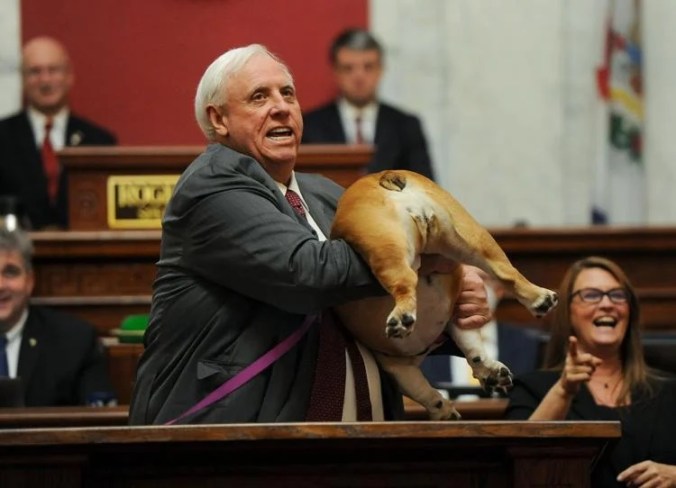
Don’t tell me this is funny. It’s not funny, as Jack Nicholson says in “Few Good Men.” It’s tragic.
West Virginia Gov. Jim Justice (R) , in his annual State of the State address, felt it necessary to further degrade public respect in elected leaders by telling Bette Midler to kiss his dog’s ass—OK, he said “hiney.” What a genteel gesture.
At the tail of an hour-long address, Justice lifted his bulldog and displayed “Babydog’s” anus et al. to say to the critics of Sen. Joe Manshin who denigrated his state while savaging him for not following in lockstep to the Lockstep Party,
They never believed in West Virginia that we could do it. They told every bad joke in the world about us. And so from that standpoint, Babydog tells Bette Midler and all those out there, kiss her hiney.
What a clod. There’s nothing like giving support to the dolts like Midler who resort to stereotypes and ad hominem attacks to make their ignorant political arguments by behaving just as crudely as the bigots expect.
This doesn’t help.
Let’s have a pool on who will be the first elected official to tell critics, “Suck my dick!”
My money’s on a female.
Sunday Ethics Fugue: Looking Like America
1. Right on cue...I am seeing an explosion of articles explaining why it is crucial that the Supreme Court “look like America.” This is one of many logically indefensible statements that is pounded into the brains of weak-minded members of the public because it sounds rational if you don’t, or can’t, think about it very hard. What is important about the membership of the Supreme Court is that it contain the best and least biased judicial scholars and legal analysts available, because then we will have the best Supreme court available. I don’t care what the Justices look like, and neither should anyone else. If the nine best legal minds happen to be black, great. If they are all female, or trans, or gay, or in wheelchairs, I don’t care, and neither should anyone else. What drives this particular brand of lookism is the presumption of bias, and judges are supposed to be, indeed are required to be, as free as bias as possible. Bias leads to lousy judges and lousy decisions. The “Make SCOTUS look like America!” crowd, which is almost exclusively on the left, want to substitute a balance of biases standard for the “as little bias as possible” standard. And, of course, the new eruption of this dumb theory is in order to make President Biden’s indefensible decision to place race and gender first among the priorities for picking Breyer’s replacement seem fair, just and rational, when it isn’t. It’s just political pandering.
2. This is a novel way to try to justify the anti-white bias...Jamelle Bouie, the full-time, race-baiting, race-obsessed black pundit formerly of Slate and now with the Times, was given an astounding two full pages in today’s Sunday Review to argue that history hasn’t sufficiently described just how awful slavery was. See, it wasn’t just evil, it was really, really, really evil. “Evil beyond measure!” Thus, we are supposed to extrapolate, it was so unimaginably evil that no current day policies devised to compensate for and make amends for that evil by the descendants of those not enslaved can ever be enough. (So stop bitching about giving blacks an edge in employment forever, because even that won’t be enough.)
Catching Up: Professional Ethics And The Challenger Disaster

Because of non-ethical matters in the Marshall household, I missed posting about the January 28 anniversary of the Challenger disaster, as it is labeled among the thousands of Ethics Alarms tags. I have written about and alluded to the completely avoidable explosion of the Space Shuttle in 1986 many times (you can check here), and there may be no other incident that so perfectly encapsulates the complexities of professional ethics, especially in a bureaucracy. In 2016, I offered an ethics quiz on the topic.
In 2020, Netflix presented an excellent, if extremely upsetting, docudrama on how the fiasco unfolded, “The Challenger Disaster.”
I have used the tragedy in my legal ethics continuing legal education courses to force attendees to consider what might make them decide to breach legal ethics and place their careers at risk when an organizational client is hell-bent on what the lawyer knows, or thinks he or she knows, will be disastrous. Legal ethics rules are different from engineering ethics, though the latter has caught up considerably since the Space Shuttle explosion, and in part because of it. However, I view the ethics conflict in parallel situations in both professions the same, as well as situations in medicine, organized religion, the military, and government. When would, and should, professionals decide to do everything in their power to stop the consequences of a terrible decision when it is outside their role and authority to do so?
In my legal ethics seminars, a majority of lawyers ultimately say they would have done “whatever it took” to stop the Challenger’s launch, whatever the consequences, if they knew what the engineers knew. They said they would go to the news media, or chain themselves to the rocket if necessary. Of course, saying it and doing it are very different things.
Here is the most recent incarnation of my Challenger disaster legal ethics question, which I presented to government lawyers a year ago. What would you answer? It is called “The Launch.”
***
In 1986, Roger Boisjoly was a booster rocket engineer at Morton Thiokol, the NASA contractor that, infamously, manufactured the faulty O-ring that was installed in the Space Shuttle Challenger, and that caused it to explode. Six months before the Challenger disaster, he wrote a memo to his bosses at Thiokol predicting “a catastrophe of the highest order” involving “loss of human life.” He had identified a flaw in the elastic seals at the joints of the multi-stage booster rockets: they tended to stiffen and unseal in cold weather. NASA’s shuttle launch schedule included winter lift-offs, and Boisjoly warned his company that sending the Shuttle into space at low temperatures was too risky. On January 27, 1986, the day before the scheduled launch of the Challenger, Boisjoly argued for hours with NASA officials to persuade NASA to delay the launch, only to be over-ruled, first by NASA, then by Thiokol, which deferred to its client. Another engineer, Bob Ebeling, joined Boisjoly and begged for the launch to be postponed, only to be overruled.
That night, Ebeling told his wife, Darlene, “It’s going to blow up.”
Question 1: Should one or both of the engineers have “blown the whistle”?
- They did.
- Only the engineer who was sure that it would be a disaster.
- No, that’s not their role, their decision, or their call.
- After the explosion, but not before.
- I have another answer.
Question 2: How are the ethical obligations in such a situation different for government lawyers than engineers?
- Government lawyers have to disclose when human life is threatened, engineers don’t.
- Engineers have to disclose when human life is involved, government lawyers don’t.
- Lawyers get kicked out of their profession for blowing whistles, engineers just get blackballed.
- There is no difference.
- I have another answer.


I was very pleased to receive this Comment of the Day by Ryan Harkins on the post “Catching Up: Professional Ethics And The Challenger Disaster,” because it focuses on the ethics of risk, a great topic that EA hasn’t covered as well as it should.
I’ll have one brief note at the end.
***
I was 4 and in preschool when the Challenger exploded. We watched the launch on TV before I went to school that day, and apparently it really disturbed me, because I bit another student and then hid under a table for the rest of the day.
Working at the refinery now, we get to revisit the Challenger explosion frequently (along with the Bhopal Union Carbide gas leak, the Texas City tanker explosion, the Texas City ISOM explosion, and a host of others) when discussing process safety. Michael West is absolutely right in that it isn’t simply a calculation of what the worst consequence is, but also the likelihood of that occurring.
Part of the reason the engineers’ concerns were dismissed was because the problem with the O-rings had been known and discussed for quite some time, and there had been numerous launches prior to this one that had been perfectly successful. In other words, NASA had gotten away with using the faulty O-rings before, so they saw no reason to be overly concerned this time around. Furthermore, the launch had already been delayed multiple times, and they were under intense pressure to launch. Why should they listen to the doom-saying of engineers when empirical evidence said the worst-case scenario was not going happen?
Continue reading →