Two Ethics Movies For The Holidays

I typically use this time of year to catch up on or revisit ethics movies, especially since the ones in the Christmas sub-category are embedded in my brain already. Two ethics movies that I recently watched again are Ben Affleck’s “Gone Baby Gone” from 2007 and “Seven Days in May” (1964).

“Gone Baby Gone” is the more obvious ethics movie thanks to its famous ending, which sparked thousands high school essay assignments at the time of its release. I can’t write too much about that ending without spoiling the film for you if you’ve never seen it; let me just state that the climactic decision made by the film’s protagonist, played by Ben’s brother Casey, is or should be an ethics no-brainer. It’s depressing to me that so many viewers agreed with the character’s ethically clueless, emotion-driven girlfriend that his solution to an admittedly wrenching ethics conflict made him a monster. There is literally no ethical system that would legitimately support her argument, which can only be backed by using an army of rationalizations. That a large proportion of the public, perhaps a majority, would back her analysis shows how miserably the education system and our culture has failed in teaching basic ethics problem-solving skills.

“Seven Days in May” presents more diverse and complex ethical issues to consider, and also is old enough after almost 60 years that I have no hesitation in revealing the plot: if you have never seen it, you should have.

That movie is also fascinating as a period piece, flashing ideas and images that seem surprisingly familiar in today’s context in rapid juxtaposition with moments that are hard to imagine today. Silent protests in front of the White House? Women picketing in dresses and men in suits and ties? I found a review of the film from The Harvard Crimson in 1964 that featured this:

“[T]he film has a civil rights tinge. The producer has dutifully used Negroes in minor roles wherever he deemed it appropriate. A Negro in the Pentagon running an automatic door receives a good deal of film footage. Negroes sit in the airports. They march in the pro and anti-treaty lines before the White House. Finally, there are Negroes at the President’s press conference as the film closes. These are simply kowtows to the New Republic set; if the producer had real guts he could have cast Sydney Poitier in Kirk Douglas’ role. But then Producer Edward Lewis would have been troubled by the script’s implication that Douglas will some day sleep with Ava Gardner, who plays Lancaster’s former mistress. Miscegenation might have confused the good guys and the bad guys, particularly for southern audiences. Anything that controversial would have detracted from the film’s propaganda force.“

Fascinating, don’t you think? Today, mixed-race couples on TV and movies are de rigeur, even when it makes no historical sense whatsoever. Today, it takes courage to resist the political correctness edicts that “actors of color” be gratuitously shoehorned into stories and casts based on skin-hue and little else. But today the motivation isn’t “civil rights” but rather affirmative action and “racial justice.” I really don’t care that in Netflix’s “Enola Holmes” blacks turn up in highly unlikely roles for Victorian England, I really don’t. OK, it’s a misrepresentation of history, but the film is a fantasy. However, such blatant virtue-signaling and diversity box-checking does take me out of the story for a moment, and that’s just bad direction. (How many black female martial arts tutors were there in Victorian England, I wonder?)

But I digress. “Seven Days in May” was indeed anti-war, nuclear disarmament propaganda in 1964 at the height of the Cold War, but that’s not one of the ethics issues central to the film.

Continue reading →

Ethics Dunce: Santa Claus

In a video that has “gone viral,” a mall Santa, socially distanced of course, engages in conduct that by Ethics Alarms standards triggered a duty to confront on behalf of the mother of the child he mistreated.

I wish we could determine when and where this episode occurred; I half expect to find out that it was staged by Breitbart or James O’Keefe. Assuming the video is genuine, howeverit is an example of a Santa Claus seriously abusing his authority.

In the video, a little boy is seen sitting across a table from Santa who asks, “What do you want for Christmas?” The child inaudibly asks for a toy gun, and Santa responds, “No guns.” Even after the mother clarifies that her son only meant a Nerf gun—you know, these sinister playthings…

Best-Nerf-Guns-for-Toddlers

Continue reading →

Comment Of The Day: “These Are The “Experts” Your Present And Future Masters Rely Upon”

Benjamin-Franklin-Quotes

For your Wuhan virus pleasure today, here is Glenn Logan’s Comment of the Day on the post, “These Are The ‘Experts’ Your Present And Future Masters Rely Upon”:

Jack said: “I’m not going to wear a mask inside my home, nor in my car, nor outside while playing with my dog, and I’m going to regard anyone who follows this edict with a “please” attached as an enemy of my future liberty as an American.“

As a person who has taken college classes in both epidemiology and virology as part of my course of study, I can tell you that yours is a sane response. I don’t style myself any kind of an expert, but I do know plenty about both subjects. The SARS-CoV-2 virus appears to require a minimum viral load to produce symptomatic disease, and that load is nearly impossible to achieve outside without being in crowded close quarters due to natural air currents.This is one likely explanation why there are so many asymptomatic infections. Viruses producing the common cold display this same characteristic, and coronavidae is one of the cold-producing families of virus. As far as wearing a mask in a car, this is unnecessary unless you have high-risk potentially exposed people other than you moving in and out of it all the time, and don’t follow basic sanitation rules. Even then, the risk of dangerous viral concentrations in a single-person car are very small.

Continue reading →

Roald Dahl And The Imaginary Apology

896full-airport-screenshot

In “Airport,” the ’70s disaster movie, actress Maureen Stapleton (above) has a memorable and moving moment at the end of the movie, greeting the disembarking passengers on the plane nearly brought down by her disturbed husband’s bomb, and saying, tearfully, “I’m sorry! I’m so sorry!” She received an Oscar nomination for it. But the passengers weren’t going to forgive the man who nearly killed them because his wife was apologizing. What makes the scene so touching is her desperation and guilt when she did nothing to feel guilty about. Her apology, no matter how emotional, was meaningless to those who were receiving it.

Roald Dahl, who died in 1990 at the age of 74,was a famed and critically acclaimed writer of classic children’s books like “Charlie and the Chocolate Factory,”“The BFG,” “Matilda,” and “The Witches.” He was also, by his own admission, an anti-Semite, complete with a belief in “Jewish bankers” controlling world economies. Now that writers and artists face “cancellation” from the self-empowered censors of the cancel culture, his family has taken to Dahl’s “official website” to offer an apology to the world.

“The Dahl family and the Roald Dahl Story Company deeply apologise for the lasting and understandable hurt caused by some of Roald Dahl’s statements,” read the online statement.. “Those prejudiced remarks are incomprehensible to us and stand in marked contrast to the man we knew and to the values at the heart of Roald Dahl’s stories, which have positively impacted young people for generations. We hope that, just as he did at his best, at his absolute worst, Roald Dahl can help remind us of the lasting impact of words.”

Continue reading →

Morning Ethics Warm-Up, 12/7/2020: The Day That Will Live In Infamy

Pearl Harbor

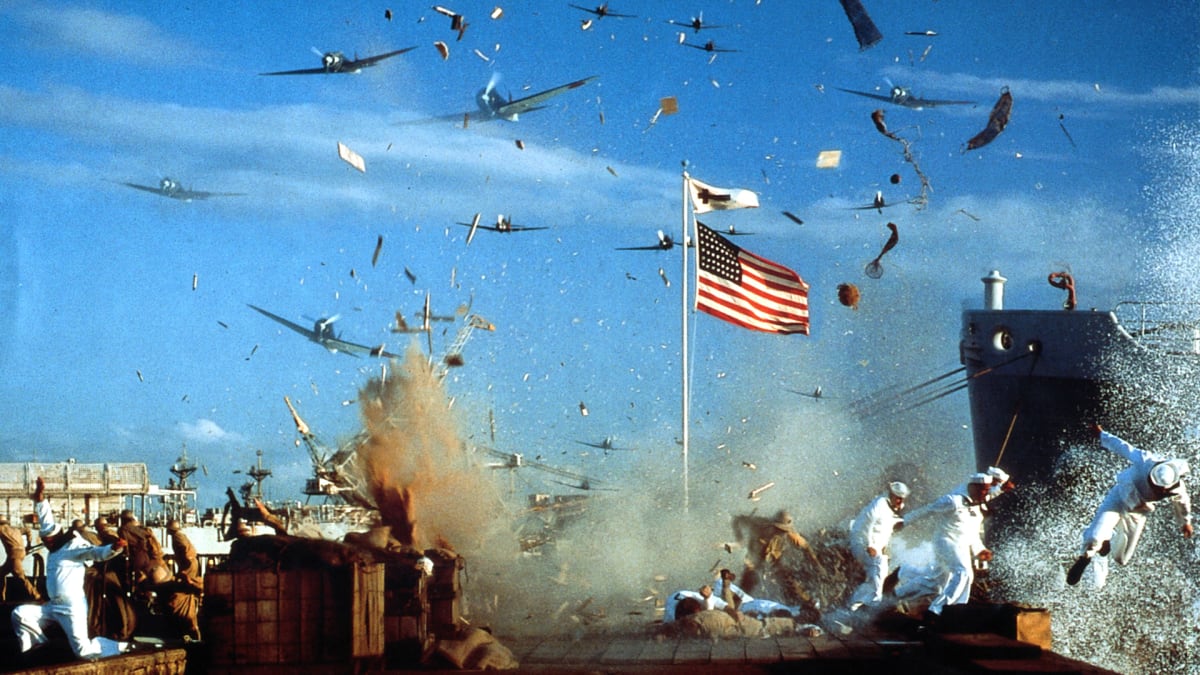
Today, of course, is the anniversary of the Japanese sneak attack on Pearl Harbor on December 7, 1941.

At 7:55 a.m Hawaii time, a Japanese dive bomber emerged out of the clouds above the island of Oahu. 360 Japanese warplanes followed in a devastating attack on the unsuspecting U.S. naval base at Pearl Harbor. The U.S. Pacific fleet was nearly obliterated: Five of eight battleships, three destroyers, and seven other ships were sunk or severely damaged; more than 200 aircraft were destroyed; 2,400 Americans were killed and 1,200 were wounded. Japan lost just 30 planes and fewer than 100 men. By the sheerest luck, all three Pacific fleet aircraft carriers were out of the harbor and at sea on training maneuvers, allowing the U.S. to use them to turn the tide of the Pacific war against Japan at the Battle of Midway six months later.

I always felt connected to the tragedy at Pearl Harbor through my father. At the dedication of the World War II Memorial in Washington, D.C., Dad introduced me to a veteran who had survived the attack, and just shaking his hand was a moving experience I shall never forget.

1. I’m glad I’m not a South Korean ethicist, because this would make my head explode. More than 200,000 young men each year​ have to interrupt their studies or careers in South Korea to join the military, for mandatory conscription is seen as crucial to the country’s vigilant defense against North Korea. Men must enlist for about 20 months once they turn 28. Last week, however, pop star Kim Seok-jin, the oldest member of the global K-pop phenomenon​ BTS​, turned 28 knowing that he could keep on singing, recording, touring and making money: South Korea’s Parliament passed an exception to the country’s Military Service Act​ to allow top K-pop stars like Mr. Kim postpone their ​military ​service until they turn 30.

There’s just no excuse for this classic “laws are for the little people” move, only rationalizations. “It’s a sacred duty to defend our country, but that doesn’t mean that everyone has to carry a weapon,” Noh Woong-rae, a senior lawmaker in the governing​ Democratic Party, ​said in a fatuous statement supporting the special treatment. The bill to craft pop stardom exception the Military Service Act was first introduced in September, after BTS became the first South Korean group ever to top the United States Billboard Hot 100 singles chart with its song “Dynomite.”

Here is the song that helps defend South Korea:

Continue reading →

Help! My 2020 Christmas Tree Ethics Dilemma

Osage-XMas-Trees-1292x609

It’s always something, as Rosanne Rosannadanna used to say.

The Virginia Marshalls joined two families with intense Christmas traditions, centered on elaborately decorated Christmas trees. The Marshalls of Massachusetts collected ornaments and antique tinsel, and their trees really shined with the lights off. When on, the Christmas tree lights were the old-fashioned large bulbs, and muli-colored. The Bowens, of the Washington, D.C. area, in contrast, were lights-obsessed. Every Christmas season, Mrs, Bowen decorated a large, very realistic artificial tree with thousands of small white lights. For 40 years, our household has maintained a hybrid tradition: real trees, thousands of small, multicolored lights, hundreds of ornaments of all sizes, themes and ages, and no tinsel.Our trees must be at least eight feet high, with strong branches and tough needles. Most of our trees have been Frasier Firs, with an occasional Douglas Fir or Noble Fir; twice, when I was in a masochistic mood, we used Blue Spruce trees, and I was nearly prickled to death.

In recent years, we’ve let our next door neighbor of the full 40 years pick out our tree. (I recently wrote about Red and Beth here.) He has sold Christmas trees for his church all that time, and he knows what we need and like—or always has in the past. But yesterday he left leaning against our house some kind of pine with long needles, soft branches: the furthest thing from a fir tree imaginable. It is, my wife thinks, the same kind of tree his wife Beth likes, but it won’t work with the traditional Marshall decorations. My wife is upset, and I’m not thrilled either: I have to put on the lights, and I don’t see how this tree will hold the usual number of strings.

Continue reading →

Ethics Quiz: The Marilyn Monroe Statue

MM statue

Alternate title: “At Last A Statue Everyone Can Get Behind!”

At least this statue ethics controversy has nothing to do with the Civil War.

Palm Springs, California’s City Council voted last month to place a giant sculpture of Marilyn Monroe, her white skirt blown up above her waist and her mouth poised in the semi-erotic smile everyone remembers from the classic movie moment, in the middle of the city. For three years, 2012 to 2014, the sculpture by Seward Johnson enlivened downtown Palm Springs, and now it will be coming back with financing from a local hotel consortium. The 26-foot high “Forever Marilyn,” turned up as a short-term tourist attraction in other cities in the intervening years (many visitors enjoyed posing for photographs between MM’s feet, looking up) but now Palm Springs is offering it—her?— a permanent home.

Ah, but all statues are controversial now. Marilyn will stand across from the entrance to the Palm Springs Art Museum, and its executive director Louis Grachos objects. “You come out of the museum and the first thing you’re going to see is a 26-foot-tall Marilyn Monroe with her entire backside and underwear exposed,” Grachos pointed out to the council. “We serve over 100,000 school-age children that come to our museum every single year. What message does that send to our young people, our visitors and community to present a statue that objectifies women, is sexually charged and disrespectful?” The museum’s previous three directors, Elizabeth Armstrong, Steve Nash and Janice Lyle, designer Trina Turk and others issued a joint op-ed in The Desert Sun condemning the statue as “blatantly sexist.”

Your Ethics Alarms Ethics Quiz of the Day is...

Is Johnson’s statue of Norma Jean unethical public art?

Continue reading →

Sunday Morning Ethics Warm-Up, 12/6/2020: Euphemism, Epidemiology And Epistemology

Blazing Sun

1. Unfortunately, the University of Chicago is not typical of American educational institutions. Smith College is. When Jodi Shaw, a Smith administrative staff member, criticized the college’s critical race theory-based “sensitivity training” required of all staff members and posted here own YouTube videos on the issue, the president of Smith College, Kathleen McCartney, felt it necessary to issue a formal statement that said in part:

This past week, an employee of the college posted a personal video to express their concerns about the college’s programming to promote racial justice….This employee does not speak for the college or any part of the college. Further, we believe the video mischaracterizes the college’s important, ongoing efforts to build a more equitable and inclusive living, learning and working environment.

You should know that the employee has not violated any college policies by sharing their personal views on a personal channel. The National Labor Relations Act protects employees who engage in concerted activities, including speech, with respect to workplace conditions. All members of any workplace, including Smith College, have the freedom to criticize the policies and practices of their employer.

Nevertheless, I am writing to affirm that the President’s Cabinet and I believe we have a moral responsibility to promote racial justice, equity and inclusion at Smith College. To the people of color in our community, please know our commitment is steadfast. And especially to our students of color, please know we are here for you always.

All members of Smith College, have the freedom to criticize the policies and practices of their employer; they just risk having the president call them racists.

“Racial justice” is now an Orwellian phrase and euphemism (like “black lives matter”) to avoid discussion and to cut off dissent before it starts. After all, what kind of person objects to “justice”?

2. But wait! There’s more! In an open letter to the Smith community authored by an alumnae group, Shaw is being targeted for “re-education”:

Continue reading →

These Are The “Experts” Your Present And Future Masters Rely Upon

monster-replica

If I weren’t so sick of this topic, it would deserve longer post…a rant even.

Reason reports that many epidemiologists believe we should all wear masks and socially distance forever:

“I expect that wearing a mask will become part of my daily life, moving forward, even after a vaccine is deployed,” Amy Hobbs, a research associate at the Johns Hopkins Bloomberg School of Public Health says.Marilyn Tseng, an assistant professor at California Polytechnic State University, said life would never revert to the way it was, though the preventative measures currently practiced—masks and social distancing—will feel “normal” in time. Similarly, Vasily Vlassov, a professor at HSE University in Moscow, said life was perfectly normal now because this is the new normal….”

Of course they say that. Are you surprised?

Continue reading →

Ethics Hero Prof. Dorian Abbot Rescued By Ethics Hero Robert Zimmer, University Of Chicago President

Screen-Shot-2020-11-30-at-3.13.33-PM

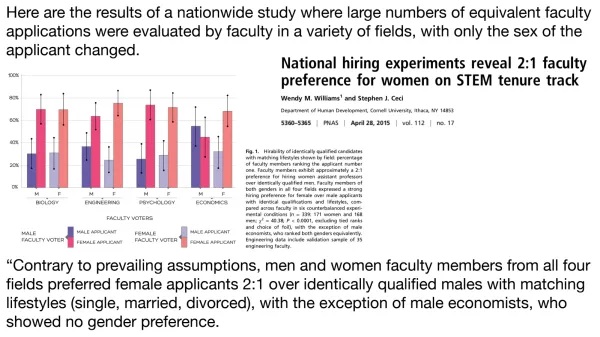
Dorian Abbot, a professor of geology at the University of Chicago, was troubled when a colleague in his department gave an internal seminar that included the idiotic and unethical quote, “If you are just hiring the best people, you are part of the problem.” The setting being a university, Abbot set out to provoke some enlightened discussion on this assertion, creating a video slide show including graphics like the one above.

His primary messages in the presentation were, he wrote, that “we need to think through the consequences of diversity efforts on campus lest they harm promising scientists of all demographics; adjusting departmental demographics at elite universities doesn’t solve any problems, but may make some worse, and that ” the current academic climate is making it extremely difficult for people with dissenting viewpoints to voice their opinions.

Yes, “The Horror.” Such opinions obviously meant that the professor was evil and a danger to everyone on campus.

The professor writes,

Continue reading →