We’ve started a year without a dog enriching each day for the first time in over three decades. Don’t like it much.
1 . Lobbying the Supreme Court against abortion. 207 members of Congress — 39 senators and 168 House members from 38 states — filed an amicus brief urging the Supreme Court to uphold a Louisiana anti-abortion law when it hears the case in March, stating they “have a special interest in the correct interpretation, application and enforcement of health and safety standards for elective abortion by the people of the states they represent.” In the brief, the mostly GOP legislators (two Democrats also signed on) implore the Supreme Court to uphold a lower court’s decision to let stand a Louisiana statute that requires physicians who perform abortions to have admitting privileges to a hospital within 30 miles of where the procedure is being performed. SCOTUS declared virtually the same law unconstitutional in Texas; the argument for this law is that Texas is bigger than Louisiana.
I’m serious.
The Center for Reproductive Rights argues that the Louisiana law is really an effort to “regulate abortion out of existence,” claiming that only one physician in the state would be able to provide abortions if the law is allowed to stand.
Oh, I think it’s pretty obvious what’s going on.
2. Another Big Lie. When I went to a local cineplex to see “Ford vs. Ferrari,” I was stunned at how few employees were in evidence at a movie house with 18 screens and hundreds of people buying tickets. There was one human being selling tickets, the rest were dispensed by automated kiosks. There were no ticket-takers at all; we figured out that we could have just walked into any of the theaters without showing a ticket to anyone. To buy drinks and snacks, I had to stand in a line for over 20 minutes, because only one person was filling orders. Continue reading →
In my one, fortuitous one-on-one conversation with futurist Herman Kahn, then regarded as the most brilliant man in America, he observed that society periodically for forgets everything it has learned over the years, and then chaos reigns temporarily until bad ideas and horrific mistakes re-teach the lessons that once were accepted as obvious. He was talking about the Sixties, but it is clear that this is another one of those periods. Kahn also noted that some of the forgotten lessons are re-learned too late to save society from permanent harm. The Sixties gave us socially acceptable promiscuous sex and the resulting normalization of children born out of wedlock, the re-assignment of of abortion as ethical (somehow) rather than criminal, and societal sanctions of recreational drug use.
Nice work, Boomers…
1. Speaking of abortion...can there be a more empty, fatuous justification of it than what Senator Cory Booker tried last week? ”Abortion rights shouldn’t matter to men because women are our mothers, sisters, daughters, friends,” Booker tweeted. “They should matter to men — to everyone — because women are people.”
How profound. Nobody has ever disputed that women are people, and Booker’s non-logic—the statement compels the response, “And SO…????”—is an appeal to emotion without substance. It also makes its own rebuttal screamingly obvious to anyone but a pro-abortion zealot: “Abortion should be repugnant to men and women…and Presidential candidates…because unborn babies are living human beings.” Continue reading →
1. “Radical? What radical?” Stanford law professor Pam Karlan, who stood out as a neon beacon highlighting 2019 Democratic Party extremism when she turned her House testimony on impeachment into an unhinged, Trump-hate rant including a cheeap shot at Barron Trump’s name, was apparently too radical for Barack Obama, says Legal Insurrection. He appointed far more moderate Solicitor General Elena Kagan to the Supreme Court, despite Democrats then being in control of both Houses.
“Fast forward to 2019, and this radical Obama SCOTUS reject is a star witness for the Democrat impeachment circus,” the blog notes. “It’s surreal how completely the Democrats have removed themselves from any semblance of rational thought when it comes to their impeachment obsession.”
If we regard the public as the jury and the House Democrats as prosecutors, how can one explain putting such an angry, ugly, biased and partisan fanatic on the metaphorical stand as an “expert witness”? Isn’t that gross incompetence? What’s going on here? In fact, let’s poll it. Who knows, maybe it will draw almost as much interest as the Peloton commercial poll, the second most active in Ethics Alarms history (so far). (But then there were more Google searches on “Peleton” than “impeachment” last week, so we know what American priorities are…)
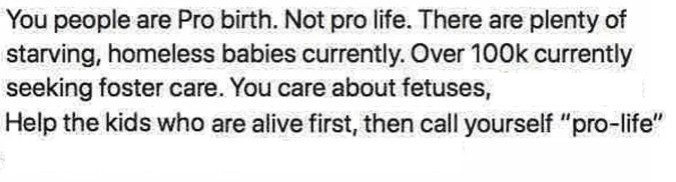
2. Polls suggest that public opposition to abortion is rising again. Gee, I wonder why?
The Knights of Columbus, a Catholic charity organization, was accused accusations of “shaming women” after the group erected a monument to aborted babies in a Canadian cemetery. Local activists were offended by the gravestone.
“Can you believe this?” wrote one on Facebook. “Knights of Columbus Belleville (all men) organized this absolutely shameful act ….and also posted it on their facebook page.” Erecting a the memorial is shameful. Got it.
Well, they were just warts and parasites, so she has a point.
The National Post reported that the coordinator of a protest over the memorial stone, Elissa Robertson, accused the Catholic charity of “attacking a women’s right to choose,” saying,
“It was designed to shame people. I think it was absolutely uncalled for and that money they put into this anti-abortion monument could have done a lot of good somewhere else. It ties into patriarchal values and this idea that women’s bodies are meant to be controlled by men. It’s a broader issue that ties into violence against women, it ties into health care, it ties into safety.”
It ties into climate change! It ties into racism! It ties into tooth decay!
If one has no regrets or shame about snuffing out nascent human lives, then how does the monument shame you? The abortion argument is very difficult to win on a factual or ethical basis, but advocates have learned that “How dare you!” and “Shut up!” are very effective.
Actress Jameela Jamil certainly isn’t ashamed. She’s refreshingly honest…and scary. In a November Harper’s Bazaar interview with Gloria Steinem, she said,
“I’m very outspoken about the fact that I, similarly to you, feel very passionately about a woman’s right to choose I’m someone who’s had an abortion, and I feel like I need to make sure that we prove it’s not always just emergencies. People have abortions, sometimes a woman just wants her liberty, and we have to normalize that it’s okay just to make that choice for yourself, because your life is as important as a newborn life that doesn’t even exist yet.”
Wait, if it’s not living, then why do you have to kill it? Is it really a fair to compare your avoiding an inconvenient responsibility or life disruption with another human being losing its life? Challenged on this, the actress responded on social media, “I SAID WHAT I FUCKING SAID and you’re clueless if you think I’m going to take it back. My life is more important to me than an unborn fetus’s one. Suck on THAT!”
Wait: I thought you said no life was involved.
This is the approximate level of thought, sensitivity and ethical analysis we hear from almost all pro-abortion activists. Basic competence and responsibility rules: if you can’t discuss a topic more articulately and thoughtfully than this, leave the issue to others. Here’s another one of Jamil’s clever arguments:
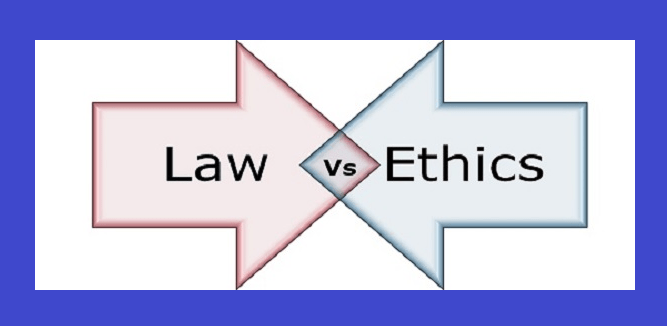
The comments on the recent post regarding the so-called conscience rule being voided in court generated the comments the topic always does. What follows is a relatively short, general post to frame the issues as clearly as possible. Admittedly, when a post is titled “When Law and Ethics Converge,” perhaps I shouldn’t have to explicate with a post focusing on the difference between law and ethics. I strongly believe that conscience clauses undermine the law, and are unethical, as you will see.
Law and Ethics are not the buddies people think they are, or wish they were. If you look around Ethics Alarms, you see why. Ethics, as the process by which we decide and learn what is good and right conduct, evolves with time and experience. A predictable cut of a society’s ethics are always going to be a matter of intense debate. Ethics are self-enforcing, for the most part and by nature, because being ethical should make us feel good. Once an authority or power starts demanding conduct and enforcing conformity, we are mostly out of the realm of ethics and into morality, where conduct is dictated by a central overseer that, if it is to have genuine authority, must be voluntarily accepted by those subject to its power.
Society cannot function on ethics alone. Without laws, chaos and anarchy result. Because chaos and anarchy are bad for everyone, no individual who has accepted the social compact may decide which laws he or she will follow and which he or she will defy—at least, not without paying a price, which is society’s punishment. In ethical terms, this is a utilitarian calculation: we accept laws that individually we may find repugnant, because allowing citizens to pick and choose which laws they will obey as a matter of “conscience” doesn’t work and has never worked. Ethics pays attention to history.
Thus it is ethical to obey the law, and unethical not to, even if good arguments can be made that particular laws are themselves unethical. This is where civil disobedience comes in: if a citizen chooses to violate a law on a the basis of that citizen’s conscience or principle, the citizen also has to accept the legal consequences of doing so as an obligation of citizenship. Continue reading →
Today’s decision by U.S. District Judge Paul Engelmayer, voiding the Trump administration’s “conscience rule” that resuscitated the Bush Administration’s similar rule, is right on the law, and, more important for this blog, right on ethics. The Trump version, which was yet to go into effect, allowed health-care providers to refuse to participate in abortions, sterilizations or other types of care they if they disagreed with them on religious or moral grounds.
It was an invitation to open-ended discrimination, and as objectionable in principle as allowing public accommodations to refuse to serve Jews, blacks or gays. This topic has been thoroughly explored on Ethics Alarms over the years, and I don’t have anything much new to say. In fact, perusing my various essays on the topic, my favorite is one that is so old, it was on the Ethics Alarms predecessor the Ethics Scoreboard (on which I am slowly making progress in my efforts to get it back online) and mentions Paris Hilton, working at Blockbuster, and an earlier incarnation of Colin Kaepernick in the NBA.
1. Not exactly a shock, but we now know Ruth Bader Ginsburg lied in her 1993 Senate confirmation hearings. At a Georgetown Law Center event last week featuring both Clintons and Justice Ruth Bader Ginsburg, Bill Clinton told the audience that he queried the Justice-to- be about Roe v. Wade before nominating her to the Supreme Court in 1993:
[Ginsburg] knew this perfectly well, that I was under a lot of pressure to make sure I appointed someone who was simon-pure, which I had said I thought was important. But I was fascinated by a—either an article I had read or something I had read on Justice Ginsburg saying that she supported the result in Roe v. Wade but thought Justice Blackmun should have decided the case on the equal protection clause not the right to privacy. And I asked her the question and she talked about it just as if it was any other issue, no affect: “This is what I think, this is why I think it,” and she made a heck of a case.
That’s odd, because one of the written questions she responded to in the process was…
Has anyone involved in the process of selecting you as a judicial nominee (including but not limited to a member of the White House staff, the Justice Department, or the Senate or its staff) discussed with you any specific case, legal issue or question in a manner that could reasonably be interpreted as seeking any express or implied assurances concerning your position on such case, issue, or question? If so, please explain fully.
It is inappropriate, in my judgment, to seek from any nominee for judicial office assurance on how that individual would rule in a future case. That judgment was shared by those involved in the process of selecting me. No such person discussed with me any specific case, legal issue or question in a manner that could reasonably be interpreted as seeking any express or implied assurances concerning my position on such case, issue, or question.
Usually, October might be my favorite month…New England foliage, the best of baseball, my sister’s birthday, the Monster Mash…
1. I hate this stuff. A woman confronted Rep. Ocasio-Cortez during a town hall in Corona, Queens this week and ranted that the Green New Deal wasn’t enough to save the world. She declared instead that “we must eat the babies” to stop climate change. “We got to start eating babies! We don’t have enough time! … We have to get rid of the babies! … We need to eat the babies!,” she exclaimed. Then she took off her coat to reveal a T-shirt bearing the phrase: “Save the planet, eat the children.”
The Representative calmly responded that we have “more than a few months” to solve the climate crisis (“though we do need to hit net-zero in a few years”) and that “we all need to understand that there are a lot of solutions that we have.” Naturally, Tucker Carlson criticized her for not emphatically rejecting the woman’s cannibalism proposal.
The woman was a plant, and the disruption was a hoax. A right-wing PAC started by the late Lyndon LaRouche confessed, saying, “It was us. Malthusianism isn’t new, Jonathan Swift knew that. Sometimes, only satire works.”
Works at what? Interfering with legitimate civic discourse?
2. No, the latest SCOTUS abortion cases don’t pose a threat to abortion rights. The hysteria you may be hearing is more anti-Kavanaugh hype. The cases involve Louisiana’s law requiring abortion clinics to have admitting privileges at a hospital within 30 miles. The Supreme Court granted certiorari to June Medical Services v. Gee, Secretary of the Louisiana Department of Health and Gee v. June Medical Services the U.S. after the 5th Circuit Court of Appeals ruled that the Louisiana law was permissible. However, in 2016 the Supreme Court struck down a nearly identical Texas law by a vote of 5-3. The theory in Louisiana is that the law there will not have the same restrictive impact as in Texas.
Even if the Fifth Circuit’s ruling stands, the cases are only tangentially related to Roe v. Wade.Continue reading →
as long as I don’t read the newspaper or watch the Talking Heads…
1. Before I finish a long postabout the most recent contrived Brett Kanavaugh smear by the New York Times, ponder this quote from the Times review of “The Education of Brett Kavanaugh”: “[The authors] come to a generous but also damning conclusion, which is that Blasey Ford and Ramirez are believable and were in fact mistreated by Kavanaugh as teenagers, but that over the next 35 years he became a better person.”
Ugh. The conclusion is “damning” because it relies almost entirely on confirmation bias: Blasey Ford’s own lawyer revealed that her motive in using her “recovered memory” against Kavanaugh was to discredit any future anti-abortion opinions he participated in as a member of the court. The accusation by Ramirez isn’t, apparently, even believable to Ramirez herself, since she says she isn’t certain that the Mad Penis-Dangler was Bret Kavanaugh. Why then, do the authors find the claims “believable”? Oh, because they want to believe them, of course; they work for the New York Times, and they certainly weren’t going to get their book promoted by their employer and snatched up by its readers if they concluded, as objective reporters would, that there is no more reason to believe Justice Kavanaugh did these things than there is reason to believe he didn’t.
The real ugh is this, however: if even these biased analysts conclude that the accusations, even if true, do not have any relevance on the grown man who was nominated to the Supreme Court because they relate to a minor who existed 35 years ago—and who has, as most children do, grown up—then the episodes that their book focuses upon literally don’t matter, shouldn’t have been brought into Kavanaugh’s hearing, and should not be used now to denigrate and discredit him.
2. From “Social Q’s,” a glimpse of what a malfunctioning ethics alarm is like. Prompting the frequently appearing question in my mind, “How does someone get like this?” was the query into Phillip Gallane’s advice column from a woman who threw herself a birthday party, directed guests not to bring gifts but to make a donation to a charity she supports instead, and was annoyed that some brought gifts anyway. She asked if it would be inappropriate to send the gifts back with a disapproving note so they “would listen” to her “next time.”
I know what I would do “next time”…
3. Hey, sounds great, Facebook! Why wouldn’t everyone trust your judgment?Facebook announced a series of changes last week to squelch hate speech and extremism—meaning what Facebook and its allies consider such— on its platform in a letter to the chairman of a House panel. Facebook said it would prevent links from the fringe sites 8chan and 4chan from being posted on its platform—you, know like it blocks links to Ethics Alarms! Then it explained how it would develop an oversight board of at least 11 members to review and oversee content decisions—like the decision that a wide-ranging ethics blog that has no political affiliation or agenda, written by a professional ethicist of some note, doesn’t meet the Facebook “community standards.”
In other, unrelated news regarding the obstacles being thrown in my path, the Appeals Court in Massachusetts finally alerted me that it was taking “under advisement” the request for an appeal of the rejected frivolous defamation suit filed about two years ago by a banned commenter here whose boo-boo I wounded.
I won’t make a habit of this, I promise: a Comment of the Day deserves its own post. However, the comments on the question of whether Mayor Buttigieg’s brother-in-law was crossing ethical lines or not by making an inter-family disagreement into media fodder have been uniformly excellent, and bundling the three of moderate length coming up makes sense to me.
Incidentally, the polling shows a real split of opinion, but 59% agree on the basic question: they feel the pastor was ethical. (I’m still not sure about that.)
As a pastor, Pastor Ryan Glezman has an obligation to attempt to resolve his conflict with his brother-in-law in a way that respects Biblical teachings. (If he doesn’t respect the wisdom of the Bible, he’s probably in the wrong line of work…)
Fortunately, the Book of Matthew, Chapter 18, has some straightforward instruction for dealing with such conflicts. Since both profess to be believing Christians, they are “brothers”, and Matthew’s Gospel gives clear direction:
Verses 15-17: 15 “If your brother or sister sins, go and point out their fault, just between the two of you. If they listen to you, you have won them over. 16 But if they will not listen, take one or two others along, so that ‘every matter may be established by the testimony of two or three witnesses.’ 17 If they still refuse to listen, tell it to the church; and if they refuse to listen even to the church, treat them as you would a pagan or a tax collector.
Pastor Glezman has expressed his concern that Pete Buttigieg’s frequent forays into Biblical interpretation pose a risk of leading others astray. He didn’t go public over this right away: Mayor Buttigieg has been bloviating about what he thinks Christians should do for quite some time now. Based on that, I’d guess that the pastor has already attempted to privately address the issue with his brother-in-law, and has now moved to treating him as if he were “a pagan or a tax collector”.
Since Chapter 18 gives dire warnings to us all not to cause others to stumble in their faith, Pastor Glezman has ample cause for his concern. Pete Buttigieg’s religious pronouncements do pose a risk of misleading others.
The chapter also emphasizes the vital importance of practicing forgiveness and grace when we deal with others. Now, some people think that means that Christians need to let bad actors continue to cause problems, “turning the other cheek” and “going the extra mile”. That is only part of the truth. Our obligation as Christians includes helping bad actors to understand whatever they’re doing wrong and repent of doing it. We’re not doing a bad actor any favors if our compliance leads him to continue screwing up. We need to approach the problem with love for the bad actor, but we may also cause the bad actor significant heartburn if that’s what it takes to deal with their behavior.
Next is first time commenter Barbara Ravitch. I love when a new commenter enters with such a high-level splash, and with some recent defections and unexplained disappearances, the Ethics Alarms binders full of women could use some replenishment.
In May, the Trump administration issued a new rule that gives health care workers the power to refuse to provide services their religion disapproves of, such as abortion, sterilization or assisted suicide. A religious conviction isn’t even essential to trigger the rule; a matter of conscience is enough. The measure essentially revived a Bush rule that the Obama administration reversed.
It’s a bad rule, and an unethical rule, as Ethics Alarms has held before. If you can’t perform all the duties of a job, then don’t take the job. If an employee can get his or her employer to agree that he or she is exempt from certain duties, that’s freedom of contract. Fine. The Trump rule, however, like the Bush rule before it, breaches a basic principle of the workplace, and common sense as well. It also leads inevitably to messes like this one:
The federal government has accused the University of Vermont Medical Center in Burlington, Vermont of violating federal law by forcing a nurse to participate in an abortion despite her objections. The hospital denies it.
The nurse, who is Catholic, filed a complaint with the Office for Civil Rights. It alleges, that she was misled by supervisors to believe she was assisting in a procedure scheduled after a miscarriage. “After [she] confirmed that she was, in fact, being assigned to an abortion, [her employer] refused her request that other equally qualified and available personnel take her place,” the complaint reads. She then participated in the procedure and “has been haunted by nightmares ever since.”
Now the Office for Civil Rights at the Department of Health and Human Services has filed a notice of violation against the hospital, the first since the Division of Conscience and Religious Freedom was added to HHS in 2018. Continue reading →
Next is first time commenter Barbara Ravitch. I love when a new commenter enters with such a high-level splash, and with some recent defections and unexplained disappearances, the Ethics Alarms binders full of women could use some replenishment.
Here is her Comment of the Day: Continue reading →