Ethics Note To Bill Maher: Be Funny Or Be Accurate, Otherwise You’re Just Being A Divisive Asshole

Stop! Stop! You’re killing me!

I used to watch Bill Maher regularly during his Comedy Central days, before he decided he was such an insightful political pundit that he could afford to eschew comedy and just engage in full-time conservative and Republican smearing. On his HBO show Bill is only useful now to remind us of the ugliest tendencies of the Young Angry Left, as Maher will engage in such “comedy” as calling Sarah Palin a cunt, while his audience of fawning dim bulbs clap and bark like hyper-active seals. All Maher does is try to fan the flames of societal division and hate, and HBO is apparently satisfied with that, since there are enough progressive fans of societal division and hate that being funny isn’t deemed essential.  Maher’s weekly partyist ranting has even spawned imitators on other networks, like Samantha Bee and John Oliver. Both are funnier than Bill.

Still, millions of people see this poison and spread it around the internet, so I guess it’s past time to point out how Maher is either ignorant or determined to spread stupidity via confirmation bias. We can stipulate that he’s no longer funny, and seldom even attempts to be.

At the end of last week the latest episode of “Bill Foams At the Mouth” debuted, with the confirmation of Neil Gorsuch the primary object of Bill’s wrath, I mean “wit.”  He began with his monologue.

If anyone senses a joke, raise your hand.

“I don’t know why you’d be happy today. Today is a day Republicans are happy. They got their two favorite things — a right-wing asshole on the Supreme Court and Trump finally blowing some shit up.”

Please note:

  • Bill assumes that only one side of the political divide watches him. He’s right, but it’s not healthy for the culture, and he’s one of the reasons comedy and the arts now divide rather than unite us.
  • Maher calls a dedicated jurist and legal scholar an “asshole” simply because he’s conservative. This is bigotry. Denigrating, stereotyping and demonizing whole categories of people based on their priority of values is no different ethically from denigrating them based on their religion or ethnicity. It’s unfair, disrespectful, irresponsible and undemocratic.
  • Did you raise your hand? Maher, a professional comedian, gets laughs by using words like shit, asshole, and cunt. There was a guy I knew named Larry who did that quite successfully too.

Of course, we were in the 5th grade…

Then Maher, as usual, moved on to calling Republicans racists.

In 2013, 98 Republicans signed a letter saying bombing Syria in response to a chemical attack was unconstitutional without congressional authorization. But this is different because Obama was President then. That would have involved bombing while black, and you can’t — can’t do that.

In the wake of the embarrassment and the exposure of President Obama by President Trump’s decisive handling of an issue that his predecessor made into a trademark display of his weakness, fecklessness  and dithering, the desperate Obama Fan Club has virtually made Maher’s spin a talking point. Almost all media accounts bolstering their narrative leave out the actual sequence of events, which was… Continue reading

A New Rationalization For A Slow Sunday: #57A The Utilitarian Cheat, or “If It Saves Just One Life”

On another thread, a reader attacked the Rationalization List <GASP!>,, the beating heart of Ethics Alarms, arguing that many of what are labelled rationalizations are valid justifications and cited as such on this very site. A vile canard! Of course many rationalizations can also be valid arguments for or against conduct. Take #59. The Ironic Rationalization, or “It’s The Right Thing To Do.” We do the right things because they are right, but we also have calculated why they are right, which means dealing with and rebutting the counter-arguments that might suggest those decisions are not right.  However, #59 addresses the frequent use of the “It’s the right thing to do” as a argument-ender, employing it as evidence when it really has to be a conclusion based on other evidence and analysis.

The latest addition to the Ethics Alarms Rationalization List does not have this problem. It is almost always a cheap rhetorical device, slyly edging what needs to be a clear-eyed, rational analysis of proposed conduct into the confounding realm of emotion. #57 A, The Utilitarian Cheat or “If its saves just one life” is a sub-rationalization under #57, 57. The Universal Trump, or “Think of the children!”  (It could easily be the other way around.)

#57 A. The Utilitarian Cheat or “If it saves just one life”

Invoking Rationalization #57A is as good a test as there is for identifying an untrustworthy demagogue. The claim that something is worth enacting, eliminating, establishing or doing is ethically and morally validates “if it saves juts one life” is aimed directly at the mushy minds of sentimentalists  and the dangerously compassionate. If the argument is made in good faith, the speaker is an incompetent dolt; usually it is the desperate last resort of a someone who has found that their real arguments are inadequate or unpersuasive.

The insidious trick inherent in the device is that we agree that human life is precious, and that we can not and will not place a dollar sign on a human being. The next step, however, in which a single life, or even many, is deemed justification for any expense or other draconian societal trade-offs, is impractical and irrational. It would save many lives if automobiles were built like tanks and could never exceed five miles an hour. Locking up ever angry husband that threatened the life of an estranged spouse with a menacing phone call would save many lives. So would forcing women to carry their babies to term, eliminating the right to have an abortion. Torture used without restrictions probably would save one life or more. Prohibition was sold using #57A.

All of these policy conundrums and many others are too complex by far to use simple-minded absolutism as their ethical guideline, and about 30 seconds of logical clarity will usually make that clear.  Those who employ The Utilitarian Cheat, however, don’t want clarity. It is an appeal to embrace acts that can do wide-ranging harm to society, civilization, human aspirations and liberty, because un-named lives can be saved. Though it is opposite of the exploitation of human life for other goals that Kantian ethics forbids, it is equally invalid.

___________________________

Graphic: gunssavelives.net

Ethics Quiz: The Fate of Rachel Dolezal

dolezaltoday

I hope you remember Rachel Dolezal, the former NAACP branch president who falsely claimed to be black, double-talked and lied about her racial origins, and was defended by the “race is just a social construct” crowd on the left, as part of the same ideological fantasy that holds that a man can be a woman by just deciding that she is one. Ethics Alarms discussed her strange story here, here, and here.

Following her 15 minutes of fame, Rachel was somehow unable to manage a book contract or a speaking tour, perhaps because she is a walking, talking Achilles heel for several beloved progressive myths, Now she’s jobless and living on food stamps, and facing foreclosure and expects to be evicted next month.

“There’s no protected class for me,” she told The Guardian. “I’m this generic, ambiguous scapegoat for white people to call me a race traitor and take out their hostility on. And I’m a target for anger and pain about white people from the black community. It’s like I am the worst of all these worlds…I do think a more complex label would be helpful, but we don’t really have that vocabulary. I feel like the idea of being trans-black would be much more accurate than ‘I’m white.’ Because you know, I’m not white.”

Of course, she is.

Dolezal says she’s been rejected for  over 100 jobs. She has had offers on the freak show circuit,  in porn and reality TV. But Dolezal is not uneducated or dumb. Surely there are many jobs that she could perform, and well.

Your Ethics Alarms Ethics Quiz Of The Day is this…

Would you hire Rachel Dolezal?

Continue reading

Late Nominations For 2016 Jerk Of The Year: Lena Dunham And Daniel Goldstein, Ivanka’s Jet Blue Harasser

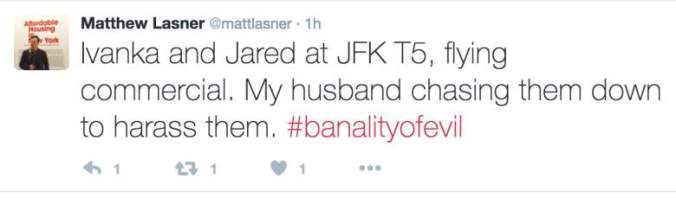
jet-blue-tweet

I’m pretty sure the Ethics Alarms 2016 Jerk of the Year Award was locked up a while ago, but two new challengers for the title at least strengthen the field:

1. Daniel Goldstein, attorney

Goldstein, in the cabin of a JetBlue flight on which Donald Trump’s daughter, Ivanka, was also a passenger, verbally accosted the soon-to-be First Daughter before take-off. Holding a child in his arms, the New York lawyer started shouting, “Your father is ruining the country!” Then he asked, “Why is she on our flight? She should be flying private!”

Ivanka, who had her own kids in tow, tried to ignore him and attend to her family until he was removed from the flight by JetBlue personnel. “You’re kicking me off for expressing my opinion?” he yelled as he was led off the plane.

What a rude and obnoxious jerk.

Other observations: Continue reading

Holiday Ethics Assigment: Quick! Watch These 25 Great Old Ethics Movies Again Before You Go Bonkers Too!

movie-theater

I am compiling a new list of great ethics movies to help those troubled by the recently completed Presidential campaign, the election and its aftermath. I haven’t decided whether to reveal it piecemeal, or collectively as I have before, but I do need to begin by presenting the previous list of 25, actually the combination of several previous posts. Ethics films I have covered individually since those lists debuted, like Spotlight and Bridge of Spies, will eventually be added.

For now, here’s the top 25. Don’t pay attention to the order.

1Spartacus (196o)

The raw history is inspiring enough: an escaped gladiator led an army of slaves to multiple victories over the Roman legions in one of the greatest underdog triumphs ever recorded. Stanley Kubrick’s sword-and-sandal classic has many inspiring sequences, none more so than the moment when Spartacus’s defeated army chooses death rather than to allow him to identify himself to their Roman captors (“I am Spartacus!”)

Ethical issues highlighted: Liberty, slavery, sacrifice, trust, politics, courage, determination, the duty to resist abusive power, revolution, love, loyalty.

Favorite quote: “When a free man dies, he loses the pleasure of life. A slave loses his pain. Death is the only freedom a slave knows. That’s why he’s not afraid of it. That’s why we’ll win.” [Spartacus (Kirk Douglas)]

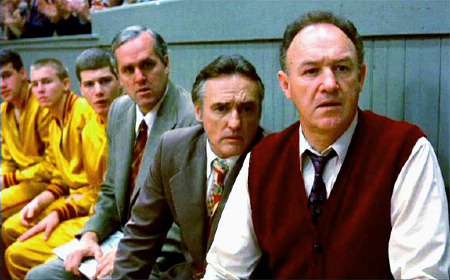
2.  Hoosiers (1986)

“Hoosiers” is loosely based on true story, but its strength is the way it combines classic sports movie clichés—the win-at-all-costs coach down on his luck, the remote superstar, over-achieving team—into a powerful lesson: it isn’t the final victory that matters most, but the journey to achieving it.

Ethical issues highlighted: Forgiveness, generosity, leadership, kindness, courage, loyalty, diligence, redemption.

Favorite quote: “If you put your effort and concentration into playing to your potential, to be the best that you can be, I don’t care what the scoreboard says at the end of the game, in my book we’re gonna be winners.” [ Coach Norman Dale (Gene Hackman)]

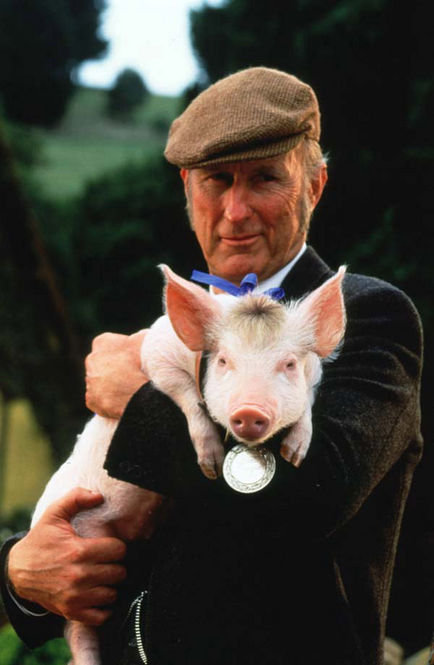
3. Babe (1995)

A wonderful movie about the virtues of being nice, the greatest civility film of all time. Second place: “Harvey.”

Ethical issues highlighted: Civility, kindness, reciprocity, loyalty, courage, love, friendship, bigotry, bias.

Favorite quote: “Fly decided to speak very slowly, for it was a cold fact of nature that sheep were stupid, and there was nothing that could convince her otherwise…The sheep decided to speak very slowly, for it was a cold fact of nature that wolves were ignorant, and there was nothing that could convince them otherwise”  The Narrator (Roscoe Lee Browne) Continue reading

Unethical Quote Of The Week: Gloria Allred

crying-george-2

“If Hillary signed off on a private investigator, let’s call it a minus. It wouldn’t change my support for her because there are so many pluses for her, like her stance on abortion.”

Feminist attorney Gloria Allred, responding to a New York Times report regarding Hillary Clinton’s efforts to intimidate and discredit her husband’s various female accusers.

This is the language of corruption and ethics cowardice, and it is very close to a majority mindset among Americans., who increasingly rationalize away what should be taken as unquestionable proof that a leader or potential leader is untrustworthy and therefor unqualified to lead. In respect to the Clintons, this is a flashback: feminists like Gloria Steinem betrayed their central principles to make rationalizations for Bill Clinton during the Monica scandal (which was a about workplace harassment and a President lying under oath, not about illicit sex), again because he supported abortion.

Here, on Ethics Alarms, the never-ending debate concerns  whether leaders should be chosen based on their positions, or their character. That the two parties are officially all-in betting that character is both irrelevant  to governing and to the voting public is proven by the disgusting Clinton-Trump choice. The message is that character doesn’t matter at all, which makes it more than  strange that the news media and the Clinton campaign’s primary focus is on attacking Trump’s character. If character mattered as it once did and should, Trump wouldn’t be nominated, and neither would Hillary. If sufficient numbers of voters cared that the standard bearers of their pet policy positions were dishonest, ruthless, cruel, cynical, incompetent and manipulative human beings with little genuine regard for fairness, honesty, responsibility, integrity, respect or citizenship, this election would be literally impossible, except in some hideous alternate universe. Continue reading

Four Supreme Court Decisions: Abortion, Guns, Affirmative Action, Corruption…And Ethics. Part 3: Whole Woman’s Health v. Hellerstedt

shrinking-number-of-abortion-clinics-in-texas

[The Supreme Court came down with four controversial and ideologically contentious decisions in June, and I apologize for taking almost a month to cover them all. One of the reasons Ethics Alarms occasionally launches a series like this one is to ensure that developing ethics stories of importance do not push important issues to the sidelines. The fact that this four part series had only finished parts 1 and 2 was an irritant to me, as well as some readers.]

In Whole Woman’s Health v. Hellerstedt, decided on June 27, the Supreme Court held in a 5-3 majority that two provisions of a Texas law, one requiring physicians who perform abortions to have admitting privileges at a nearby hospital and another requiring abortion clinics in the state to have facilities comparable to an ambulatory surgical center,  places a substantial and unconstitutional obstacle in the path of women seeking an abortion, because they constituted an undue burden on abortion access.

Life would be so much simpler if our elected officials and activists employed an adaptation of the Golden Rule, and looked objectively at issues from the other side’s point of view. This is especially true in the realm of rights.  Second Amendment absolutists insist that virtually any laws regulating who can purchase guns, when and where they can purchase them, and how and how quickly they can be purchased are efforts to whittle away the right to bear arms. They also argue that such regulations have the ultimate goal of  eliminating that right entirely, which, in many instances is the case, especially if you listen carefully to the rhetoric of the legislators proposing such measures. There is little difference from this and what anti-abortion advocates are attempting to do with laws like House Bill 2 (H. B. 2).

The bill ostensibly is designed to make abortions safer, thus protecting women’s health, just as many gun laws are promoted as safety measures. Oddly, virtually all of the supporters of the Texas bill would make abortion illegal if they could. I’m sure it’s just a coincidence, just as it’s a coincidence that the authors of bills requiring potential gun owners to jump through increasingly burdensome hoops and deal with mandatory trigger locks and “safe gun” technology would gladly repeal the Second Amendment if they could. The ethical principle is the same in both matters: a right isn’t a right if legal obstacles make it difficult to exercise that right.

The question is, what’s a reasonable obstacle? Any regulation imposed on a constitutional right must not create “a substantial obstacle” and must be reasonably related to “a legitimate state interest.” The Supreme Court uses the language and logic of case precedents, which are its previous examinations of these issues and the balancing they require. One such case, though I did not find it mentioned in the majority opinion or dissents in Hellerstedt, would be the voter ID decision of many years ago, in which a strong majority ruled that the state interest in preventing fraudulent voters and maintaining the integrity of the election process justified inconveniencing those who were subjected to the extra burden of obtaining appropriate identification. In recent years, this decision has been questioned because many believe the motive behind voter ID laws is not really to protect the franchise, but to keep likely Democratic voting blocs from the polls.

Is there a difference legally between a bill that is authored with the intent to restrict the right to vote of older, poorer, and darker citizens while claiming that its sole purpose is to make sure non-citizens don’t affect the results of elections, and an identical  bill that is genuinely intended to safeguard the voting rolls, without any political motive at all? No, or at least there shouldn’t be. The Court’s job is to evaluate what the law does, not try to read the minds and hearts of those who wrote it. Justices only should try to do the latter when there is a debate over what the law says.

Ethically, however, there is a significant difference between a law using a public purpose as a sham to accomplish unethical ends, and a law with a legitimate purpose that has some negative side effects. Trying to restrict a citizen’s rights because one doesn’t respect those rights (or perhaps the citizen) is unethical.

The SCOTUS majority, in its typical examination of a balancing case like this, looked at whether there was a sufficient public safety benefit to a law that had resulted in a precipitous reduction in abortion services: Continue reading

Unethical Research, Unethical Headline, Unethical Media Report: “Many Parents Will Say Kids Made Them Happier. They’re Probably Lying”

I think this made me 12% less happy than when I passed the bar exam...

I think this made me 12% less happy than when I passed the bar exam…

[An UPDATE is HERE]

On the Washington Post’s Wonkblog, Ana Swenson breathlessly writes “that research suggests …[p]eople who have kids in the United States and in many countries around the world report being less happy than people who don’t have kids.”

Ah-HA! This must be why DirecTV is certain that promoting a device that it facetiously suggests would make your kid disappear will appeal to its customers!

Except that Swenson’s headline is click-bait, her article is irresponsible and incompetent, and the study is politically motivated junk, as such things usually are.

“Research” doesn’t suggest this politically manufactured finding.  A single dubious study may suggest it to those who already are inclined to be dubious about parenthood, and who could also be persuaded to buy valuable swampland property in Florida. If you aren’t smart enough to bale on both the “study” and Swenson after this statement central to the issue, I have little hope for you:

“On average, an American parent reports being 12 percent unhappier than a non-parent in America – the biggest gap in the 22 countries the researchers looked at, followed distantly by Ireland.”  

What (the hell) does it mean to be “12 per cent unhappier,” or “12 per cent happier”? Happiness is not quantifiable like that, nor can it be measured with that kind of precision, or any kind of precision. Gee, what is the margin of error in that 12 %? Is it 12%, +/- 3%? I’m trying to think of two states of happiness I have experienced in which I could say with any certainty that I was 12% happier/ 47% happier or 71% happier  in one more than the other, and if I can’t determine that, how are a bunch or researches going to do it?

Let’s see—did discovering I had to undergo a circumcision at the age of 30 make me 12% more unhappy than I was when the Red Sox lost Game 6 of the 1986 World Series? Did watching the T-Rex beat the Indominus Rex in the dino-showdown in “Jurassic World” make me 12% happier than when bought our home for a bargain, or 12% less? You know, I really can’t answer that. Both made me happy in different ways. Did my happiness that my dad died the way he wanted, with dignity and in his sleep just short of his 90th birthday, exceed by 12% the happiness I felt when my final performance at my theater company got a deserved standing ovation, though I was also saddened that my dad wasn’t there to see it?

Please, O Wise and Researchers, enlighten me! They can’t. Of course they can’t. Nor can they tell me how to quantify the happiness my son has given his mother and me, even though he has driven and almost certainly will continue to drive us out of our minds with worry and worse on a regular basis, and has cost us a lot of money we will surely miss when we are dreaming about finally seeing Paris. Am I 12 % less happy than I would have been with a son more like I was, a non-rebellious, conventionally obedient, healthy and lucky kid who sailed through school and never got in any serious trouble? No, because then my son wouldn’t be the unique, amazing, gutsy and original individual he is.

Swenson’s report is filled with statements that make it clear that this is politically motivated  entitlement and anti-child propaganda (and thus pro-abortion propaganda). The smoking gun comes early: Continue reading

Ethics Quiz: Satirical Baby Hate

scary baby

I’m still getting hate comments about my verdict on the Bon Jovi DirecTV commercial that extols the virtue of erasing one’s children from existence, so this piece of New Yorker satire, by real parents about a real newborn child, gave me pause. Here is how  “An Honest Birth Announcement” starts…

Dear friends and family,

Jen and I are utterly horrified to announce the arrival of our son, Jasper Heusen-­Gravenstein, born May 21st at 4:56 A.M. For nine long months, we’ve wondered who this little creature would be. Well, now we know: he’s the living embodiment of our darkest imaginings, with a nefarious agenda and Grandpa Jim’s nose.

At seven pounds four ounces, Jasper may be small, but he’s large enough to have triggered our most primal fears. We’ve already been driven to the brink of madness with unanswerable questions such as: How can we sustain the life of a creature whose incessant, blood­curdling screams communicate nothing but blind rage and indeterminate need? What if he senses our fear and, like a wild hyena, is instinctively triggered to attack? Will we ever finish the most recent season of “House of Cards”?

It goes on in that tongue-in-cheek-but-you-know-we’re-half-serious-right-fellow-parent-vein…

But it names the child, who is, or course, helpless, blameless and defenseless, and creates a permanent record of parental faux-hate for Jasper to read…when he’s a parent, and old enough to get the joke, or when he’s 8, and a classmate sends it to him.

Your Ethics Alarms Ethics Quiz of the Day is…

Even as obvious humor, would it be ethical for Rob and Jen Heusen-­Gravenstein to have this published?

Continue reading

Final Thoughts On The “Turn Back Time” DirecTV Ad, The Response To My Post, And Callousness Toward Life

It’s not on TV any more, but to refresh your memory:

I’m usually a poor judge of the posts that attract controversy here.  The Ethics Alarms commentary about the Jon Bon Jovi DirecTV ad showing the fading rock star singing the virtues of a “turn back time” feature that will allow subscribers to the satellite service to watch shows from the beginning after they have already run is now five weeks old, and it is still drawing traffic and–I also didn’t see this coming—abusive responses. I haven’t changed my mind about the ad being gratuitously and smugly callous and promoting societal indifference toward children, but I have learned some things from the responses to my pointing it out, especially the angry ones.

This blog isn’t called Ethics Alarms for nothing. Its objective is to help people be more sensitive to ethical issues and the right way to handle them, as well as to give them tools to keep their ethics alarms in working order. My ethics alarms were always unusually sensitive–being raised by my father will do that—and have become progressively more sensitive with attention, trial and error, and study. They aren’t perfect, but when they go off, they go off. If I can find out what they are ringing…training and experience help with that…then I will often write a post about the reason they rang out. My alarms went off every time that DirecTV ad came on, but it took me about four viewings to analyze why.  Then I wrote the post.

The commercial has Bon Jovi explaining what’s so great about being able to “turn back time”: in addition to letting you watch the show you missed, he notes that you can have the mild salsa you turned down for a spicy variety, and retroactively decide not to have that second child you now regret. The child is shown drawing on the wall with crayons, and he vanishes as the crayons he was holding fall to the floor. The parents smile. Bon Jovi smirks.

I wrote,

“Why isn’t it immediately obvious that this shows antipathy to children, boys, and human beings generally? The human being who was made to go away because he was inconvenient and burdensome couldn’t have been a girl, because it would be a “war on women,” and the family couldn’t be Hispanic or black, because that wouldn’t have been funny, but a white couple erasing their son from existence because he misbehaves—now that’s comedy gold.”

The comments to the post made me realize that there is antipathy to children, and the concept of turning back time to eliminate an unwanted life is acceptable, and thus no big deal, to a large portion of our culture. Continue reading