
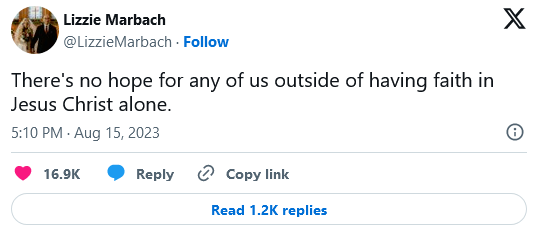
Lizzie Marbach, a former Ohio GOP official and currently director of communications at Ohio Right to Life, tweeted ,
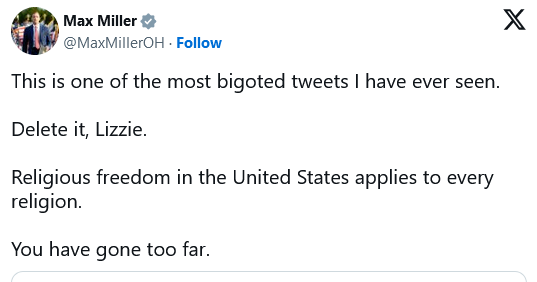
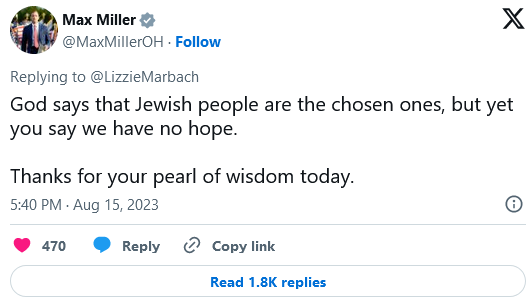
 This upset Rep. Max Miller (R-Ohio), who is Jewish, so he tweeted, twice,
 Ugh.
Ugh.
Ethics Observations: Continue reading
Lizzie Marbach, a former Ohio GOP official and currently director of communications at Ohio Right to Life, tweeted ,
This upset Rep. Max Miller (R-Ohio), who is Jewish, so he tweeted, twice,
Ugh.
Ethics Observations: Continue reading

Four days ago, rebel Democratic Presidential candidate Robert F. Kennedy Jr. was being questioned on his abortion views by a reporter from NBC at the Iowa State Fair and said, “I believe a decision to abort a child should be up to the women during the first three months of life,” but “once a child is viable, outside the womb, I think then the state has an interest in protecting the child.” Kennedy then said he would support a federal ban on abortion after the first three months of pregnancy.
That’s not a very intellectually consistent position on abortion, but it qualifies as moderate and reasonable for a progressive like Kennedy, especially as the Left’s pro-abortion Borg increasingly adopts the frightening position that unborn children should be candidates for extermination right up to birth. Unfortunately, because the Democratic Party now embraces the extreme version of “choice,” Kennedy immediately backed down, turned around, and retracted his statement.

The advocacy for abortion has always relied heavily on Rationalization #64, “Yoo’s Rationalization” or “It isn’t what it is;” indeed abortion is one of the unethical tactic’s most prominent domains. For abortion isn’t a matter of “choice,” but rather a controversy over when and to what extent society should tolerate the killing of one human being (or millions) for the benefit of another. Calling the issue “a woman’s choice” is deliberate obfuscation.
Democratic Rep. Rosa DeLauro of Connecticut—and I will wrestle my hands to the floor to avoid typing some obvious and well-deserved characterizations of the woman—recently made the head-exploding argument that abortion was squarely supported by the moral teachings of the Catholic Church.
No, she really did. I’m not making this up! This was stated on social media by an elected official who is obligated to uphold the public trust. Here’s Rose:

CNN reported a study this week that found that after the Dobbs decision correcting Roe v. Wade that had wrongly held that there was a constitutional right to abortion, 32,260 fewer abortions took place from July to December 2022 compared to the average monthly number of abortions before Dobbs. Roe’s reversal, therefore, meant roughly 5,377 fewer abortions a month. 5,377 fewer abortions means the same number of unborn children a month not having their lives terminated, which in turn means 32,260 living children that would not be alive otherwise. I recognize that there are many way that number could be inexact, for example, deaths during childbirth or other post birth fatalities, so let’s settle on 32,000.
Your Ethics Alarms Ethics Quiz of the Day is…
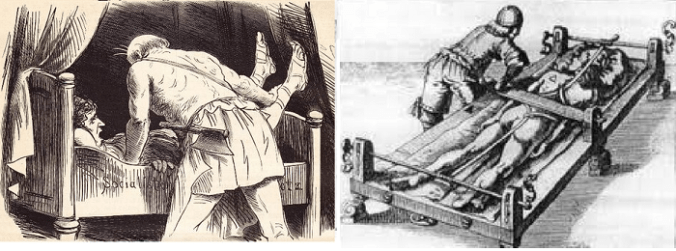
That’s Procrustes portrayed above, in both of his favored acts of mayhem. I checked: I’ve used the term “Procrustean” several times here, but never was kind enough to explain the term’s origins, which is what makes it cool.
Procrustes was the nastiest of the bad guys the mythological Greek hero Theseus encountered on his way to killing the Minotaur in Crete. Procrustes would invite a weary traveler to take refuge for the night, offering him sustenance and a bed—but the bed was a deadly trap. Procrustes guaranteed every guest would fit the bed neatly, but that was because it converted into a rack, stretching anyone who was too short. If a guest was too tall, Procrustes just hacked off enough inches from the feet up to ensure that the bed would fit him, too. Theseus killed the psycho, but the word procrustean eventually entered legal lexicon to describe an argument that illogically squeezed facts or omitted them to make a theory fit the law.
I thought of old Procrustes immediately when I read that Judge Colleen Kollar-Kotelly in the District Court for the District of Columbia suggested after a hearing that the Thirteenth Amendment might have created a right to abortions. Wait, you well might ask, “How could an amendment created specifically to make slavery illegal, passed right after the Civil War, be construed to enshrine abortion as a right?” The short answer is, “It can’t and doesn’t.” The stupid, intellectually dishonest answer, however, is the one that the previously responsible female judge has decided to promote.
When the amendment states, Continue reading

Reflecting on one of the mini-essays (by essayist/novelist Natasha Staggin) today’s obnoxious Times feature, “Future Cringe/One day we’ll look back on this moment and wonder: What were we thinking?,” my favorite quirky blogger, Ann Althouse writes,
I love the big question, what are we doing now that we are going to be embarrassed/ashamed of in the future? I noticed this question when I was a child and heard things said about people in the past, as if those people were benighted and ridiculous. We are those people to people somewhere out there in the future. How can I avoid being looked at by them the way people today are looking at the people of the past?
One answer is to be more charitable to the people of the past. Realize that some day you’ll be in their position, and don’t you want those future people to be charitable toward you? Embarrassment is over-worried about. Maybe those people in the future are looking back at us and laughing about how prudish and uptight we were to think of them feeling embarrassed about us. That is, one day we’ll look back and be embarrassed that we were embarrassed.
Typical Ann: raising what she calls a “big question,” and almost immediately suggesting it isn’t so big after all, writing, “Embarrassment is over-worried about,” which is also an interesting sentence coming from a writer who is so often a language pedant.
As an ethicist who believes that human understanding of what is right and wrong constantly evolves and usually improves, my initial reaction to Ann’s question is, “What do you mean we?” I’ve been around a while, and I can honestly say that I’m not “embarrassed” by anything I once believed in, or any major reaction to the data life gave me. Individual deeds, words and moments, sure. I have plenty of past moments I wince to think about.
Stagg was talking about the Wuhan virus freak-out, so don’t look my way. I didn’t freak out, and I did my best to try to keep others from doing so, failing miserably. However, the pandemic is the kind of event one’s response should only be embarrassed about if one knew, or should have known, that one’s response was dishonest, cowardly, or destructive, or if one had a genuine choice and foolishly took the wrong one. The pandemic was a unique challenge, and we were, as Marty Baron ( Liev Schreiber) says in “Spotlight” when a Boston Globe staffer is admitting that he could have blown the whistle on the Catholic Diocese predator priest scandal sooner, just “stumbling around in the dark.”
Yes, I think Dr. Fauci should be embarrassed. Andrew Cuomo should be embarrassed. The New York Times should be embarrassed, and the health “experts” who endorsed the mass George Floyd demonstrations as an exception to their warnings about large gatherings should hide their heads under bags. But for the most part, I think the pandemic is a poor example for Ann’s question. Continue reading
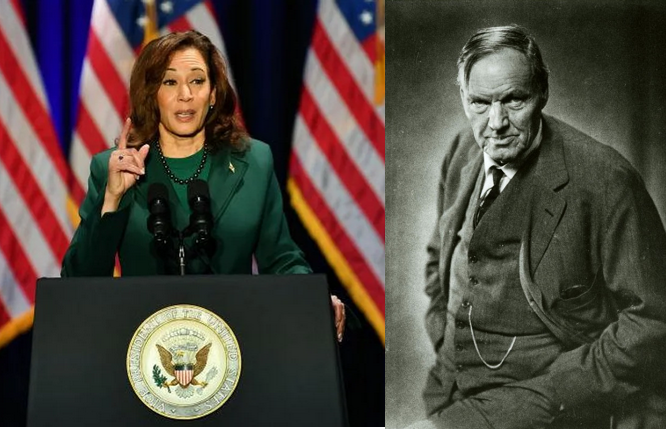
Vice President Kamala Harris, in her speech delivered on the 50th anniversary of Roe v.Wade, didn’t babble incoherently as usual. She just invoked one logical fallacy, rationalization and intellectually dishonest statement after another. The highlight, however, was her claim to the abortion fans in her audience that “we are on the right side of history.”
That’s signature significance. Nobody makes that argument unless they are a con-artist, a demagogue, or an idiot. In Kamala’s case, all three are likely true. Saying one is on the right side of history is just an extraordinarily obnoxious way of saying, “We’re right and everyone else is wrong” without actually making a substantive argument. To quote myself in the description of the phrase (it’s Rationalization #1B. The Psychic Historian on the list):
Every movement, every dictator, Nazis, Communists, ISIS, the Klan, activists for every conceivable policy across the ideological spectrum, think their position will be vindicated eventually. In truth, they have no idea whether it will or not, or if it is, for how long. If history teaches anything, it is that we have no idea what will happen and what ideas and movements will prevail. “I’m on the right side of history is nothing but the secular version of “God is on our side,” and exactly as unprovable.
Abortion supporters have been working hard lately to argue that the Bible supports abortion because it doesn’t expressly condemn it. A text thousands of years old that predates all scientific knowledge about the unborn and the predates modern medicine is irrelevant to the abortion debate. More…
It is a device to sanctify one’s own beliefs while mocking opposing views, evoking an imaginary future that can neither be proven or relied upon. Nor is there any support for the assertion that where history goes is intrinsically and unequivocally good or desirable… Those who resort to “I’m on the right side of history” (or “You’re on the wrong side”) are telling us that they have run out of honest arguments.
Which nicely describes Kamala, if not all abortion advocates. Here is dishonesty exemplified: Harris, in her speech, said, “We are here together because we collectively believe and know America is a promise. America is a promise. It is a promise of freedom and liberty — not for some, but for all. A promise we made in the Declaration of Independence that we are each endowed with the right to liberty and the pursuit of happiness.” Continue reading

Is there any political issue in American history that was more corrupting than abortion rights? Based on last week’s House vote on the Born-Alive Abortion Survivors Protection Act, I don’t think so.
The bill stated that any infant born alive after an attempted abortion is a “legal person for all purposes under the laws of the United States.” Doctors would be required to care for those infants as a “reasonably diligent and conscientious health care practitioner would render to any other child born alive.” How could anyone who doesn’t endorse legalized infanticide oppose that measure? [You can read the whole bill here.]
Yet the bill only narrowly passed, 220-210, because every Democrat except two voted “no.” (We all know that the Democratic Senate will block passage anyway.) Only one Democrat, Rep. Henry Cuellar of Texas, voted for the bill with one other Democrat, Rep. Vicente Gonzalez of Texas, courageously voting “present.” All of the rest, totally in thrall to the most extreme pro-abortion activists, want doctors to have the option of dashing out the brains of a living new-born who has survived an abortion against the nearest wall. Don’t think they won’t: doctors who botch abortions get sued. But hey, no baby, no problem! Continue reading

—Actress Anne Hathaway, revealing her ethical deficits and intellectual limitations while appearing on “The View”
Oh, hell. I’ve always liked Ann Hathaway. Now I have to continue liking her despite knowing she’s a brain-dead, self-awareness-lacking, ethics dummy.
Just so I’m not accused of misrepresenting Hathaway’s moronic and offensive claim, here is her full sentence:
“[In] my own personal experience with abortion and I don’t think we talk about this enough, abortion can be another word for mercy. We don’t know. We don’t know. We know that no two pregnancies are alike, and it follows that no two lives are alike, it follows that no two conceptions are alike. So how can we have a law, how can we have a point of view on this that says we must treat everything the same?”
Someone can only make such an absurd statement by refusing to acknowledge what an abortion is, and that two lives are involved, not just one. If she were arguing for abortion when a fetus is hopelessly deformed or certain to have devastating maladies, that’s a legitimate ethical debate to have. Abortion then might be described as merciful. (But some advocate aborting Down Syndrome babies as similarly “merciful.”) Hathaway wasn’t considering the unborn at all, however. In her warped (but too common) view, it is mercy for the mother to allow her kill the child for her own benefit.

The first observation is that neither of the surprises should surprise anyone at all. Former NFL football star Herschel Walker is about as vulnerable a political candidate for high office as one can imagine, even in the “Get Trump!” era. I’ve covered much of this already. He’s exaggerated his scholastic achievements, hidden the fact that he has several children conceived without the formality of marriage, admitted bouts with mental illness and a suicide attempt, and vaguely acknowledges committing domestic violence.
Walker has no political experience or relevant achievements that would make him a qualified candidate for the U.S. Senate in Georgia. He’s a local celebrity and has personal charisma; he is also an African-American in a state with a lot of black voters (and football fans). That’s about it. In the United States of America in the Age of the Great Stupid, that can also be enough.
It was irresponsible for the Republican Party to present such a cynically-chosen nominee to the voters of Georgia, incompetent for voters to check his name in the primary, and certifiably stupid for the GOP to store a substantial amount of their chances of taking back control of the Senate on such a shaky vessel.
Yesterday, they all got what they deserved… Continue reading

