Unethical Column of the Century: CNN’s L.Z. Granderson

OK, maybe I’m exaggerating.

But not much.
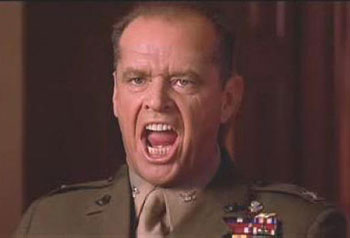
L.Z. Granderson’s role model. I’m not kidding.

In a horrifying opinion column, the regular CNN political pundit L.Z. Granderson evoked the virtues of public apathy and unchecked government conduct with warped logic and unethical rationalizations, to make the case that the public should merely shrug off scandals like “Fast and Furious.” I was only able to finish reading it without retching it by imagining Granderson’s motives for writing such mind- and culture-poisoning swill. At least, as an African-American journalist, a liberal and a Obama supporter (I know I repeat myself), he has the self-respect, fairness and integrity not to claim that critics of Attorney General Holder’s Waterloo are being racist. Like the race-baiters, however, he is in denial, and willing to throw principle to the wolves to protect the first African-American Attorney General, though far from the first corrupt and incompetent one.

In a column with the descriptive and idiotic title, “Don’t be nosy about Fast and Furious,” Granderson argues…

“…Times have changed. Yet, not everything is our business. And in the political arena, there are things that should be and need to be kept quiet…..there comes a point where the public’s right to know needs to take a back seat to matters like national security and diplomacy. Heads should roll because of the Fast and Furious debacle. We don’t need every detail of that operation to be made public in order for that to happen. If it were an isolated sting, maybe. But it is at least the third incarnation of a gun-running scheme stretching across two administrations, which means we could be pressing to open Pandora’s Box. We do not want to open Pandora’s Box, not about this and certainly not about a bunch of other potentially scandalous things the federal government has been involved with.” Continue reading

Ethics Quiz: Alcoholics Anonymous and Judicial Abuse of Power

Uh, wrong meeting, Barney…

A friend who is a member of Alcoholics Anonymous flagged an interesting ethical dilemma involving the huge, loosely-affiliated alcoholism recovery and support group.

Judges often order mandatory attendance at AA meetings as conditions for leniency in alcohol-related crimes, like DUI, spousal abuse, and others. The problem is that AA is system of commitment and trust, and someone who only comes to meetings under threat of jail time have neither. It is the AA attendee’s acceptance of the reality that they are helpless against alcohol and willingness to commit fully to the program with others like than that allows AA to be as successful as it is, and the assurance of anonymity the group provides makes its existence possible. “Court-ordered attendees slink in here, roll their eyes, do their time and leave,” he told me. “How do we know that they aren’t regaling their friends with hilarious tales about what does on at meetings? What right does a judge have to make AA host someone who doesn’t really meet the group’s criteria?”

Good question, and it’s the Ethics Quiz of the Day:

Is it ethical for judges to force a non-profit, non-government, voluntary organization to assist the justice system at the risk of their own integrity and their members’ confidentiality?

This time I’m going to let everyone weigh in before I show my cards.

Here is a link that discusses some of the related issues.

More School Bullying…As In Schools Bullying Students

What the hell kept you?

From an ACLU complaint recently filed in the Northern District of Indiana:

“The plaintiffs in this case are all 14-year-old girls, proceeding by their initials, who were previously enrolled as eighth graders at Griffith Middle School, which is operated by Griffith Public Schools. In late January, they engaged in a lengthy conversation on http:// http://www.facebook.com-through the comments section of one of their personal pages after school from their personal computers. This conversation spanned numerous subjects, from the pain of cutting oneself while shaving to the girls’ friendship, before turning to a discussion of which of their classmates they would kill if they had the chance. At all times, the conversation was purely in jest and could not have been interpreted seriously, as is evidenced by the girls’ repeated use of “emoticons,” by their use of abbreviations indicative of humor, and by the nature and tone of the conversation. The girls were simply engaged in teenage banter.Nonetheless, on January 26, 2012, all three (3) girls were suspended from school for ten (10) days as a result of this conversation, and they were ultimately expelled for the remainder of their eighth grade year. This disciplinary action occurred because they had supposedly violated a provision of the student handbook prohibiting bullying, harassment, and intimidation, even though no statement in the conversation-nor the conversation as a whole–constituted a “true threat.” Additionally, the conversation did not cause any disruption to the educational environment or to school activities, nor was it foreseeable that it would.”

Glory be and Halleluiah! Continue reading

Comment of the Day: “The Ethics of Bloomberg’s Soft Drink Ban”

Peter, who is a physician, a libertarian, and one of my oldest friends (we met in the 6th grade) from Arlington, Massachusetts, generously responded to my request for his professional expertise and philosophical perspective regarding the New York City soda ban.  Here is his thoughtful response, the Comment of the Day, on the post The Ethics of Bloomberg’s Soft Drink Ban: 

“It has become a reflex response to answer adverse circumstances with more regulation. To a lawyer, there is always a law, or regulation for any and every misstep in human behavior. Of course, we forget that we cannot predict the unintended consequences, not even to mention reviewing the effects of the laws we pass to determine if they are even having the INTENDED effect. Somehow, we believe that it is appropriate to pass laws to deny other people’s freedoms due to the “discomfort” of whiny types who have the connections and persistence to keep whining until they can get someone to pass a law. The consequence of such legislation’s continued passage, at ever more confiscatory levels of our liberties, is that we are legislating our way into a police state, and the widespread acceptance of the idea that it’s OK to deny personal liberty because it makes someone else “uncomfortable.” Again, as RR so aptly pointed out, “the government that is big enough to give you everything you want, is big enough to take away everything you have.” And this goes for not just your personal assets, but your freedoms as well.

“That said, in this context, yes, drinking lots of sugary sodas will make you fat, smoking will kill you, too much alcohol will kill you, doing extreme sports can kill you, and so on. And as long as one’s decisions affect only himself, have at it. However, when you want me to pay, through my insurance premiums, and my taxes, for the consequences of your stupidity, you cede the sovereignty of your decision to others beside yourself. If you want to ride your motorcycle without a helmet, while drunk, sure, do it. Just don’t expect me to pay the costs of your head injury. Continue reading

The Ethics of Bloomberg’s Soft Drink Ban

It’s a serious problem.”

“Something needs to be done.”

“This is a public health issue.”

The media defenses of New York Mayor Bloomberg’s controversial decision to ban the sale of large soft drink servings in New York City, and Bloomberg’s defense as well, set up a classic utilitarian argument for a government intrusion into personal choice and lifestyle. It is, simply, that the ends justify the means, and as we all know, sometimes they do.

Sometimes, however, those means sacrifice too much: lives, dignity, fairness, liberty, fun. Sometimes employing those means require crossing lines that have not been crossed before, opening the door to more and greater sacrifices that even advocates of the particular measure would find objectionable and wrong. This leads to the slippery slope dilemma, and invokes absolutism. Some things must never be considered as just means, no matter what the ends being sought may be. Immanuel Kant’s philosophy of absolutism declared that it was always wrong to use human beings against their wills to solve problems, no matter how great the problems are. The Declaration of Independence holds that a human being’s rights to life, liberty and the pursuit of happiness must never be breached by government. Continue reading

Lost: Our Incompetent, Arrogant, Unethical Public Schools

You know it’s time to homeschool when…the school nurse is named “Ratched.”

Today, blogger Glenn Reynolds wrote, “You know, I’m beginning to think that sending your kids to public schools is starting to look like parental malpractice.” On the way to the decision to home school my son, I reached the same conclusion years ago, and nearly every day brings more evidence to support the decision. Here, for example, are two recent news stories, one alarming, the other horrifying: Continue reading

So Wrong It Defies Belief: The Green Bay Police Heist

Maybe the public and the media are finally waking up to the astoundingly un-American abuse of power that are the  civil forfeiture laws,  which allow property and cash to be seized as helping to facilitate a crime, and later are divvied up between the police and the state. There are some promising signs. Libertarians like Radley Balko have been trying to ring the ethics alarms on this horrendous example of government misconduct for years, and the Institute for Justice continues its lonely battle to defeat the most egregious offenses, but George Will just used the trumpet of his weekly column to expose the Caswell family motel scandal, which Ethics Alarms discussed in February here. Now comes a tale of civil forfeiture from Wisconsin that is so brazen that it defies belief, and also compels the following question:

How can this happen  in America? Also this one: If the government will use its power to steal money and property from law-abiding citizens, and no effort is made on the part of national government leaders to do anything to stop it, how can at least 50% of the American public continue to advocate giving more power and money to a government that obviously cannot be trusted with either?

The first question is frightening in its implications.

The second is a mystery, on par with “What happened to the Mary Celeste?” Continue reading

Jamie Lynn Grumet, Child Abuser

Those were the days….

My focus in the earlier post regarding Time Magazine’s borderline kiddy porn cover, showing a young woman with one breast exposed as a three-year-old child simultaneously sucks on it and eyes the camera, was the sleazy professional ethics behind such a flagrant attempt to attract sales through titillation. It never occurred to me that the photograph was real, and that the model had dragooned her own toddler son into the public eye as the world’s most-viewed breast-feeder. It never occurred to me because it seemed obvious that doing this would be spectacularly irresponsible and wrong, indeed a form of child abuse and as well as an abuse of parental power.

Ironically, I was a sucker. Continue reading

Ethics Dunce: New Jersey Department of Education

“All right, children: Tell…us…everything!”

This year’s New Jersey ASK test, given to grade schoolers to assess their skills and knowledge, required some third graders to reveal a secret about their personal lives, and to explain why that secret is hard to keep. Surprisingly, many parents had a problem with this.

Here is what Dr. Richard Goldberg, a father of twin third grade boys told reporters:

“…To ask an 8-year-old, a 9-year-old to start revealing secrets in the middle of an exam  I thought was really inappropriate.  These children, they want to answer the question, they want to answer it correctly, they don’t want to get a bad grade. But at the same time, think about the things a child might know – about themselves or their family.”

Yes, let’s think about that: Continue reading

Teacher Manuael Ernest Dillow: An Ethics Dunce, But, Of Course, An Aberration

“THIS will teach you lousy kids not to disrupt class….KIDDING!!!”

We don’t have to belabor this one. Manuael Ernest Dillow, a welding teacher at a vocational school in Abingdon, Virginia, wanted to get the attention of his students, so he lined up twelve of them against a wall, took out a pistol, and fired at them multiple times. The gun was loaded with blanks.

Oh! Well that’s all right, then!

This idiot was arrested, and it looks like there is a good chance he’ll get serious jail time. Obviously he is an aberration in the great, essential and honored field of teaching. Continue reading