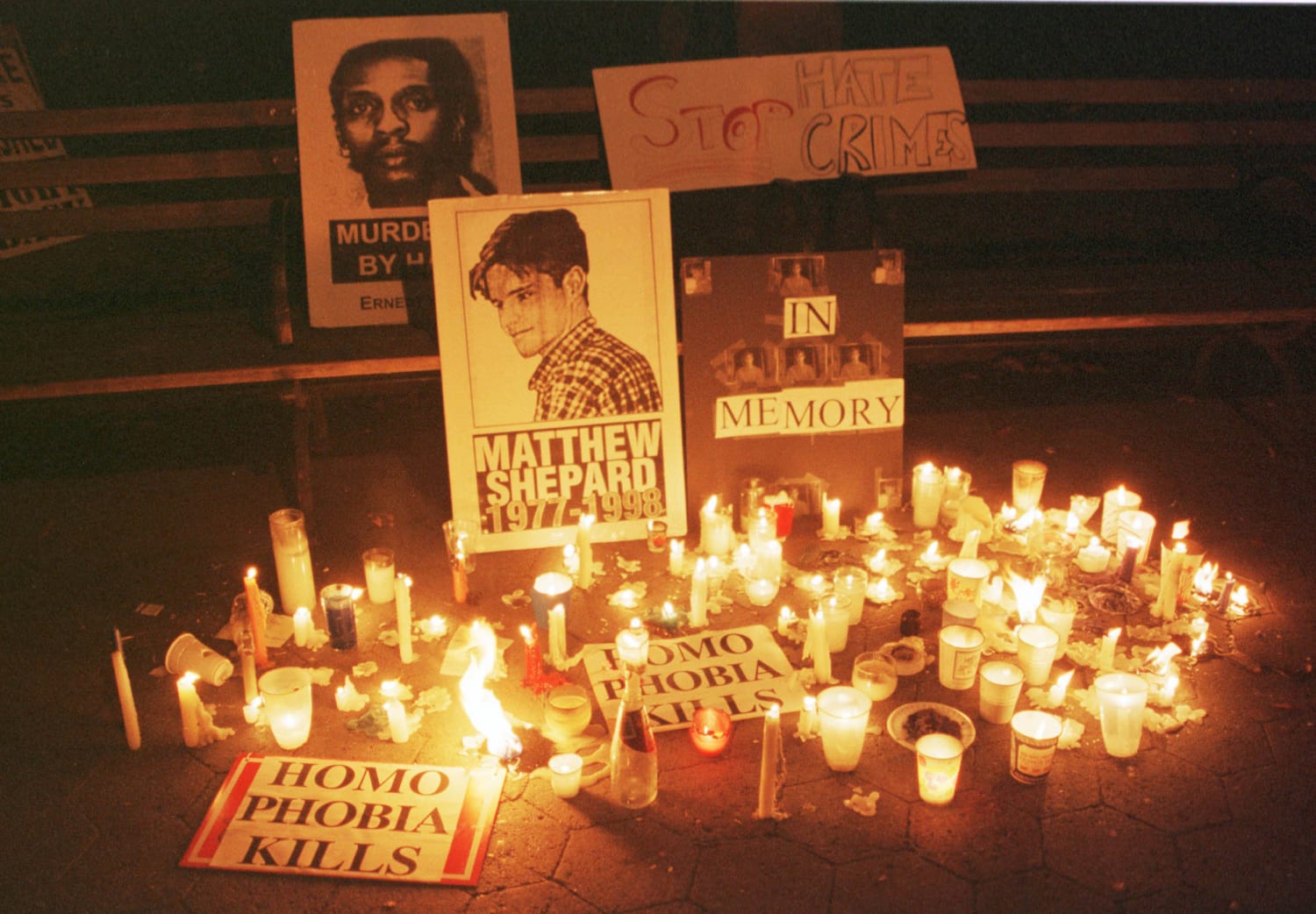
Another cherished Facebook friend wrote a few days ago that it was the anniversary of Matthew Shepard’s death (October 6) in Laramie, Wyoming. He was the young gay man who was beaten, tortured, and left to die tied to a split rail fence in 1998. Because gay activism was on the rise, a martyr was useful and the murder was lurid enough to attract eyeballs (“If it bleeds, it leads”), Shepard’s murder immediately was styled as a hate crime. After all, he was gay.
My friend wrote, in part, “We pray for the repose of his soul along with the souls of all those taken from us in prejudice.” But there is no evidence that Shepard’s murder was motivated by his homosexuality, other the fact that he was gay. As with the George Floyd debacle, the event was a gleaming example of presumed prejudice, fed by a powerful minority group that was pushing the “hate crime” concept hard. Eventually Barack Obama signed a federal hate crime law bearing Shepard’s name—of course he did, because that’s our O. But there is more evidence that Shepard’s death was the result of a drug deal gone wrong rather than anti-gay hate. Nevertheless, the story is still framed as a hate crime. Here’s NBC (gee, what a great news department!) stating as fact that Shepard’s death was motivated by homophobia.
My friend is gay, usually rational and always astute. It bothers me to see him spreading urban legends and bad history. But his heartfelt post got all sorts of “care” and “love” imogis, and I didn’t have the heart to spoil a public pandering.
Shepard died horribly, but so do lots of people, and that he’s remembered today because he happened to be a gay crime victim when so many genuine heroes are forgotten bugs me: you know how I am. There is not only a duty to remember but a duty to remember accurately, as well as a duty not to make people more ignorant than they already are.


This certainly put Laramie, WY in the public eye a year before I started attending the University of Wyoming. It also prompted the University to bulk up on diversity courses, pro-LGBT rallies, and the like. I had not previously been concerned about homosexuality one way or another, but the way they forced so much content on us (through our required cultural context courses), and the way they treated anyone who pushed back at the pro-LGBT agenda, did a lot to sour me towards the LGBT movement. (Though to be fair, when Phelps’ Westboro Baptist Church came on campus to protest UW’s Shepard Symposium, that did a fair amount to raise the LGBT movement on my cognitive dissonance scale…)
Years later, Stephen Jimenez, a journalist who did a great deal of digging into the hidden sub-cultures in Laramie, published The Book of Matt, in which he argues that Matthew Shepard was involved in the drug highway that ran between Ft. Collins and Laramie, fell afoul with a drug dealer, and was taught a brutal lesson. Frankly, the sheer amount of drug activity Jimenez described going on in Laramie shocked me. I certainly had no idea, but then, I never put together that sour smell in one wing of my high school with kids secretly smoking pot, either.
Later, after moving to Rawlins, I talked with a member of the local Department of Corrections, and he told me flat out that probably 10% of the drivers I passed each evening in town were probably high on drugs at that moment. A lot of drugs pass through the I-80 corridor. (My wife had the privilege of sitting on a jury on some poor Hispanic mules carrying meth from California to somewhere back east, and who had the misfortune of getting arrested in Wyoming.) The reason why Laramie is an ever hotter bed of drug activity than Rawlins is because of US-287 and the direct connection to Ft. Collins. Thus 287 meets I-80 in Laramie, making it a good hub. (I’m guessing the fact that Laramie and Ft. Collins are both University towns plays a large role, as well.)
What happened to Shepard is tragic. He was a skinny kid, well-liked, and so many people in Laramie were devastated by his murder. Several people I met in college, themselves lesbian or gay, would still tear up over the incident years later. I understand that. But when it seems we keep discovering that these “hate crimes” were not racial or sexual-orientation motivated crimes, it actually does a great deal to turn what could have been a sympathetic audience hostile. There’s a reason Instapundit has the flag “The demand for hate crimes far exceeds the supply.”