Ethics Quote of the Week: “Ethics Bob” Stone

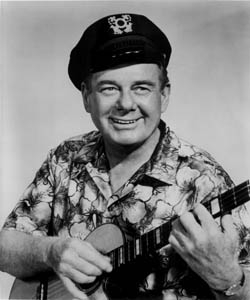
Is Joe Scarborough the new Arthur Godfrey, as in "nice guy" revealed as "unethical creep"?

“It’s always upsetting when one of your heroes turns out to be an unethical creep.”

Ethicist and business ethics professor Bob Stone on his blog “Ethics Bob,” expressing his disappointment in the conduct of MSNBC talk show host Joe Scarborough, who persuaded guest and colleague Mark Halperin to “go for it” when Halperin suggested that his description of President Obama’s press conference was not appropriate for public broadcast, and then did nothing to accept responsibility for the uproar when Halperin referred to Obama as “kind of a dick.” Halperin was suspended indefinitely by MSNBC, following a complaint from the White House.

Bob had expressed hope, in a comment to the Ethics Alarms criticism of Scarborough’s role in the incident, that Scarborough would do the right thing by the next day. He did not. And Bob is correct: this is proof positive that Scarborough is an unethical, cowardly creep.

What should “Morning Joe” have done? Several things: Continue reading

Ethics Train Wreck on “Morning Joe”

Coincidentally, the previous VICE President was frequently called a "Dick"

Time Magazine editor Mark Halperin, a frequent contributer to MSNBC’s “Morning Joe” program,  took one more chunk out of the tradition of gentility and civility in public discourse, not to mention broadcast journalism, by referring to the President of the United States as “a dick” Thursday morning. He was promptly suspended by the network, which was also the scene of Ed Schultz referring to conservative talk show host Laura Ingraham as a “right wing slut.”

Obviously the inhibitions supposedly bred into Americans about vulgar language in inappropriate places—like live TV—are crumbling fast, along with the tradition of respect for the office of President. What is more interesting about the incident, however, is how Halperin was egged into his gaffe by co-host Joe Scarborough, with an assist from Mika Brzezinski. Scarborough then took no responsibility for the incident at all. Continue reading

A Psychic Ethics Train Wreck in Liberty County

Surprise: her anonymous tip is not credible.

I have been remiss in not discussing a recent Ethics Train Wreck that occurred two weeks ago, a fiasco that occurred in Liberty County, about an hour from Houston, Texas.

A self-professed psychic who calls herself Angel called police and told them that she had a vision that a mass grave containing the dismembered bodies of children was on the property where Joe and Gena Bankson lived. She also described some of the features of the property. That was enough for the Liberty County Sheriff’s Office, which armed itself with a search warrant and cadaver-sniffing dogs and converged on the home,  along with a mob of reporters and two news helicopters. As the police dug holes, somebody jumped the gun, and soon cable news stations flashed alerts that up to 30 bodies had been found.

There were no bodies. Continue reading

Sorrell v. IMS Health: Legal, Ethical, and Unjust

The case of Sorrell v. IMS Health, which the Supreme Court decided yesterday, sharply focuses the philosophical disagreement over the role of the courts in public policy. The legal question was rather straightforward; the ethical issues are complex. Is it the Court’s duty to make bad—but constitutional— laws work, or is its duty to follow the laws, and leave it to the legislature to fix their flaws?

This was a case about incompetent  lawmaking. Gladys Mensing and Julie Demahy had sued Pliva and other generic drug manufacturers in  Louisiana and Minnesota over the labels for metoclopramide, the generic version of Reglan. The drug, used to treat acid reflux, had caused them to develop a neurological movement disorder called tardive dyskinesia. None of the generic drug’s manufacturers and distributors included warnings on the labels about the danger of extended use of the medication, even though the risk was known to them. Neither did the manufacturers of the brand-name drug. The problem was that the state statutes required generic drug manufacturers to included warnings about dangerous side effects, while federal regulations required generic drugs to carry the exact same label information as their brand name equivalent.  Continue reading

The FDA’s Disgust Offensive: Manipulative and Wrong

Why stop at this?

I’ve never smoked.  My wife is a smoker and I am worried about her; I also think the tobacco industry is more or less despicable. Nevertheless, I find the new disgust-initiative by the FDA on cigarette package labeling  troubling. If it’s ethical, it only passes muster in a utilitarian balancing formula, and even then I think it opens the door to government abuse.

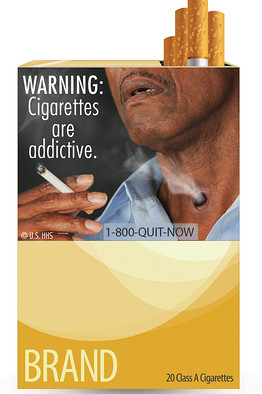
Thanks to a 2009 law, cigarette makers must add large, graphic warning labels depicting diseased lungs, a man exhaling smoke through a hole in his neck, a baby near a cloud of smoke, a dead body, a man wearing a black t-shirt with “I Quit” written across the chest and three other ugly images to packaging and advertising in the U.S. by October 2012. These will be accompanied by warning labels with messages like “Smoking can kill you” and “Cigarettes cause cancer.” In full, stomach-turning color, the new labels must occupy the top half of the front and back of  cigarette packs, and 20% of any cigarette ad’s space. The labels must also include the number of a national quit line and the current warning labels.

All this, yet the government allows the stuff to be sold. I don’t get it, frankly. If cigarettes are so bad that the FDA feels it has to use tactics this extreme, then it should have the courage to just ban them, like they ban other harmful substances. Continue reading

Comment of the Day on “Ethics Triple Dunces…”

[In his Comment of the Day, Jeffrey Field endorses the actions of both the teacher and the superintendent that I labeled “ethics triple dunces” for making students write letters lobbying for more money in school budgets, raises some other provocative ethics issues related to teacher and student conduct, and questions my indictment of the ethics of the teaching profession. I think he’s wrong on every count (you can read my response with my original post), but it’s a terrific comment.]

“When I was a 5th grade teacher teacher at Clements school in North Alabama, the all-white Limestone County School Board voted to allow students the Martin Luther King holiday, but teachers would be required to work that day. So, partially in self interest and partially in empathy of the small percentage of black teachers, I got my 5th grade class to write letters to the board asking them to reconsider. Long story short, the board reversed position and everybody got a day off.

“Yes, I used this as a writing exercise, and I offer no excuses. You see, too many times teachers have students write a paper with no real purpose in mind. In this case, my students had a real purpose in penning a persuasive letter to the people who ran the schools (btw – no one was required to write the letter, but they all did). And boy, you should have seen the smiles and heard the whoops of joy the morning the Athens News Courier ran a story saying the board had reconsidered its position. Continue reading

Ethics TRIPLE Dunces: Tramway Elementary Teacher Melanie Hawes and Lee County Board of Education Superintendant Jeff Moss

"MUST...WRITE...LETTER ....TO...DAD....

North Carolina state legislator Mike Stone is a budget hawk, and is supporting a budget-cutting proposal that could eliminate 9,300 positions in the public schools. It’s a contentious issue, and the representative has received many letters—including a plaintive one from his own third grader daughter, a student at Tramway Elementary, who was one of several students in her class directed by teacher Melanie Hawes to write to the  Republican and plead with him to save the jobs of their two teacher assistants.

“Our school doesn’t want to lose them,” she wrote. “Please put the budget higher, dad.”

Ugh. Ethics foul; in fact, three of them:

1. It is unethical for teachers to indoctrinate their students in political positions in which the teachers have a personal interest.

2. It is unethical to exploit children as lobbying tools, under the pretense of educating them.

3. It is extremely unethical to recruit a legislator’s 8-year-old daughter to carry a lobbying message. Continue reading

The Strange, Unethical Saga of Junius Puke

Junius Puke

This week seems to mark the end of a perfect storm of ethical misconduct that almost drowned a young student in legal persecution for the non-crime of exercising his First Amendment rights. An insufferable and humorless bully with a professorship collided with an irresponsible prosecutor wielding an unconstitutional law, and it has taken eight years to undo the carnage.

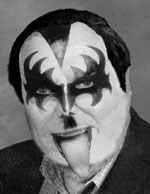
A man named Junius Peake was an economics professor at the University of Northern Colorado,  who due to his parody-inviting name and undoubtedly also the character traits that he was soon to display so prominently, found himself being lampooned in a student satire blog called “The Howling Pig.”  The editor-in-chief of the blog was facetiously identified in the newsletter as the obviously fictional “Junius Puke,” who was portrayed with an outrageous photograph of Professor Peake altered to include sunglasses, a different nose,  a Hitler-esque mustache, and, on occasion, Kiss make-up and a Gene Simmons tongue.  Junius Puke, with tongue. “Junius Puke” wrote prose like this:

“This will be a regular bitch sheet that will speak truth to power, obscenities to clergy, and advice to all the stoners sitting around watching Scooby Doo. This will be a forum for the pissed off and disenfranchised in Northern Colorado, basically everybody. I made it to where I am through hard work, luck, and connections, all without a college degree. Dissatisfaction with a cushy do-nothing ornamental position led me to form this subversive little paper. I don’t normally care much about the question of daycare since my kids are grown and other people’s children give me the willies.” Continue reading

Ethics Quote of the Week: The Washington Post Editors

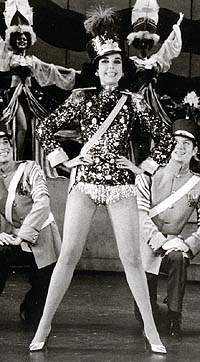
Clear out, everybody! Ann Miller wants to honor Thomas Jefferson!

“Aggrandizing what amounts to a stunt based on misinformed views of the First Amendment cheapens the real and courageous achievements of those who advance the causes of civil rights by refusing to comply with immoral laws”

—–The Washington Post, in an editorial entitled “Dancing at a National Memorial Isn’t Civil Disobedience”

The Post is talking about the escalating and pointless battle by self-indulgent, publicity-seeking, First Amendment grand-standers —a description that I shortened to the crude but sufficiently explanatory “assholes” in my post on the same topic-–to demonstrate for the endangered ‘right” to dance inside government memorial structures(Next up: frog races, strip shows, and Mummer parades). The editorial makes the true content of this noble exercise plain: it is 100% nonsense: Continue reading

Dancing With Thomas Jefferson: How Assholes Make the Law Spoil Life For Everyone

Coming to a place of honor and reflection near you.

On Saturday, the U.S. Park Police forcefully arrested five “Code Pink” protesters under the dome of the Jefferson Memorial for defying a recent Federal Appeals Court ruling that dancing at federal monuments was not constitutionally protected expression.

Perhaps you missed that ruling earlier this month, which was, I presume, made necessary by the realization that a flash mob could break out at any moment at the Lincoln Memorial or the Alamo. That was not the threat in 2008, however, when Mary Oberwetter was arrested, also at the Thomas Jefferson Memorial, for hoofing to celebrate Thomas Jefferson’s birthday.

She sued the National Park Service for violating her First Amendment rights, and on May 17 the U.S. Court of Appeals for the D.C. Circuit held that the Jefferson Memorial should have a “solemn atmosphere” and that dancing, silent or otherwise, was an inappropriate form of expression there. The appellate judges concurred with the lower court that the memorial is “not a public forum,” and thus demonstrators must first obtain a  permit. Demonstrations that require permits in the Park Service’s National Capital region are defined as

“…picketing, speechmaking, marching, holding vigils or religious services and all other like forms of conduct which involve the communication or expression of views or grievances, engaged in by one or more persons, the conduct of which has the effect, intent or propensity to draw a crowd or onlookers. [The] term does not include casual park use by visitors or tourists which does not have an intent or propensity to attract a crowd or onlookers.”

The Appellate Court wrote: Continue reading