I’m certain some will say that it is self-serving, that he made the video to try to minimize his punishment. This could be, and so what? The YouTube confession is still the best, most honest, most ethical, most courageous option that he had, once he had made the tragic and irresponsible decision to drive while intoxicated. Many, indeed most, and arguably all ethical acts have an element of self-serving in them. If they are right, they are right.
Imagine how much better society and the justice system would be if those who committed crimes fulfilled their societal duty to admit them, apologize, and accept their just punishment. Cordle, ironically, is not merely an Ethics Hero, but a role model.
I live in the Washington, D.C. area, and at this moment even the beginning of the NFL season, usually the one thing everyone here (except me) usually cares about, is being over-shadowed by the drama of the looming Congressional vote on Syria. What was assumed—why, I cannot imagine–to be a likely rubber stamp with only an insufficient number of Republicans providing opposition because, as we all have been told repeatedly, they will oppose the President on anything, has materialized as strong bi-partisan opposition. The Washington Post estimated last night that the votes in the House are currently running 3-1 against the symbolic-and-deadly-but-promised-to-be-non-committal missile strikes on pre-announced targets. This is the most encouraging development in the government since President Obama was elected, I am tempted to say. It shows that this is not a nation of lemmings, and that the separation of powers has its virtues after all. Nonetheless, interesting ethical arguments are arising in favor of votes both no and yes.
The no arguments are varied, and reach the same conclusion from different positions, some more ethical than others. The pacifist Left and the isolationist Right, both irresponsible and dedicated to ideology over reality, are on the same path here, and would be on that same path even if the President’s argument for missile strikes was strong. Others, including me, but also those who supported more extensive military action in the Bush administration, fault the plan because of its dubious results, its contradictory logic, and the feckless and troubling way the President brought us to where we are.
I just heard an interview with a Republican House member who announced that he reversed his initial support for the missile strike after hearing Obama’s remarks in Sweden. After hearing Obama appear to deny that he drew the red line—a rhetorical point that was too cute by half and clumsily stated—this Congressman decided that he couldn’t believe anything Obama said or promised regarding Syria, including his assurances that nothing would lead to “boots on the ground.” (I would argue that his assurances that nothing would lead to boots on the ground is, if not dishonest, frighteningly irresponsible.)
The yes arguments are more perplexing. Naturally, there are those who, against all logic, simply adopt the contradictory and militarily nonsensical arguments John Kerry was asked to present to the Senate (apparently because President Obama knows that he appointed an inarticulate—but loyal!!!—dim-bulb, Chuck Hagel, as Secretary of Defense—but that is another, though related, issue). Liberal columnist Eugene Robinson, who has won an Affirmative Action Pulitzer Prize and who has proven that he will cheer whatever his fellow-African American in the White House does, even if he makes a decree like the South American rebel-leader-turned-dictator in Woody Allen’s “Bananas”...
“From this day on, the official language of San Marcos will be Swedish…In addition to that, all citizens will be required to change their underwear every half-hour. Underwear will be worn on the outside so we can check. Furthermore, all children under 16 years old are now… 16 years old!”
made this “argument”…
“The issue can’t be who wins that country’s civil war. It has to be whether the regime of Bashar al-Assad should be punished for using chemical weapons — and, if the answer is yes, whether there is any effective means of punishment other than a U.S. military strike…Let me clarify: I believe that a U.S. strike of the kind being discussed, involving cruise missiles and perhaps other air-power assets, can make it more likely that Assad loses. But I also believe that — absent a major commitment of American forces, which is out of the question — we cannot determine who wins.”
Gee, thanks for clarifying, Eugene!
Other, more coherent voices argue for endorsing Obama’s plan do sent a few missiles—not any that might hit Assad or his weapons, mind you– because they argue, even if the plan is weak, misguided, dangerous or certifiably bats, the President and, by extension, the United States will be dangerously weakened if a call to arms is rejected. This is essentially the argument of rational conservative James Taranto. Here is former Bush speechwriter Michael Gerson, this morning:
“…During the Syrian crisis, the Obama administration has generally waged a war of words and then used those words casually and clumsily. President Obama declared that Assad “must go” when his departure seemed inevitable — without a strategy, or even the intention, to achieve this goal when it became difficult. He drew a chemical-weapons “red line” that became a well-trodden thoroughfare. The Obama administration revealed details of an imminent military operation, which was promptly repudiated by the parliament of our closest ally, then abruptly postponed. The administration seemed to indicate that United Nations support for a military strike was needed — before declaring it unnecessary. It seemed to indicate that a congressional endorsement was superfluous — just before staking everything on securing it. Obama is inviting members of Congress to share responsibility for a Syrian policy that has achieved little to justify their confidence. In fact, he has undermined political support for the legislative outcome he seeks. For more than five years, Obama has argued that America is overcommitted in the Middle East and should refocus on domestic priorities. Now he asks other politicians to incur risks by endorsing an approach he has clearly resisted at every stage…”
Wait…this is how Gerson argues that Congress should vote yes? Indeed it is…
“Legislators are not arguing between preferred policy options, as they would on issues such as health care or welfare. They are deciding if they will send the chief executive into the world with his hands tied behind his back. This would be more than the repudiation of the current president; it would be the dangerous weakening of the presidency….even if this military action were wrong or pointless, it would have to be sufficiently dangerous to justify the gelding of the executive branch on a global stage. A limited military strike may be symbolic. But for Congress to block that strike would be more than symbolic. It would undermine a tangible element of American influence: the perception that the commander in chief is fully in command.”
This is a good time to stop and offer today’s Ethics Alarms Ethics Quiz, based on the reasoning of Gerson and others:
Are members of Congress ethically obligated, by loyalty and responsibility for the image and credibility of the U.S. abroad and to avoid weakening the institution of the presidency, to support the missile strikes on Syria, even if they and their constituents believe that to do so is wrong and misguided?
I won’t go so far as to call him an Ethics Hero, but killing himself was probably the ethics highlight of Ariel Castro’s miserable, evil life.
The state of Ohio can’t navigate the moral-ethical logic necessary to execute a monster like Castro ( I see nothing ethical or moral about preventing society from making a crime like his just cause for capital punishment), so Castro took matters into his own hands and did the right thing.
Good.
Oh, I agree that the state has an obligation to do everything it can to prevent a prisoner from doing harm to himself, just as it would have an obligation to let Castro have gender reassignment treatment (though I am amused by wondering whether the advocates for Bradley Manning would be as vociferous if the subject was a sick rapist-kidnapper rather than a popular traitor). But I don’t want to pay my tax dollars to keep the likes of Ariel Castro in food, lodging and medical care, and I doubt many Ohio taxpayers do either. Taking himself out was an ethical act all around for Castro: we benefit, the system benefits, justice is served, and Castro is dead, all the better to make sure some future regime of touchy-feely uber-humanists don’t declare all sentences over 20 years as “cruel” or Ohio jails don’t become California Crowded, resulting in an elderly Castro being released to do the talk show circuit and star in a documentary.
Was his act cowardly? I heard an angry pundit declare so today, but I don’t feel we have any way of knowing that. Personally, I’d rather keep living, even in prison, than kill myself. I don’t really care if it was cowardly or not. They guy was a serial rapist-kidnapper-torturer, and his memory is supposed to be further stained by “And he was a coward, too”?
Is it’s a sin? I don’t think killing Ariel Castro can possibly be a sin…even if the killer is Ariel Castro.
Today, at his press conference in Stockholm, President Obama raised many a hackle by saying,
“First of all, I didn’t set a red line,” Barack Obama said today at a press conference in Stockholm. “The world set a red line. The world set a red line when governments representing 98% of the world’s population said the use of chemical weapons are [sic] abhorrent and passed a treaty forbidding their use, even when countries are engaged in war.”
The President’s critics take this as yet another of his habitual accountability dodges, even though, for once, he didn’t blame George W. Bush. I will give the President the benefit of the doubt here, as he was speaking extemporaneously and is infamously imprecise when he is not delivering a prepared speech. He is saying that the bright line prohibition on chemical and germ warfare was not devised by him, that it is a matter of international law of long-standing, and that his red-line statement only re-affirmed the United States’ pre-existing obligation, in his view, to take action when such a line is crossed. I have no problem with that; the problem is, as this episode has shown, that President Obama did not and does not mean what he said, and the consequences he has devised for the crossing of that red line by the Assad government manage to be weak, insignificant, inadequate, cynical, cruel, dangerous, misdirected, ill-timed and illegal (under international law) all at the same time. That’s quite an accomplishment, but not one I’d want my mother to hand on the fridge.
The Wall Street Journal’s James Taranto, who, at his best, delivers a clarity of ethical analysis and a precision of language that are unsurpassed in U.S. punditry, moved on from mocking the latest red line clarification to an excellent discussion of why the credibility of the American President, and leaders generally, is so important. Credibility is the practical result of integrity: that is the ethical virtue President Obama’s handling of this matter betrayed.
Indecisiveness and narcissism makes great drama, bad leaders, and gets people killed , too.
I try to think about the ethics of war as little as possible, much less write about it. It is too frustrating, and ultimately a waste of time: the same debates and philosophical arguments have been made, eloquently and passionately, for not just hundreds but thousands of years, and only the mechanics of warfare have changed.
My father, a war hero and a man who would have loved to have devoted his life to the military if his wounds hadn’t prevented it, used to say that war was the stupidest of all human activities. “There is nothing good about war,” Dad said. “Yet it is sometimes necessary and unavoidable. And don’t ask me to reconcile those statements: I can’t. Nobody can.” I remember asking him about General Patton, who led my father and his comrades during the Battle of the Bulge. “Patton supposedly loved war,” I said. “He did,” my father replied. “He was insane.” He loathed Patton.
The Syria crisis has triggered all the same arguments again, and I want no part of them. Ethical analysis doesn’t work where warfare is concerned. The conduct of ritualized killing combatants and innocents is, at best, an extreme utilitarian act that always creeps into ethically indefensible “the ends justify the means” territory before the end of hostilities. So many invalid rationalizations are used to justify killing—“It’s for a good cause,” or the Saint’s Excuse, prime among them, with “They started it!” following close behind—that it is useless to tote them up. The war most often cited as a “moral war,” World War II, still involved the killing of innocent non-combatants by the Allies. ( My father remained amazed at the efforts at “limited war” in Iraq, noting that Allied soldiers were expected to accept civilian deaths as unavoidable and not a matter of concern. He also felt that the current dedication to half-measures just guaranteed longer wars, more deaths, and less satisfactory results. “It’s war,” he said. “You can’t make it humane or sensible; you can only make it shorter. Telling the military that it has to waste time and military personnel to avoid civilian deaths makes no sense. There is no such thing as a humane war.” Naturally, he approved of Truman’s decision to drop the atom bomb, in part, he admitted, because he was slated to be in the Japanese mainland invasion force that was likely to sustain up to a million casualties.) The Allies engaged in atrocities too, such as the fire-bombing of Dresden.
You want to talk about the problem of supporting terrible people and factions to defeat another? World War II is the champion on that score. The U.S. partnered with Stalin, who was a greater mass murderer than Hitler, and defeated Japan, the enemy of China, allowing Mao, a greater mass murderer than Stalin and Hitler combined, to enslave a billion people. The peace negotiated after the Second World War was only slightly less destructive than the one that ended the First World War (and led directly to the Second): The U.S. handed over half of Europe to Communism, laying the seeds of the Cold War that only avoided ending humanity in a nuclear holocaust by pure moral luck. The fact that WWII is the “best” war powerfully makes the case: ethics and war have nothing to do with each other. Each renders the other useless and incoherent. Continue reading →
Henri Salmide, Hero: Unknown in the US, and only barely recognized in Germany or France. Greatly appreciated on Ethics Alarms, however.
German visitor Reinhard Gross sent me a useful clarification on the 2010 Ethics Alarms tribute to Henri Salmide, who as a German soldier in World War II saved the French port of Bordeaux by defying orders to blow it up and blowing up his German superiors instead. You can read the post on Salmide, an Ethics Hero Emeritus, here, and his New York Times obituary here. It’s an inspiring story, and if you are not familiar with Salmide, you should be.
Salmide lived the rest of his life as a French citizen in Bordeaux, and until late in life was seldom noted for his heroic act in France, so strong was the bias against him as a former German soldier. I asked Reinhard what the attitude in Germany was toward Salmide, and his Comment of the Day was the response. It also provides some insight on the the long and painful process the German culture must work through, as the German people come to terms with the dark Nazi period, when their society and its values were so horribly warped, with such tragic consequences for Germany and the world.
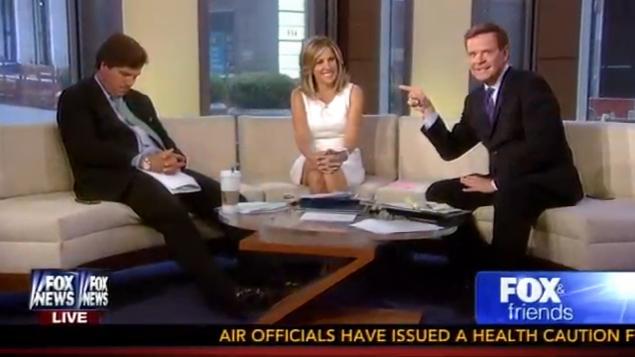
“Fox and Friends” represents the professional nadir of the Fox News broadcasting day, which is a little like being the worst Italian restaurant in Kuala Lampur. Nonetheless, even that misbegotten mutation of The Today Show should maintain some minimum standards, meaning that there needs to be some unprofessional conduct up with which it will not put—like, say, a host falling asleep on the air.
Yes, that’s what conservative, forever young, over-committed and sleep-deprived Tucker Carlson did on Saturday, and if Fox News wants to send the message that it actually believes in those bedrock conservative principles it blathers on about, like the work ethic, responsibility and respect, it needs to fire him, no excuses accepted. He should have been fired already. Continue reading →
1. Call him irresponsible… He piloted his 27 foot power boat, named “The Legislator,” while (allegedly, of course) roaring drunk, causing an accident and a wreck that resulted in injuries to seven people, including a five-year-old-girl. His trial is in October.
2. Call him unreliable…He also was recently arrested for DUI, resulting in fifteen charges including driving under the influence of alcohol, reckless and negligent driving, displaying expired and suspended registration, and driving 70 mph in a 55-mph zone.
3. Throw in undependable, too…Apparently Dwyer just can’t stand the stresses that go along with his position. He explained his boating accident to the Maryland Gazette by saying that the incident was caused by his escalation in drinking frequency after he separated from his wife, and as a result of feeling “betrayed’ when colleagues voted to sanction gay marriage.“I felt a tremendous amount of pressure in my family,” he said. “You take those personal issues (and) add betrayal on the professional side, and it really gets to be overwhelming.”
Mostly, call him unaccountable, which isn’t in the song lyrics, but fits this loser to a fare-thee-well. He’s driven dangerous vehicles twice under the influence, risking lives, and his response is to blame the gay marriage vote rather than his own failure to acknowledge and treat a serious alcohol problem. Law makers cannot be law breakers, especially the laws against operating vehicles drunk, which only require the sense and responsibility it takes to avoid getting behind the wheel.
Too many state legislators are inept when sober; we certainly don’t need drunk ones too.
Some distinguished members of the Enormous Ego Club…
The New York Daily News today issued a scathing rejection of Eliot Spitzer’s candidacy for New York Controller, and endorsed his rival. This, from an ethical point of view, is a no-brainer, but it was the manner in which the rejection came about that was noteworthy, and the lessons we can glean from Spitzer’s character that are worth pondering.
The Daily News editors were obviously incensed that Spitzer obfuscated, spun and, in their view, lied when they quizzed him on the shady circumstances that caused him to resign in disgrace as Governor of New York. Spitzer was alternately indignant—How dare you interview me about my criminal use use of a prostitution ring when I was Governor, when that was long ago and I’m offering my services to the people of New York?—and evasive, as described in this passage of the endorsement piece: Continue reading →
Do you ever feel like Jerry when they didn’t have his rental car?
I am always friendly, respectful, kind and generous to people behind desks, windows and counters, unless they engage in a particular kind of conduct that is guaranteed to cause me to be confrontational and critical, and that almost always leaves me feeling simultaneously guilty and infuriated. This is when an agent of a service provider announces, almost always with a smile, that the organization/company/government agency will not be able to do what it has assured me, often for a price, that it would do, or is not able to do it at an acceptable level of quality, or perhaps in the promised time frame. The agent helpfully tells me that I am stuck with the inferior product or service I bargained for and relied upon, and that yes, it shouldn’t be this way, but it is, so there.
Then, when I express some dissatisfaction with that result, explanation, and most important of all, the absence of any guaranty that I will be compensated or that the organization, while acknowledging its failure, has given any thought to compensating those like me or executing some response in time for my problem to be, if not solved, mitigated, the agent pathetically points out that he or she is just a humble and powerless messenger and that it is cruel of me to persist in expressing my dissatisfaction to him or her, since the agent is neither responsible for the problem nor has any power to fix it.
This is where I lose it.
And it happened again.
My wife and I paid close to $1500 ( in fees only, transportation and lodging not included) for the privilege of attending a national conference of a professional association to which we belong. When we arrived at the site hotel to register and pick up our credentials, badges, tickets and materials, shortly before the opening reception, we were told by a cheery, smiling woman that our name and convention materials were not there. “But we paid for them, and pre-registered,” my wife said. “I got a confirmation. We were told in an e-mail response that the materials for events and programs we designated would be waiting for us here.”
“Ah, then you must have registered on-line after Wednesday,” she told, us smiling. “Unfortunately, we were already here by then, and there was no way for us to make out your package! And you don’t have one of our formal, printed, professional badges that make you look like the member you are, but I’m happy to give you a crappy sharpie so you can scratch out a couple and look like you snuck in instead of paying 1500 buck for the privilege. Isn’t that good enough?” (She didn’t quite say it that way, but that was the gist of it.)
“Well, no, actually, it’s not,” I said. “Your confirmation said that everything would be ready for us here. It isn’t ready.”
“That was just an automatic response, sir.”
THERE it is! “Don’t blame the owners and programmers of the computer, sir—it’s Skynet’s fault!” Do not tell me that. Ever.Continue reading →








 Ethics Alarms