Forgetting Farrah

The film montage of significant Hollywood figures who have died since the last Oscars broadcast is always an emotional and evocative feature of the Academy Awards, as well as a time to bid a final  farewell to various faces that became affectionately remembered parts of our past. Except for fanatic film buffs, there is always the occasional “who the heck is that?” moment, as a the image of a”famous” make-up artist or key grip passes by. But they were all important, in their own ways, and deserve their final salute.

Farrah Fawcett,  who died of cancer last year, deserved her final salute too. Yet she was missing. Continue reading

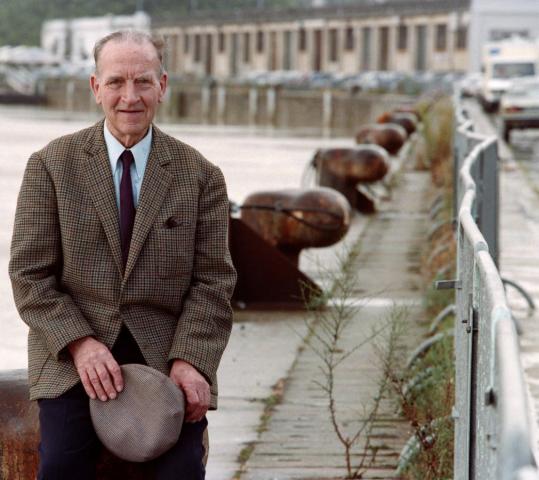
Ethics Hero Emeritus: Henri Salmide, 1919-2010

Henri Salmide by the port he saved, and came to love.

Henri Salmide by the port he saved, and came to love.

In the Nuremberg war crimes trials following World War II, the Allies took the high-minded position that “just following orders” was no defense to “crimes against humanity” committed during wartime. It is and has always been much easier to argue for defying military orders in the abstract, however, than in real combat situations. Conveniently, the victors in a war can take such a position, even knowing in their hearts, as most honest soldiers do, that they themselves might not be able to muster the courage and conviction to tell a commanding officer, “No!”

Henri Salmide, a former German soldier in World War II who died in France this week, would have been an appropriate judge for the trials, for he would not have been plagued by any such conflict or hypocrisy. For Salmide, back when he was called by his birth name of Heinz Stahlschmidt, was a rare and remarkable man who did defy an order he knew was wrong, and saved a city with his courageous, dangerous, and principled actions. Continue reading

Essay: Ending the Bi-Partisan Effort to Destroy Trust in America

Both the Pentagon shooter and the Texas I.R.S. attacker were motivated by a virulent distrust of the U.S. government, the distrust mutating into desperation and violence with the assistance of personal problems and emotional instability. We would be foolish, however, to dismiss the two as mere “wingnuts,” the current term of choice to describe political extremists who have gone around the bend. They are a vivid warning of America’s future, for the media, partisan commentators, the two political parties and our elected officials are doing their worst to convert all of us into wingnuts, and the results could be even more disastrous than the fanciful horrors the Left and the Right tell us that the other has planned for us. Continue reading

“Trust Us, It Only LOOKS like Bribery!”

Imagine, if you will, that I post an enthusiastic testimonial to the superior depilatory virtues of  Braun electric razors as compared to Norelco Triple-headers. Then suppose that you learn that, prior to the publication of my pro-Braun rave, Braun had sent Ethics Alarms a generous contribution “to support its good works in support of ethical consciousness.” Not only that, but also imagine that this contribution was brokered by an organization paid by Braun because it guaranteed that it could get good reviews of for its clients’ products on ethics websites. If I subsequently claimed that my razor review rave and the felicitous gift from Braun were absolutely unrelated, that I recommended Braun’s razor purely because of the product’s wonderful qualities  was influenced not one whit by the payola and the implicit promise of more, would you believe me?

If you would, you would be…well, I think the technical term would be “an idiot.” Yet that is the gist of the most recent outrage from the House of Representatives ethics committee, which  issued a report clearing the late Rep. John Murtha as well as Reps. Jim Moran (D-VA), Marcy Kaptur (D-OH), Norm Dicks (D-WA),  Rep. Pete Visclosky (D-Ind.), Todd Tahrt (R-Kan.) and Rep. Bill Young (R-FL) of acquiring lucrative earmarks for government contractors after the same contractors had sent them huge “contributions.”  Continue reading

The Dishonest or Cowardly Joke Excuse

An enthusiastic commenter to the post on Tony Kornheiser’s suspension by ESPN bases his defense of the suspended sports commentator on what I call “the joke excuse”: poor Tony was only joking when he insulted colleague Hannah Storm on his syndicated radio show, and that should insulate him from any negative consequences because humor is subjective, and we don’t want people without senses of humor snuffing out laughter in the world.

As anyone who actually has read the contents of this blog (the commenter in question has clearly not), I tend to be in general sympathy with the concept of giving humor free reign. The problem with its application here is that I see no evidence that Kornheiser was joking. His words:

“Hannah Storm in a horrifying, horrifying outfit today. She’s got on red go-go boots and a catholic school plaid skirt … way too short for somebody in her 40s or maybe early 50s by now. She’s got on her typically very, very tight shirt.She looks like she has sausage casing wrapping around her upper body … I know she’s very good, and I’m not supposed to be critical of ESPN people, so I won’t … but Hannah Storm … come on now! Stop! What are you doing?”

I’ll pause a second so you can catch your breath from uncontrollable laughter at Tony’s wit, deft use of irony. brilliant wordplay and creative absurdity. Continue reading

Randy Cohen Watch: “The Ethicist” vs. Integrity, Accountability, and the Law

Randy Cohen, “The Ethicist” of the popular New York Times Magazine column, frequently gets in trouble when he opines on the law, legal ethics, and how lawyers interact with society. This week he was at it again, and he got in trouble, all right. Big time.

Bruce Pelligrino wrote to the column to get “The Ethicist’s” take on the actions of a friend, who told Bruce he wanted to hire a lawyer to challenge a speeding ticket even though he had admitted to the police officer, in the presence of his children who were passengers in the car, that he had been driving 51 m.p.h . where the limit was 35.

“I think he should accept the consequences, learn from the experience and give his children a lesson in ethics,” wrote Pelligrino. ”Shouldn’t he just pay the ticket?”

Cohen sided with the speeder, opining…

“Even those who think themselves guilty are entitled to their day in court, and there is civic virtue in their exercising this right. A trial is a way to hold officials accountable for their conduct. Was the radar gun accurate? Was the speed zone clearly marked? Did the police officer behave properly? And what, given all the circumstances, is an appropriate punishment? Little of this could be scrutinized if everyone simply paid the ticket. It would be a court-clogging nightmare if every self-confessed speeder demanded a trial, but it is a fine thing if, now and then, some people do.”

Randy appears to have misunderstood the question, believing that Pelligrino’s friend was being charged with an arcane S.E.C. violation, or some intricate form of criminal conspiracy. The guy was driving too fast, knew it, and got caught! What does Cohen mean “Even those who think themselves guilty”? The driver admitted he exceeded the speed limit on the basis of his own car’s speedometer; he didn’t “think” he was guilty; he knew with complete certainty he was guilty, and said so to the cop who stopped him.

“The Ethicist” thinks “it’s a fine thing” for that driver to renege on his admission and impugn the policeman’s behavior, challenge the speed limit posting and question the radar gun to get out of a wrongful fine for an act he admits he committed. How could this course of action possibly be called ethical?

Here is what really is “a fine thing,” Randy: integrity—sticking to one’s word and backing it up with action. The driver said the ticket was correct. It is dishonest and irresponsible for him to turn around and challenge it as Cohen suggests. Here’s something else that is “a fine thing,” Randy: accountability—admitting when you have done wrong when you know it and accepting the consequences. The purpose of the legal system is not to encourage citizens to try to avoid just consequences for admitted violations of the law. Yes, as Cohen correctly notes, everyone has a right to challenge charges in court, but as anyone who calls himself an ethicist is supposed to know, it is not always ethical to exercise a right. Banks have the right to kick elderly homeowner out onto the street as soon as they fall behind on their mortgage payments. I have the right to limit my circle of friends and business associates to straight, white, Protestant bigots. I have the right to be blatantly incompetent in my free ethics commentary, and, like Randy in this case, to give mistaken and even harmful advice. All of these things are still unethical, however.

The Ethicist’s answer to Mr. Pelligrino’s query is unethical too, dramatically so. Cohen is saying that it is reasonable and ethical to force a trial on a traffic offense when…

  • The driver admitted the offense to the police officer…
  • …in front of his children…
  • …in order to challenge the veracity of the officer, who took his admission in good faith…
  • ….requiring the officer to appear in court, taking him away from community law enforcement duties…
  • …taking up court time, using taxpayer-funded personnel, that should be devoted to cases where the facts are genuinely in dispute…
  • …with the objective of avoiding the payment of a just fine to the government, where it would be used for community purposes, in order to transfer money instead to the pocket of, not just a lawyer, but the unethical species of lawyer who is willing to take unconscionable cases…
  • …thus teaching the driver’s children, if the driver prevails, that the objective in life is use the system to avoid accountability, even when you deserve to be punished, and..
  • …that respect for the law is less important than avoiding a thoroughly earned fine, and
  • …that speeding is all right if you can get away with it, thus…
  • …increasing the likelihood that the children themselves will regard excessive speed this way when they become drivers, and also increasing the chances that their driving habits will cause harm to themselves or others.

I have  read “The Ethicist” for years, I have learned that Randy Cohen has unseemly problems with honesty, a reflex prejudice against law enforcement, and shocking and brazen cluelessness on matters of legal ethics and the exercise of legal rights. Bruce Pelligrino managed to ask a question that involved all of them, and the result was one of the most indefensible answers I’ve seen from Cohen yet.
Ethics Quote of the Week

“Passivity cloaked in tolerance results in nothing being done.”

—-National Public Radio Correspondent Megan Williams, reporting on how Italians are apathetic regarding the ugly graffiti marring virtually every public building, including churches, in Rome.

Tolerance as a virtue receives too much unqualified praise.. Often what passes for tolerance is really ethical negligence and laziness, or, as in Rome, apathy. Some things do not deserve toleration, and tolerating what should be intolerable is no virtue at all.

Futile Ethics Lessons From the Luge

Long before Luger Nodar Kumaritashvili of the Republic of Georgia crashed and died on a training run there, Vancouver’s Whistler Sliding Centre, now the site of the Olympics luge, bobsled and skeleton competitions, had been the target of complaints, warnings and controversy regarding its safety. After the first international training event at Whistler in November 2008, the president of the luge governing body openly expressed worries over the speed of the track. Since then, there have been sufficient accidents on the track, not only in the luge, but also bobsled and skeleton races, that the fatal accident there could not fairly be called “a surprise.”  Just a  day before the Georgian was killed, United States luger Mark Grimmette was quoted as being concerned about the course’s speed, saying, “I think we’re probably getting close, too close, to the edge.” Later the same day, a Romanian luge racer was knocked unconscious during his training run. The frequency of crashes during the training runs last week were far above the norm.

Nevertheless, Olympic and luge officials chose not to make changes to the course that would limit the speeds in excess of 90 miles per hour that luge, bobsled and skeleton competitors were reaching, speeds beyond what they were used to, or had trained to handle.

And yet… Continue reading

After the Tebow Ad

The Super Bowl ad featuring Tim Tebow and his mother that caused so much angst and controversy before it aired turned out to be mild, understated and forgettable. Now we know why CBS felt it could use the spot to move away from its long-time ban on issue advertising during the NFL’s big game. We also know that the actual ad made the argument by abortion rights groups that the ad would be inappropriately “divisive” for an American sports ritual designed to bring us together seem even more ridiculous than it was—no mean trick.

In the ad, Quarterback Tebow and his mother never did tell the story of his birth after Pam Tebow had been counseled to terminate her pregnancy. You had to go to a website to read about it. Indeed, had the various advocacy groups that opposed the ad just kept their collective rage to themselves, few viewers would know about the pro-life aspects of the Tebow story. All of the ad’s work was done before it ran, thank to the pre-Super Bowl sputtering of NARAL, NOW, and their colleagues. Continue reading

The A.I.G. Bonus Payments…Again

Here we go again.

A.I.G. is paying out another 100 million in “retention pay,” also known as eye-popping bonuses, which is certain provoke another round of cursing from the public and posturing by politicians. The question is whether it is unethical to pay these bonuses, and you’re not going to like the answer. I don’t like it much myself.

It is no. Continue reading