“Who Are You Calling A Nut?” And Other Ethics Issues In The Community College Shooting Aftermath (Continued)

I apologize for the length of this two-part entry, but the preponderance of fact- and reasoning-free anti-gun hysteria in the wake of the Oregon shooting has even exceeded Sandy Hook levels, a development I didn’t think was possible. An emotional national reaction to such a tragedy is fine, and natural, as long as it doesn’t stampede policy-makers and make the public dumber and more ignorant than they already are regarding basic rights, the reasons for them, and the limits of law and government. This post and its earlier installment are offered to catalogue, in part, the ethics carnage, and perhaps to save some readers time when they are confronted with a usually sane friend or family member who begins ranting about how “ridiculous” it is that this “problem” hasn’t been “solved” and how it’s all the fault of the NRA and bribed politicians, because if Australia can do it, why can’t we? In my experience, however, the angry anti-gun zealots—yes, you can still be a zealot and talk about “common sense solutions” if they are either not sensible or not solutions—don’t want to hear facts or reason. People have died, guns are bad, and why can’t we stop it? The same people also tend to think we can stop prejudice, poverty, risk, inequality, war, and the effects of mankind living on the planet. They also rank “Imagine” among the most profound songs ever written.

Sigh.

Here are the rest of the points:

V. Another Facebook friend published this chart…

wholechart

…and said that it showed that “states with fewer gun regulations had frequent gun related murders than those with more regulations. It doesn’t show that. It shows, for example, that Vermont, Maine and North Dakota have few regulations and low gun murder rates. I know him well–he’s an honest man. But he saw what he wanted to see, not what was actually on the chart. Meanwhile, everyone “liked” his post.

VI. I know I’ve made this observation before, but it still drives me crazy. I just had another argument over it with my sister, and she hung up on me. Obama and the hoard leaps on this shooting to once again lobby for “common sense” gun controls that most agree wouldn’t have stopped this shooting. There is , I would say, an obvious, ethical and logical disconnect there. If the measures being sought would not have stopped this shooting, why all the angry, “blood on your hands,” “how long will this go on” rhetoric? The clear and misleading message is that the shooting would have or might have been stopped if only, if only, but when the substantive recommendations are listed they have little or nothing to do with the incident itself. Why do smart people tolerate this? The shooter’s father–who, by the way, shares at least as much culpability for the Oregon shooting as anyone, and a lot more than the NRA, gave an interview in which he blamed the shooting on the fact that the law allowed his son to acquire 13 guns: Continue reading

“Who Are You Calling A Nut?” And Other Ethics Issues In The Community College Shooting Aftermath (Parts I-VI)

mr__peanut_s_cane_gun_I. A good friend, who is a nice man so I chose not to upset him by explaining why he sounds like an idiot, announced on Facebook that he wasn’t reading any more “gun nut” posts. Hmmmm. I wonder what he thinks a “gun nut” is? Is a gun nut a teacher who punishes a student for pointing his finger like a gun, or who prevents a deaf child from signing his name, Gunner? Or is it someone who believes that the Second Amendment, which wasn’t second by accident, should be followed? Is it someone who keeps saying that laws need to be passed that will stop shootings like the one in Oregon, but who either has no realistic proposals to suggest or who suggest measures that wouldn’t have affected that shooting at all? Isn’t it nutty to engage in magical thinking? I think so.

II. I also think it’s nutty, not to mention hypocritical, to decry the lack of “civil debate” regarding gun policy and then call anyone who doesn’t want guns melted down by government order “nuts.”  Actually it’s worse than that: pundits, politicians and anti-gun advocates are increasingly equating  opposition to gun regulations advanced using false arguments, dubious logic, ad hominem attacks and deceitful statistics with insanity and intractable evil. Frankly, I resent it. I’m not opposed to sensible gun regulations, but my job is to oppose false arguments, dubious logic, ad hominem attacks and deceitful statistics, as well as to make sure that they don’t succeed lest “the ends justify the means” become a social norm.

III. Speaking of hypocritical, Mike Huckabee and others have been quite properly criticized (by me, for example) by claiming that since the Supreme Court ruling on gay marriage is “wrong,” it shouldn’t be followed. Yet the most vociferous defenders of that SCOTUS decision simultaneously advocate anti-gun measures that are forbidden by the Court’s decisions interpreting the Second Amendment….because, you see, “it’s wrong.” Continue reading

Ethics Heroes: Five Democratic Economists

Senator Warren, who is always right.

Senator Warren, who is always right.

Senator Elizabeth Warren (D-Mass)  was annoyed that Robert Litan, a nonresident and unpaid economics fellow at the reliably liberal Washington think tank, the Brookings Institute, dared to author a study critical of financial advisor regulations being pushed by Warren and the White House. Thus she sent a letter to Brookings last week, challenging the independence of the study and the integrity of Litan, since the study was, as Litan states up front, “supported by the Capital Group, one of the largest mutual fund asset managers in the United States.”

Warren called the report “highly compensated and editorially compromised work on behalf of an industry player seeking a specific conclusion.”

You know, unlike the various donors to Warren’s political war chest, who are not trying to buy specific policies and votes from her.

Literally hours after receiving the letter, Brookings, knowing which side of the bread its butter was on, dutifully forced Litan to resign.

The issue isn’t whether the policy Warren wants is a good one or not; personally, I tend to agree with Warren on the need for the regulation, which would make 401(k) and 403(b) advisors as well as other compensation-related retirement plan advisors be subject to fiduciary duties. the issue is Warren’s embrace of the increasingly popular tactic from the Left of dealing with adversaries by silencing them. Continue reading

Look! “An Illustrated Book of Bad Arguments”!

bad arguments

As various thought fallacies and flawed arguments are constantly being exposed, used, debunked or otherwise referenced during our ethics discussions and debates—the Ethics Alarms compendium is here–this looked like something readers would enjoy. I probably should dedicate this post to former blog Commenter of the Year tgt, in appreciation for his ending—maybe just briefly, we shall see—his latest sabbatical with a flurry of 70 comments while I was lecturing in Newport last week. I didn’t have time to properly engage him or even read all the comments, but he seemed in characteristic form.

Tgt loves the fallacies and delights in slapping them down whenever they occur. His favorite is “No True Scotsman.” I immediately thought of him when I  stumbled upon “An Illustrated Book of Bad Arguments” by the multi-talented Ali Almossawi. Tgt’s  pet fallacy is here, as well as ad hominem, appeals to authority, the straw man, equivocation and others, some under different names than those I am used to. I haven’t read it carefully: there may be one or two that needs to be added to the Ethics Alarms list.

This is a well-researched and written exposition of some major fallacies with lovely illustrations, presented like a vintage children’s book. Someone should actually publish a children’s book like this: I would have been grateful for one when my son was a boy, or when I was a boy.  I’m grateful for this now.

You can find this amazing work of art, ethics, rhetoric and logic here. I’ve already sent the link around to many friends, young and old, and you may want to do the same.


The Washington Post—Finally—Admits The Truth About President Obama

fingers-pointing

I will reprint The Washington Post’s lead editorial here nearly in full. I will have comments after, though I will make this one now: every character trait and leadership deficit the Post points to  was evident to objective observers—like me—from the beginning of Obama’s administration. That one of the most consistent and prominent Democratic Party and liberal policy boosters in the national news media finally mounts the integrity, honesty and integrity to admit it now is not all that satisfying.

Here is, with a few omissions so you will link to the site and read the whole thing (it’s only fair), is the damning and undeniable editorial:

Charles E. Schumer (D-N.Y.) decided he would vote against President Obama’s nuclear deal with Iran, he explained his reasoning in a 1,700-word essay. On balance, he concluded, “the very real risk that Iran will not moderate and will, instead, use the agreement to pursue its nefarious goals is too great.” We disagree with that conclusion, but not with serene confidence; we share the senator’s concern that Iran will use the lifting of sanctions to intensify its toxic behavior in the region. We understand and respect Mr. Schumer’s decision; also, it’s generally better to treat policy disagreements in good faith.

That has not been the spirit in which Mr. Obama and his team have met his Iran-deal critics. The president has countered them with certitude and ad hominem attacks, the combined import of which is that there are no alternatives to his policy, that support for the deal is an obvious call and that nearly anyone who suggests otherwise is motivated by politics or ideology. Mr. Obama’s rhetoric reached its low point when he observed that the deal’s opponents value war over diplomacy and that Iranian extremists were “making common cause with the Republican caucus.”

Continue reading

Re The Latest In The Stream Of Clinton Scandals: If Hillary Clinton Really Cared About The U.S., She’d Drop Out Now

"..and in US public officials!"

..and in US public officials!

Has any American politician voluntarily and sincerely given up power or the quest for it in the best interests of the nation? I’m searching through my American history materials, and so far, I can’t find one since George Washington, who knew he could have been President for Life, and also knew it was a terrible idea. President Nixon and Johnson both said that they were giving up the Presidency for the good of the nation, but Nixon was toast and knew it, and Johnson, the consummate politician, knew that he faced an ugly rejection by the public and the destruction of his party as a result.  I can point to one president who definitely refused to give up power in the best interests of the nation, and thus set us on the divisive and dysfunctional path we are on now: Bill Clinton.

What a coincidence!

Hillary is not Bill, but it is already clear that she is willing to reduce American politics to new lows in blood warfare and polarize the nation even more than it is now, corrupting the news media and her supporters beyond recognition if the carnage can take  her to the White House. Surely she realizes that the months between now and November 2016 will consist of a river wild of revelations, accusations, scandals,  and search and destroy operations by her opponents as well as objective supporters of honest and responsible government. She also knows that there is plenty of substance—as in evidence of her duplicity and untrustworthiness—to discover. And she knows that she will respond, as the Clintons always have and always will, with carefully worded denials, ad hominem attacks on her critics, dark theories about conspiracies, accusations of sexism, and, of course, cover-ups and lies.

Next to a terrorist attack or a national police announcement that yes, they are hunting down African Americans, this is the last thing the United States needs….which means, in turn, that the next to last thing is the candidacy of Hillary Clinton.

The latest controversy is instructive. Continue reading

Musings On The “You Can’t Even Spell” On-Line Debate Tactic

dooleyIn a debate on a live thread here between two esteemed commentators, one of the contestants expressed vivid annoyance when the other derided the quality of his text in a retort. I’ve witnessed this many times online, as have you, I’m sure: someone registers an opinion while making a blatant typo, a bad misspelling, a misuse of a word, or a grammar gaffe and the opponent immediately focuses on it. What is this, exactly, and is it always wrong?

1. What is it? As I mentioned on the thread in question, it’s pretty close to an  ad hominem attack once removed, right? The sense of such a comment is, “Why should I respect your opinion? You can’t even spell “inaugural!” which in turn suggests that the individual is an ignoramus rather than a worthy adversary. It needs a name though. Is there one?

2. Is the tactic ever justified? Clearly it is not fair and indeed an unethical deflection if the issue is a typo or two. Or, in my case, or six. Anyone who visits here often knows that I have a serious typo problem, paired with an even worse proof-reading problem. I have dinged job applicants for resumes and job letters that contain “your” for “you’re” and “recieve” for “receive”? Indeed I have. Is there a difference? I think so: if someone wants to make a good impression and still makes these mistakes, I am justified in concluding that this is really the best that applicant can do, or, in the alternative, that he or she doesn’t care very much.

I wasn’t blogging 2000 words a day then, however.

3. Mentioning a gaffe seems to be mandatory if the comment or text containing it was complaining about carelessness, illiteracy or stupidity generally. Again, though, what does this mean? Is it essentially another variation of an ad hominem attack: “Hey, you’re so dumb you make the same kind of error you’re bitching about! Your argument must be dumb too!”? I think it is, but it also falls in the category of “Boy, I asked for that!” In “Twelve Angry Men,” the bigoted Juror 10 derides the character of a witness, saying, “He’s an ignorant slob! He don’t even speak good English!” Whereupon the heavily-accented naturalized citizen in the group corrects him, saying, “He doesn’t even speak good English,” humiliating his fellow juror. Ethical? In that setting perhaps; generally, however, I would think that the Golden Rule should apply, but most of us can’t resist the hanging curve over the center of the plate. Continue reading

Hillary Clinton and the E-mails: A Case Study In Ethics Corruption

corrupted

I’ve been meaning to write this post for a couple of days now, but haven’t had the heart. Frankly, I am really sick of having to make the same point about the Clintons over and over again—they never learn, and will never change—knowing that so many people will just immediately turn off their brains and run for the rationalizations dispensary any time dishonesty, hypocrisy, deceit or misconduct by one of them is uncovered.

This happens, you see, because the Clinton are perhaps the most prominent among a particular harmful species of individual in our culture, the ethics corrupter. Ethics corrupters are popular, powerful, successful and famous people who, because they are popular, powerful, successful and famous, many citizens conclude that they must also be good and wise, and therefor trustworthy. Since they are (many believe) good and wise, what they choose to do must also be good, and when they are accused of doing wrong, even when the evidence is unavoidable that they have done wrong, there can be only two explanations to those vulnerable to correuption. The first is that the evidence, no matter how strong, cannot be believed, and those wielding it are in fact enemies of right, good, honesty and fairness. The second is that if these good and wise people did it, then what they did cannot be wrong, or can be justified, usually by “the ends justify the means.”

Thus by gaining the trust and admiration of good people, usually through clever use of dishonesty, deception and manipulation, ethics corrupters set their admirers and supporters up to have their own values weakened or destroyed. Richard Nixon caused honest people to defend the covering up of crimes. Charlie Rangel caused people with integrity to support accepting bribes. Bill Clinton made feminists excuse exactly the kind of sexual harassment they persuaded Clinton to sign a law prohibiting, and inspired lawyers to excuse perjury because “everybody lies about sex.” Lance Armstrong made parents who once taught their children not to cheat to defend cheating, because he had a foundation with a noble cause. Brian Williams and Bill O’Reilly made TV viewers excuse lying by journalists.

Ethics corrupters make their supporters worse parents, friends, employees, employers and human beings; in turn, those corrupted supporters make society less ethical and more cynical as well. These are genuine cultural polluters; indeed, they are cultural pollution.

Hillary Clinton is an ethics corrupter, and the response to the revelations of her use of exclusively personal e-mails proves it beyond the shadow of a doubt.

There is no benign interpretation of her conduct regarding her State Department e-mails. It was not a mistake; one cannot claim that it was accidental. Since it was intentional, there must have been a purpose, and the only conceivable purposes are unethical ones. According to the 2009 National Archives and Records Administration regulations in effect when Clinton took office, “Agencies that allow employees to send and receive official electronic mail messages using a system not operated by the agency must ensure that Federal records sent or received on such systems are preserved in the appropriate agency recordkeeping system.”  With a private e-mail account and only using that for official correspondence, Clinton did not have a system that ensured such preservation. She, not the system, determined what would be preserved. Anything not preserved or left on her private account would not be subject to the Freedom of Information Act. Is there any explanation for having a private account only, an justification that is simultaneously responsible, plausible and does not suggest that Clinton wanted to control which of her communications could come before the public and the press?

No.
Continue reading

Now THIS Is An Ad Hominem Attack! or “Boy, Is Howard Dean An Ass, or What?”

“True, Harry didn’t go to college, but he’s a Democrat.”

People commenting on Ethics Alarms constantly accuse me of making ad hominem attacks, when what they mean to say is “You’re name-calling.” I’ll cop to name-calling. It’s can be a bad habit, but it has its uses, best illustrated when President Ronald Reagan referred to the Soviet Union as an “evil empire.” The description was true, and it immediately focused values-based criticism on a government and culture that needed it and deserved it.

Ad hominem, in contrast, is a logical fallacy in which one attempts to counter a substantive argument by attacking the character or other aspects of the advocate that can’t possibly have any bearing on the argument’s validity. For example, “you’re uglier than a pug” does nothing to disprove the substance of your adversary’s position, even if he is. Similarly, Bill Cosby has argued, even before 34 women accused him of raping them, that his advocacy of black community responsibility should not be undermined because of questions about his own rectitude.

There is nothing inherently fallacious, however, about diagnosing the conduct or statements of someone as proof that he or she is a fool, or a liar, or a jerk. It may not be civil, and it may be unfair, but it is not an ad hominem attack. As I have  explained it before, if I say you are an idiot because I think your comments are idiotic, that is a legitimate, if rebuttable assumption. (I may also be using “you are an idiot” as shorthand for “you are talking/sounding/acting like an idiot, and should avoid that.”) If I say you are an idiot, and therefor everything you say must be dismissed and ignored as the rantings of an idiot, that’s an unethical debating technique, ducking the argument by impugning the advocate.

Distinguishing between these very different but similar-appearing phenomenon can be a problem when trying to be fair to someone whose prior statements and conduct have already generated a negative diagnosis, and thus a bias. I have concluded, for example, that Joe Biden is a dolt, that Michele Bachmann is not playing with a full deck; that Sarah Palin is intellectually lazy and irresponsible, that Newt Gingrich is manipulative and untrustworthy, that Bill Maher is a pompous, none-too-bright blowhard and that Howard Dean is a vicious and unscrupulous ideologue. Nonetheless, I have to fight to assess what they say on the basis of merit, not my well-considered assumptions. It’s hard. When an idiot asserts something, is it unreasonable to be more skeptical of the statement than one would if, say, a brilliant, credentialed, unbiased observer said the same thing? (Wow—I can’t think of a single one!) No. And this is why ad hominem attacks, especially coy, subtle, clever ad hominem attacks, work so well in politics.

This brings us to that vicious and unscrupulous ideologue, Howard Dean. Continue reading

Jack Ohman’s Cartoon and Desperate Obama Defense Derangement

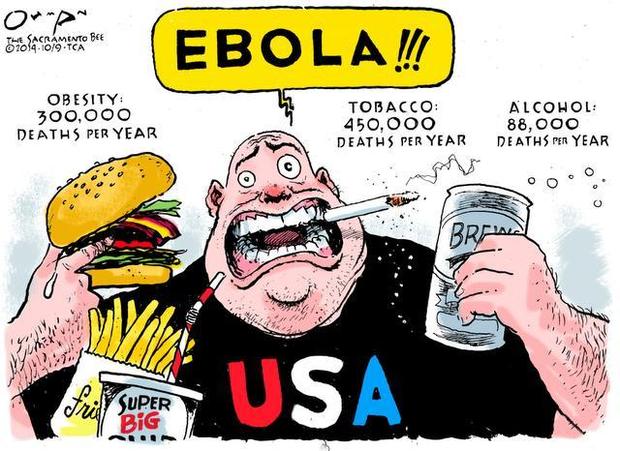
Ebola cartoon

This cartoon, which should cause editorial cartoonist Jack Ohman to hang his head in shame, has made me realize that there is an odd and pervasive parallel today with the familiar Clinton Derangement Syndrome and Bush Derangement Syndrome of yore, which caused the mouth-foaming political opponents of these polarizing Presidents to make ridiculous claims undermining the many more legitimate criticisms available to them. In the case of Barack Obama, it is Desperate Obama Defense Derangement (DODD) that we are seeing. So horrible is the prospect of having to admit that this President is an unequivocal, incompetent flop by almost every measure imaginable that disappointed, panicked partisans in the media, the President’s party and bitterly disappointed hope-and-changers are resorting to obvious rationalizations, absurd analogies and insane arguments to avoid facing the miserable, depressing truth.

This cartoon can stand as a graphic symbol of the malady. In order to preemptively duck accountability when yet another government agency, in this case the CDC, proves inept and another national policy–the measures designed to keep Ebola out of the U.S— proves ill-thought out and poorly managed like so many other agencies and national policies under this administration’s stewardship, DODD sufferers like Ohman and the sad Democrats posting it on Facebook are making the argument that Ebola is no big deal.

You know, like AIDS was no big deal. When the Reagan administration was being justly criticized for its tardy and in inadequate response to AIDS, I don’t recall any cartoonists listing the stats for all of the other causes of death to ridicule gays, humanitarians and sane people who were saying that this was a national crisis. But then, there aren’t very many conservative cartoonists, for which, in that instance, at least, we can be grateful.

Look at Ohman’s cartoon, and try to translate it into a coherent statement that makes any sense at all: Continue reading