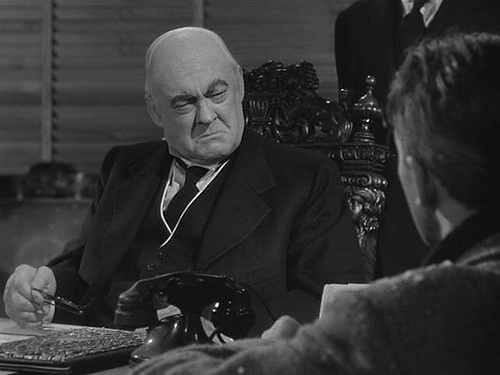
Your Boss Asks If You Have Prayed About A Work-Related Matter…What Is The Ethical Response?

This question was asked of the New York Times’ “Workologist” (It’s stuff like this that keeps me subscribed despite the paper’s disgraceful partisan bias and unocnscionable manipulation of the news):

I recently had a manager ask me if I have “prayed about” a particular situation at the office… this statement crossed a personal line with me. I am very private about my religious life. Do you have any recommendations on how I could handle this?

The question immediately reminded me of “Breach,” the film about the capture of spy Robert Hannsen (Chris Cooper), who was always urging his clerk (actually the undercover FBO agent recruited to unmask him) to pray. The “Workologist” (Rob Walker) begins by pointing out the obvious: a boss can’t demand that you pray, or fire you for refusing to. Then he adds,

Your manager can’t discriminate against you on the basis of religion, but your company can’t discriminate against him, either — by, say, forbidding him to ever mention prayer. In general, companies are supposed to make an effort to accommodate the religious practices of employees, although this can be weighed against the potential burden on the employer…Faith-related workplace conflicts and litigation have become more common in recent years. So it might be better to think about this incident in the broader context of personal expression and identity…

your best move is to make your own boundaries clear — yet also try to avoid an outright conflict. The fact that you already consider him your “worst manager” might make that difficult. But simply declaring his question inappropriate or offensive won’t help.

Instead, try something like “Well, I’ve thought about it,” and either leave it there or, if that doesn’t seem to connect, add something like “But I’m not comfortable talking about what I do or don’t pray about.” This should be delivered in a friendly-to-neutral tone. You’re not making any judgments — and neither should he.

I find that approach cowardly and dishonest. Continue reading

Morning Ethics Warm-Up, 11/27/2017: Gibberish From Congress, Race-Blindness in the UK, Cruel Law Enforcement In Atlanta, And More

Mornin’!

1 “Rarrit!!” You will seldom see or hear as excellent an example of Authentic Frontier Gibberish than this word salad belched out by the leader of House Democrats on “Meet the Press” yesterday. Nancy Pelosi attracted so much negative attention with her “Rep. Conyers is too much of an icon to hold accountable” blather that this masterpiece was relatively ignored. Pelosi was asked by Chuck Todd whether she would support releasing to the public the full information behind heretofore secret settlements of sexual harassment accusations against Congressmen, even indispensable, virtuous icons like John Conyers. She said…

“Well, here’s the thing. It’s really important. Because there is a question as to whether the Ethics Committee can get testimony if you have signed a nondisclosure agreement. We’re saying we think the Ethics Committee can, but if you don’t agree, we’ll pass a law that says the Ethics Committee can, a resolution in Congress that the Ethics Committee can…. But there’s no– I don’t want anybody thinking there’s any challenge here to our changing the law and see how people– when we know more about the individual cases. Well, because you know what our biggest strength is? Due process that protects the rights of the victim, so that, whatever the outcome is, everybody knows that there was due process….”

http://www.youtube.com/watch?v=0_2Npp-euLU

If Chuck Todd wasn’t a partisan hack, he would have recognized his journalistic obligation to say, “That made no sense at all, Congresswoman. Please try again.”

Public pressure is increasing to force Congress to release the names of the members of Congress who paid taxpayer funds to settle with their accusers. Good. Democrats are obviously terrified, and presumably Republicans are as well.

2. That mean Trump Administration insists on enforcing the law. The New York Times had a front page story Sunday about the plight of illegal immigrants in Atlanta. The story, entirely sympathetic to the arrested, deported, and those afraid of being arrested and deported, saying in one headline that “immigrants” (that’s illegal immigrants, NYT editors, a material distinction) fear “even driving.”

“Even driving” without a license.

Here’s a quote to make any rational American’s head explode, about a local journalist who uses social media to warn illegal immigrants when ICE is lurking,

“Asked whether he had any reservations about helping readers evade immigration law, he said he preferred to think he was helping people with no criminal records stay in the country. “Honestly, I believe it’s an honor as a journalist if the people can use your information for protecting their own families,” he said.”

Translation: “I prefer to think of what I am doing as something other than what I am really doing.”

It’s kind of like a newspaper calling illegal immigrants “immigrants.” Continue reading

Nazi Memorabilia Ethics?

“ARRRGHHH!!!!”

I haven’t checked in on The Ethicist column in the New York Time Magazine in a while: the current resident, Kwame Anthony Appiah, is the real McCoy, unlike all of his predecessors, and his analysis of various queries from readers is usually valid and properly reasoned. This week’s featured issue is a strange one, however.

A Peter Hulit of Los Angeles wrote to ask what was the “ethical way” to deal with  a belt buckle from a Nazi uniform that was stored in his late father’s box of World War II memorabilia, collected during his service overseas. Hulit explained,

“I have kept it stashed in my desk. I’m now in my 60s and really don’t want it in my house..I have checked resale sites, and it does have some monetary value, but I do not want it to fall into hands that may use it symbolically for what my father fought against.”

I rate this question as more evidence of Nazi hysteria, one of the side-effect of the 2016 post election Ethics Train Wreck that includes the effort by the Left to slander opposition to Democrats, Clinton and Obama as nascent fascism. It is also a continuation of the historical air-brushing that Orwellian progressives seem to think will magically eliminate all evils from modern society.

World War II artifacts are history and are tools of acquiring knowledge. Knowledge is what those seeing German Nazi motivations in President Trump and his supporters sorely lack. There is no such thing as dangerous history. What is dangerous is to forget history, or to try to pretend that what happened did not.

Nor are objects cursed, or evil. People are evil, and history leaves evidence of evil deeds.  “I don’t want it in my house” smacks of superstition. It’s a belt buckle.

Hulit’s question seems to suck The Ethicist down some unethical holes that he should avoid, and usually does. For example, he writes, Continue reading

Unethical Manager Writes Advice Columnist For Affirmation, Gets Head Handed To Him.

mr-potter

Well and rightly done, Allison Green!

Allison Green, a management advice blogger, received this jaw-dropping question from a relative of Mr Potter:

I manage a team, and part of their jobs is to provide customer support over the phone. …One employee asked to come in two hours after the start time due to her college graduation ceremony being that same day (she was taking night classes part-time in order to earn her degree). I was unable to grant her request because she was the employee with the lowest seniority and we need coverage for that day….I told this team member that she could not start two hours late and that she would have to skip the ceremony. An hour later, she handed me her work ID and a list of all the times she had worked late/come in early/worked overtime for each and every one of her coworkers. Then she quit on the spot.

I’m a bit upset because she was my best employee by far. Her work was excellent, she never missed a day of work in the six years she worked here, and she was my go-to person for weekends and holidays.

…I want to reach out and tell her that quitting without notice because she didn’t get her way isn’t exactly professional. I only want to do this because she was an otherwise great employee, and I don’t want her to derail her career by doing this again and thinking it is okay. She was raised in a few dozen different foster homes and has no living family. She was homeless for a bit after she turned 18 and besides us she doesn’t have anyone in her life that has ever had professional employment. This is the only job she has had. Since she’s never had anyone to teach her professional norms, I want to help her so she doesn’t make the same mistake again. What do you think is the best way for me to do this?

He also said that on one occasion he had granted a similar request “because they had concert tickets that they had already paid for, but this was a special circumstance because there was cost involved.”

!!!!!

Before showing you Allison’s response, here’s mine: Continue reading

Ethical Quote Of The Week: Relationship Advice Columnist Carolyn Hax

befriend-v-t-to-make-an-ingrate-quote-1

“[I]t’s time you made the acquaintance of an institution we all must embrace at some point in life: the thankless task. That’s how you file away changing a baby’s diaper, paying your taxes, visiting a relative turned cranky from infirmities, throwing in extra toward the tip because everyone else left the table. You do these because they’re the right thing to do, even though babies don’t sit up and say thanks for the squeaky-clean butt.”

—–Syndicated advice columnist and natural-born ethics whiz Carolyn Hax, answering a young woman’s question regarding the proper response to someone who should have thanked her for a kindness, but did not.

The letter writer was a high school athlete who, like most high school students today, had never been introduced to the satirical wisdom of philosopher/humorist Ambrose Bierce in his indispensable “The Devil’s Dictionary.”  The young woman had organized a senior night tribute to a graduating teammate, who then expressed no gratitude after the event.

“I am not sure whether or when I should broach the subject. Am I being needy and selfish, or do I have a legitimate case for feeling disowned?” she queried Hax.

As she is about 98% of the time, the columnist was spot on in her response. Doing good things and right things do not assume some kind of quid pro quo, cosmic or otherwise, in this  world or a subsequent one. Learning to feel good about doing the right thing whether you are praised, rewarded, thanked, or derive any tangible benefits yourself is one of the hardest lesson on the way to ethical living, and one of the most important. No, you shouldn’t assume that you will be treated unfairly, as Bierce suggests. As he meant to warn you, however, you shouldn’t be surprised, either.

Do not expect karma, or justice, or thanks—don’t even hold out for credit. Just figure out the right thing to do–how you would want to be treated, how you wish everyone would act, the conduct that will make society better for everyone by solving problems or making them bearable—and do it. Those who don’t understand that it’s also right to reciprocate by exhibiting recognition and gratitude  haven’t figured things out yet, and their ethics alarms are jammed.

Be glad yours are in good repair.

Carolyn Hax Sides With Bobby Darin, And Dazzles With Her Ethics Advice Again

Syndicated relationship advice columnist Carolyn Hax is as trustworthy an ethicist as I know. She doesn’t call herself an ethicist, and probably doesn’t think of herself as one, but she is far better qualified in the field than many with advanced degrees and tenured teaching positions, not to mention the corporate compliance hacks who write Ethics Codes for the likes of Enron. Carolyn Hax is an ethicist and a superb one because she has an innate, instinctive, nuanced and perceptive understanding of right and wrong, as well as remarkable skill at ethical analysis.

She proves this routinely in her weekly columns, but occasionally special attention should be paid. That was the case last week, when she was asked her blessing by an annoyed fiance on a decision to exit the relationship because her betrothed had decided to reject an offer to enter the world of high finance in favor of pursuing a career as a carpenter, concluding:

I’m seriously considering walking away because I think he is being really selfish given the long-term prospects. I am a professional and have supported us through his two-year master’s program. I am at my end here — what do you think?

In as nice a manner as possible, Hax nails what is wrong with this, saying in part: Continue reading

1. The NY Times Has A New Author Of “The Ethicist” And 2., Boy, Did He Ever Botch The Dilemma Of The Closeted College Student

"NEXT!!!"

“NEXT!!!”

The New York Times Magazine column “The Ethicist,” long authored competently by non-ethicist Randy Cohen, had lost me due to the biased and often unethical answers to his reader’s queries by his most recent successor, Chuck Klosterman. So repellent was Klosterman’s version of the column that I didn’t even notice when the Times sacked Klosterman late last year after one bizarre response too many.

[The final straw:  An inquirer  went to a Starbuck’s  wanting to buy a regular over-priced cup of coffee, but when the woman in front of the customer  ordered a pumpkin-spice latte  and received a coupon for a free drink because the shop was out of it, “NAME WITHHELD” ordered a pumpkin- spice latte to get the free coupon. Was this ethical, he/she/it asked?” Klosterman’s answer: “No. You’re a liar and a low-rent con artist. And you live in a community where pumpkin-flavored beverages are way too popular.”  Now, “No” is correct, but it’s a great question, and deserving of a serious analysis rather than whatever that was from the ex-Ethicist. The coupon was a nice gesture to someone who had come to the Starbuck’s wanting a specific beverage and was disappointed—a store should not be tantalizing customers with products they don’t have to sell, essentially setting up a bait and switch. The coupon was an ethical “We’re sorry,” but also made the employee vulnerable to anyone who decided to misrepresent his real intent in order to get a free drink later. Yes, taking advantage of this opportunity to the detriment of the store is unethical, because the inquirer took an appropriate gesture clearly intended for a specific situation and exploited it. It was not illegal, however, and was  not a con. I would compare it to the scenario where a computer glitch has resulted in an airline selling tickets online for absurdly small amounts, and travelers rush to take advantage, rationalizing that mistake or not, the opportunity is there and they can legally grab it.]

Now the Times has a new author of “The Ethicist,” after experimenting with a new format in which a podcast including him and some other commentators hashed over ethics hypotheticals and then the podcast was transcribed and published in the Sunday Times magazine. He is Kwame Anthony Appiah, who teaches philosophy at N.Y.U.  This week Appiah’s  first solo, so I would normally say that it’s too early for any fair assessment, but boy, did he ever botch the September 2 podcast. He botched it so badly that I can’t see myself paying much attention to anything else he writes. It was an ethics disaster.

A college student asked if he could ethically lie to his anti-gay father about his sexual orientation so Dad would keep paying the student’s tuition. The father is suspicious based on some clues during his son’s high school days, and has made it very clear to his son that if he is gay, he would not only withdraw all financial support but also reject him entirely. “Questions about my sexuality are inevitable whenever I come home,” the inquirer wrote. “My father has demanded I produce archives of all emails and text messages for him to review, although I have successfully refused these requests on the grounds that he has no claim to my adult communications.”

He asks, Is it ethical for me to continue accepting financial support for my education and my career that will come from it? Could I continue to lie to accept the support and one day disclose my sexuality and pay him back to absolve myself of any ethical wrongdoing?”

The correct answer is “Of course not,” and it amazes me that anyone would think otherwise. The second part of the question is an especially easy ethics lay-up: the steal now, pay back later scheme, also known as “the involuntary loan,” or “I meant to pay it back!”, is pure rationalization, and its existence proves that the writer knows damn well that what he’s doing is wrong, and just wants someone to tell him that it’s OK.

Astoundingly, Appiah and his podcast buddies (Amy Bloom, a novelist and psychotherapist, and  Kenji Yoshino, an  N.Y.U. law professor) tell the inquirer that it is OK, because, it is clear, they are advocates for gay rights and don’t appreciate anti-gay bigots. Thus they amass nothing but rationalizations  and outright unethical arguments to justify the student’s ongoing deception. As a philosopher who knows better, Appiah should have been correcting his colleagues. Instead, he enables them, because gay advocacy trumps honesty and ethics. Continue reading

Ethics Hero: Advice Columnist Carolyn Hax

But it worked for Scarlet!

But it worked for Scarlett!

I’ve made Hax, the Washington Post’s relationship advice columnist, an Ethics Hero before. This time it’s for something more than her usual spot-on instincts about right and wrong, and more about her method of expressing them. You know I am not fond of weasel words, equivocation and gentle rhetoric when emphatic prose is called for, and Hax, though she is more prudent than I, laps her competition when it comes to firing off both barrels when it is called for.

In this response, she was responding to a man whose brother stopped speaking to him after he gently suggested to him that his niece had a huge honker for her face and it might be time to visit the local plastic surgeon. The advice-seeker lives  “in a community where a lot of teenage girls have cosmetic surgery at 16,” he explained, and both his wife and daughter had their noses made button-like. “Was I over the line in making this suggestion in a private setting?” he asked Hax.

Her unrestrained, wise and glorious response: Continue reading

Further Thoughts And Questions On “The Lottery Winner’s Sister-in-Law” (Part 1)

lottery win

The last ethics quiz posed the questions of whether a financially struggling (that is, like most people) brother [NOTE: In the earlier version, I incorrectly said they were twins. Why, I don’t know, except that it makes the set up more perfect. I apologize for the error. It didn’t change the issues any, or the commentary.]  in his Sixties should suggest to his lottery-winning brother, now 50 million dollars richer, that he could use some of that excess cash…and whether the brother would be unethical to refuse.

The more I think about it, the more I am sure that Slate advice columnist Emily Yoffe was answering a fictional hypothetical carefully devised to coax out the answer it did. I write these things for a living, and the brothers element is suspicious. The idea was to emphasize the perception of unfairness: here we have two genetically similar human beings raised with the same advantages and disadvantages, not just metaphorically “created equal” but equal in fact. How cruel and unfair that, in “Dear Prudence’s” words,  “your brother-in-law, through no effort of his own—save the purchase of a quick pick—was smiled on by fate and now enjoys luxuriant leisure. Especially since the two brothers suffered from a start in life that would have crushed many, it’s disturbing that the lottery winner hasn’t been moved to share a small percentage of his good fortune so that his brother doesn’t spend his last years scrambling to meet his basic needs.”

I didn’t exactly give my preferred answer to the quiz, but I did suggest that Yoff’e’s answer and the orientation of the questioner were redolent of the prevailing ethos of the political left. This was met with some complaining in the comments, but come on: “it’s disturbing that the lottery winner hasn’t been moved to share a small percentage of his good fortune so that his brother doesn’t spend his last years scrambling to meet his basic needs” would be a great Occupy Wall Street poster if it wasn’t so long, and it perfectly states the ethically dubious mantra we can expect from Bernie, Hillary or Elizabeth and probably any other Democrat who is selected to be called “a lightweight” and “a loser” by Republican nominee Trump.  In fact, I think this hypothetical would be a great debate question….and better yet if we explore some of the  variables.

For example: Continue reading

Ethics Quiz: The Lottery Winner’s Sister-in-Law

_rich_man_poor_man“Dear Prudence” (a.k.a Emily Yoffe), my least favorite advice columnist (who answers weird questions from weird people at Slate), received an ethics quiz worthy query from a woman whose husband has had some business reverses and now, as he near retirement age, is looking at two jobs and tarnished golden years without a pension or vacations. Meanwhile, her husband’s brother (let’s assume this is true: it sounds like a hypothetical to me) won 50 million bucks in the lottery a few years ago, and is having a ball. The two brothers are on good terms and speak often. She asks,

“What I don’t understand is how he can stand to see his little brother so stressed and working so hard while he has more money than he could spend in a dozen lifetimes. Obviously he is under no obligation, but he does not seem to realize how hard it is to see how he spends his money on travel and amusements. I think he should help his brother out. What do you think?”

Prudence  thinks the poor brother should ask the rich brother for money, and that if he won’t, the wife of the poor brother should: Continue reading